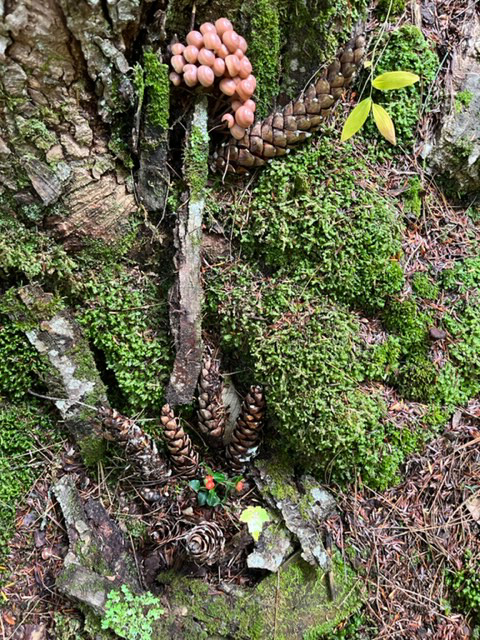
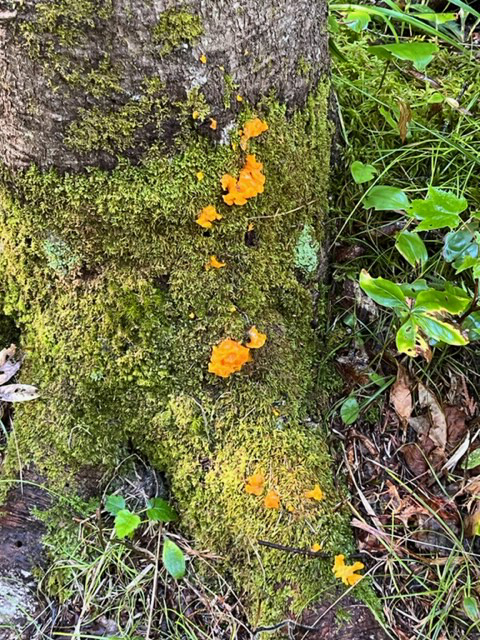
The other day I found the most beautiful fungus on an aging white pine set against deep green moss that was almost arcing over the brook. When I looked up Dacrymyces palmatis I discovered that it’s common name was “Witches Butter.” That figures I thought – this must mean that this plant has medicinal qualities, and of course it does along with the fact that the fungus is edible.
Any time I see the word witch associated with a plant if I am not familiar with it I start digging into research inevitably coming up with the same kind of information – the plant/ tree/ fungus/slime mold is edible and has medicinal value.
The word witch as many of us know has at its root to bend or shape. Shape -shifting by non –ordinary means.
I personally think the quality of endurance is underrated. Remember Celie in The Color Purple? After living through hell this woman became who she was meant to be. Sometimes endurance does seem to be the way through. Just now the Woman’s Movement seems to be quite dead, but perhaps if we can just endure in time this situation may shift. That at least is my fervent hope.
Endurance and the Long Winding Road
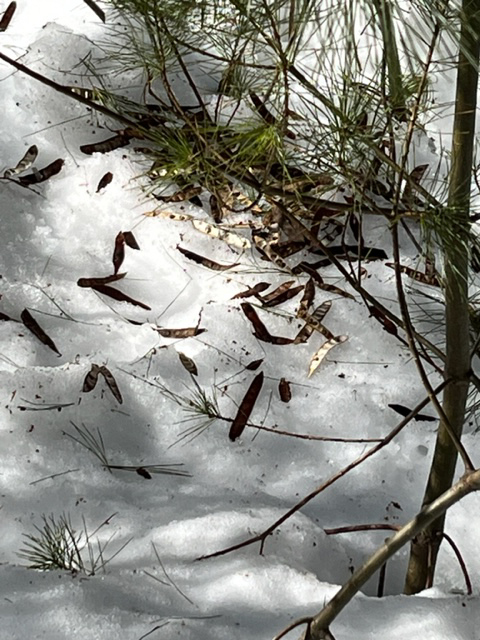
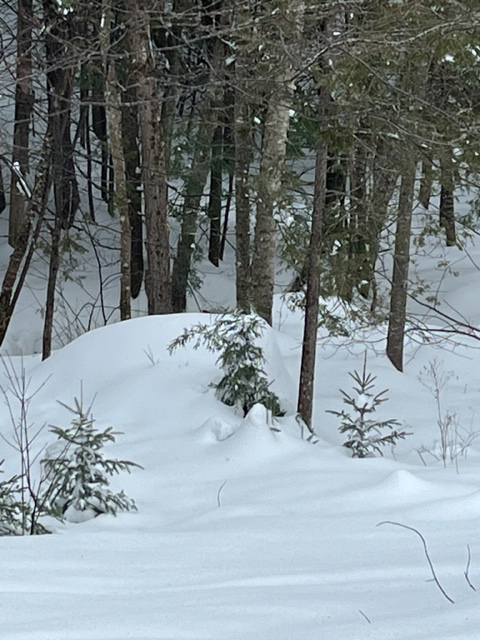
From the day I bought this property almost 40 years ago I walked down this lovely road with a sense of the deepest pleasure. The trees were young then. In spring wild cherries burst with pure white or rosy pink blossoms, the bark of each a different hue, emerald pines bore startling white candles, chattering poplars multiplied, pale gray and pearl white birches leaned in for intimate conversation, smooth barked red maples graced open spaces all lemony lime in spring – leaves and needles etched against cobalt blue. The trees were healthy then.
“Our Father who art in Heaven” becomes “Our Mother whose body is the Earth.” Transcendence of the earth and the body are replaced with immanence, suggesting that the earth and the body are good. Our mothers’ bodies are the source of our lives. Our Mother’s body is the Source of all life on our planet. The earth as the body of the Mother is a very ancient conception. Process philosopher Charles Hartshorne says that the earth as the divine body is the best rational model for understanding the intimate relationship of God to the world.
Labyrinths are magical. I’ve always been drawn to them. About two years ago, a local Episcopalian Church rebuilt their beautiful outdoor labyrinth and opened it to the public. In concert with them, I have been delighted and honored to offer guided walks there. Doing these walks, both in leading them and in walking myself, have given me the opportunity to reflect deeply on what they mean from many perspectives: historical, personal, spiritual, philosophical, experiential.
When I walk a labyrinth, it feels like I am mirroring the universe while expanding my internal journey. Teresa of Avila agrees with me (or, more accurately, I with her). She wrote, “If we learn to love the earth, we will find labyrinths, gardens, fountains and precious jewels! A whole new world will open itself to us. We will discover what it means to be truly alive.”
Moving from town to town – by train, bus and ferry – I have walked and walked the ancient land of the Scottish Highlands. From Paleolithic to Mesolithic to Neolithic and on to Picts, Celts, Scots, Romans, French and English – many different people have walked these same paths.
Standing Stones, Cupmarked Stones and Pictish Stones along with medieval castles, monuments, graveyards to soldiers lost in centuries of battles and sheep, always sheep – pepper the landscape everywhere.
The Callanish Stones – circa 3500 BC – Isle of Lewis, Outer Hebrides, Scotland
Cupmarked Stone, Aberfledy, Perthsire
Pastures of Fortingall – a very small village in Perthshire, Scotland
Graveyard to soldiers lost to war, Fort William, Scotland
This land was formed millennia ago when Mother Earth first birthed herself from the waters of our beginnings. Through epochs of volcanic spewings, earthquakes, continents splitting, the ice advancing and retreating – change, always change, remains the one constant. Here in this high land, one is reminded of the smallness of our individuality.
Isle of Skye, East side of island formed by tectonic plate movement
Niest, most westerly point on Isle of Skye
Tales of goddesses, gods, faeries, giants, monsters and countless heroines and heroes inhabit the land.
After the ice receded – the Faery Glen, Isle of Skye
The Faery Glen – another view
All along this way the Ancient Ones have whispered to me – whispered through the rushing streams and babbling creeks, joyous bird song, waves murmuring, waves crashing against the shore, and wind howling through the air.
A beach on the Isle of Lewis
It has rained and rained and yet one day the sun emerged, revealing the vibrant green, green, green – everywhere green – temporarily lifting the blue grey mists and the brown, brackish swaths of horizon.
Every moment has been a joyous exaltation of our beautiful Mother Earth. And of course, along the way I was drawing. Here are a few sketches or dream remembrances.
Sheep, Birds and Trees
On the Banks of the River Tay
Seaweed and Rocks
Loch Dreams
And one day there was snow!
I’ll leave you with just a few more photos – big vistas, trees and small things – all parts of the beauty found in this ancient land of Mother Earth – our mother who sustains and supports us through all time.
Leaving Uig, Isle of Skye by ferry
Uig, Isle of Skye
Judith’s deck of Celtic Goddess Oracle Cards is available now. You can order your deck from Judith’s website – click here. Experience the wisdom of the Celtic Goddesses!
Judith Shaw, a graduate of the San Francisco Art Institute, has been interested in myth, culture and mystical studies all her life. Not long after graduating from SFAI, while living in Greece, Judith began exploring the Goddess in her art. She continues to be inspired by the Goddess in all of Her manifestations. She is now working on her next deck of oracle cards – Animal Wisdom. Originally from New Orleans, Judith makes her home in New Mexico where she paints as much as time allows and sells real estate part-time. Give yourself the gift of one of Judith’s prints or paintings.
The more I practice the spirituality of the Goddess, the more I understand that earth-based spiritualities are rooted in two fundamental principles: gratitude and sharing. We give thanks to the earth for the gift of life. As we recognize our interdependence and interconnection in the web of life, we are moved to share what has been given to us with others. *
When I first began to lead Goddess Pilgrimages in Crete, I was inspired by a line in Homer to begin a pilgrimage tradition of pouring libations of milk, honey, water, and wine on ancient stones. At first I knew the form, but not its deeper meaning. It gradually dawned on me as I thought about the large number of pouring vessels in the museums, the altar stones, and the Procession Fresco from Knossos, that an important part of Minoan rituals involved processions in which people offered first fruits back to the Mother whose body had produced them, and poured libations on altars.
The night before last I had a dream that has stayed with me. My dreams rise out of my body to teach and to comfort me so I pay close attention. I had recently written tributes for two men, Lynn Rogers, bear biologist, and Rupert Sheldrake, biologist and plant physicist. Both of these men mentored me like a “father” each encouraged me to believe in myself, celebrated my original thinking and told me to trust my intuition. Writing about these mentors reminded me of my own father with whom I had a most difficult relationship…
I am talking to my mother (she has been dead for 13 years) about having found someone who could help me with math and stuff I can’t do because of dyslexia. In this conversation my mother is not a personal figure (when she appears as herself it usually means that I am going to face some difficulty – As an impersonal ‘great mother’ figure she is very helpful). She replies that my fatherwantedto teach me all these things but he just couldn’t.So many problems were in the way. I choke up weeping over this knowing (and my tears carry over into waking) because I know that “my mother” is speaking the truth. I feel such heartbreak for both my dad and for me. Neither of us had a chance… as I awaken from this dream in the middle of the night Lily b., my dove, is bellowing.He is reiterating the truth of the dream.
The days are slowly winding down toward Winter Solstice in the northern hemisphere, the longest night of the year. Today the sun rose at 7:20 and will set at 5:08 in Crete. In Sweden, the sun will rise at 9:25 and set at 2:12. Though I light candles in the darkness of morning and have lights on my tree, I am not celebrating the “return of the light,” but rather welcoming the restful dark.
In The Spiral Dance, Starhawk writes that Winter Solstice is about the rebirth of the sun. This interpretation has taken hold. For most pagans, Summer Solstice also is a celebration of the sun on the longest day. Few are those mark it as the time of the dying of the sun or the rebirth of night.
In our culture we have learned to celebrate the light and to avoid and disparage the darkness. We have inherited this habit of mind from the Indo-Europeans who, as Marija Gimbutas wrote, celebrated the shining light of the sun as reflected in their shining bronze weapons. When the Indo-Europeans rewrote the myths of the land that came to be called Greece, they placed the “Olympian” deities on Mount Olympus while relegating many of the oldest female deities to the underworld, which became a fearful place. New Age spiritualities follow this pattern, celebrating “light and love.” This habit of mind reinforces racism. Continue reading “Winter Solstice: Can We Celebrate the Restful, Welcoming Darkness?”