Sisters of the Joyous Mysteries: an interview with author Isabella Ides by Elizabeth Cunningham

Elizabeth Cunningham
Isabella Ides

Isabella Ides’ White Monkey Chronicles is my lectio divina, the wisdom, humor, and wonder of her story savored daily. (For an overview, see BJ Austin’s review.) Although the titular white monkey is at the heart of the chronicles, and his charge, foundling/avatar Conrad Eppler, is a boy, I have never encountered a more vivid evocation of goddess—multi-dimensional, earthy, transcendent, fierce, compassionate. No one knows Godma better than the Sisters of the Joyous Mysteries, an order of rogue nuns, the focus of this interview with the author.

Give us a thumbnail sketch of the three remaining members of the order, Sister Mary Subordinary, Sister Merry Berry, and Mother Mary Extraordinary. 

Mother Mary Extraordinary is ancient, icy white, her soul as scuffed as an old shoe. Extraordinary’s veil hides long white hair that reaches to her ankles.  Sister Merry Berry is youthful, dark as an espresso truffle, her hair a disarray of dreadlocks.  She ditches her veil, crochets a Rastafarian beret, and adopts a pair of florescent orange running shoes. Nun on the run. The orderly Sister Mary Subordinary is almost without physical detail. She is selfless, a giver, a maker of bread and soup. She is porous. Sometimes her soul escapes her. Mary Subordinary has visitations; the monkey god, for one, slips in.  Subordinary herself can enter other minds, although she tries not to snoop.

Have you encountered rogue nuns in your own life? 

Author with Sr. Mary Agnus, Blessed Sacrament School

I spent my first-communion year at a Catholic school in Hollywood, on Sunset Boulevard. One day on the playground, Sister Mary Agnus asked if I wanted to see the bones of a saint. Yes, I did! She reached into her deep pocket and fetched out a small gold case with red velvet lining and a glass portal.   Forget Mary Poppins. I was enthralled. Yet in my secret life, I did not believe in her god.  I was a seven-year-old redactor, appalled by the vision of an ocean of children drowning as the ark of animals sails on.

Then years of public school in the suburbs drained the world of mystery.  I jumped at the chance to enroll in an all-girls Catholic high school. My notions about nuns changed irrevocably the day I wore a faux zebra coat over my school uniform.  Sister Mary Malua asked to try it on. Her Sister friends giggled like girls.  And with a shock, I was made aware that they were girls. Like me. These young Sisters, fresh off the boat.  Irish – they spoke Gaelic when ruffled — upper-class girls, smart, some of them brilliant, but not very pretty, and not necessarily traditionally gendered.

And none of them as rogue as my creations. Indignant on their behalf, I stepped into the role of fairy Godmother to the Sister Cinderellas — working for no pay, made to obey their priest confessors, denied agency, denied priesthood, doomed to be brides of an indifferent god.  Waving my writer’s wand, I de-colonized their minds, redressed them, and sent them invitations to a spiritual ball, the likes of which they had never known.

Toni Morrison said that she wrote the novels she wanted to read. I wrote the world I wanted for my beloveds.

Their mysterious foundling, Conrad Eppler, is home-schooled by the sisters who have widely and wildly varied approaches to his education. Give us a brief description of their curricula.

Author costumed as Shakespeare’s Helena with Sr. Mary Joseph, Louisville High School

Paraphrasing Marx, from each according to her gifts. Sister Subordinary, mindful of Conrad’s origins, reads to him from the Ramayana, stories of the monkey god, Lord Hanuman, and the story of Guha, her idea of a perfect devotee. Guha’s practice is to faithfully kick the statue of Shiva that the Brahman priests have brought to his forest.  She passes to Conrad the spiritual gifts of discernment and doubt.

Merry Berry gives Conrad the childhood that she never had. This is one of the fascinations of motherhood and mentorhood,  how the child/student changes the teacher. Motherhood is actually one of the deep themes of the Chronicles, that and redemption. How we transform and are transformed by what we create, what we give birth to in the world.

Mothering a child, a planet, a poem, a prayer, a god.

Mother Mary Extraordinary teaches Conrad astral travel. She is a visionary, come to grief over dead and dying dreams. She is cranky, reluctant to crank up further investments in the material world that betrayed her. Her most potent gift comes late in the novel. She is the difficult parent. The dark side of the moon.

The sisters have a highly original approach to prayer, which lands them in mortal trouble with the Great Church. Tell us a little about the flowering of the heretical practices. 

The Great Church cast out its rebel brides for ordaining sister priests.  Unbound, all holy mayhem broke loose at the convent.  New sacraments were invented, Sisters married each other, created scrumptious communion breads, and each sister wrote a personal mass, worshiping the gods as she imagined them. Then disaster. The prayer eaters came and licked the pages of the prayer books clean.  When a Sister’s prayer book went blank, death soon followed. And then there were three.  Mary Extraordinary.  Mary Subordinary. Merry Berry.

When the sky-blue baby deity is delivered to the convent, the three survivors crack open one of the old prayer books to enter his name in the litany of infants.  Theirs is a radical hospitality.  All gods are welcome. Well. Almost. This hospitality doesn’t quite extend to those gods who deny that they have mothers, or that claim one-and-only status, or label their progeny the only begotten.  In the Sisters’ theology every child is a coming, and a godsend.

We’ll close with an excerpt from one of the sisters’ prayers:

Litany of the Infants

The infants come

on fresh beds of hay
on sterile hospital sheets
down dark Calcutta streets
on the back seats of taxi-cabs
on the beds of Mack trucks

they come

in woodshed and chateau
in barn and bordello
on the snow belt
and bible belt
on the green veldt
and parched plains of Africa

they huddle

in refugee camps
in quarantined villages

they set sail in Moses-baskets

afloat on the Nile
launched

from Bodrum
from the shores of Vietnam
from the banks of the Rio Grande

let them come

with halo hair
and soft eyes shining

Divine Mother, Sweet Protectoress

shelter each foundling
in the house of your infinite kindness
in the womb of your joyous mystery

Holy of Holies, Mary Mother of God

teach us thy trade.


Isabella Ides was born under the Hollywood sign and attended a Catholic School on Sunset Boulevard. Her father ran search lights for movie openings.  Thus she was bent towards stage lights and spirit lights from the get go. A poet and playwright, she considers her debut novel, White Monkey Chronicles, the mother lode.  Everything leads to it.  And away.

Elizabeth Cunningham is best known as the author of The Maeve Chronicles, a series of award winning novels featuring a feisty Celtic Magdalen. Her novels The Wild Mother and The Return of the Goddess have both been released in 25th anniversary editions. She is also the author of Murder at the Rummage Sale. The sequel, All the Perils of this Night, will be published in 2020. Tell Me the Story Again, her fourth collection of poems, is now in print. An interfaith minister, Cunningham is in private practice as a counselor. She is also a fellow emeritus of Black Earth Institute.
Temple Magdalen by Elizabeth Cunningham

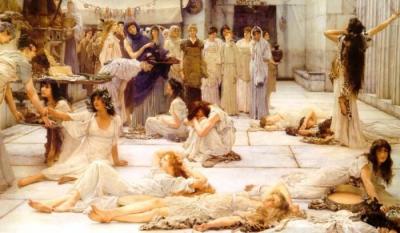
The Women of Amphissa, 1887, by Lawrence Alma-Tadema

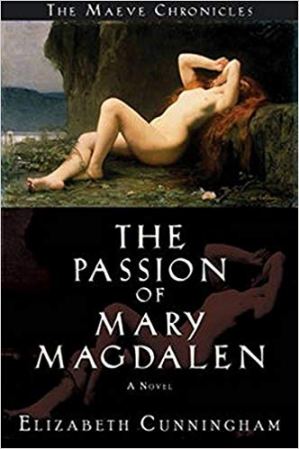
Since I began writing for FAR in July 2012, I have written about Mary Magdalen, or excerpted a passage from one of my novels, near or on her July 22 Feast Day. For why I made the controversial choice to depict her as a prostitute, see last year’s post. The below excerpt is from The Passion of Mary Magdalen. I made this selection in remembrance of all the refugees in the world today. In this passage, Judith, a Jewish widow whose family was driven from the land by tax collectors, returns to the place where Maeve (my fictional Celtic Magdalen) and her friends have recently founded a Temple to Isis on the outskirts of Magdala. Maeve has just invited Judith to join them. (Edited for brevity.)

She stared at me, her eyes full of anger and longing.

“I will not be a slave and a whore where I was once a wife, the one who made the challah bread, who said the Sabbath prayers over it. This was our place, my husband’s and mine. We brought the best we had to the temple, the finest oil and wine, the unblemished kid—”

“Goats? You kept goats? You know how to make cheese?”

She sat quietly for a moment before she answered. “How can I live here with you?” she wondered. “I don’t understand.”

Continue reading “Temple Magdalen by Elizabeth Cunningham”

Resurrections by Elizabeth Cunningham

Photo by: Douglas C. Smyth

As a minister’s daughter, I grew up almost literally in the church, its red door and ivied walls across the driveway from the rectory. On Easter the church was packed; every family received a pink or red geranium. There were Easter egg hunts, baskets stocked with chocolate rabbits and the jelly beans these magical creatures laid. The church rang with triumphant hymns: Jesus Christ is risen today. Although like all children I reveled in holidays involving excessive sweets, it was not the candy or the or the requisite rejoicing that moved me most.

It was the women, or in the Gospel according to John, the woman, bereft and brave, who went to the tomb to tend Jesus’s body. The male disciples had scattered and gone into hiding. In the Protestant Episcopal Church, Christmas Eve and Easter were the only times women played a prominent role in the story. Those were not the loud, triumphant moments. They lived in my child’s imagination as the quiet, mysterious times, Mary giving birth in the night attended by cows, donkeys, and stars. Dawn in a garden, wet with dew, the only sound birds waking and singing, the only people, the women, or the one woman who captured my imagination and, in my story, has her own apotheosis on that morning.

I did not question the miracle of resurrection. Miracles and magic made sense to me as a child. Theology didn’t. My father liked to expound on Jesus’s utterance from the cross “My God, my God why hast though forsaken me.” He insisted that Jesus was not crying out in despair but quoting Psalm 22, which ends in triumph. The Gospel narratives emphasize Jesus’s rising again “in accordance with the scriptures,” implying that he knew he would come back to life on the third day.

Continue reading “Resurrections by Elizabeth Cunningham”

Ancient Dreamer by Elizabeth Cunningham

Raised view fallen autumn leaves deciduous trees

The poems below are excerpted from my new (I hope forthcoming) collection, Tell Me the Story Again. Ancient dreamer’s voice is one among many voices including sorrow singer, temple sweeper, sword woman, morose fool, merry drunk, grey cat and mouse, stone mountain, skeleton woman, mother rain and many more. The voices speak from a time perhaps just after (or long before) our time, in a real and magical world.

I chose to excerpt ancient dreamer’s poems because winter is the time, in Celtic lore, of the Cailleach, the old one, the divine hag.  When I began writing the poems in 2014, my mother-in-law, then age 101, was in the last stages of her life. She slept and dreamed most of the time, and I would sit and daydream with her. She died two months before her 102nd birthday. When I took up the collection again in 2018 to complete it, ancient dreamer remained a strong presence and has the last word.  

Continue reading “Ancient Dreamer by Elizabeth Cunningham”

Fierce Heart: The Power of Women’s Voices by Elizabeth Cunningham

“Women, when you begin to make fierce sounds on your own, don’t be surprised if it’s difficult at first. Start gently. Get close to the earth. These sounds may bring up memories, emotions. Have a way to work with them. When you get together to make fierce sounds with other women, experiment. Try a growl, a howl. You are sounding for all the beings that have no voice. It’s bigger than your personal story. The sounds of outraged women have not been heard collectively on this planet for a long time. Let them out. We are a force of nature. It’s time to quit being afraid of our power. Many women are terrified of their outrage. They confuse it with anger. Anger is a small, though intense, emotion. Outrage is rooted in love.  It’s ok. Understand it’s time. Time for these sounds to come out.”Rebecca Singer, founder of the Fierce Heart movement

One hot summer day my friend Rebecca and I both participated in local marches in different towns in support of immigrants’ rights. A lively band called Tinhorn Uprising led our march in song. At Rebecca’s march there were choruses of an oft heard call and response: “Tell me what democracy looks like! This is what democracy looks like!” Nothing wrong with the sentiment, but Rebecca suddenly knew she was done with the old chestnuts, chants and songs. A powerful vision came to her:

Thousands of women in the streets, roaring, howling, banging pots and pans, beating drums, sounding their outrage on behalf of the planet. Women in an ancient lineage of women, raising their voices together, making fierce sounds beyond words. Continue reading “Fierce Heart: The Power of Women’s Voices by Elizabeth Cunningham”

Did You Have to Make Her a Prostitute? by Elizabeth Cunningham

When I toured with The Passion of Mary Magdalen, opening by belting out the first paragraphs of the novel’s prologue in song, (ending with the line “when only a whore is awake!”) that question almost always came up.  In celebration of Mary Magdalen’s feast day, I’d like to offer answers that continue to evolve.

There is no scriptural evidence that Mary Magdalen was a prostitute. In a sermon, 6th century Pope Gregory I gave as his opinion: “This woman, whom Luke calls a sinner and John calls Mary, I think is the Mary from whom Mark reports that seven demons were cast out.” (This confusion and proliferation of Marys inspired me to make a joke. Q: How many holy Marys does it take to change a lightbulb? A: I don’t know. I keep losing count.)

In fact, very little is known about Mary Magdalen. There are fourteen references to her in the Gospels, then she disappears from the New Testament. The possibly Gnostic gospel of Mary dates to the 2nd century CE, and there is no scholarly consensus as to which Mary is the source of the tradition. Early on Mary Magdalen gave history the slip and took on an extended life in legends, which take her to Ephesus as well as to France where her alleged fingernails, bones, and skull reside and continue to be venerated.

Continue reading “Did You Have to Make Her a Prostitute? by Elizabeth Cunningham”

Glimpses of Women in India by Elizabeth Cunningham

Recently I traveled in India with my husband who did doctoral research there 48 years ago. I had no goals of my own other than to be open. Back only a short while, I am still pondering the journey. Here are glimpses of the women I saw, often only from a distance, with gratitude for so much kindness.

“Welcome to the City of Joy,” says our guide when we step out of the airport into the warm Calcutta night.  “You have arrived on Maha Shivaratri, the Great night of Shiva. This is especially a holiday for women. Every woman wants a husband like Shiva.”

Source: Alamy; used with permission

Continue reading “Glimpses of Women in India by Elizabeth Cunningham”

Happy Anniversary, Women’s March, with love from Madge by Elizabeth Cunningham

Like many in the FAR community, I participated in the world-wide 2017 Women’s March.  So did Madge, the bodacious cartoon character who took me by surprise in 1990 and went on to become the narrative character of The Maeve Chronicles. Her life in print, as the first century Celtic Magdalen, satisfied her until….November 8th, 2016 when Madge returned, mouthy as ever, to rejoin us in our own times.


On the first anniversary of the historic march, I’d like to share a little of Madge’s millennia-spanning story and a few images from her two books of cartoons, now published in one volume.

Madge first appeared to me in 1990 as a line drawing of an ample woman sitting naked at a kitchen table drinking coffee. I had recently finished writing a novel, The Return of the Goddess, A Divine Comedy, and felt I had nothing more to say. I decided to play with magic markers for a while. Madge, as the naked woman introduced herself, was far from done with words. Fleshed out with peach magic marker, Madge told me she wanted “fiery neon orange” for her hair color. She also required speech balloons for her theological queries. (For example: If we are all members of the body of Christ, who is the twelve-year molar, the kneecap, the colon?) Enchanted with her sass, I invited her to be in my next novel. I pitched ideas to her. She rejected them all as too dull and said, “I want my own book of cartoons first.” Continue reading “Happy Anniversary, Women’s March, with love from Madge by Elizabeth Cunningham”

Sisterhood, Service, Sovereignty: The Living Spirit of Avalon by Elizabeth Cunningham

Like so many women, I read Marion Zimmer Bradley’s The Mists of Avalon and got caught up in her vision of the Holy Isle and the priestesses who knew how to navigate those mists and travel between the worlds. Like so many women, I wished Avalon existed still.

In fact, Avalon does exist, because Jhenah Telyndru did more than wish. In 1995 she founded The Sisterhood of Avalon. Twenty-two years later, the Sisterhood is going strong and growing, attracting members from all over the world. I urge you to explore their website where the Sisters speak eloquently about their vision, structure, and purpose.

Continue reading “Sisterhood, Service, Sovereignty: The Living Spirit of Avalon by Elizabeth Cunningham”

Who is She? an excerpt (edited for brevity) from the 25th anniversary edition of The Return of the Goddess, A Divine Comedy by Elizabeth Cunningham

Introduction by Maeve: Elizabeth’s July post usually features an excerpt from my Chronicles in honor of my feast day, July 22.  This year the excerpt comes from the novel that opened the way for my story.  Ever since a playdough figure took shape spontaneously in her hands, Esther, a minister’s wife,  has been on a quest to find out Who She Is! Here she encounters the Lady as the Virgin Mary. (For my take on the BVM, aka Ma, the scene stealer, see The Passion of Mary Magdalen and Bright Dark Madonna.)

A kitchen, yes. That’s what a sacristy was: a sacred kitchen, Esther mused as she stood in St. Paul’s sacristy, the light strong but thickened by the plain, stained-glass, lead-fitted windows over the sink—the piscina, if you were high church. The walls, an ancient, graying yellow, did what they could to reflect the filtered light in a gallant effort to create an atmosphere intended to be cheery. Continue reading “Who is She? an excerpt (edited for brevity) from the 25th anniversary edition of The Return of the Goddess, A Divine Comedy by Elizabeth Cunningham”