

 In the summer of 1960 when I was 14 years old my much loved grandmother Mae Inglis Christ died of a cancer that affected her brain. The last time I saw my Nannie was shortly after her diagnosis in the early spring. While we were visiting, the cancer affected her back, and she took to her bed. In those days children were not allowed in hospitals. I never saw my grandmother alive again, but my mother told us that our grandmother was hooked up to tubes much longer than she should have been. Mother vowed, “This will never happen to me.” I was driven to the funeral in a limousine with my grandmother’s girlfriends. They spoke about my grandmother’s last days, describing how (because her mind was affected by cancer) my little grandmother had screamed and screamed at them for not visiting–even though they were with her every day. They found my grandmother’s outbursts so traumatic that they said they were relieved to see her looking so peaceful in her coffin. Continue reading “Death with Dignity by Carol P. Christ”
Tag: feminism and religion
The Ancestors Live in Us by Carol P. Christ
On the recent Goddess Pilgrimage to Crete women had the option of riding up a winding road on a mountainside in the back of a farm truck singing “She’ll Be Comin’ ‘Round the Mountain” or could choose to go with the guard in his closed automobile.
That evening one of the older women who had chosen to ride in the car said, “I saw how much fun you were all having, but I have done that before. This time I was happy to let the rest of you do it.”
“That’s exactly how I feel about death,” I responded. “Some people want to live on after death, but I don’t. I am happy to let others do it. The only thing that would upset me would be if life did not go on after me.” Continue reading “The Ancestors Live in Us by Carol P. Christ”
Anne Hutchinson, America’s First Feminist Theologian: 1591-1643 by Carol P. Christ
“She had rather been a husband than a wife; and a preacher than a hearer; and a magistrate than a subject.” Reverend Hugh Peter of Salem
Anne Hutchinson was banished from the Massachusetts Bay Colony for heresy in 1637 and excommunicated from the Puritan Church of Boston in 1638. Her banishment came just three years after she, her husband, and eleven living children arrived in America seeking the freedom to practice their religion as they saw fit. Governor Michael Dukakis pardoned her in 1987. Historian Howard Zinn called her a true American hero.
 I managed to get through graduate school in Religious Studies without ever having studied the theology of Anne Hutchinson,* though I vaguely remember references (probably with smirks of disapproval) to the “Antinomian Controversy” which is associated with her name. I recall Anne Hutchinson’s name because of an article published in Feminist Studies in the 1970s, when I had just begun to study women and religion. However it was not until recently that I learned of her place in history through reading American Jezebel by Eve LaPlante.
Hutchinson was accused of theological errors in her trials. The Calvinist doctrine of predestination figured heavily in the accusations. But the real issue at stake was that Anne dared to follow her own inner knowing, to articulate it theologically, and to teach her views against the grain of the Puritan authorities in Boston. Continue reading “Anne Hutchinson, America’s First Feminist Theologian: 1591-1643 by Carol P. Christ”
Fannie Lou Hamer’s Commitment to Life by Elise M. Edwards
 A few weeks ago, I came across a postcard that I was given at a conference last year. I got the postcard (advertisement?) because it has a picture of Fannie Lou Hamer on it, and in my home and office, I like to display images and quotes from inspirational women, especially black women. Hamer was a sharecropper from rural Mississippi who became a leader within the civil rights movement in the United States. I was happy to have something with her likeness on it. It was only later that I looked at the text on the front and back of the card, which read in part, ”Often called the ‘spirit of the Civil Rights Movement,” Hamer worked tirelessly on behalf of the rights of others—including the unborn. [She said,] ‘The methods used to take human lives such as abortion, the pill, the ring, etc. amounts to genocide. I believe that abortion is legal murder.’” I realized then that the card was distributed by an organization called Consistent Life, who, in support of a “consistent ethic of life,” is “committed to the protection of life threatened by war, abortion, poverty, racism, capital punishment and euthanasia.”
I was conflicted about the us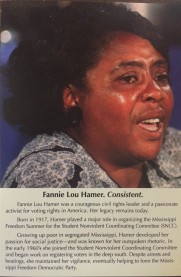 e of Hamer’s image for this organization’s purposes. It is true, Hamer did have those views about abortion and birth control. But I did not know if her image and story was being manipulated for a particular political and religious agenda—one I do not align myself with. I put the card in a box of other images and quotes. I didn’t display it, but I didn’t throw it away, either, which is why I came across it again a couple weeks ago as I was cleaning and decorating my home office. I had the same misgivings about the image as before, and I set it aside again. Continue reading “Fannie Lou Hamer’s Commitment to Life by Elise M. Edwards”
A Change in the Air by Deanne Quarrie
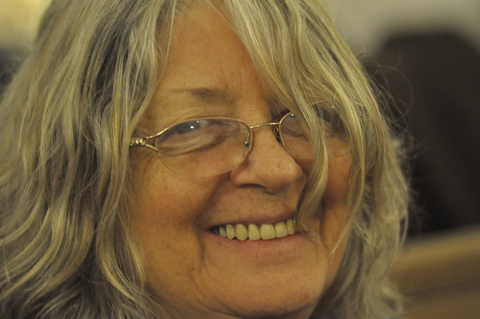 We had a wonderful taste of the autumn yet to come here in Austin, Texas. It began with a lovely, cool and drenching rain. We have been blessed with more rain than normal this year. When one comes in, however, after days of scorching heat, it feels like such a gift. This one brought cooling temperatures for a couple of days, a damp coolness that makes you want to lie in bed with the window open feeling the cool breeze and lingering just a bit, relaxing longer than usual. You know it won’t last for long so you have to just stop and be with it. Revel in it! For us to go from the near 100’s dipping down into the 60’s for the high of the day was such a treat! Later today, we will be back up in the 90’s, the coolness just a memory and yet a taste for what is coming.
Lying in the cool, green grass, I feel it thick beneath me.
I gaze at the clouds in the sky and my mind wanders,
drifting out to times remembered and times yet to come.
I feel close to the Earth, immanently connected and
embraced by the unknown universe above. Continue reading “A Change in the Air by Deanne Quarrie”
Reciprocity, Empathy, and Reconciliation: The Roots of Human Morality in Our Primate Ancestors by Carol P. Christ
 A link to a talk called “Moral Behavior in Animals” by Franz de Waal recently found its way into my email inbox. I am a big fan of Franz de Waal because his findings confirm what I always believed—that animals are intelligent. I followed the link and other suggested links and spent most of the evening listening to de Waal.
De Waal began his studies of animal behavior at a time when instinctual behaviorism was academic orthodoxy: the idea that animals can think and feel was “poo-pooed” by “scientists.” As de Waal observed ironically, everyone who has a pet knows better than that. But academic researchers continued down this path, expressing contempt for ordinary people who thought their pets were intelligent and the likes of de Waal who suggested that scientists might be colossally wrong.
De Waal’s discovery that chimps almost always “reconcile” after fights by touching hands, hugging each other, grooming, and even kissing, led him down “the garden path” to his discovery that what he calls the “two pillars of morality”—“reciprocity and empathy”– are found in primate social systems and in those of other higher mammals including dolphins and elephants . Continue reading “Reciprocity, Empathy, and Reconciliation: The Roots of Human Morality in Our Primate Ancestors by Carol P. Christ”
Essentialism Reconsidered by Carol P. Christ
In my Ecofeminism class we have been discussing essentialism because some feminists have alleged that other feminists, particularly ecofeminists and Goddess feminists, are “essentialists.” They argue that essentialist views reinforce traditional stereotypes including those that designate men as rational and women as emotional. I too find essentialism problematic, but I do not agree that Goddess feminism and ecofeminism are intrinsically essentialist.
Goddess feminists and ecofeminists criticize classical dualism: the traditions of thinking that value reason over emotion and feeling, male over female, man over nature. We argued that the western rational tradition sowed the seeds of the environmental crisis when it separated “man” from “nature.”
Goddess feminists and ecofeminists affirm the connections between women and nature in an environmental worldview that acknowledges the interconnection of all beings in the web of life.
This view has been criticized as essentialist. Is it? Continue reading “Essentialism Reconsidered by Carol P. Christ”
More than Individual Concerns by Elise M. Edwards
Well, the fall semester of the school year has begun. I’m teaching undergraduate classes in Christian Ethics and Bioethics this fall. I’ve designed my classes so that they are much more discussion-based than they have been in previous semesters and as a result, I’m noticing the things that challenge and confuse my students fairly early. I have readings from feminist, womanist, and mujerista thinkers in these courses, and unsurprisingly, some of my students don’t know what to do with the arguments feminists make about how we arrive at moral decisions and live them out. I hope that as we work through the essays together, my students and I learn from each other.
I assigned an essay called “Theology’s Role in Public Bioethics” by Lisa Sowle Cahill that was included in the Handbook of Bioethics and Religion edited by David E. Guinn (2006). Cahill, a feminist thinker, asserts that theology can be a conversation partner in public debate about bioethics and also an advocate for just, compassionate, and inclusive health care practices. Citing the work of another feminist, Maura Ryan, Cahill argues that ethical questions about reproductive technologies should be examined not only as individual dilemmas but as issues that exist within a social justice context. In the conclusion of the essay, she states, ”Specifically, one of [theology’s] most important and distinctive contributions to public discourse is a critique of the ways in which modern biomedicine and biotechnology have become luxury items marketed to economically privileged classes, while the world’s poor majority lacks basic health needs.” (55).
I suppose because I’ve been reading feminist thought, theology, and social ethics for years, some of the claims that my students see as radical and new are commonplace and go unquestioned by me. I expected some of my students to disagree with Cahill and Ryan’s particular positions about assisted reproduction. But I was surprised by students’ rejection of the idea that debates about reproductive technologies include MORE than individual considerations.
I’ve blogged on this site about reproductive rights before, and let me be clear that I do not think that the church, state, or any institution should have more governance over a person’s body than that person herself. But while respecting individuals’ rights to make health decisions for themselves, I also acknowledge that these “individual” decisions have broader social implications and meanings. This is one reason second-wave feminists have insisted that “the personal is political.”
Feminists routinely relate individual, “personal” acts and beliefs to larger constructs and the too-often asymmetrical power dynamics at work within them. This is why we are disturbed by video of a man who knocks his fiancée out and drags her unconscious body from an elevator and pop stars who gain commercial success by graphic displays and descriptions of sexuality that is objectifying or exploitative. And, in response to one of my students who wondered if feminist interpreters of religious texts go too far, that is why they point to patriarchy in a story that seems to be about devotion (referring to the Book of Ruth).
I’m grateful to my students for prompting me to explain some of these convictions that feminists hold. Certainly feminism is not monolithic. We feminists disagree on many issues including the scope of individual rights, the role of religion in public debate, and the extent of harm (or lack thereof) in media portrayals of female sexuality. But I believe we tend to agree that our personal decisions as well as our societal issues should be addressed with a consciousness that as humans we are beings-in-relation. Our conviction that we are connected and affected by each other lies behind our motivation to make the world a better place for women and girls and others who suffer from patterns of dominance.
What do you think?
Elise M. Edwards, PhD is a Lecturer in Christian Ethics at Baylor University and a graduate of Claremont Graduate University. She is also a registered architect in the State of Florida. Her interdisciplinary work examines issues of civic engagement and how beliefs and commitments are expressed publicly. As a black feminist, she primarily focuses on cultural expressions by, for, and about women and marginalized communities. Follow her on twitter, google+ or academia.edu.
We are Worth the Time it Takes to Create a Practice by Xochitl Alvizo
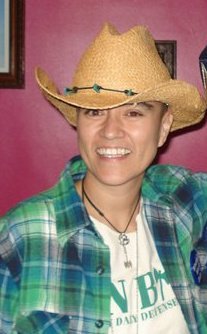 Recently, in response to the excellent conversation following Nancy Vedder-Shults’ post on the goddess Kali, Carol Christ commented to Nancy, “I too love our conversations, wish there was more in depth talk on our blog [FAR], maybe there will be.” Carol’s comment* struck a deep chord within me. One of the main objectives that the FAR co-founders had in creating Feminism and Religion was that it be a place where we could and would engage with one another across a diversity of feminist issues and the broad range of feminist passions and work – where we could discuss, critique, and build upon on each other’s efforts.
So two things came to mind as I reflected on Carol’s comment. The first was my personal lament that I have not been as actively participating in the discussions that follow the FAR blog posts as I did when we first started Feminism and Religion. FAR has such rich and valuable material – it really does provide a great opportunity for conversation and dialogue – and sadly I have been a passive participant as of late. I read and learn from the discussions, but I have not been joining in. I lament that. FAR is definitely a place where I could engage with others in deep conversations, but how actively am I actually doing this? Continue reading “We are Worth the Time it Takes to Create a Practice by Xochitl Alvizo”
In the Face of Despair, Choose Life by Carol P. Christ
Yesterday I had a delightful swim with a friend in the cool Aegean Sea. In in the evening I met two dear friends at an open air restaurant for a delicious meal and good conversation. Last night a beautiful moon rose over the sea and a soft breeze caressed my skin. All of this made me very happy. However, the state of the world does not.
Michael Brown. Trayvon Martin. The Ferguson police. Hold your ground laws. Bombing in Gaza. War in Ukraine. War in Iraq. War in Afghanistan. War in Syria. Wars that are not on my radar. Rape as a part of war. Joe Biden threatening to chase ISIL “to the gates of hell.” Citizens United. A rash of laws restricting voting rights. A rash of laws restricting abortion rights. Police brutality. Police brutality that is racially motivated. Young men being sentenced to prision for minor drug offenses. The brutality of the prison system. A woman with children being paid $8.50 an hour working at McDonalds and not even knowing when she will be called in to work. Open carry laws allowing Americans to walk the streets with loaded weapons. And that’s just off the top of my head this morning.
When I was young and protesting poverty, racism, and the War in Vietnam, I thought that it would be a relatively simple matter to change the world. It turned out that I was not only wrong: I was very wrong. The world has changed all right, but not for the most part for the better. In fact, despite the diligent efforts of social justice activists, in many respects the world has changed for the worse. Continue reading “In the Face of Despair, Choose Life by Carol P. Christ”
 Feminism and Religion