

 This is a great day for me as I announce the publication of A Serpentine Path: Mysteries of the Goddess. It is the first —but certainly not the last—book from the new FAR Press, directed by Gina Messina and Xochitl Alvizo, two of the founders of www.feminismandreligion.com. The release of my book is the fruit of friendship and collaboration that has been nourished in the blog community. I hope you will join with us in celebrating our joint venture by ordering the book, telling your friends about it, sharing it Facebook and Twitter (links below), reviewing it on Amazon, and letting Gina and Xochitl know if you can review in a magazine, journal, or blog.
Here is an excerpt from the preface to whet your appetite.
*
A Serpentine Path is a story that begins in despair and ends in rebirth and regeneration. It depicts a turning point in my life, a psychological and spiritual breakthrough that opened me to living the rest of my life in grace and joy. Though I am tempted to say it was a journey from darkness to light, that would be inaccurate, for mine was a journey into the darkness and out again. The path of life is never straight or narrow, and the circle of light and darkness is never-ending.
When I began the journey described in A Serpentine Path, I did not feel loved, I did not want to live, I could not write, and I believed the Goddess had betrayed my faith. As I completed the book, I knew I was loved, I wanted to live, I was writing, and I understood that the Goddess had never abandoned me. Though my life has had its ups and downs since then—as all lives do—I have never forgotten that I am loved, I have wanted to live, I have not stopped writing, and I feel the Goddess ever-present in my body, in my breath, and in my connections with the living and the dead. Though my story is deeply personal, my struggles with love and death, trust and control, are widely shared.
A story of finding the Goddess, A Serpentine Path is part of a growing genre that is developing as women explain to themselves and others why they left the patriarchal religions of their origins for a more nourishing spiritual vision that affirms both women and the earth. A Serpentine Path documents the first of the Goddess Pilgrimages to Crete I have been leading twice a year since then. For the women who have traveled with me, it will evoke many memories. For those who have dreamed of a pilgrimage to the Goddess, it offers an opportunity to imagine the journey. I now know a great deal more about ancient Crete, the folklore and customs of traditional Crete, and the rocks, trees and plants of Crete, than I did when I began. But I learned the mystery on my first pilgrimage. Because we are all deeply connected to each other, I know that the path to the mystery I discovered is not mine alone.
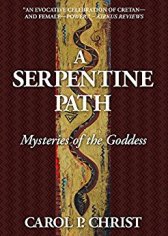 Be among the first to order A Serpentine Path, Carol P. Christ’s moving memoir of transformation. Carol’s other new book written with Judith Plaskow is Goddess and God in the World: Conversations in Embodied Theology. Carol also wrote the first Goddess feminist theology, Rebirth of the Goddess.
Join Carol on a Goddess Pilgrimage to Crete in 2017. Save $200.
Read two of the chapters in the book: Mysteries and Dionysian Rites.
Thanks to Judith Shaw for the cover art “Downward Serpent”

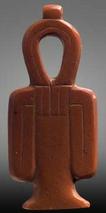 Friday night, I served as co-priestess in the opening rite which amazingly elevated every woman there. We called the Quarters, invoked the Elements and tied the Knot of Isis, with nine-foot-long, red sashes, on to bamboo poles cut with a cross bar, made to resemble ankhs. Each woman invoked her Element and the Power and Magic of Isis to guard and protect the space where we were gathered. We then called to Isis to join us. With doumbeks playing, Isis – yes, a real live Isis – walked into our Circle. She had two escorts who assisted Her up onto a platform where She spoke to everyone present.
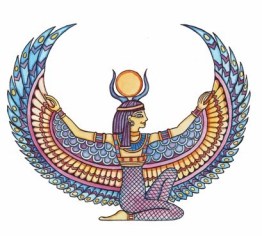 She was dressed, as you can imagine, in Egyptian robes with Her regal crown of horns and sun. On Her arms were Her beautiful wings. They were made by sewing men’s ties together with the small ends flapping in the breeze at the back. They stretched from Her shoulders to Her finger tips. Every woman and maiden there was able to come forward to receive a blessing from Isis. Many were enfolded in Her wings. Our Isis was a beautiful African American woman with long black hair, braided in knots. She completely embodied the spirit of Isis. This was her first time to ever come to a Goddess festival and I am sure when she agreed to her role in the ritual she thought it was going to be like a theatrical performance but she truly aspected Isis. It was amazing. I talked to her later and she told me that she never anticipated the intense emotional experience she had.
 My own part, in addition to what I did on-site, was to take all incoming email messages with questions and respond with answers. I organized the first Crone Camp ever. We offered a tent already in place as well as cots to sleep on. It was the first time since we moved from Stonehaven that beds were offered. Our Crone Guardians helped by erecting and taking down our large tent. They were also there to help when needed. I also got to be the one who took care of all the women seeking scholarships. I told everyone that I definitely had the best job in the Planning Circle as I got to speak to so many marvelous women! I came home with new friends and a happy glow from being surrounded by so much love.
 When the Spirit of the Cap upon which were embroidered the words
  We are closing in on the last of the season of abundance. Wherever we look we see Her harvest around us. Purple grapes hang from their vines. Branches hang heavy from the weight of fruit and sweet nuts. All the forces of life have done their work ~ the sun ~ the rain ~ the earth ~ the wind ~ all have added and blessed everything with fruitful abundance.
 Max Dashu’s


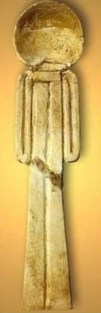 Over the years I have seen the image of the amulet called the Knot of Isis but in all honesty, never paid it much attention. I am on the organizing committee for our annual Goddess Festival here in Austin this year and we have chosen Isis as our Goddess to honor. The intent is to reclaim the Sacred Name of Isis and celebrate Her power, especially for women.
 Killing us slowly with your rules.
 Goddess, explains:
 part of my second trimester and I give birth to him in my bathroom, on my own with only my husband as witness. The blood comes, welling up over my fingers and spilling from my body in clots the size of grapefruits. I feel myself losing consciousness and am unable to distinguish whether I am fainting or dying. As my mom drives me to the emergency room, I lie on the back seat, humming: “Woman am I. spirit am I. I am the infinite within my soul. I have no beginning and I have no end. All this I am,” so that my husband and mother will know I am still alive.
 Feminism and Religion