Legacy of Carol P. Christ: Tree-Hugging Is About Trees and So Much More Than Trees

This was originally posted March 11, 2019

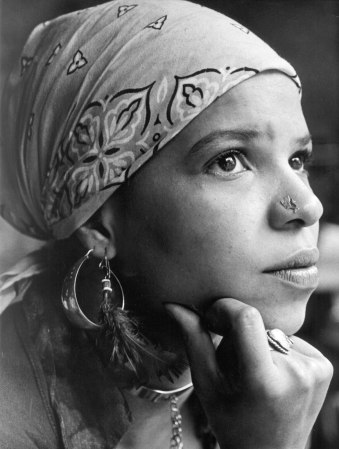
Not too long ago I heard someone deride members of a seminar who were building labyrinths in the olive groves of Greece as “a bunch of tree-huggers.”  I bristled! I probably first heard of the Chipko tree-hugging movement which is led by women in the 1970s and 1980s. Because I love nature, I naturally assumed hugging trees is a good thing. Originally, I had no idea that the tree-hugging movement was about much more than saving trees from being felled in the interests of short-term profit.

I did not know that the deeper purpose of the movement is to save a way of life based on forest-culture that is being threatened by the imposition of western ideas and practices promoted by colonialism and its successor, the green revolution. Nor did I know that the traditional forest-culture of India is the provenance of women: more than 4000 years of observing and experimenting created a “women’s knowledge” passed down from mother to daughter.

Continue reading “Legacy of Carol P. Christ: Tree-Hugging Is About Trees and So Much More Than Trees”

Legacy of Carol P. Christ: Goddess as Love: From Experience To Thealogy

This was originally posted on September 24, 2012

If theology is rooted in experience, how do we move from experience to theology? In my life there have been a number of key moments of “revelation” that have shaped my thealogy. One of these was the moment of my mother’s death.

In 1991 my mother was diagnosed with cancer. While she was being treated, I realized that I had never loved anyone as much as I loved her. When I wrote that to her, she responded that “this was the nicest letter” she “had ever received” in her life and she invited me to come home to be with her and my Dad.

My mother died only a few weeks after I arrived, in her own bed as she wished. She was on an oxygen machine, and I heard her call out in the dark of early morning. When my Dad got to the room, he tried to turn up the oxygen, but it didn’t help. Then he called the doctor who reminded him that my mother did not want to go to the hospital under any circumstances.

Continue reading “Legacy of Carol P. Christ: Goddess as Love: From Experience To Thealogy”

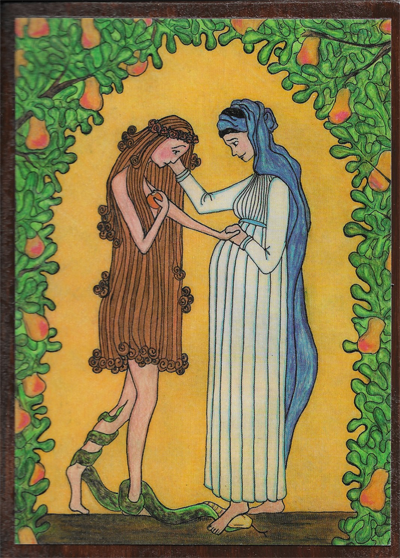
What is Wrong with This Picture? Rewriting Eve by Caryn MacGrandle

One of my oldest friends who I met when I was eight years old reached out to me the other day saying that if there was ever anything she could do, please let her know. She lives in another state far away but is a subscriber to one of my blogs so she has been aware of the various things going on in my life (second divorce, so many changes and transitions in my life yet again, etc.)

Her note said if there was ever anything she could do to help, just let her know.

And I thought to myself: hmmmmmm.

You see I just put a new feature on my app where it emails local events to local users, and one of the first steps in getting this to work is having those local events on the app. So I asked her if she would mind helping me put local events on the app.

We had not actually talked in a long time, and when we had a zoom call to discuss this, I broke down crying.

I felt the pity from her. I also saw just how far I had departed from ‘normal.’ 

But I don’t want to be ‘normal’. 

Continue reading “What is Wrong with This Picture? Rewriting Eve by Caryn MacGrandle”

Legacy of Carol P. Christ: Let Us Proclaim the God Who Bleeds Now

This was originally posted November 19, 2018

we need a god who bleeds now

we need a god who bleeds now
a god whose wounds are not
some small male vengeance
some pitiful concession to humility
a desert swept with dryin marrow in honor of the lord

we need a god who bleeds
spreads her lunar vulva & showers us in shades of scarlet
thick & warm like the breath of her
our mothers tearing to let us in
this place breaks open
like our mothers bleeding
the planet is heaving mourning our ignorance
the moon tugs the seas
to hold her/to hold her
embrace swelling hills/i am
not wounded i am bleeding to life

we need a god who bleeds now
whose wounds are not the end of anything

–Ntozake Shange

Continue reading “Legacy of Carol P. Christ: Let Us Proclaim the God Who Bleeds Now”

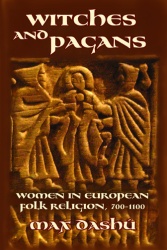
The Legacy of Carol P. Christ: Weaving and Spinning Women: Witches and Pagans by Max Dashu A Review

Moderator’s Note: This was originally posted on September 19, 2016

Max Dashu’s  Witches and Pagans: Women in European Folk Religion 700-1000 challenges the assumption that Europe was fully Christianized within a few short centuries as traditional historians tell us. Most of us were taught not only that Europe became Christian very rapidly, but also that Europeans were more than willing to adopt a new religion that was “superior” to “paganism” in every way. Careful readers of Dashu’s important new work will be challenged to revise their views. When the full 15 volumes of the projected series are in print, historians may be forced to hang their heads in shame. This of course assumes that scholars will read Dashu’s work. More likely they will ignore or dismiss it, but sooner or later–I dare to hope–the truth will out.

witches-and-pagans-cover

History has been written by the victors—in the case of Europe by elite Christian men. These men may have wanted to believe that their views were widely held, but Dashu suggests that they were not. Combing artistic and archaeological records, Dashu finds (to give one example) that images of Mother Earth nursing a snake are far from uncommon and can even be found as illustrations in Christian documents and on Christian monuments. Clerics rage against people—particularly women–who continue to visit holy wells and sacred trees and to practice divination and healing rituals invoking pagan powers. To paraphrase Shakespeare: “Methinks the cleric doth protest too much.” Were these things not happening and happening often, there would have been no need to condemn them.  Using these clues, Dashu provides intriguing new readings of the Poetic Edda and Norse sagas.

Continue reading “The Legacy of Carol P. Christ: Weaving and Spinning Women: Witches and Pagans by Max Dashu A Review”

The Magic of the Labyrinth by Janet Maika’i Rudolph

Labyrinths are magical. I’ve always been drawn to them. About two years ago, a local Episcopalian Church rebuilt their beautiful outdoor labyrinth and opened it to the public. In concert with them, I have been delighted and honored to offer guided walks there. Doing these walks, both in leading them and in walking myself, have given me the opportunity to reflect deeply on what they mean from many perspectives: historical, personal, spiritual, philosophical, experiential.

When I walk a labyrinth, it feels like I am mirroring the universe while expanding my internal journey. Teresa of Avila agrees with me (or, more accurately, I with her). She wrote, “If we learn to love the earth, we will find labyrinths, gardens, fountains and precious jewels! A whole new world will open itself to us. We will discover what it means to be truly alive.”     


Continue reading “The Magic of the Labyrinth by Janet Maika’i Rudolph”

Carol P. Christ’s Legacy: Great Goddess, Mother Goddess, Creatrix, Source of Life

This post was originally posted on February 5, 2018

The symbol of the Goddess is as old as human history. The most ancient images of the Goddesses from the Paleolithic era are neither pregnant nor holding a child. In Neolithic Old Europe the Goddess was most commonly linked with birds or snakes and only rarely portrayed as mother. Yet we tend to equate the Goddess with the Mother Goddess. I suspect that images of the Virgin Mary with Jesus on her lap and prayers to God as Father have fused in our minds, leading us to think that the Goddess must be a Mother Goddess and primarily a Mother.

In a recent blog, Christy Croft reminded us that in our culture, women’s experiences of mothering and motherhood are not always positive:

[The mother] doesn’t always appear in our stories in simple or easy ways. Some of us mother children we did not or could not grow in our bodies; some of us birth babies who are now mothered by others. Some of us are not mothers at all. Some of us had mothers who could not love us unconditionally, or did not have mothers in our lives, or had mothers who brought us more pain and humiliation than comfort, from whose effects we are still recovering, are still healing.

Continue reading “Carol P. Christ’s Legacy: Great Goddess, Mother Goddess, Creatrix, Source of Life”

Carol P. Christ’s Legacy: THE LABRYS: A RIVER OF BIRDS IN MIGRATION

Moderator’s Note: Carol Christ died from cancer in July, 2021. Her work continues through her non-profit foundation, the Ariadne Institute for the Study of Myth and Ritual and the Goddess Pilgrimage to CreteThis blog was originally posted July 29, 2013. You can its original comments here.

labrys seal ring

“There’s a river of birds in migration, a nation of women with wings.” Goddess chant, Libana

On the Goddess Pilgrimage to Crete, I explain that many of the names given to “Minoan” (c. 3000-1450 BCE) Cretan artifacts and architecture are products of patriarchal and Eurocentric imaginations, and as such, are misleading.  For example the name “Minoan” was given to the culture of Bronze Age Crete in honor of “King Minos,” who was said to have ruled in Crete a few generations before the Trojan War–several hundred years after the end of the culture to which his name was attached.  In fact, despite his eagerness to find evidence that King Minos ruled at Knossos, the excavator Sir Arthur Evans finally had to concede that the best he could do was to produce a fresco of a “Prince of the Lilies” which he identifed as the image of the male ruler of the culture he called “Minoan.”  Evans’ Prince had white skin, a fact that Evans conveniently overlooked–because according to his own interpretation of “Minoan” iconography, white skin would mark the figure as female.  Mark Cameron, who reviewed Evans’ reconstruction of the fresco, suggested that the Prince is more likely to be a young woman who is perhaps leading a bull to take part in the bull-leaping games.  He also stated that the “crown” belonged to another fresco altogether.

Continue reading “Carol P. Christ’s Legacy: THE LABRYS: A RIVER OF BIRDS IN MIGRATION”

My Goddessy by Dale Allen

I am passionate about sharing the image, essence and energy of the sacred feminine.  Having presented this material to thousands of men and women at universities, conferences, corporations, expos and theaters across the US, Canada, from Kauai to Dubai, to the Parliament of the World’s Religions, and twice to the UN Commission on the Status of Women, I have humbly witnessed its healing effect.  (I return to UNCSW on March 21, and welcome you to join this free online event, which you can find here.

When I first encountered the word, “Goddess,” I didn’t like it.  Using it felt strange, and I wondered why I should bother.  The word “Goddess” felt uncomfortable and unnecessary.

Continue reading “My Goddessy by Dale Allen”

An Experience of the Aphrodisia by Olivia Ciaccia

A warm summer sun smiles down upon the British coastline, the low tide reflecting jewels which are wash up and dispersed upon fine sand. A welcome breeze dances around a gathering of Goddess devotees encircling a small bonfire. Amongst them stands a banner and statue depicting and imitating Botticelli’s Venus and bouquets of roses. Just before the sun sets, those gathered lovingly collect these assembled artifacts, holding them aloft, and begin to process barefoot towards the sea.

Aphrodite-Venus’s banner and sculpted face shines in the low afternoon sunlight. As the procession slowly steps, weaves, and dances, towards the sea to the beat of a drum, the sun reaches further behind the hills, casting a long shadow upon the beach. The Goddess’s image dances with them, banner swaying and statue bobbing with the dance of its carrier. By the time the procession reaches the sea, the sun has dipped behind the now black silhouette of the hills bathing the beach ahead in dusky oranges and brilliant blues. At the shoreline, a priestess steps forward and turns the Goddess’s statue to face the procession, which has now fanning out into a semi-circle.

Continue reading “An Experience of the Aphrodisia by Olivia Ciaccia”