Holy Acts of Becoming: Sacred Reclamations and Gender in Children’s Literature, part 2 by Elanur Williams

part 1 was posted yesterday

Liminality of the Soul

‘Hansel and Gretel’ illustration by Karrie Fransman in ‘Gender Swapped Fairy Tales’ by Karrie Fransman and Jonathan Plackett (Faber & Faber, 2020). Used for commentary and review purposes under Fair Use guidelines. Website: https://karriefransman.com/project/gender-swapped-fairy-tales/

I have always adored fairy tales and folk tales, as they were the original, shimmering mirrors of my own interior world. In my own spiritual formation, I found my earliest refuge in the ‘monsters’ of the canon. I was drawn to the Selkie, whose power lived in her shed skin, and the shapeshifters who refused to be fixed in a single narrative. These were my mysterious teachers who offered profound knowledge, that I might have an interior life that does not match the exterior expectations of the world. By re-reading these archetypes, I see that the ‘liminal’ is not a place of exclusion, but the most sacred place of all: the threshold where the divine creates.

The traditional “curse” of the beast in fairy tales can be approached as a narrative of liminality, an invitation to exist in the “in-between” where nature and spirit intersect. This “curse” is, fundamentally, a colonial misunderstanding of power and a fear of the fluid. Figures like the trickster, the shapeshifter, and the mermaid reveal that the “soul” has never been bound by a static form.

Continue reading “Holy Acts of Becoming: Sacred Reclamations and Gender in Children’s Literature, part 2 by Elanur Williams”

Holy Acts of Becoming: Sacred Reclamations and Gender in Children’s Literature, part 1 by Elanur Williams

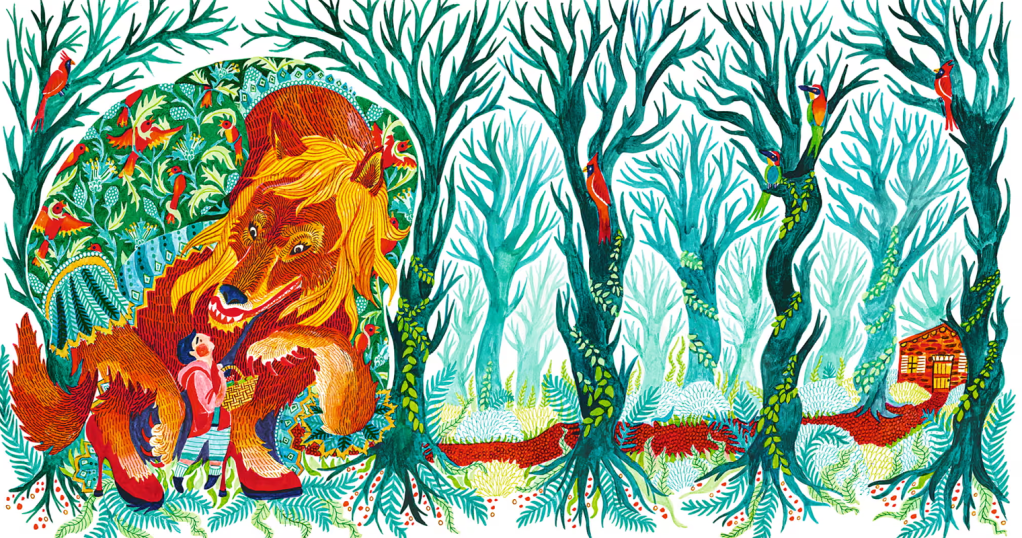
‘Little Red Riding Hood’ illustration by Karrie Fransman in ‘Gender Swapped Fairy Tales’ by Karrie Fransman and Jonathan Plackett (Faber & Faber, 2020). Used for commentary and review purposes under Fair Use guidelines. Website: https://karriefransman.com/project/gender-swapped-fairy-tales/

For generations, books have served as children’s first primers on the soul, and long before children encounter formal theology, they are offered spiritual blueprints through folklore, myths, and fairy tales. Although folklore is a metamorphic and often subversive space, too often these stories have been constrained by essentialist moralism, a framework where goodness must be beautiful, evil must be deformed, and gender is an immutable divine decree. Imagine the princess waiting in passive, delicate virtue; the prince acting with muscular, conquering strength. Any disruption of these orders (think of the cursed beast or the transformative sea witch) is framed as a tragedy, a cautionary tale against altering one’s inherent form.

But these interpretations do a profound disservice to the expansiveness of the divine. Spiritual language does not need to be rigid; spiritual experience is often the opposite. In fact, the lexicon of faith, mysticism, and mythology is uniquely, beautifully equipped to honor gender fluidity and the trans experience. To diversify children’s literature is not merely a political act; it is an act of holy reclamation.

Continue reading “Holy Acts of Becoming: Sacred Reclamations and Gender in Children’s Literature, part 1 by Elanur Williams”

Medieval Bhakti Women Saints: Early Voices of Feminism by Sonal Jakhar

Long before the first wave of feminism in the mid-nineteenth century had its initial launch, a well-established religious movement sparked a socio-political awakening in India. The processes of social and cultural integration in the bhakti tradition have significantly reshaped medieval Indian society. To understand the reclamation inherent in the bhakti movement, one must first acknowledge the ‘dominant power structure’ that prevailed.

The orthodox Brahmanical hierarchy (the priestly class) enforced a strict monopoly over religious ceremonies, temple access, and sacred texts. On the other hand, spiritual knowledge was bound within Sanskrit, a language only upper-class men could learn. The bhakti movement arose from a desire for a direct relationship with God while rejecting society’s rules and rituals. Women and marginalised castes were heavily oppressed and restricted from public spheres. Since religious space was the only space available to women in the early medieval period, many women embraced bhakti (devotion), and it eventually provided them space to define their own voices that revised society, relationships and religions.

The bhakti movement, since its emergence in the 7th century in South India, had a seismic impact on women and marginalised groups. Ideas of inclusivity, accessibility, and connectivity were running through reforms and resistance. A small but steadily growing group of thinkers called for the democratisation of the Divine against the social hierarchy in religious practises. Many women supported this reform with resilience, as they knew that change, whether conservative or revolutionary, would inevitably shape gender relations and advance women’s rights.

Continue reading “Medieval Bhakti Women Saints: Early Voices of Feminism by Sonal Jakhar”

Falling into Spring by Sara Wright

The glorious
white stars
waited in vain
for rain
for miner
sweat
mason
or bumblebee
to feast
on pollen
sacred to All
after three days
petals
drooped
golden
eyes shut
pearled
almonds
fell
one by one
next year’s
compost
soaked in
unshed
tears.
Perhaps
Bee Goddess
has a plan
Changing Woman
transforms
Sky Woman
holds the
seeds …
clasping
bloodroot
spears
and
buds
wrapped in
gray shawls
she may
yet
choose
to
intervene.

Continue reading “Falling into Spring by Sara Wright”

Into Me I See: The Sacred Torch of Feminine Heat by Jsabél Bilqís

There’s that throbbing again! In the slit center of me. Spreading vehemently, devouring, insatiable, red like blood and warm like body. They say I’m Jezebel because I like it when she purrs.

𖦹

‘Now you can get pregnant.’

I became a woman but all my mother saw was a dirty girl. Like the wombs before and around me, scorched by estranged origins, I got in bed with shame and became disembodied, found myself in hell.

‘Virgin or Harlot?’, they asked me at the gates.

Sensing my fullness, I looked Illusion in the eyes.

‘Both.’

Engulfed in the flames, I chose all of me and it purified every thing that was not free.

Continue reading “Into Me I See: The Sacred Torch of Feminine Heat by Jsabél Bilqís”

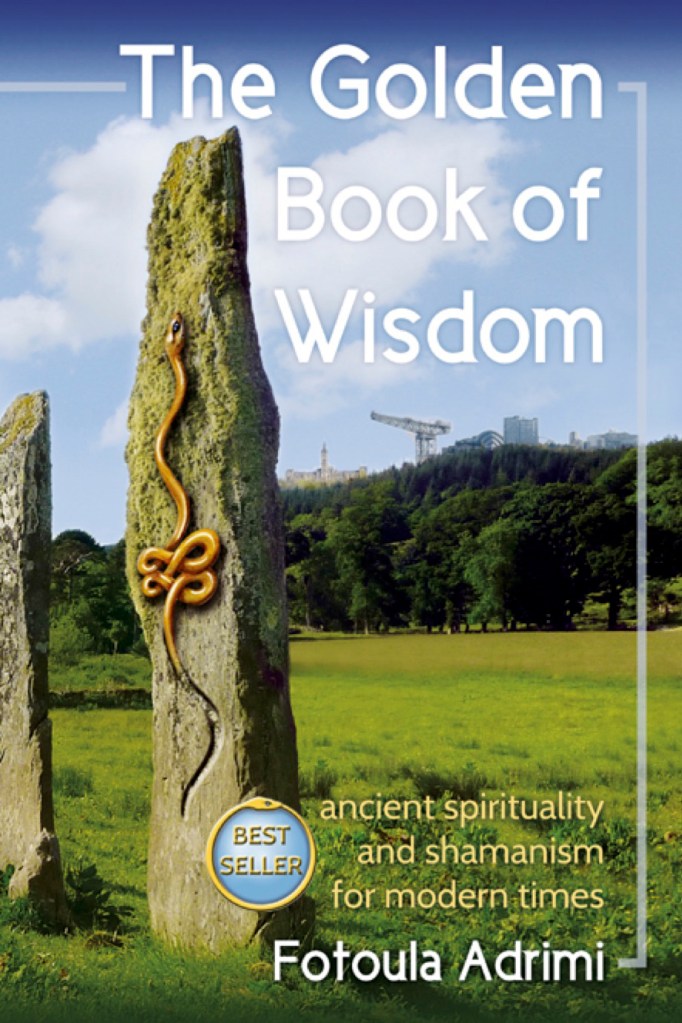
The Golden Book of Wisdom: Ancient Spirituality and Shamanism for Modern Times by Fotoula Adrimi

There comes a moment on the spiritual path, often arriving quietly and unexpectedly, when a woman begins to sense that the life she has been living does not fully belong to her. The roles, expectations, and inherited beliefs that once seemed natural begin to feel like garments that no longer fit. Beneath them, something older and deeper stirs. It is not new knowledge, but an ancient calling.

This call to return to an inner truth has been suppressed in us through centuries of patriarchy, yet it has been carried within us across time. This is a deep exploration that I share throughout The Golden Book of Wisdom – ancient spirituality and shamanism for modern times. In my own journey, this path did not arise as a rejection of the modern world, but as a remembering of something that had always been present. As I share in the book, my early life was marked by intuitive awareness and spiritual connection, which I later suppressed in order to conform to societal expectations. It was only when I returned to spiritual practice through meditation, healing work, and shamanic training, that these gifts reawakened, guiding me back to a path of service and teaching.

At its essence, shamanism is not a belief system but a lived, experiential relationship with spirit, nature, and the unseen worlds. It echoes an ancient role: the healer, the seer, the priestess, the one who walks between the worlds.

In the twenty years I have been practising shamanism professionally, I have come to realise that this movement from disconnection to remembrance, is one that many women recognise. Since 2012 I have been sharing The Priestess of the Moon™ training: a two-year apprenticeship exclusively for women to hold ceremony, rites of passage, and work with the wheel of the year and the moon cycle, reclaiming their inherent mystical power.

Continue reading “The Golden Book of Wisdom: Ancient Spirituality and Shamanism for Modern Times by Fotoula Adrimi”