

Part 1 was posted yesterday.
Stories That Reveal the Depth of the Tragedy
Only in November 2025, the following murders were reported:
Mobina Zare, age 20, in Islamshahr (a city southwest of Tehran), was killed by her former fiancé. After murdering her, he burned her body in an aluminum-melting furnace at his father’s workshop. Her family searched for her for ten days before finding her half-burned body.
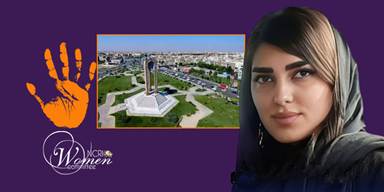
Leila Aliramaii, age 40, in Marivan (in Kurdistan Province, western Iran), was killed with a Kalashnikov rifle because she refused the vile demands of a member of the Revolutionary Guard Corps (IRGC). Leila was married and the mother of a young daughter and son.
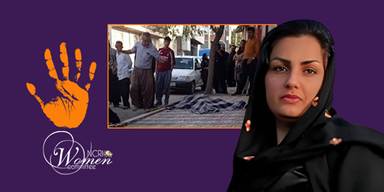
Sarina Rostami, age 16, in Sarpol-e-Zahab (in Kermanshah Province, western Iran), was killed by a male relative because she refused accept a forcible marriage.

A 40-year-old woman in Pakdasht (Tehran Province) was suffocated with a blanket by her husband.
Reyhaneh Dorzadeh, age 23, in Nikshahr (Sistan and Baluchestan Province, southeastern Iran), was suffocated by her husband because she opposed his desire to take a second wife.
A 29-year-old woman identified as J.D. was murdered by her father, who then dismembered her body and set it on fire.
Sakineh, age 80, in Tehran, was killed by her son using an iron rod.
Zahra Ghaemi, a women’s rights activist and member of the Women’s Study Group at the University of Tehran, was suffocated by her husband.
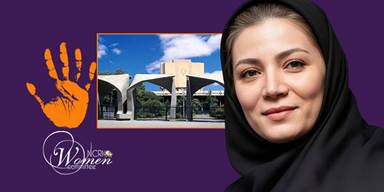
Shahla Karimani, age 38, mother of two, in Mahabad (Kurdistan Province), was strangled with a scarf by her husband and brother-in-law.
Sajedeh Sand-Kazehi, in Khash (Sistan and Baluchestan Province), was killed with a hunting rifle because her father-in-law wanted to forcefully take a gas regulator that belonged to her. Sajedeh was the mother of two young children.
Raheleh Siavoshi, age 26, in Nahavand, a town in Hamedan Province in western Iran, was fatally stabbed by her husband after participating in a sports camp. She died in the hospital two days later.

Justice Has Lost Its Meaning
While women are sentenced to long prison terms for “removing their hijab” or protesting discrimination, men who murder their wives typically receive only a few years in prison. In many cases, they can pay money to buy their way out and return to their lives.
In notorious cases such as Romina Ashrafi and Mona Heydari, the murderers received only two to eight years in prison. Even state-run media sometimes acknowledge this “inverted justice”: “The punishment for beheading one’s wife: 8 years in prison; The punishment for removing one’s hijab: 10 years in prison!”
According to the regime’s laws, the father, who is also the “male guardian and blood-owner (vali-ye-dam),” is exempt from retributive punishment for killing his own child.
Zahra Eftekharezadeh, founder of one of Tehran’s safe shelters, said regarding the absence of deterrent laws: “When the law does not impose a punishment proportionate to the crime, perpetrators realize there is no serious consequence waiting for them. In many cases, the sentences issued by the judiciary are not only non-deterrent but encourage the offender. Romina Ashrafi’s father is an example. He openly said that if he killed his daughter, he would receive at most ten years in prison.” (Shargh newspaper – October 11, 2025)
Atrocities Rooted in Law and Politics
Under Iran’s misogynistic clerical laws, a woman is not recognized as an independent individual but as “subordinate” to a man. Without legal or structural protection, women are forced to endure domestic violence, and each day adds new names to the list of women murdered.
Article 1105 of Iran’s Civil Code assigns family leadership exclusively to men.
Article 1108 makes a woman’s right to financial support conditional on her “obedience.”
Article 1114 gives the husband the right to determine the wife’s place of residence.
In such a system, women seeking divorce must prove their lives are in danger, and their testimony is worth only half that of a man. Judges routinely force women who have been beaten or threatened back into the homes of their abusers.
Through its laws, media, and judiciary, the clerical regime perpetuates these crimes. Violence extends from home to the school, from the street to the courtroom, widening its reach every day.
But beyond the laws, today’s social tragedies in Iran stem from political roots. The misogynistic clerical regime is founded on the subjugation of women. The horrific killings of women are not isolated acts of personal fanaticism; they are the product of a system that authorizes violence against women.
The rising number of honor killings must therefore be understood as the direct result of the regime’s anti-woman policies and the patriarchal culture embedded within its structure. The Iranian people blame not society but the regime itself, an oppressive, misogynistic establishment that preserves its power through the suppression and elimination of women.
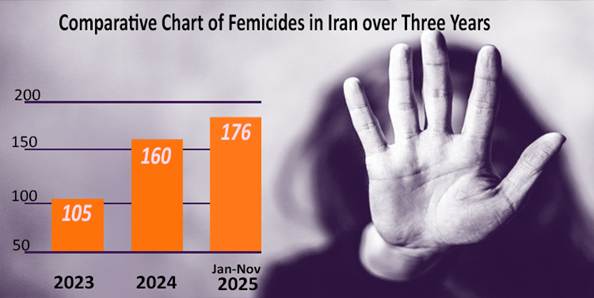
Data compiled over the past three years by the NCRI Women’s Committee shows a sharp upward trend in the number of women murdered under the misogynistic rule of the clerical regime. These figures are drawn entirely from documented and published reports by state-run media and other available sources. They therefore represent a minimum estimate, as the regime deliberately obscures such information, and many families, fearing the perpetrators, avoid publicizing the killings of their daughters and female relatives.
According to these findings, at least 105 women were murdered in 2023, 160 in 2024, and during just the first eleven months of 2025, no fewer than 175 women have been killed in Iran.
INFO: NCRI The NCRI Women’s Committee works extensively with Iranian women outside the country and maintains permanent contact with women inside Iran. The Women’s Committee is actively involved with many women’s rights organizations, NGOs, and the Iranian diaspora.
The NCRI Women’s Committee is a major source of much of the information received from inside Iran with regard to women. Attending meetings of the UN Women, the UN Commission on the Status of Women (CSW), the Human Rights Council, and other international or regional conferences on women’s issues, and engaging in a relentless battle against the Iranian regime’s misogyny are parts of the activities of members and associates of the NCRI Women’s Committee.
The NCRI Women’s Committee is one of the 25 committees of the National Council of Resistance of Iran.
For more on this women’s committee click here.



 Sitting in front of the computer, I slowly and intentionally insert earbuds, click to start my favorite writing playlist, and open up Microsoft Word. I feel the tips of my fingers resting lightly on the keys, and notice the slight give of each printed square, glossy in the middle from months of 80 words per minute. I lightly tap my fingers on the keys, not pressing enough to type a letter, body motionless except my fingers, watching the absolute stillness of the screen, exploring the edge between pressure and performance with slow, shallow breaths, finally noticing the moment when the edge is breached, the key catches, and a letter appears on my screen, taking it in with satisfaction.
 Feminism and Religion