
Holy Acts of Becoming: Sacred Reclamations and Gender in Children’s Literature, part 2 by Elanur Williams

part 1 was posted yesterday

Liminality of the Soul

‘Hansel and Gretel’ illustration by Karrie Fransman in ‘Gender Swapped Fairy Tales’ by Karrie Fransman and Jonathan Plackett (Faber & Faber, 2020). Used for commentary and review purposes under Fair Use guidelines. Website: https://karriefransman.com/project/gender-swapped-fairy-tales/

I have always adored fairy tales and folk tales, as they were the original, shimmering mirrors of my own interior world. In my own spiritual formation, I found my earliest refuge in the ‘monsters’ of the canon. I was drawn to the Selkie, whose power lived in her shed skin, and the shapeshifters who refused to be fixed in a single narrative. These were my mysterious teachers who offered profound knowledge, that I might have an interior life that does not match the exterior expectations of the world. By re-reading these archetypes, I see that the ‘liminal’ is not a place of exclusion, but the most sacred place of all: the threshold where the divine creates.

The traditional “curse” of the beast in fairy tales can be approached as a narrative of liminality, an invitation to exist in the “in-between” where nature and spirit intersect. This “curse” is, fundamentally, a colonial misunderstanding of power and a fear of the fluid. Figures like the trickster, the shapeshifter, and the mermaid reveal that the “soul” has never been bound by a static form.

Continue reading “Holy Acts of Becoming: Sacred Reclamations and Gender in Children’s Literature, part 2 by Elanur Williams”
Holy Acts of Becoming: Sacred Reclamations and Gender in Children’s Literature, part 1 by Elanur Williams

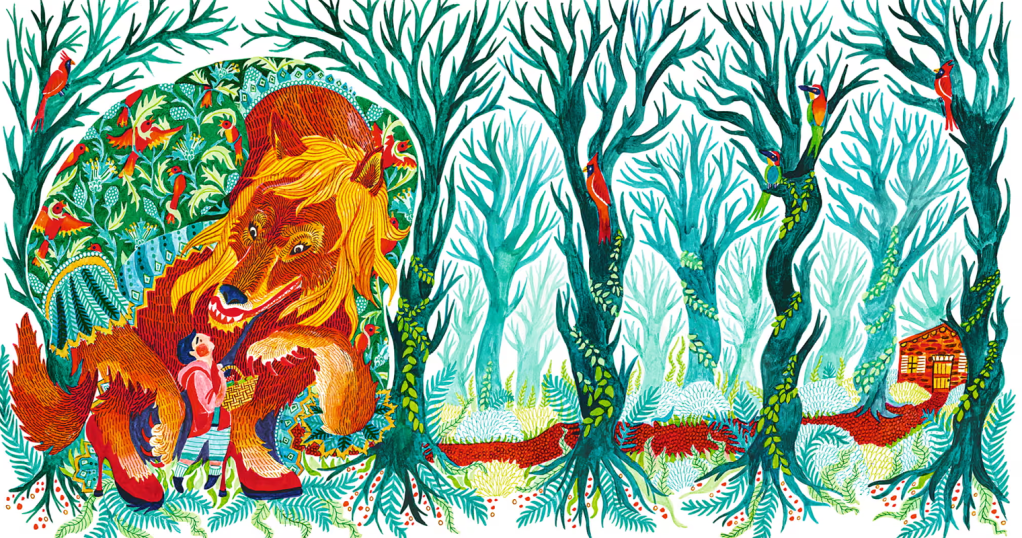
‘Little Red Riding Hood’ illustration by Karrie Fransman in ‘Gender Swapped Fairy Tales’ by Karrie Fransman and Jonathan Plackett (Faber & Faber, 2020). Used for commentary and review purposes under Fair Use guidelines. Website: https://karriefransman.com/project/gender-swapped-fairy-tales/

For generations, books have served as children’s first primers on the soul, and long before children encounter formal theology, they are offered spiritual blueprints through folklore, myths, and fairy tales. Although folklore is a metamorphic and often subversive space, too often these stories have been constrained by essentialist moralism, a framework where goodness must be beautiful, evil must be deformed, and gender is an immutable divine decree. Imagine the princess waiting in passive, delicate virtue; the prince acting with muscular, conquering strength. Any disruption of these orders (think of the cursed beast or the transformative sea witch) is framed as a tragedy, a cautionary tale against altering one’s inherent form.

But these interpretations do a profound disservice to the expansiveness of the divine. Spiritual language does not need to be rigid; spiritual experience is often the opposite. In fact, the lexicon of faith, mysticism, and mythology is uniquely, beautifully equipped to honor gender fluidity and the trans experience. To diversify children’s literature is not merely a political act; it is an act of holy reclamation.

Continue reading “Holy Acts of Becoming: Sacred Reclamations and Gender in Children’s Literature, part 1 by Elanur Williams”