

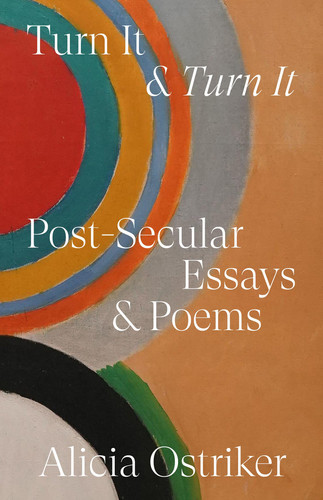
For more than half a century, Alicia Ostriker has been sounding the ram’s horn of her poems: passionate, precise cries of the mind, heart, and soul. She has been, at the same time, a literary scholar, a feminist commentator on the Bible, an explorer of goddess-language, and a searing poet of contemporary life. In this book, Ostriker seeks to bring her passions together: literature, the Bible, women, and spirit. Turn It and Turn It is a reference to what rabbinic lore says about the Torah: “turn it and turn it, for everything is in it.” Ostriker sees herself as a turner of and a returner to the core images of Torah. She is also a visionary who confronts the world as it is and imagines it as it should be.
In the first of Ostriker’s three sections, she pursues her love for poetry, considering poets from Paul Celan, the Holocaust poet, to Emily Dickinson, an icon among women’s independent voices. Nowhere is her intention more evident than in her analysis of Muriel Rukeyser, the Jewish woman poet whose astonishing work brought myth and mystery into a modern Jewish age. Ostriker particularly loves Rukeyser’s brief but theologically shattering words:
O for God’s sake
they are connected
underneath
Ostriker astutely points out that these words are a response to Matthew Arnold, the poet who imagined humans as islands in a vast sea and wrote: “We mortal millions live alone.” Rukeyser reminds us that, just as the islands are connected underneath, so we are all connected, and her “O for God’s sake” introduces a theology of interweaving. Ostriker is alive to all the nuances of this, for she too is seeking a new theology, not derived from classical religious thought but from the poetry of the present. Rukeyser writes of Jewish identity: “To be a Jew in the twentieth century/is to be offered a gift…/Accepting, take full life. Full agonies…” Ostriker in her own work struggles with this legacy, its gifts and its agonies, and so she is sensitive to what Rukeyser is trying to express.
Similarly, in Ostriker’s analysis of Paul Celan, she examines his famous poem “Deathfugue” and considers the mythic resonance of his two characters, the golden-haired Margarete and the ashen-haired Sulamith. “Two auras, two force fields, two names for the soul, one German, one Hebrew, both victims, both dead, both deathless,” Ostriker writes, as if she is continuing the poem, as if the tragic tension between these two dream-entities Celan has conjured exists in Ostriker’s mythic field as well. She calls them “the Eternal Feminine.” In her reading of Celan, we see both Ostriker’s love of the feminine in all its forms, and also that she too is a post-Holocaust poet, struggling with what it means to seek justice in a world that has made justice a joke.
In her final chapter of this section, Ostriker addresses the problem of feminine spirituality. “Women’s spirituality is complicated. We live in both a secular and post-secular world,” she writes, alerting us to the reason for the title of the book. “There is, for many of us, no going back to a culture shaped by male monotheism and its divine dictator. And yet we are spiritual seekers. We know that we have souls… We believe in the life of the spirit.” Ostriker claims the tradition of the Goddess as an answer to the patriarchal snuffing out of the feminine divine, and seeks the Goddess in poetry, surveying poets like Judy Grahn, Lucille Clifton, Marcia Falk, Joy Ladin, and Mohja Kahf, teasing out the Goddess in each of these poets’ words. Ostriker, in this essay, is a theologian, figuring out what the Goddess might look like for her and for us in a “post-secular” milieu.
Ostriker’s second section is called “Midrash and Multiplicity.” Here, she deals explicitly with the Bible. She offers incisive analysis of Jephthah’s daughter, asking: “Why did God intervene to save Isaac but not this child?” She addresses the conflict between Sarah and Hagar, wives of Abraham, noting that “the long shadow of enmity between Sarah and Hagar reaches to this moment.” She presents her own feminist poems and analyzes the poems of others, showing how these poems give women a voice. Yet Ostriker has not come to condemn the Bible for its faults, but to notice its multiplicity. She teases out the diverse currents in these narratives, saying: “Does the Torah contradict itself? Yes, like all great art, the Torah contradicts itself; it is large, it contains multitudes.”
In her essay, “Miriam and Others: Biblical Heroines Lost and Found,” Ostriker begins by saying: “It is a truth universally acknowledged that the Torah features power-wielding male figures.” Ostriker’s humor, as evidenced in this sentence, peppers the book and makes it delightful to read. Ostriker proposes in this essay that powerful women often disappear abruptly from the biblical narrative and that these disappearances echo the disappearance of the Goddess from Israelite life. Like other feminist Bible critics, she understands Miriam and the midwives, Rachel, Lot’s daughters, Rebekah, Michal, and Abigail as female tricksters who subvert patriarchal authority and vanish, just as the Goddess vanishes from biblical narrative.
Ostriker’s longing for the restoration of the feminine divine is clear. If there is anything lacking here, it is that Ostriker does not take time to weave in the actual Goddess texts of the Bible or the ancient Near East (though Goddess knows plenty of others have done that, so perhaps it is not needed). Although Ostriker often invokes the antiquity of goddesses, it is a new feminine she is seeking, one that comes from a merging of the tales of tradition and the words of contemporary poets.
This theological question is what she pursues in the final essay of the section, “The Wandering Jewess: Feminism Seeks the Shekhinah.” Here, Ostriker presents her own poetry to the Shekhinah. For me, most striking among these poems are the ones from The Volcano Sequence, which merge Ostriker’s words to the Goddess with her words to and about her own mother(s). She writes: “Theoretically, the parallel lines of ‘God,’ ‘my mother,’ and ‘Shekhinah’ converge at infinity—the infinity that is a mystic’s imagination, and that is also here and now.” Here, Ostriker reveals herself as a contemporary mystic whose consciousness-transformation practice is poetry.
they cannot say seek me
they teach us cooking clothing craftiness
they tell us their own stories of power and shame
and even if it is she who speaks through their mouths
and has crawled through ten thousand wombs until this day
we cannot listen
their words fall like spilled face powder
(Ostriker, Turn It and Turn It, p. 131)
Ostriker does not only speak of the Goddess. She conjures her, imagining her struggling through womb after womb to reach the present. Who can remain the same after picturing such an image? These poems are liturgy. Ostriker is correct that she is not a secular poet, but neither is she a “religious” poet. The lines of secular and sacred converge at the poetic infinity she offers us.
In Ostriker’s final section, she presents several of her own poetic midrashim, including the haunting and desolate “Jephthah’s Daughter: A Lament,” in which a Greek-style chorus tells the tale of the daughter sacrificed by her father. Ostriker brings to life the ritual the Bible claims was celebrated four days in the year to mourn the death of Jephthah’s daughter. As part of these poems, the daughter herself speaks:
Yes I am dead
Yes I was a daughter of Israel
Yes I am nameless…
Yes the men lay me on stone like a sheep
Yes I was naked like a sheep
Yes I called God God Mama…
Yes the angel of the Lord rescued my ancestor Isaac
Yes the Lord sent a messenger to stop the father’s hand
Yes he would save a boy but not save me…
Yes I am weeping
What else do you want of me
(Ostriker, Turn It and Turn It, p. 175-176)
This is unbearable stuff, and into it we can read all the horrific abuses women and girls have endured since time immemorial. While Ostriker is a seeker of the Goddess, she is not a seeker of spiritual bypass. The pain is still there and always will be. This keeps Ostriker’s poems from romanticizing anything, and that is what makes her voice one of the most authentic poetic voices of our time.
Ostriker’s book unabashedly brings together what she loves: poets, Jewish poets, feminist poets, biblical women, mysterious undercurrents of the Goddess. She contextualizes her own work by placing it in this trickster company. Ostriker has given us a huge gift: in this book, she has let us know how she has changed us.
Changing the language is
not easy you don’t
just disrupt
it you got
to raise it, raise it up but
what with?/what with the weeds pushing
busting with lust
up between the cement
cracks of our dirty sidewalks and what with
their perfect stems and leaves their
grace their goings
to seed and the stone
crumbling up some more then
pretty soon soil appears on
some kind of time-scale
which is not our business
how long it
may happen to take?
just we keep pushing
child, we keep dropping the seeds
(Ostriker, Turn It and Turn It, p. 194)
To purchase a copy, click here.
Discover more from Feminism and Religion
Subscribe to get the latest posts sent to your email.

