

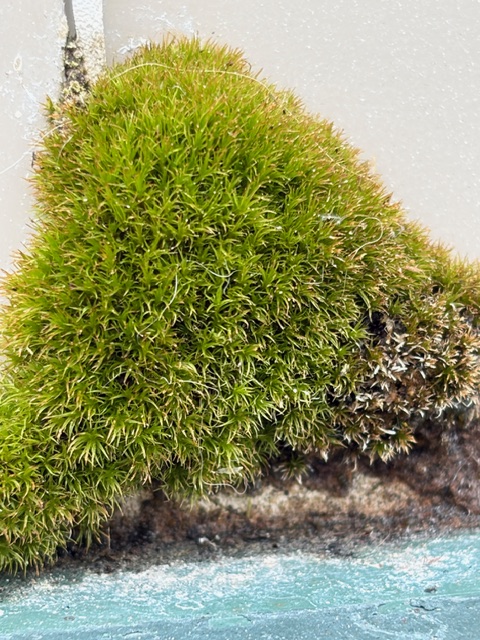
Now that the leaves are off the trees and the sun is low on the horizon mosses come into their own with their emerald – green tufts, hills, cushions, tree – like structures or by hugging boulders, tree trunks, and ground. I am particularly mindful because any day now snow could cover many species up for months. I want to be present for this brief moss moment in time.
Yesterday at the community forest I was counting the different mosses I found in soil, rock, rotting wood with the usual amazement (I do the same at home) while plumbing my mind for specific names. Mosses are just waiting to be noticed. It is said that beauty is survival tool; it certainly is for me. I am never disappointed when my thinking shuts down and my hands touch smooth, prickly, or velvety surfaces, or my eyes follow the graceful curves and patterns of the mosses as they move along whatever surface they have chosen to live.
Currently, academic/scientific thinking suggests that mosses are older than lichens and were the first plants to colonize land some 470 million years ago. This thinking is based on fossil evidence (very poor) and some genetics. The story could shift tomorrow.
More interesting to me is that mosses are the ancestors of trees. Trees emerged 385- 370 million years ago evolving from moss -like beings that shared a non – vascular common ancestor that later developed roots, leaves and wood. I love being in forests because the story of the earth over time is being told everywhere. As I peer up into bare trees that allow a pale winter sun-star to gaze down on the bryophytes I am aware that ground or tree loving mosses shine this time of year for a reason. Leaves provide mosses with shelter from fierce summer sun and lack of rain. I note the hair cap moss that so resembles miniature trees. Others remind me of ferns. Mosses like this time of year, especially in an area like the community forest or any other wild place where some moisture is present.
What I like best about bryophytes besides their astonishing beauty, variation, the fact that they provide homes for tiny creatures, and food or medicine for others, is that they remind me that life will go on. Having survived four or five extinctions, they will no doubt manage another.
I have trees all around my house, trees that once emerged from mosses. Trees have mosses spiraling around the bottom of their trunks or climbing through bark. Relatives engaging in conversations that I cannot imagine. When the massive logging trucks roll by with dying bodies of newly harvested trees, or yards fill up with broken balsams I remember mosses who will survive to birth wild forests again. Someday. Living through this picture offers me a momentary gift of peace. Grace.
The light was just right when I glimpsed the velvety hill of broom moss Dicranum scoparium thriving on a wall of concrete that housed the grocery store. Concrete is porous and retains moisture. It also contains calcium which some mosses like this one prefer. Mosses are non – vascular, that is, they lack the phloem found in higher plants that absorb water and nutrients. Instead, mosses have rhizoids, a kind of primitive pre- root that does absorb water directly through tiny leaves (osmosis) while anchoring the plant to its surface. Mosses are dependent upon water for fertilization because sperm must swim through water or dew to reach an egg.
Just below me at the edge of concrete and cement, other mosses are growing too. How utterly reassuring it is to find bryophytes growing in seemingly unlikely places.
The vibrant green ‘hill’ sparkled. I recognized the broom moss easily because it has a windswept look with all tufts growing in one direction, and in this case the moss formed a dense velvety cushion. When spores arise on slender burnt umber filaments the capsules bear tiny-forked teeth that are wind pollinated. Like any moss any part that is detached will generate another plant. When drought persists, the moss goes dormant and ki’s color fades (mosses can live indefinitely in this state).
Broom moss is ‘native’, quite common, and found in most places on this continent. However, it also grows throughout the world.
Perhaps when lighting your Christmas trees this season it might be worth taking a moment to give thanks for mosses the tiniest Trees of Life.
(Postscript: I am writing about ‘trees’ in response to a recent essay about encroaching Data Centers that are slaughtering whole forests along with logging and fires at an unpresented rate even as we give them permission to take over our lives. After doing further research on AI I felt thoroughly discouraged. It’s too late.Then I went into the forest peered at mosses and re-membered their message. Trees will return.)
Discover more from Feminism and Religion
Subscribe to get the latest posts sent to your email.


