We Don’t Have to Live Like This by Trista Hendren

A Tribute to Carol P. Christ’s Legacy of Peace

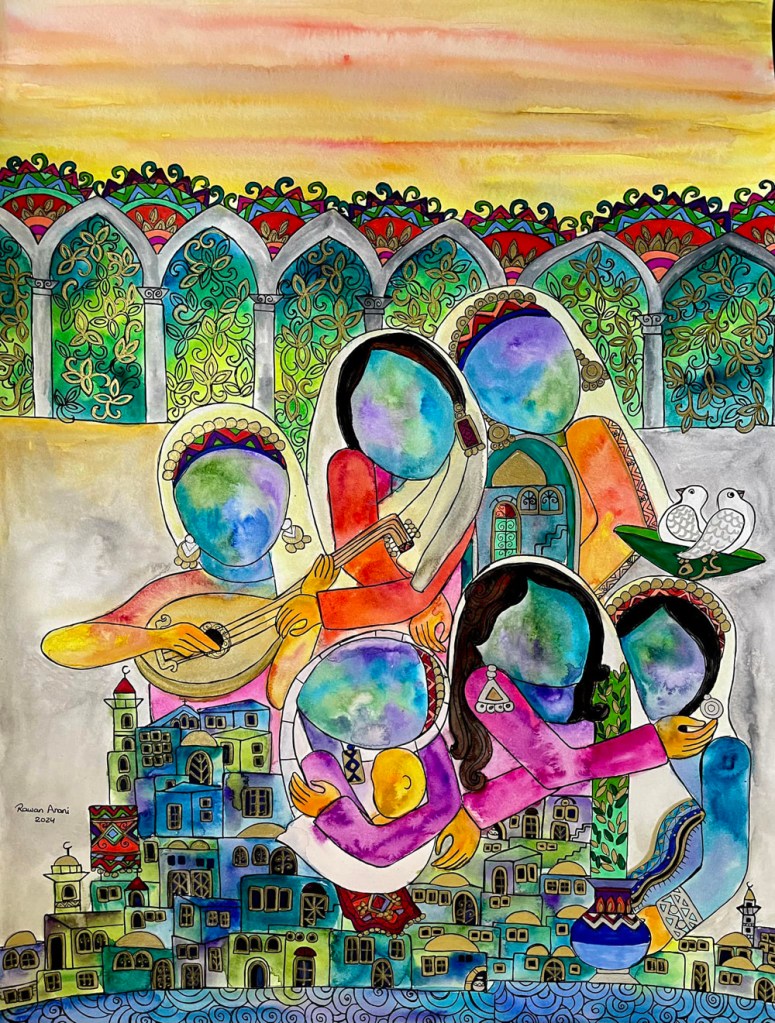
Rawan Anani, The Melody of Freedom, Gaza Palestine

Carol P. Christ was a feminist scholar and thealogian I deeply admired from afar for many years. That changed when I read her post in Feminism and Religion describing “washing wet clothes cast off by refugees who crossed the Sea of Death.”[1]

In that moment, she became a woman I connected with on a soul level. What could be more profound than washing and folding the clothing of tiny dead children? What other metaphor could be more vivid for how desperately we need to change the world?

“A tiny pink long-sleeved shirt with a boat neck, for a girl, size 3 months. 

A pair of leggings with feet, grey with pink, orange, brown, white, and blue polka-dots, to be worn over diapers.” 

The week before, she asserted that “the only ‘solution’ to the problem of people leaving their homes in fear for their lives is TO END WAR.” She continued, “No one takes this suggestion seriously enough to engage it.”[2]

I remember sitting inside the Idean cave with our Goddess Pilgrimage group when Carol read, “We Need a God Who Bleeds Now” by Ntozake Shange. I knew the poem well, but hearing Carolina read it so forcefully shook something deep inside me.

While I have had the privilege of having several wonderful female pastors, they were never particularly affirming of my womanhood—or my divinity. They certainly never celebrated my period.

Continue reading “We Don’t Have to Live Like This by Trista Hendren”

So, You Think You’re a Feminist? The Culturally Palatable ‘Feminism’ of The Barbie Movie by Tallessyn Zawn Grenfell-Lee

People are often surprised to learn that I actually love Barbie. Years ago, I heard a BBC interview with Ruth Handler, the creator of Barbie. In a world of baby dolls for mothering creative play, she wanted her daughter – Barbara – to have the opportunity to imagine other things, too. A computer scientist. A top executive. An astronaut. (The film shows a bit of this early intent.) Of course, no one would support her idea. Then, one day in Switzerland, she was walking past a toy shop and saw a small, plastic, adult, female doll. She had finally found a prototype! 

Unfortunately, this original Lilli doll had been created to depict an alluring, sassy, provocative “golddigger, exhibitionist, and floozy.” And Ruth specifically didn’t want her doll to be stereotypically ‘beautiful,’ because she didn’t want it to hurt girls’ self-esteem. But the only manufacturer willing to create the dolls was in Japan; their English was so limited, she finally picked up a file and literally filed off the plastic nipples in order to explain that she didn’t want the doll to have nipples. 

Continue reading “So, You Think You’re a Feminist? The Culturally Palatable ‘Feminism’ of The Barbie Movie by Tallessyn Zawn Grenfell-Lee”

Kedoshim: On Women, Patriarchy, and Respect.

The Torah portion for today’s blog is Kedoshim (Leviticus 19:1-20:27), which was read by Jewish communities yesterday, May 10, 2025.  Among scholars, it is part of what is often referred to as the Holiness Code, Leviticus 17-26 (Note 1).  Kedoshim covers all manner of topics: from what fabric to wear to how to treat one’s neighbor and from keeping Shabbat to when one can eat the fruit of newly planted trees.  These, what I will call prescriptions, all fall under the general reasoning that one does these things so that one can be holy like the deity is holy.  In a way, the Holiness Code then is an apt name for this section.  But, what can we take from this parshah from a (eco)feminist point of view?  To answer this question, I will be using the methodology I have laid out in a previous blog and ask three questions.

Continue reading “Kedoshim: On Women, Patriarchy, and Respect.”

The Story of Changing Woman, part 2 by Sara Wright

Part 1 was posted December 7th. You can read it here.

Commentary:

I love this story because it demonstrates the evolutionary and eternal nature of Woman; her intimate relationship to Nature, her ability to give birth, to mother, to let go, her ability to endure, her need for animals and plants as companions and her willingness to stand her ground until she is able to get what she needs. Changing Woman matures from a passive figure who is acted upon by the forces of Nature into a self-directed female power who knows what she wants, and one who finds peace in choosing relationships with animals, plants and humans on her own terms.

Initially, Changing Woman is impregnated by the wind – the power of the spirit moving across the land – and not through sexual intercourse. Spirit and the Body of the Earth are the two equally creative aspects involved in her birth. The same holds true for her children, who are male, but conceived and birthed in a similar manner without the need for male insemination (no room for Patriarchy to enter here), suggesting to me that all three are parts of one spiritual/bodily whole that cannot be separated. As creative principles (beyond gender stereotypes) they work together as a triad to rid the world of monsters, to make the Navajo world a safe place, and to secure the matrilineal line. According to Navajo mythology securing the matrilineal line is primarily how Changing Woman saves the world.

Continue reading “The Story of Changing Woman, part 2 by Sara Wright”

Harris Could Not Outrun 2000 Years of Patriarchy by Janet Maika’i Rudolph

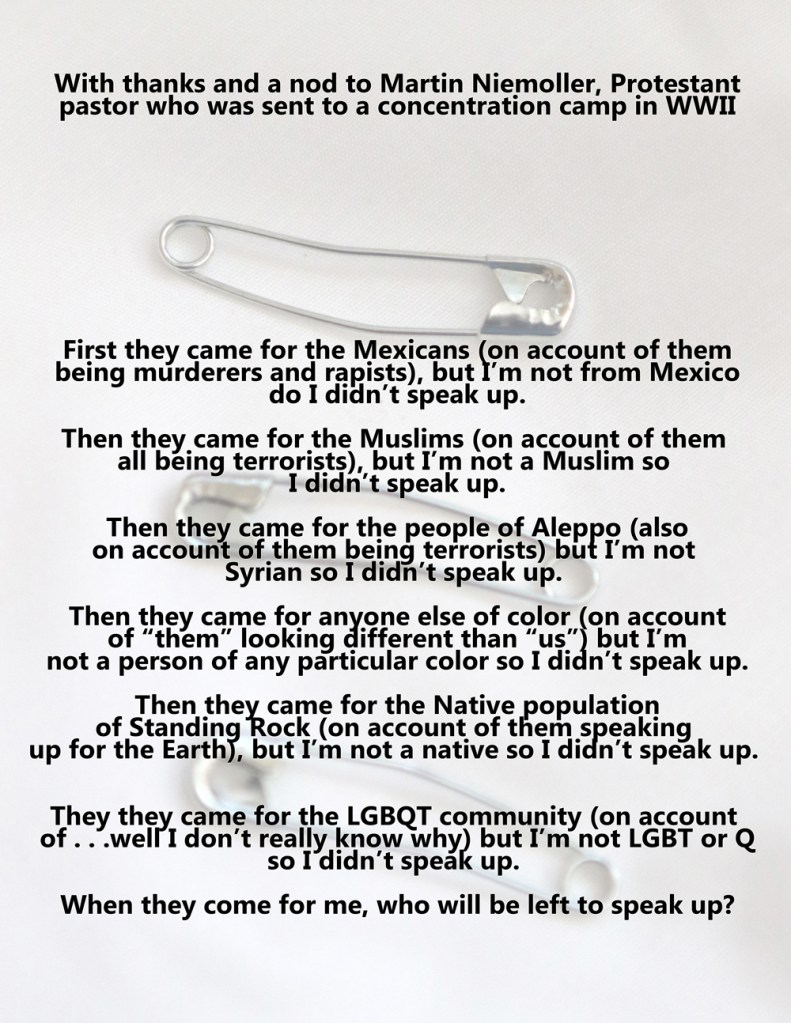
I made this poster 8 years ago and am devastated to have to dust it off again. The safety pins came from a British idea when Brexit was passed. People would wear the safety pins on their clothes to let anyone feeling vulnerable know that they would be “safe” with them.

The political finger pointing for Harris’ loss is beyond noxious. I have heard all manner of scapegoats; Biden, the Obamas, VP candidate Walz, Harris for saying too much of one thing, not enough of another, the progressives, Liz Cheney and even George Clooney. . . .blah blah blah

How can we make sense of a world where women voted for a misogynistic abuser. Black and brown people voted for a white supremist. Latinos voted for a policy of mass deportations targeting their brethren. Youth voted for a climate denier affecting their future. And so on. Think of all the women who voted for a world where they, their daughters and their granddaughters can be denied basic healthcare. It’s a true-to-life Cinderella scenario whose stepmother cut the toes off her own daughters to please a prince. Or Chinese mothers who would bind their own’s daughter’s feet, thereby crippling them in the service of marriage.

Continue reading “Harris Could Not Outrun 2000 Years of Patriarchy by Janet Maika’i Rudolph”

On Noach and its Ecofeminist Potential.

The Torah portion for November 2, 2024 is Noach.  The portion includes the stories of Noah’s ark and the tower of Babel and ends with Abraham and Sarai settling in the land of Canaan.  In my feminist analysis of Noach, I will focus on the ecofeminist potential of divine acknowledgements and how the divine is portrayed.

As ecofeminists at the intersection with religion, one task we have is to interpret those sacred texts which have something to say about nature and animals.  Within Judaism, there are numerous such texts, and parshah Noah is one of them.  Afterall, most of Noach revolves around a great flood in which the deity destroys the earth and most of its inhabitants, animal and human.  

The divine destruction of the material realm is problematic.  The deity blames the divine decision to destroy creation on the rampant corruption of the flesh: human and animal alike (6:13).  In feminist thinking, linking material existence to corruption is unsettling since patriarchy often disavows material existence by linking it to evil.  In addition, in Noach, an aspect of the material world, water, is used in bringing about that destruction.  However, water is also ironically what all flesh depends on for life.    

Continue reading “On Noach and its Ecofeminist Potential.”

Daughters of Witches By Julia Park Tracey

“We are the daughters of the witches you couldn’t burn.”

That’s a popular meme going around the internet these days, as we await the joyful coming of our savior, Kamala Harris, or the End Times, with the Mango Mussolini. I say that only slightly in jest, because I do believe we are in a fraught time. A woman president could set us up for incredible progressive movement, while a Trump/Vance win could mark the beginning of the end of women’s rights altogether.

There’s no way not to be political in an essay about feminism and religion, so if the current election is not of interest to you, I say, enjoy your privileges while you can and I hope the leopards don’t eat your face, as another meme goes. Regardless, the bodies of witches and the bodies of all our women, young and old, are still interconnected, both by virtue of our gender and of our position as political pawns (again? still? It is to weep).

Continue reading “Daughters of Witches By Julia Park Tracey”

On Persephone and the Racetrack: My Experience at Lake Pergusa.

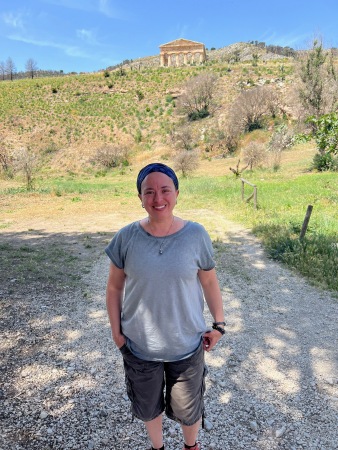
At the Segesta temple.

This May, I visited Sicily to present at the European Academy of Religion’s Annual Meeting. There I saw various historic, religious sites: parts of the city of Siracusa; the Valley of the Temples in Agrigento; mikvot in Palermo; various churches including the Cathedral in Palermo and the Church of St. Cataldo; the Segesta temple; and lake Pergusa where Hades emerges from the land to abduct Persephone. In this blog, I will focus on this lake. As an ecofeminist focusing on religion, this place gave me mixed feelings.

Continue reading “On Persephone and the Racetrack: My Experience at Lake Pergusa.”

To Childless Cat Ladies by Janet Maika’i Rudolph

I feel you. In a patriarchy where women’s reproductive abilities determine our worth, to be childless is a curse. We can thank VP candidate JD Vance for revealing this truth in all its ugly fullness. He is a walking billboard for patriarchy. Bottom line: Patriarchy is all about women’s bodies, our reproductive abilities and men’s desire to control them. We saw this in the Dobbs decision where it was declared that women have no constitutional right to the basics of healthcare, in Texas where it’s pretty much illegal to have a poor pregnancy outcome, and in Ohio where raped children are expected to give birth to their abuser’s child. Its endless 

But it is JD who made it plainer than plain what this is all about. Besides childless cat ladies being an old trope, just think of the judgement involved. Who is JD to decide on anyone’s family constellation? Or their pets? He also made disparaging remarks about the “childless left,” who have no “physical commitment to the future of this country.” That is a statement that only a person who totally lacks empathy can make. He is making a sweeping generalization that people without children don’t care about the future. This statement is more confession than truth. He reveals that until he had children, he had no care about the future of our world. It’s beyond egocentric. If only his kids are the center of his “caring,” that shuts out most of the world’s other children.

Continue reading “To Childless Cat Ladies by Janet Maika’i Rudolph”

Naso: An Invitation for Feminist Imagining.

This week’s Torah portion is Naso (Numbers 4:21-7:89).  The portion discusses who, among the Israelites, carries the components of the Miskan (Tenting of Meeting) while wandering through the desert.  It also entails a census of the tribe of Levi, describes various offerings that were brought to the Tent of Meeting in general and for its twelve days of dedication, decrees keeping the ill and ‘contaminated’ out of Israelite settlements, details the Nazirite vow, gives us the priestly blessing, and proscribes the process through which women are acquitted or found guilty of affairs.  There are many components of this parshah that offer food for thought when it comes to a feminist analysis, but for today, I am going to focus on where there is equality between men and women within the text and where there isn’t.  

Continue reading “Naso: An Invitation for Feminist Imagining.”