Harris Could Not Outrun 2000 Years of Patriarchy by Janet Maika’i Rudolph

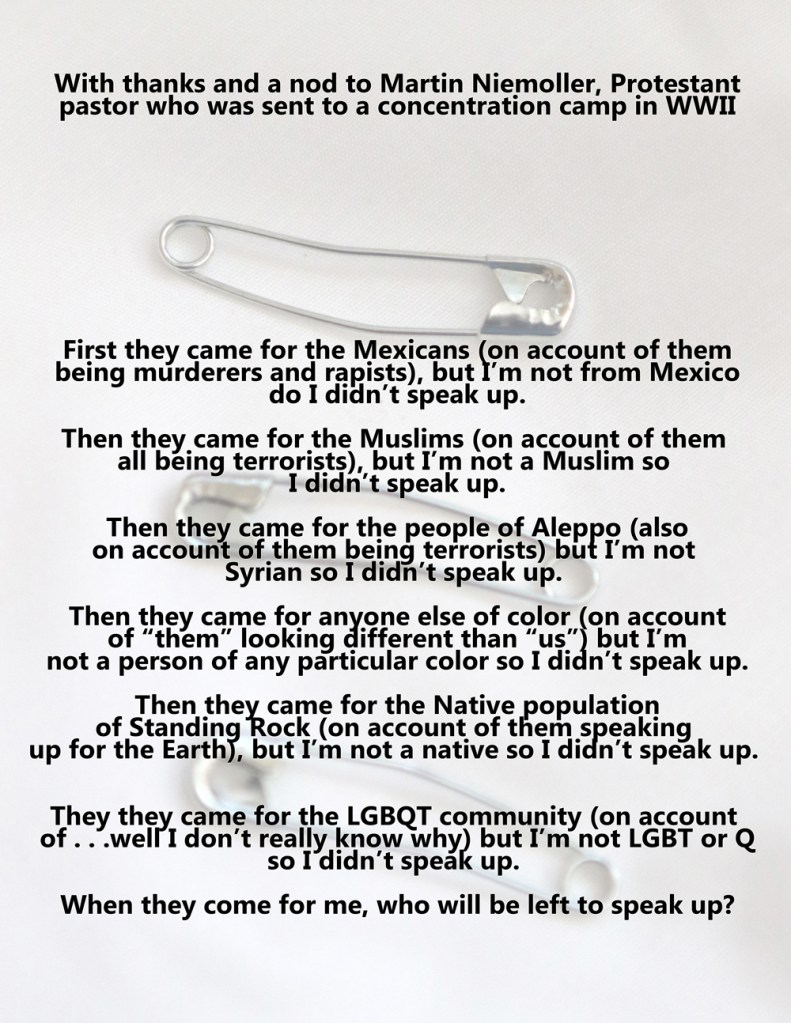
I made this poster 8 years ago and am devastated to have to dust it off again. The safety pins came from a British idea when Brexit was passed. People would wear the safety pins on their clothes to let anyone feeling vulnerable know that they would be “safe” with them.

The political finger pointing for Harris’ loss is beyond noxious. I have heard all manner of scapegoats; Biden, the Obamas, VP candidate Walz, Harris for saying too much of one thing, not enough of another, the progressives, Liz Cheney and even George Clooney. . . .blah blah blah

How can we make sense of a world where women voted for a misogynistic abuser. Black and brown people voted for a white supremist. Latinos voted for a policy of mass deportations targeting their brethren. Youth voted for a climate denier affecting their future. And so on. Think of all the women who voted for a world where they, their daughters and their granddaughters can be denied basic healthcare. It’s a true-to-life Cinderella scenario whose stepmother cut the toes off her own daughters to please a prince. Or Chinese mothers who would bind their own’s daughter’s feet, thereby crippling them in the service of marriage.

Continue reading “Harris Could Not Outrun 2000 Years of Patriarchy by Janet Maika’i Rudolph”

On Noach and its Ecofeminist Potential.

The Torah portion for November 2, 2024 is Noach.  The portion includes the stories of Noah’s ark and the tower of Babel and ends with Abraham and Sarai settling in the land of Canaan.  In my feminist analysis of Noach, I will focus on the ecofeminist potential of divine acknowledgements and how the divine is portrayed.

As ecofeminists at the intersection with religion, one task we have is to interpret those sacred texts which have something to say about nature and animals.  Within Judaism, there are numerous such texts, and parshah Noah is one of them.  Afterall, most of Noach revolves around a great flood in which the deity destroys the earth and most of its inhabitants, animal and human.  

The divine destruction of the material realm is problematic.  The deity blames the divine decision to destroy creation on the rampant corruption of the flesh: human and animal alike (6:13).  In feminist thinking, linking material existence to corruption is unsettling since patriarchy often disavows material existence by linking it to evil.  In addition, in Noach, an aspect of the material world, water, is used in bringing about that destruction.  However, water is also ironically what all flesh depends on for life.    

Continue reading “On Noach and its Ecofeminist Potential.”

Daughters of Witches By Julia Park Tracey

“We are the daughters of the witches you couldn’t burn.”

That’s a popular meme going around the internet these days, as we await the joyful coming of our savior, Kamala Harris, or the End Times, with the Mango Mussolini. I say that only slightly in jest, because I do believe we are in a fraught time. A woman president could set us up for incredible progressive movement, while a Trump/Vance win could mark the beginning of the end of women’s rights altogether.

There’s no way not to be political in an essay about feminism and religion, so if the current election is not of interest to you, I say, enjoy your privileges while you can and I hope the leopards don’t eat your face, as another meme goes. Regardless, the bodies of witches and the bodies of all our women, young and old, are still interconnected, both by virtue of our gender and of our position as political pawns (again? still? It is to weep).

Continue reading “Daughters of Witches By Julia Park Tracey”

On Persephone and the Racetrack: My Experience at Lake Pergusa.

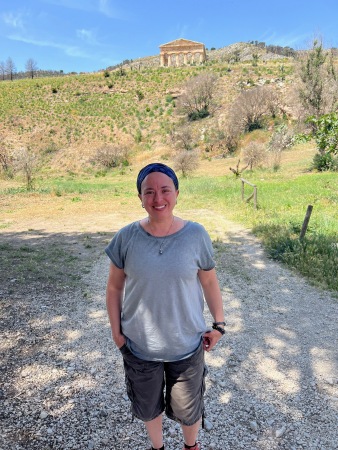
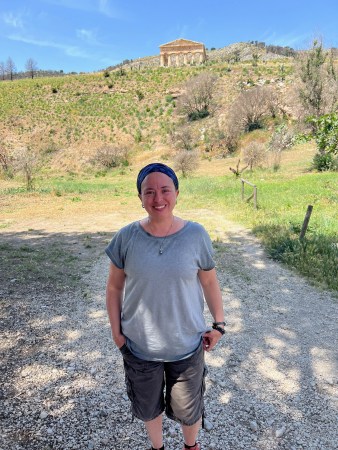
At the Segesta temple.

This May, I visited Sicily to present at the European Academy of Religion’s Annual Meeting. There I saw various historic, religious sites: parts of the city of Siracusa; the Valley of the Temples in Agrigento; mikvot in Palermo; various churches including the Cathedral in Palermo and the Church of St. Cataldo; the Segesta temple; and lake Pergusa where Hades emerges from the land to abduct Persephone. In this blog, I will focus on this lake. As an ecofeminist focusing on religion, this place gave me mixed feelings.

Continue reading “On Persephone and the Racetrack: My Experience at Lake Pergusa.”

To Childless Cat Ladies by Janet Maika’i Rudolph

I feel you. In a patriarchy where women’s reproductive abilities determine our worth, to be childless is a curse. We can thank VP candidate JD Vance for revealing this truth in all its ugly fullness. He is a walking billboard for patriarchy. Bottom line: Patriarchy is all about women’s bodies, our reproductive abilities and men’s desire to control them. We saw this in the Dobbs decision where it was declared that women have no constitutional right to the basics of healthcare, in Texas where it’s pretty much illegal to have a poor pregnancy outcome, and in Ohio where raped children are expected to give birth to their abuser’s child. Its endless 

But it is JD who made it plainer than plain what this is all about. Besides childless cat ladies being an old trope, just think of the judgement involved. Who is JD to decide on anyone’s family constellation? Or their pets? He also made disparaging remarks about the “childless left,” who have no “physical commitment to the future of this country.” That is a statement that only a person who totally lacks empathy can make. He is making a sweeping generalization that people without children don’t care about the future. This statement is more confession than truth. He reveals that until he had children, he had no care about the future of our world. It’s beyond egocentric. If only his kids are the center of his “caring,” that shuts out most of the world’s other children.

Continue reading “To Childless Cat Ladies by Janet Maika’i Rudolph”

Naso: An Invitation for Feminist Imagining.

This week’s Torah portion is Naso (Numbers 4:21-7:89).  The portion discusses who, among the Israelites, carries the components of the Miskan (Tenting of Meeting) while wandering through the desert.  It also entails a census of the tribe of Levi, describes various offerings that were brought to the Tent of Meeting in general and for its twelve days of dedication, decrees keeping the ill and ‘contaminated’ out of Israelite settlements, details the Nazirite vow, gives us the priestly blessing, and proscribes the process through which women are acquitted or found guilty of affairs.  There are many components of this parshah that offer food for thought when it comes to a feminist analysis, but for today, I am going to focus on where there is equality between men and women within the text and where there isn’t.  

Continue reading “Naso: An Invitation for Feminist Imagining.”

Processing my experiences of patriarchy has changed my faith for the better by Liz Cooledge Jenkins

As my first book, Nice Churchy Patriarchy, approaches six months of being out there in the world, I find myself reflecting on the journey. The process of unpacking all the ways patriarchy shows up in faith communities—and, in particular, the ways patriarchy has impacted my experience of church—has been a long one, and a winding one. It is no easy path.

How could a person travel this road and have their faith remain unscathed? Or perhaps a better question is this: How could one’s faith remain unchanged? And is this even a desirable goal?

After spending eleven years in “complementarian” (that is, explicitly patriarchal) evangelical church spaces and then two years in evangelical spaces that were egalitarian in theory but still had a long way to go to reach full gender equity—and, especially, after spending four years intentionally reflecting on these experiences and writing about them—I certainly see questions about gender roles and women in leadership differently. But it’s not only that. I see everything differently.

Continue reading “Processing my experiences of patriarchy has changed my faith for the better by Liz Cooledge Jenkins”

Bloody Waters by Ivy Helman

(Author’s note: I live in Prague, Czech Republic and teach at Charles University.Try as I might, I could not express in prose my thoughts about the violence in the world and particularly the violence here, in Prague, on the 21st of December, especially given the fact that I was a block away from what took place. So, I have written a poem instead.)

I swim through
the slimy waters of patriarchal violence
Difficult to express in words
the anxieties, the fear, the sadness
I feel as I take another stroke

towards

the parshah Bo (Exodus 10:1-13:6),
a divinely wrought plague of locusts
devouring all in their path.

Breathe,
stroke.

Darkness lasting three long days
blood smeared on doorposts and lintels
the deaths of first-borns, humans and animals alike,
the proclamation of a New Year and its festivities
to remind us of such nonsensical violence.

Breathe.
There is blood in the water.
Stroke.

Continue reading “Bloody Waters by Ivy Helman”

RELIGIOUS POLITICS by Esther Nelson

As I mentioned in an earlier post, I am a fan of Jim Rigby, a Presbyterian minister, serving a parish in Austin, Texas. I follow Jim on social media and read his posts regularly. I find his take on modern, American Christianity succinct, on-point, and very similar to my own experience growing up with evangelical, fundamentalist missionary parents.

Jim describes his initiation into religion in the following paragraph:

“As a child I learned an a-political version of Christianity. I…was offended if a preacher brought up social issues in a sermon. Religion for me meant a personal relationship with God so I could sing “Jesus loves the little children” but not feel any need to confront the possibility that my nation might be dropping napalm on them. I was taught to pray for world peace but to remain silent about my nation’s polices that made war inevitable. I could talk about Moses telling Pharaoh to set his people free, but was not permitted to break any chains in my own day.”

Continue reading “RELIGIOUS POLITICS by Esther Nelson”

What “Can” Women Do? – An Excerpt from Nice Churchy Patriarchy by Liz Cooledge Jenkins

In an essay called Sister, You Can Be Anything God Desires You to Be,[1] Kara Triboulet recalls a discussion in her theology class at her Christian college. When the professor opened up the floor and invited students to express their views on women in leadership, these are some of the things her classmates said:

“I believe women can be in leadership, just not as pastors.”

“Allowing women to teach other women and children isn’t limiting. At least they have a place to serve.”

“Women can be directors, but not pastors.”

“The Bible is very clear . . . women can’t teach or lead men because men were created first. It’s just the way God ordained it, and we all just need to accept that.”

Continue reading “What “Can” Women Do? – An Excerpt from Nice Churchy Patriarchy by Liz Cooledge Jenkins”