Bible Study Back in the White House after 100 Years – And… They Still Hate Gays and Women! by Marie Cartier

So, I am perusing my twitter feed and I come across this headline:

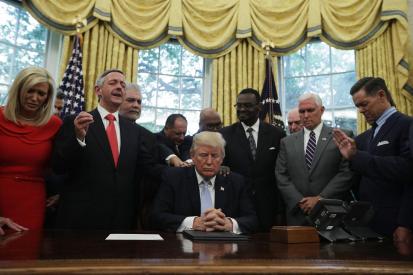
White House Bible Study Led by Pastor Who Is Anti-Gay, Anti-Women and Anti-Catholic

The opening paragraphs read like my LGBTQ+ religious studies nightmare:

“The first Bible study group held for the U.S. Cabinet in at least 100 years is led by a pastor who believes homosexuality is ‘illegitimate,’ who doesn’t believe women should preach and has described Catholicism as a ‘false’ religion.

Ten members of the Cabinet, including Vice President Mike Pence, Secretary of State Mike Pompeo, and Education Secretary Betsy DeVos, sponsor the study group, which holds meetings lasting between one hour and 90 minutes every Wednesday, according to BBC News. It unfolds at a location in Washington, D.C., that is kept secret for security reasons.

Its leader is Ralph Drollinger, a pastor and president of Capitol Ministries: an organization which aims to ‘evangelize elected officials and lead them toward maturity in Christ.’”
Continue reading “Bible Study Back in the White House after 100 Years – And… They Still Hate Gays and Women! by Marie Cartier”

Breaking the Silence by Chris Ash

Christy CroftYesterday, Time Magazine announced that its “Person of the Year” for 2017 would be “The Silence Breakers” – the name it has given to those women who helped launch and made headlines in the #metoo movement. This movement was started by activist Tarana Burke in 2006 to highlight the sexual abuse of women of color and was sent viral by actor Alyssa Milano in 2017. It speaks volumes that this designation falls exactly one year after Time awarded this honor to Donald Trump for the political shift heralded by his defeat of Hillary Clinton.

This defeat that was fueled, at least in part, by the way Trump’s own normalization of sexism, harassment, and assault played on the fears and bitterness of misogynist voters hell-bent on preserving what racial, gender, and economic privilege they could continue to hoard for themselves and those like them. This defeat, and the ensuing glorification of a sexual predator and rampant misogynist, in turn fueled a movement of people, mostly women, tired of being scared into silence to protect the powerful who abuse. Continue reading “Breaking the Silence by Chris Ash”

Looking for a Mouth to Tell the Story by Esther Nelson

In Chinua Achebe’s novel, THINGS FALL APART, Okonkwo, a proud, hard-working, albeit quick-tempered tribesman living in the village of Umuofia, fires a gun at Ekwefi, one of his three wives, almost killing her.  Chielo, a widow with two children, who also serves as the priestess of Agbala, Oracle of the Hills and Caves, asks Ekwefi, “Is it true that Okonkwo nearly killed you with his gun?”

Ekwefi replies, “It is true indeed, my dear friend.  I cannot yet find a mouth with which to tell the story.”

I love Ekwefi’s turn of phrase as she responds to Chielo.  Shaken, distraught, and outraged over being shot at by her fiery husband, she “cannot yet find a mouth with which to tell the story.”  That’s exactly how I feel these days.

Continue reading “Looking for a Mouth to Tell the Story by Esther Nelson”

Nobel Peace Prize 2017: ICAN and Those Who Can’t by Elisabeth Schilling

If there is any sanity in the world, it has come from the Nobel Peace Prize of 2017, which was awarded to ICAN, the International Campaign to Abolish Nuclear Weapons. They received the award for the work they have done on the Treaty for the Prohibition of Nuclear Weapons. According to the ICAN site, the agreement was adopted July 2017 and is backed by 122 nations. If signing the Treaty, a nation must agree to refrain from the following:

“[. . .] developing, testing, producing, manufacturing, transferring, possessing, stockpiling, using or threatening to use nuclear weapons, or allowing nuclear weapons to be stationed on their territory. [. . .] A nation that possesses nuclear weapons may join the treaty, so long as it agrees to destroy them in accordance with a legally binding, time-bound plan.”[1] A nation cannot encourage or support another nation to hold them either.

Continue reading “Nobel Peace Prize 2017: ICAN and Those Who Can’t by Elisabeth Schilling”

A Middle: Understanding the Relationship between Violence and Power by Katie M. Deaver

In my last post here on Feminism and Religion I unpacked the three primary understandings of atonement theology as well as some of the feminist critiques of those understandings.  In this post I’d like to focus a bit more on how the relationship between power and violence influences how Christian women view the atonement.

In her book, On Violence, Hannah Arendt puts forth a new analysis of the relationship between power and violence.  Arendt’s analysis, though primarily focused around concepts of the potential for worldwide destruction and war following major global occurrences such as the Second World War and the struggles for civil and women’s rights within the United States context, supplies an interesting framework with which to consider this relationship as it relates to domestic violence.    Continue reading “A Middle: Understanding the Relationship between Violence and Power by Katie M. Deaver”

Rape, Community and Healing by Vanessa Rivera de la Fuente

During my last months in Cape Town I have been facilitating a series of workshops on Rape, Gender Justice and Culture of Consent. I am blissful for the opportunity to teach and learn with a group of people with whom we have navigated in the approach of Rape and Sexual Assault in their different perspectives, from the socio-political to the intimate tenets.

This has been an exciting journey of healing and soul blooming. I have realized the critical role that Cape Town has played in pushing me towards empowerment and thriving, enhancing my taking back ownership of my body and all the experiences happening through it.

This journey started few years ago when I decided to come out of the closet as a rape survivor. I wrote about it on Feminism and Religion. This was the first step of my breakthrough. Little by little I became confident and shameless about saying: “Yes, I was raped”.

Continue reading “Rape, Community and Healing by Vanessa Rivera de la Fuente”

Reflections on Trauma, Part II: YOLOCAUST by Stephanie N. Arel

stephanie-arelIn light of the recent attacks on Jewish cemeteries —the desecration of Mount Carmel Jewish Cemetery in Philadelphia and the toppling of more than 150 gravestones at Chesed Shel Emeth Cemetery in Missouri — along with my reminiscing that a year ago today (March 1 as I am writing) I was en route to Jerusalem to work with a group of scholars for the Intercontinental Academia on Human Dignity, I wanted to once again confront trauma (building on Part I of this topic). In this case, I consider trauma as an affront to the dignity of ALL bodies and their memories, while simultaneously questioning how those who have not experienced trauma develop respect for its proximity – in individual lives, in sacred spaces, and in memorials.
The desecration of memory alive in the space of the cemetery presses me to repeat what I have said before: that the violation of bodies lies at the heart of traumas caused by human design — even if those bodies are inhumed. Continue reading “Reflections on Trauma, Part II: YOLOCAUST by Stephanie N. Arel”

Redeeming Gender, Softening Extremes by Chris Ash

Christy CroftLast month, I attended a lecture by Anglican theologian Adrian Thatcher on his recent book, Redeeming Gender. In this book, Thatcher draws upon the one sex and two sex theories described by Thomas Laqueur in his book, Making Sex: Body and Gender from the Greeks to Freud. Laqueur posits that until the eighteenth century, it was believed that women and men were two expressions of the same basic sex – that women were men whose reproductive organs were similar but found in the “wrong” places. Ovaries were internal testes, the vagina an inverted penis, and the labia a parallel for the scrotum – all making women flawed expressions of man.

This sets up a continuum in which there is one sex rather than two, with men as more perfect expressions of man, and women as inferior expressions. Thatcher argues that if the language, liturgy, and doctrines of the church arose in the context of the one sex theory, then Christianity’s foundational beliefs and practices are already compatible with acceptance of a spectrum of gender identity within a one-sex model, opening up new interpretations that allow for full participation of women and LGBTQ+ people within the church. While the old one sex theory as described by Laqueur is a spectrum from more to less perfection, from more to less like God, the spectrum Thatcher proposes is clearly progressive – one in which all places along the spectrum share in the same equality.

And yet it is still a linear spectrum, with extremes envisioned as opposites, as distant from each other. Continue reading “Redeeming Gender, Softening Extremes by Chris Ash”

Women, Theology and Identity as Believer by Vanessa Rivera de la Fuente

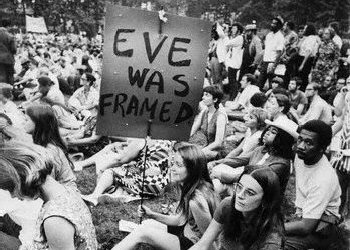
eve

Like all my reflections, this is not intended to be conclusive, but rather, to share some impressions about theology and the way in which women are created or given an identity as believers.

In the androcentric and misogynist narratives of religious traditions lies the root of much violence against women. This is not new, since the same diagnosis has already been raised by the theologian José Luis Tamayo when he says that although women are the majority presence of religious communities and those most involved in the transmission and practice of traditions “they are the biggest losers” for all the exclusion and violence exercised against them in the name of religion.

The influence of religion on the lives of women goes beyond the realm of religion itself. From theology comes the gender discourses that impact our lives as political subjects. In all the most obvious (sociological, historical, economics) causes of the weak status of women, we can find theological roots or argument religion-based. These  roots are discursive. What is said about women from religions, as well as from the social and exact sciences, institutions and the media, are stories, narratives that are the product of the interaction of mechanisms of power, enunciation authority and historical accumulation of performative actions. Continue reading “Women, Theology and Identity as Believer by Vanessa Rivera de la Fuente”

Hate Trumps Love? by Gina Messina

Gina Messina-Dysert profileThis election cycle has left many of us in a serious state of mourning.  The idea that Donald Trump could be elected president following the many bigoted, xenophobic, and sexist statements he has made seemed impossible, and yet it has happened.  Our nation has been left divided with various reactions to our President Elect.  Likewise, I have been wondering if hell has frozen over, because for the first time ever, Glenn Beck and liberals agree.  

On the Trump side we have seen racist acts of violence across the nation.  Signs that say “white power” or “make America white again” have been showing up on church lawns, schools, and more.  And let’s not forget how many women have been told they are going to be grabbed by the pussy. If President Elect Trump can do it, why can’t they? Continue reading “Hate Trumps Love? by Gina Messina”