From the Archives: A Feminist Retelling of Noah’s Ark

This was originally posted on May 4, 2018

My daughters came to me after Sunday School one day, concerned about a story they had heard in which God drowned almost everyone on Earth. So I sat down and thought about why a community might want to tell that story, and what valuable wisdom might be lifted from it for my children. Here is what I told them:

God/ess  has  many  faces,  which  help  us  understand  different  things we  need  to  know  at different  times. Sometimes we think of God/ess as Crone, an old, old  woman  crowned with silver hair as  an  emblem of her wisdom, who helps us  learn to let go of anything that is holding back the wellness of our community and ourselves. 

Continue reading “From the Archives: A Feminist Retelling of Noah’s Ark”
Winter Solstice Drama by Sara Wright

Last year I attended a bonfire on the night of the winter solstice at a friend’s house. As my companion and I walked towards the ledge where the fire had been the year before we were both astonished. Where was everybody? We stood in the dark confused. Minutes passed.

After suggesting we leave, my companion remarked with annoyance, “What the hell is going on here?” A Rhetorical question. I sure didn’t know.

Sudden hooting split the night and some dissonant musical sounds seemed to be coming from out of the bushes below us.

Following the sounds we descended the steep hill and discovered that the fire was at the river’s edge, and that a few people were already gathered there.

Unbeknownst to either of us the location had changed, and from our vantage point on the hill we couldn’t see the fire or hear any sounds. I had been looking forward to this celebratory turning, and liked the idea of sharing it with friends. Yet, now I felt uneasy.

Continue reading “Winter Solstice Drama by Sara Wright”

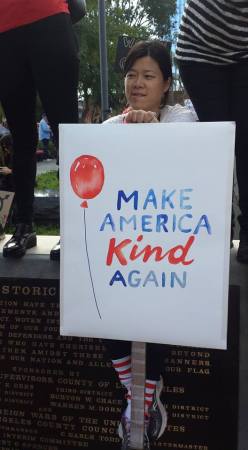
Poem: Make America Kind Again by Marie Cartier

Photo by Marie Cartier

Make America Kind Again was my favorite poster slogan of every Women’s March.

We’ve had three and will have a fourth soon, January 18. I’ll be there and hope I see this sign again.

It’s a sign that maybe it will happen –America will be kind again.

It will be a place where we don’t put kids in cages

Or gouge people’s health care

Or ban Muslims from entering our country

Or kick transgender people out of the military

Or threaten voting rights for Blacks

Or remove registered voters from the polls

Or… fill in the blank


Continue reading “Poem: Make America Kind Again by Marie Cartier”

Blinded by the White by Marcia Mount Shoop

mms headshot 2015White supremacy culture is on full display day in and day out in America.  You don’t have to strain to see it—the President’s recent comparison of the impeachment proceedings to a lynching is the latest example.


Of course, even such an extreme example is still defended by white people of all shapes and sizes: senators, voters, talking heads, and the offender himself.  The grotesquery of such a distorted perspective is emblematic of a sickness in our country to be sure.

But there are even more sinister forms of white supremacy that afflict our collective lives.  They are harder for many white people to see. And they are, therefore, harder for us to believe. This kind of whiteness is the whiteness that blinds us. This is the whiteness that creates the conditions for the extremes to be mistaken for the whole problem.  But more importantly, this is the kind of whiteness that creates the conditions for whiteness to be even more tenacious in some dangerous and annihilating ways.

Continue reading “Blinded by the White by Marcia Mount Shoop”

Temple Magdalen by Elizabeth Cunningham

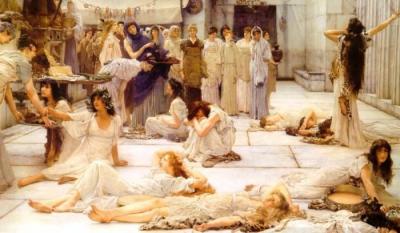
The Women of Amphissa, 1887, by Lawrence Alma-Tadema

Since I began writing for FAR in July 2012, I have written about Mary Magdalen, or excerpted a passage from one of my novels, near or on her July 22 Feast Day. For why I made the controversial choice to depict her as a prostitute, see last year’s post. The below excerpt is from The Passion of Mary Magdalen. I made this selection in remembrance of all the refugees in the world today. In this passage, Judith, a Jewish widow whose family was driven from the land by tax collectors, returns to the place where Maeve (my fictional Celtic Magdalen) and her friends have recently founded a Temple to Isis on the outskirts of Magdala. Maeve has just invited Judith to join them. (Edited for brevity.)

She stared at me, her eyes full of anger and longing.

“I will not be a slave and a whore where I was once a wife, the one who made the challah bread, who said the Sabbath prayers over it. This was our place, my husband’s and mine. We brought the best we had to the temple, the finest oil and wine, the unblemished kid—”

“Goats? You kept goats? You know how to make cheese?”

She sat quietly for a moment before she answered. “How can I live here with you?” she wondered. “I don’t understand.”

Continue reading “Temple Magdalen by Elizabeth Cunningham”

All Are Our Teachers by Elisabeth Schilling

Art by doanminh0205

What can we learn from each other? Some people teach us that we need help with boundaries. Some remind us that we are easy to love. We can observe the way some lovers make us want to escape, simmering a queasy feeling in our stomach that we practice patience and non-attachment with so that we are not harmed too much whilst in their presence and other lovers are always ready with a supportive word, assuring us that what we desire is valid, that we do not need to justify our path.

The people who we react to the most intensely, most of the time negatively, are these people our lessons? That sounds rather crass when thought to apply to anyone in an extremely oppressive and/or abusive situation. I would not suggest we apply this to anyone but ourselves, if indeed, it works for us. This is not the fatalistic idea of people belonging in a certain state or being punished for something. This is more a strategic curiosity of looking at our own agency from a back door. For example, my body might contort in frustration and sadness with someone, which could indicate I need to not be in relationship with their energies, but until I can create another path (maybe due to work commitments, relational obligations, financial situations, etc.), I feel more empowered reflecting so that I can learn about myself and others so as to perhaps not invite the same energies in during the future or to not have them affect me so harshly so that it doesn’t matter.

Continue reading “All Are Our Teachers by Elisabeth Schilling”

The Doorway Part Two by Sara Wright

When I look into his face

I wonder

what he is thinking

as he loses himself

in sweet mountain mist.

He’s alone now.

His fear of the unknown

keeps him vigilant

ears erect,

mouth tasting air

standing on two legs to see

beyond summer’s diaphanous veil.

No wonder he climbs trees.


He’s not yet two.

Did she warn him

about the others

before she left?

Two legged threats armed

with hatred,

the need to destroy life

men addicted to power,

who will gladly spew fire

through his gut,

strike out an eye, maim a paw

so he cannot flee?

Continue reading “The Doorway Part Two by Sara Wright”

If Holly Near’s Simply Love Album Were a Musical by Elisabeth Schilling

For many of us, listening to women-loving-women songs is a spiritual experience. That is because somehow it makes us feel seen, puts a sense of hope into our world as well as daydreams of romance. We can understand the challenges and the regret or guilt that comes with disappointing others and ourselves, them for not being who they wanted us to be and for us, not being who we are for far too long. Holly Near’s Simply Love album narrates a story that I might envision as a musical theatre production, and I really wish someone would ask me to write it and then hold the casting call (yeah, I’d want to be in it too, so save me a part). I offer some of my thoughts on two central songs in the would-be musical in hopes of sacred liturgy on a potential stage.

Simply Love has 28 songs and was released (according to Spotify) in 2000. I think the synopsis would be surrounding Cassandra, in a loving relationship with her partner, reflecting on her journey to this place of authenticity. I can imagine how it might be living one’s live in an exploratory way and coming to new revelations later in life.

Continue reading “If Holly Near’s Simply Love Album Were a Musical by Elisabeth Schilling”

The Tree as Mother by Mama Donna Henes

Arbor Day, Earth Day, May Day and Mother’s Day are deeply connected conceptually, etymologically, culturally and emotionally.
The tree, with its roots buried deep in the earth and its branches reaching upward toward heaven, spread wide to embrace all of eternity, is a prime symbol of life in many cultures. Trees have long been worshipped as beneficent spirits of bounty. Trees, after all, shade and feed us. Supply and sustain us. Serve us in endless ways. Trees breathe life into our lungs, the source of endless inspiration.
Possessing the potent powers of fertility, growth, resilience and longevity, the tree is widely seen as the progenitor of the world Family Tree. The Tree of Life. The tree goddess was seen as a sylph, an airy tree spirit who resides among the green leaves, sustaining and nurturing the vegetative forces. She is the symbol of the flow of life, a Mother Goddess who is Herself the Tree of Life.

Continue reading “The Tree as Mother by Mama Donna Henes”

Gift-Economy in a Time of Lack by Elisabeth Schilling

Carol Christ wrote about gift economy on this blog in 2013, and I am taken by her story of the woman who brought raisins or cracked nuts to the group even though she had very little. In beginning to encounter the literature on gift economy myself, I am wondering how it all works, especially wondering, perhaps outside of such a conversation if it doesn’t relate or misses the point, what someone who feels they have nothing to give can give.

When Genevieve Vaughan wrote about gift economy in Ms. Magazine in 1991, she wrote, “where there is enough, we can abundantly nurture others. The problem is that scarcity is usually the case, artificially created in order to maintain control, so that other-orientation becomes difficult and self-depleting.”

I think we start to look for other ways of existing when we experience the brokenness of a current existence. The exchange economy under mindless capitalism does not honor equal, fair exchanges. If we could keep from manipulating and being deceptive about what a product is worth, if we could more generously assess the contribution of workers, then some of us might not be bothered. Of course, for that work which is never compensated by money, mostly women’s work, that is the other issue that might not be solved by more equal exchange, and probably more the point of Vaughn’s.

Continue reading “Gift-Economy in a Time of Lack by Elisabeth Schilling”