The Importance of Rituals (Part 2) by Elise M. Edwards

elise-edwards

In my previous post, I wrote about the importance of rituals. The rituals of the Easter season helped me process some difficult emotions. The way that rituals mark time and demonstrate consistency has been a comfort for me when facing new challenges and settings. But I am quite aware that rituals can become empty.   In one of the comments to that post, a woman named Barbara responded, “There came a time for me when familiar and meaningful ritual no longer made sense. I had changed in understanding of what the ritual symbolized and celebrated. And haven’t found new rituals that make sense for me now…or at least I’m not aware of any.” Barbara’s remarks capture not only the loss from no longer being able to relate to existing rituals after life changes, but also the difficulty in finding or creating new rituals to take their place. I thanked Barbara for her honesty and decided that this post would continue the discussion, focusing more on discovery and creation of new rituals.

As I was preparing that post, I watched an episode of Call the Midwife that prompted me to reflect on the need to create rituals when existing ones just don’t work. Call the Midwife is a BBC-PBS show about nurses and midwives living in a convent in London’s East End at the end of the 1950s and early 1960s. The show is based on the memoirs of Jennifer Worth, and it does a better job than most primetime dramas of showing female characters’ experiences the joys and challenges of their professional lives and personal lives. As it is set in a convent with several characters who are both nuns and midwives, the show also explores the theme of vocation. What does it mean to be called to the religious life? Called to nursing? What does motherhood demand? Continue reading “The Importance of Rituals (Part 2) by Elise M. Edwards”

The Importance of Rituals by Elise M. Edwards

elise-edwardsMy sister once said about me, “One thing you have to understand about Elise—she takes the ritual of whole thing very seriously.” My sister was right and her words helped me see this quality about myself. What ritual was she talking about me taking so seriously? Happy hour on Fridays.

It was a different season of my life when she said this. I don’t have Friday happy hours regularly anymore, although I did gather with my friends nearly every week for food and drinks for many years throughout my 20s and 30s. It was often on Fridays, but at one point it was Wednesdays and then, for about a year, it was Thursday nights after a late shift at work.

More recently, I would meet a friend for crepes at the farmers’ market on Saturday mornings. Although the day and the time and specifics of these gatherings would vary, the act of setting aside a weekly time to connect with people dear to me and relax as we indulged in good food or drink was a ritual to me.

Continue reading “The Importance of Rituals by Elise M. Edwards”

O Madre Nostra Cara by Kaalii Cargill

kaalii-pic-edit

My historical novel, DAUGHTERS OF TIME, traces a line of mothers and daughters through 4000 years as they carry the way of the Goddess from ancient Sumer to the present day. In 1926, a daughter in the lineage is born in Southern Italy:

“Marias family had lived in the village and surrounding area for longer than anyone could remember. Like all the girls of her village, she grew up a Catholic, yet on Christmas Eve she gathered with the other women to perform a ritual in the Church that no man was allowed to see. The words she spoke would have been familiar to her many, many times great grandmother, Meh-tan, who once met a Queen in Ursalimmu.It did not occur to Maria that the ritual was not in keeping with the teachings of the Church; it was what her mother and all the mothers before her had done on Christmas Eve to honour the Great Mother.

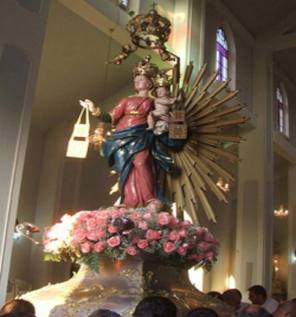
Five years after writing about my fictional Maria, I stood in the church in Calabria where my grandmother Carmella once met with the other women on Christmas Eve. And the Great Mother was still there – the Madonna del Carmine a Varapodio, whom the people call “O Madre nostra cara.”

Kargill

The transition from Goddess to Madonna is very tangible in Calabria . . . Continue reading “O Madre Nostra Cara by Kaalii Cargill”

Thanksgiving and Service by Sara Frykenberg

Sara FrykenbergGrowing up in an evangelical Christian church, I was taught that human beings should serve one another and put others before themselves.  These two different teachings, paired with patriarchal misogyny, have sometimes been very problematic for me.  I tend(ed) to give too much.  Too many demands with which I complied were self-negating (which after all, helped me to make other people more important than myself).  It took me a long time to learn how to appropriately prioritize my own needs, to stop mistaking self-esteem for the”‘sin of pride,” and how to say no when I needed to… Actually, I am still learning some of these lessons.

Conversely, my ritualized service to the church was sometimes confusing, awkward or embarrassing.  I clearly remember having the opportunity to serve as something like an usher during Thanksgiving at our family’s church as a child.  This involved wearing a pilgrim costume, which for me meant finding a Puritan style costume in the church’s closet that fit my overweight childhood frame.  This was not an easy task and left me feeling ashamed.  Later as an adolescent, my youth group asked us to wash one another’s feet as Jesus did for his disciples.  Now, don’t misunderstand me here— I do believe that this ritual has the potential to be very powerful and meaningful for those involved.  However, my teenage self could not identify with the symbolic gesture beyond realizing that:

1)    I thought touching other people’s feet was gross, as was having my dirty feet touched and,
2)    I knew I ‘should’ get something out of the ritual but did not, so I felt spiritually guilty or inadequate.

Overall, I often associated Christian service with guilt, inadequacy, my role as a daughter or woman or my sacrificial duty. Continue reading “Thanksgiving and Service by Sara Frykenberg”

An Equinoctial Ritual for Balance by Barbara Ardinger

Day and night are in balance twice a year, at the spring and fall equinoxes. (The word “equinox,” of course, comes from Latin words meaning “equal” and “night.) I think most of us will agree that balance is a good thing—after all, many of us are writing these blogs at Feminism and Religion to bring some balance to the ideas and institutions of religion. Many spiritual teachers in many faiths tell us that it’s good to bring ourselves into balance—our physical, emotional, mental, and spiritual bodies are healthier and we’re happier when they’re in balance. This is one reason we try to live healthy lives. Note that the fall equinox is also the day the sun moves into the astrological sign Libra, the symbol of which is the scale with its balance pans.

Working on achieving personal balance is a way we can act locally as we think globally. If we can get ourselves into balance, then maybe our personal balance will ripple out into our family, our extended family, our community, our church, our workplace…heck, maybe eventually into local, state, and federal governments. In this age of civil wars, terrorists, drones, and what seems like universal spying, balance is something devoutly to be wished for. And worked for. To celebrate the equinox (September 22), therefore, let’s do a modest ritual of balance. Continue reading “An Equinoctial Ritual for Balance by Barbara Ardinger”

Creating Ritual by Linn Marie Tonstad

Linn Marie TonstadLast time, we considered whether the creation of rituals, I mean habits, might serve as an antidote to depression, or as a way of managing depression. But the creation of ritual has had a much more significant role in feminist religious practice than such an approach might suggest. Currently, WATER – Women’s Alliance for Theology, Ethics, and Ritual, a leading center for feminist religious thought – creates multiple rituals marking various seasons and events in the year, most recently for the summer solstice. These rituals can provide alternative ways of marking the year’s rhythms, and they can serve as ways to take control of liturgical spaces that have tended to exclude women or to allow women to serve only in various subordinate roles.

Yet the terminology is odd. What does it mean to create a ritual? If I think of the rituals of my childhood, what presented itself to me as ritual was connected either with religious practice, or with seasons of exception. Indeed, the most stylized rituals of the year were areligious (as I understood religion). They took place on Christmas Eve. First, during the distribution of presents, my father would put on a terrifying, horrifying, grotesque Santa mask. It was intended, clearly, to be a friendly Santa, which was why its leering was so fundamentally disturbing. My sister and I would try to run away, emotionally and sometimes physically petrified by the transformation of our father into this monster. Second, after Christmas dinner, we would eat cold rice porridge with cream and try to get an almond – “mandel i grøten” in Norwegian tradition. Getting the almond, which is blanched and hidden in the porridge, is considered an auspicious omen for the new year, and requires that the finder be given a gift – traditionally, a marzipan pig. Continue reading “Creating Ritual by Linn Marie Tonstad”

Unblocking Abundance: A Ritual by Sara Frykenberg

Sara Frykenberg

Rather than release the sadness, heartache and struggle we put into the bowl out into the world, we meditated …to transform what we could of this energy, re-membering the parts of ourselves that had helped to create these blocks and are responsible for transforming them.  We took the transformed energy back into ourselves.

As I have written about many times before, I believe that contemporary Western society operates within a largely abusive paradigm.  I often think of oppression in terms of an abusive cycle.  Theologians like Cater Heyward and Rita Nakashima Brock describe the impact of the theologies that generate such abusiveness, noting how we become smaller to ourselves and smaller to one another.  We do not believe that we are enough, nor are the people or the planet around us ‘enough’ to fill the vacuous alienation that substitutes itself for real relational need in an abusive context.  Judith Shaw wrote eloquently about the environmental impact of conflating need with greed in her Friday post, “Can We Honor Inanna and Her Gifts?”

Shaw writes, “At first glance we appear to be abundant with things, energy, experiences.  But in our mad desire for more and more and always more we neglect the balance of the very earth who provides us with all.”  Many people, particularly in industrialized nations, have been taught to fill the need for a sense of abundance, connection and ‘enough-ness’ with more stuff: more things, more money, more food, more land, etc.  And yet, ironically, this quest for ‘more’ can also prevent us from experiencing the very abundance we seek.  We can create blocks to abundance by trying to fill the vacuum instead of our actual needs: and difficultly, abusive patterns and cycles can prevent us from seeing the difference between the two.  Continue reading “Unblocking Abundance: A Ritual by Sara Frykenberg”

Gratitude and Sharing: Two Fundamental Principles of Goddess Spirituality by Carol P. Christ

carol p. christThe more I practice the spirituality of the Goddess, the more I understand that earth-based spiritualities are rooted in two fundamental principles:  gratitude and sharing.  We give thanks to the earth for the gift of life. As we recognize our interdependence and interconnection in the web of life, we are moved to share what has been given to us with others. *

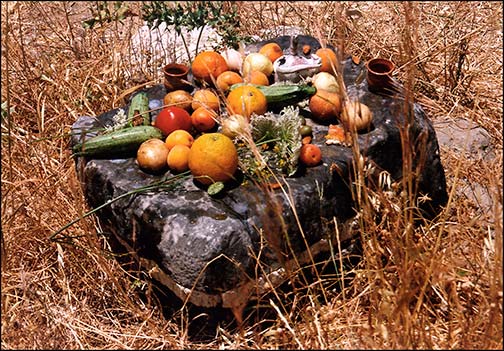
When I first began to lead Goddess Pilgrimages in Crete, I was inspired by a line in Homer to begin a pilgrimage tradition of pouring libations of milk, honey, water, and wine on ancient stones. At first I knew the form, but not its deeper meaning.  It gradually dawned on me as I thought about the large number of pouring vessels in the museums, the altar stones, and the Procession Fresco from Knossos, that an important part of Minoan rituals involved processions in which people offered first fruits back to the Mother whose body had produced them, and poured libations on altars.

kernos stone kay keys

Over twenty years of performing the ritual of pouring libations has convinced me that this was not “a” but “the” central Minoan ritual.  Its purpose is to thank Mother Earth for the bounty She has bestowed on us. Continue reading “Gratitude and Sharing: Two Fundamental Principles of Goddess Spirituality by Carol P. Christ”

Embody the Sacred – Engaging Through the Senses by Deanne Quarrie

The human body is designed to utilize all senses. We, human beings, have drifted away from our natural state through which, at one time, we engaged with all of life through our natural senses, including the intuitive.  This change has come about through our active, stress filled lives in which we seldom slow down to even appreciate what is around us.  We have ignored much of our sensory ability due to a change-over from right brain functioning, which is more imaginative, creative and intuitive, to left brain functioning, which is linear and analytical. Two of our senses are developed out of proportion to the others.  Many people grow up in an environment lacking in exposure to the natural world.  With television, computers and video games we have become residents of an indoor and often sedentary world.

In early civilization, humans and all other animals depended on finely tuned sensory awareness for survival.  We walked the Earth, using those senses for protection, to find food and to move around.  We did not just see and hear our way around but we felt, touched, tasted and smelled in order to survive. Continue reading “Embody the Sacred – Engaging Through the Senses by Deanne Quarrie”

Monthly Highlight: Mary E. Hunt

As a Catholic feminist theologian, activist, teacher, and writer Mary Hunt has made a massive impact in the field of feminism and religion.  Following the completion of her graduate education (MA, Harvard Divinity School, M.Div., Jesuit School of Theology, Ph.D., Graduate Theological Union), Mary recognized a strong need for theological, liturgical, and ethical development by and for women and responded by co-founding WATER (The Women’s Alliance for Theology, Ethics, and Water) in 1983.  Over the last 3+ decades, she has been instrumental in addressing social injustice and creating change in religion and community. Continue reading “Monthly Highlight: Mary E. Hunt”