

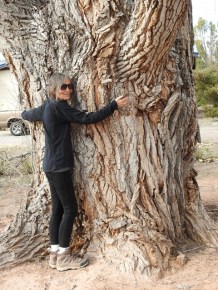
 Full Seed Moon 3/9/20
I see a beautiful fruit tree that is in full bloom with delicate pink blossoms and a man comes and attacks it violently – Oh, all the blossoms fall away, drifting tears cover the ground. Before this the little tree had bloomed “forever,” but man brought death to the blossoming tree and to the tree of life itself.
Little interpretation is necessary to understand this dream on a collective level. The Tree Holocaust is upon us. The Anthropocene is destroying more forests every second. Billions of trees. The lungs of the earth. The Beings that gift us with rain. We have less than three percent of intact forest left on this planet.
“Man” represents the age of the Anthropocene – each one of us – male or female. Every human being on this earth is complicit in tree obliteration and the terrifying violence associated with this slaughter. It’s important to note that the tree is weeping. (My sense is that the tree isn’t just weeping for being murdered but that s/he is weeping for those who would annihilate her/him). Continue reading ““Tree of Life” Dream by Sara Wright”
 I have been writing and celebrating ritual for half of my life. The equinoxes and solstices and the cross quarter days (May 1, August 1, All Hallows, and February 2) comprise the eight spokes of the year. What I have learned from my research is that virtually every Indigenous culture follows this calendar in a general way – What I have gleaned from personal experience is that during these ritual periods my body is opened to the Powers of Nature in very specific ways that can be positive or/and negative.
 I first became interested in herbalism as a young mother who kept a small herbal garden outside her back door. There is nothing better than fresh herbs to spice up any dish (as any good cook knows well) and baking my own bread, making homemade granola, etc., like gardening, was simply part of what I did. In retrospect, I see that cooking served as a highly creative endeavor that helped me to create some balance between the millions of mundane jobs associated with single motherhood and my need for creativity…
 This post follows last week’s post:
  Scientist Diana Beresford Kroeger proved that the biochemistry of humans and that of plants and trees are the same – i.e. the hormones (including serotonin) that regulate human and plant life are identical. What this means practically is that trees possess all the elements they need to develop a mind and consciousness. If mind and awareness are possibilities/probabilities then my next question isn’t absurd: Do trees have a heartbeat?
 Every morning I walk to the river in the velveteen hour between the vanishing blue night and the coming of the first scarlet, pink, lavender, purple or golden ribbons that stretch across the horizon. Sometimes clouds with heavy gray eyelids mute first light. Either way all my senses except that of sight are on high alert; a deep peace embraces me in the dark. My body knows the way. I murmur to the willows as I pass through the veil and under their bowed bridge. Their response is muted, a song beneath words.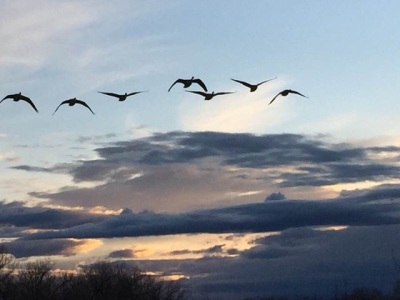
 I first discovered Rupert Sheldrake’s work by reading his first two books: “A New Science of Life” written in 1981 followed by “The Presence of the Past.” These two books changed my life because they validated my experiential reality and demonstrated that my personal experiences were located in a much larger context. I was not imagining things I felt or dreamed!
 Scientist Susan Simard is a professor of forest ecology at the University in Vancouver, British Columbia, who has been studying the below-ground fungal networks that connect trees and facilitate underground inter-tree communication and interaction. Over a period of more than thirty years this field scientist and her students have learned how fungi networks move water, carbon and nutrients such as nitrogen between and among trees as well as across species. Her research has demonstrated that these complex, symbiotic networks in our forests — at the hub of which stand what she calls the “mother trees” — mimic our own neural and social networks. This groundbreaking work on symbiotic plant communication has far-reaching implications that include developing sustainable ways to ‘manage’ forests, and to improve tree and plant resistance to pathogens. Although much of Simard’s research occurs in forests, she has also studied the underground systems of grasslands, wetlands, tundra and alpine ecosystems.
 Feminism and Religion