We Don’t Have to Live Like This by Trista Hendren

A Tribute to Carol P. Christ’s Legacy of Peace

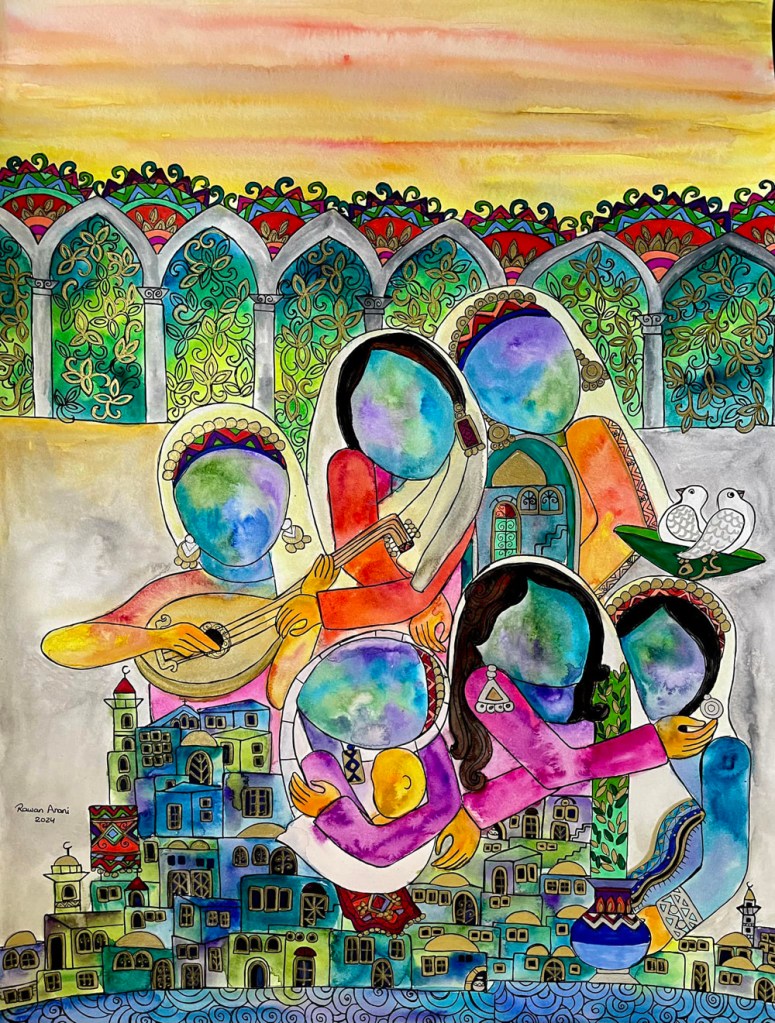
Rawan Anani, The Melody of Freedom, Gaza Palestine

Carol P. Christ was a feminist scholar and thealogian I deeply admired from afar for many years. That changed when I read her post in Feminism and Religion describing “washing wet clothes cast off by refugees who crossed the Sea of Death.”[1]

In that moment, she became a woman I connected with on a soul level. What could be more profound than washing and folding the clothing of tiny dead children? What other metaphor could be more vivid for how desperately we need to change the world?

“A tiny pink long-sleeved shirt with a boat neck, for a girl, size 3 months. 

A pair of leggings with feet, grey with pink, orange, brown, white, and blue polka-dots, to be worn over diapers.” 

The week before, she asserted that “the only ‘solution’ to the problem of people leaving their homes in fear for their lives is TO END WAR.” She continued, “No one takes this suggestion seriously enough to engage it.”[2]

I remember sitting inside the Idean cave with our Goddess Pilgrimage group when Carol read, “We Need a God Who Bleeds Now” by Ntozake Shange. I knew the poem well, but hearing Carolina read it so forcefully shook something deep inside me.

While I have had the privilege of having several wonderful female pastors, they were never particularly affirming of my womanhood—or my divinity. They certainly never celebrated my period.

Continue reading “We Don’t Have to Live Like This by Trista Hendren”

Legacy of Carol P. Christ: Women For Peace–Take To The Streets

This post was originally published on Nov. 19th, 2012

Sometimes we are told that domination and violence and war are innate in human nature; therefore, it is futile to protest war.  But this is not true.

I oppose war because I oppose all forms of power-over, domination, and violence.  As a radical feminist and ecofeminist I believe that power can and should always be power-with, the power that nurtures the growth and development of self and others.  The power of Goddess/God is always and everywhere power-with and not ever power-over. 

Are violence and domination innate in human nature?  We have been told that we are the “naked ape” descended from “apes” who, like the chimpanzees with whom we share 98% of our DNA, were male dominant and violent. Do we, then, have any hope not to be violent and dominant?

Franz de Waal’s studies of the other “ape” species that shares 98% of our DNA, the bonobo, debunks this popular myth.  The bonobo live in peaceful matriarchal clans, and their response to conflict is to rub each others’ genitals until the desire to fight goes away.  They are living proof that species very much like us can choose to “make love not war.” De Waal says that the most we can conclude from studies of our ape relatives is that ancestors of human beings, chimpanzees, and bonobos had the capacity to evolve toward dominance enforced by violence, or toward more peaceful ways of resolving conflict.

Continue reading “Legacy of Carol P. Christ: Women For Peace–Take To The Streets”

Legacy of Carol P Christ: WAR, WAR, WHAT ARE WE FIGHTING FOR?

This was originally posted Sept 16, 2013. It is sadly pertinent today

“They used chemical weapons, we must do something to stop them.”  A justification widely used in support of President Obama’s decision to launch a military strike against Syria.

We fought the Civil War to end slavery and racism. We fought the Second World War to end fascism. Did we end racism? Did we end fascism? Howard Zinn

At the time of the Revolutionary War, “a not inconsiderable Quaker element was on principle opposed to war, as itself a greater evil than any it might seek to right.”

Michelle Obama is against military intervention in Syria. Does the President dismiss Michelle’s dissent as “womanish”?

Continue reading “Legacy of Carol P Christ: WAR, WAR, WHAT ARE WE FIGHTING FOR?”

Bloody Waters by Ivy Helman

(Author’s note: I live in Prague, Czech Republic and teach at Charles University.Try as I might, I could not express in prose my thoughts about the violence in the world and particularly the violence here, in Prague, on the 21st of December, especially given the fact that I was a block away from what took place. So, I have written a poem instead.)

I swim through
the slimy waters of patriarchal violence
Difficult to express in words
the anxieties, the fear, the sadness
I feel as I take another stroke

towards

the parshah Bo (Exodus 10:1-13:6),
a divinely wrought plague of locusts
devouring all in their path.

Breathe,
stroke.

Darkness lasting three long days
blood smeared on doorposts and lintels
the deaths of first-borns, humans and animals alike,
the proclamation of a New Year and its festivities
to remind us of such nonsensical violence.

Breathe.
There is blood in the water.
Stroke.

Continue reading “Bloody Waters by Ivy Helman”

Matot-Massei: The Question of Women’s Agency and Lives under Patriarchy.

The Torah portion for July 15th is the double-portion, Matot-Massei  (Bamidbar/Numbers 30:2-36:13).  Matot, meaning tribes, runs from Numbers 30:2 to 32:42 and covers vow making as well as what the spoils of war with the Midianites are.  Massei, or journeys, is Numbers 33:1 to 36:13 and describes the Israelites journey through the desert after fleeing Egypt and the boundaries of the Promised Land.  While Matot-Massei have so much that could be discussed including war, images for the deity, and cities of refuge, this post focuses on their women. 

There are three occasions where women are specifically mentioned.  The first concerns vows and their atonement when broken.  Next, women are discussed as spoils of war.  Finally, Matot-Massei describes what to do with inheritance when there are only daughters. 

Continue reading “Matot-Massei: The Question of Women’s Agency and Lives under Patriarchy.”

The Patriarchal Dilemma by Janet Maika’i Rudolph

I was listening to a newscast when it was reported that the Ukraine sent missiles into Russia. My initial thought was “it’s about time they took it to the Russians.” The next moment I was horrified at myself.  I am a pacifist.  I think the proliferation of weapons is one of humankind’s great evils and here I was cheering on an attack.  One that could escalate an already nasty war, lead to nuclear weapons use and possibly even a world war. And yet when I look at what is happening in Ukraine, my mind simply can’t comprehend what the people are going through. The trauma of the children cuts particularly deeply. And I can see no sane reason behind the strikes other than rank cruelty.

There it is in a nutshell, what I have come to call the patriarchal dilemma. It’s a no-win situation with no right answer. While life might place us in such positions all on its own, the patriarchal form of this is created by design. It is nasty, it is cruel, and loss of human life and ecological destruction are not glitches but features.

Continue reading “The Patriarchal Dilemma by Janet Maika’i Rudolph”

From the Archives: Abortion–the topic that won’t go away–or even morph

This was originally posted on March 12, 2014. It was Esther’s first FAR post.

Recently, I got involved in a conversation about abortion.  It happened on Facebook when a relative posted that her heart hurts when she considers her “sweet baby girl” and how the law (Roe v. Wade, 1973) in the United States gave her the choice as to “whether [or not] I would have her killed.”  She’s sincere.  Many of her friends “liked” her post and, with few exceptions, commented in agreement.  I was one of the exceptions.

March celebrates Women’s History Month–a month to remember the accomplishments of our foremothers, noting their work helping to secure for us (their progeny) certain rights, most notably the right to vote (Elizabeth Cady Stanton, 1815-1902) and reproductive rights (Margaret Sanger, 1879-1966).  Support for abortion nowadays almost always falls under the rubric of “women’s reproductive rights.”  So when we hear, “It’s my body and I’ll decide what I’ll do with my own body,” the speaker is giving voice to what many consider to be a fundamental right–the right to be autonomous and exercise free agency over one’s own person.

Continue reading “From the Archives: Abortion–the topic that won’t go away–or even morph”

Patriarchy and the Supreme Court by Janet Maika’i Rudolph

I am pissed! I wrote this blogpost the day after Beltane when the leaked draft of the Supreme Court majority opinion regarding Roe v. Wade was leaked to the public. I was up anyway feeling the effects of PTSD. Lessons that Carol P. Christ wrote about and brought to my own consciousness were rattling around my head. The first is her definition of patriarchy: “patriarchy is a system of male domination in which men dominate women through the control of female sexuality with the intent of passing property to male heirs.” This definition was part of a 3-part series she wrote (and we recently re-posed in her legacy posts) beginning here.

They are all well worth reading.

I was raped in 1977 when I was 22 years old. This after being abused by my father. I never got pregnant, but I was suicidal after the rape. Had I been pregnant without recourse to ending it, I would without a doubt have stabbed myself in the stomach or reached for that metal coat hanger. (I was too young to face pregnancy when my father abused me.) Had the result been my own death, that would have been warmly welcomed on my part. To this day, I still self-mutilate at times when stress becomes too much.    

Continue reading “Patriarchy and the Supreme Court by Janet Maika’i Rudolph”

Tzav: Holiness, the Situation in Ukraine, and Eating Animals by Ivy Helman

The parshah for this upcoming Shabbat is Tzav (Leviticus 6:1-8:36).  It details the investiture of Aaron and his sons into the priesthood and lays out the basics of various offerings (mostly, although not exclusively, animal sacrifices) and the rules regarding the eating of them.  As I’ve mentioned before on this site, I would like to complete at least one commentary on each parshah of the Torah.  Yet, there are only so many times that one can question the establishment of the temple, condemn animal sacrifice, and denounce the absence of women.  Yet, as we approach another Torah portion this week, Tzav , this is more or less what we have.  So, what do we do?

Tzav starts, as parshot from the book of Leviticus often do, with descriptions of various laws.  Here, the laws focus on various offerings including the grain, sin, peace, thanksgiving, and burnt.  Only the male members of Aaron’s family can eat the offerings.  Consumption of the offering increases the holiness of the consumer as long as the eating of the animals falls into the guidelines outlined within the text.  

The parshah ends with an explanation of how to consecrate Aaron and his sons.  The process lasts a total of seven days.  It includes residing at the entrance to the tent for the duration, offering various animals as sacrifices, eating copious amounts of said animals, the donning of specific ritual clothing, and multiple anointings of the men and the altar (often with blood).   

Continue reading “Tzav: Holiness, the Situation in Ukraine, and Eating Animals by Ivy Helman”

The Treasures of Vayishlach by Ivy Helman

The Torah portion to be read this Shabbat is Vayishlach (Genesis 32:4-36:43).  It contains the reunion between Jacob and Esau, the twice-renaming of Jacob to Israel, events relating to Dinah, the mass murder of all of the male inhabitants of Shechem, the birth of Benjamin, the death of Rachel in childbirth, the death from old-age of Isaac, and a long list of the descendants of Esau.  Like every blog, there is too much material on which to comment.  Therefore, I will focus on three examples.  Each of these examples in their own way turns expectations or aspects of the Torah on their heads.   

First, we have the way in which Jacob wholeheartedly avoids war.  This is despite the fact that, in the Torah, war is demanded, normalized, or doled out as a form of punishment.  Rarely does fear factored into the Torah’s discussions of war, yet this parshah starts with Jacob’s fears about war: his brother Esau is going to start a war with him.  To avert this war, Jacob sends, in advance of their meeting, large quantities of gifts, mainly in the form of animals.  In addition, as he approaches his brother, he prostrates himself on the ground seven times.  

Continue reading “The Treasures of Vayishlach by Ivy Helman”