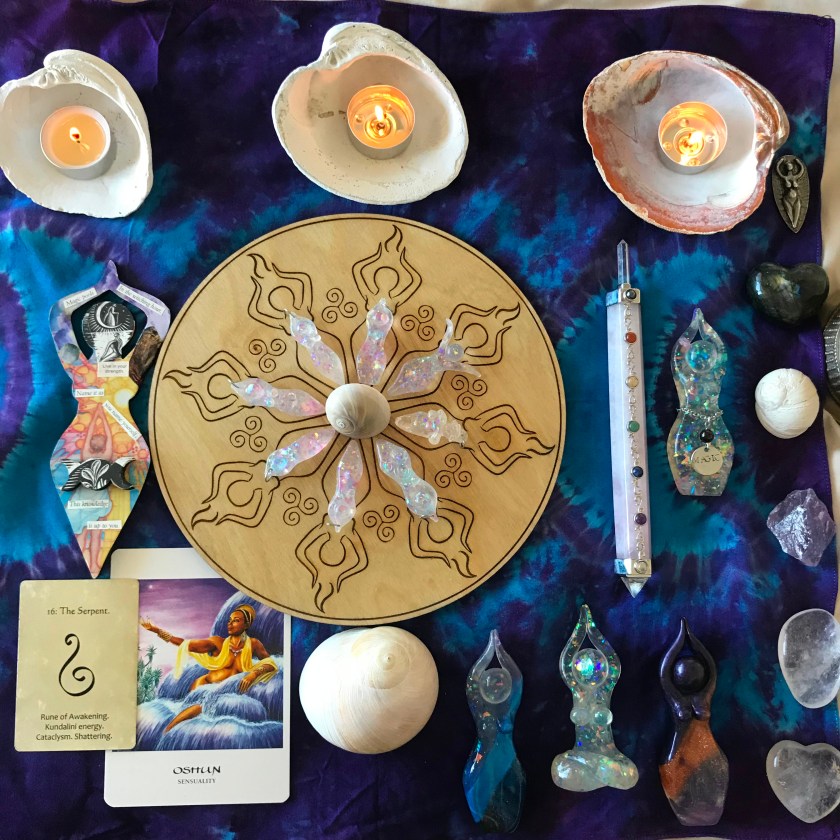
It is February, the belly of winter. We stand in the doorway between worlds, a thin, pale light ahead of us, just beginning to gather itself at the horizon. While life may feel still and inspiration frozen, something in us is listening for the first faint whispers of spring. In earth-centered, neopagan spiritual traditions drawing inspiration from old Celtic holidays, the holiday of Imbolc is on February 1-2. Imbolc is based on an old Irish word that means “in the belly.” One of my favorite reminders to myself at any time of year, not just February, is to cradle myself in the belly of the moment.* To be in the belly reminds us that we need not be focused on arriving or figuring it all out, instead we incubate, we gestate, we draw nourishment from deep within. We do not have to be ready. We are becoming. We are in the belly of winter, and the work of the belly is to hold, to warm, to nourish what is not yet visible.
In the middle of winter as well as in the middle of national crises, international conflict, and climate disaster, the world can feel grim and gray, and like hope and optimism are misplaced or even extinguished. We may feel burned out, used up, or simply too tired to offer anything of value.
A Prayer for Solstice Winter’s Crone, cave tender, cauldron keeper, mother of time, guide us into stillness, into a time of deep rest and reflection. Unwind our knots and soothe our scurrying, remind us how to listen, how to be still, how to turn inward and know. Remind us not to fear darkness for it is a time of necessary patience and growth. Help us to celebrate the cycles of change through which we move, honoring the fallow times and the flourishing times as equally essential for life. Bone woman, great mother of us all, quiet our wondering and our worries, gentle our grief, and soften our sorrow. Restore our weary hearts and renew our spirits that we might turn towards the light we carry within and warm ourselves by this, life’s eternal and powerful flame, knowing that we belong to this great grand web of incarnation and all it holds.
Yes, it is December
already and again.
Let yourself notice the milkweed pods,
how they have split their sides
and are sending silky white seed fluffs
into the waiting air.
Witness the trees,
bare and gray and patient.
Yes, it is December already and again. Let yourself notice the milkweed pods, how they have split their sides and are sending silky white seed fluffs into the waiting air. Witness the trees, bare and gray and patient. Watch the squirrels, tails puffed against the chill, stored nuts in their cheeks. Listen to the wind how it whispers and rattles through the empty branches. Watch the clouds, slow-moving white billows in a pale blue sky. Be patient with yourself. Grant yourself grace. Remember the three invitations of the solstice season: to listen, to wonder, to be content. Remember your promise to keep company with joy. Remember your vow to be in devotion to your own life. Think about everything there is to do. Open your hands. Feel that thin, whispering winter wind skim over your palms. Take a deep breath. Allow yourself to marvel at all this year has held. Bless it. Thank it. Cup your hands around your own face. Say: thank you. Here you are in the center of your own life’s unfolding. There is nowhere else to be. Be gentle with yourself. Invite the winter crone to tea. Look into her eyes. See yourself reflected there, your own winter eyes open to the possibility of both clarity and delight.
I have been writing for Feminism and Religion for 13 years. In the summer, I compiled a post with 13 summer lessons from 13 years of posts here at FAR. I decided to bookend that post with a Winter Lessons post as well. Here are thirteen lessons to share from past winter posts:
Step by step,
we make our way.
Breath by breath,
we choose.
Day by day,
we see where we are.
Let us remember
that we do not really finish anything,
we tumble with the turning
which is right where we belong.
It is now in this liminal space between the cauldron and the cave, as obligation struggles to come roaring back into center, that we sense what we truly need whispering beneath the surface of all that clamors to co-opt our time and all that howls to claim our attention. Stand steady. Inhabit your own wholeness. Cast a one word spell of power: return. Step into the sacred right where you are. Re-collect yourself. Reclaim your right to your own life. Defend your edges. Give clarity space to crystallize and your own knowing space to emerge. It is vital, this work of reclamation. Hold it holy. Let the knots unravel. Set yourself free.
Let us be gentle with ourselves as we cross the threshold into summer, as we both open our hearts to change and open our hands to choice. It is now that we both let things go and celebrate what is flourishing, what is thriving and growing and calling us onward. Let us be soft and supple, luminous and languorous. Let us practice the discipline of pleasure and the liturgy of delight. Let us protect wide margins for magic, commit to our own life’s unfolding and swim freely in the current of the sacred that is always available to receive us and welcome us home.
Today, I sit missing the orioles and thinking about cycles of change, how things grow and decline, and how we can choose to be present or not with what we see and feel. I tip my head back in the green filtered light of morning and discover berries beginning on the mulberry trees. The wild raspberries and blackberries too are tipped with small, firm caps of green. I am feeling the sort of overdue clarity that descends when I finally realize I can let something go, that not everything is mine to carry or mine to fix. I know that this clarity too will come and go, but for now, I welcome it, feeling the cool wind stirring my hair and brushing my shoulders as I enjoy the sunshine and the sound of hawks on the wing. There is a powerful hope in these blue sky days and for now, I bask in the sensation of both remembering and reclamation.
This year, as we tip into summer in the Northern hemisphere, the temperatures in my own Midwestern biome have been surprisingly cool, peaceful and rainy. In an era of climate change, this slow entry into the heat of the year has felt welcome and encouraging. Something that continues to inspire and teach me this year has been to start where my feet are, to return again and again to where I am on this earth and in my body. In a culture that encourages fragmentation and distraction, distance, discord, and dis-embodiment, this practice of return is an act of both rebellion and reclamation.
I have been writing for Feminism and Religion for 13 years. This year, sitting down to write and reflecting on the life lesson of starting where my feet are, I decided to go back through my past summer posts here to discover the other lessons I have learned from summers gone by. I chose thirteen lessons to share from past summer posts:
How to create a ritual:
Look at the sky.
Touch your skin.
Breathe deep in your belly.
Feel your heart beat.
Stand on the earth.
Let life carry you.
How to create a ritual: Look at the sky. Touch your skin. Breathe deep in your belly. Feel your heart beat. Stand on the earth. Let life carry you.
September 2024:
It is now that slender bush clover makes flower crowns along the roadside and coreopsis lifts its yellow faces to the sky. There is change in the air, whispering on cooling winds and shrieking by above the field on the feathers of broad-winged hawks. The last cicadas continue to drone and the apples hang rosy on the trees. The deck bears a sprinkling of yellow walnut leaves, and I picked up a brown and green patterned oak leaf to press into the pages of my prayers. It is now that I pause to steep, to listen to myself before pressing onward into the final part of the year. There is both an invitation and a summons here, to evaluate and renew, to consider the pace of life and whether to ease off or push onward. It is now that I remember that restoration is the antidote to depletion and I gather myself up, tenderly calling the fragments home, recollecting myself and taking time to look at where I am and what I have and what I’ve chosen. There are crows calling at the end of the driveway. I keep my eyes open for any passing monarchs. There is a slight hint of spiced pumpkin on the wind. The Virginia creeper has darkened to rusty red.
The editor of this anthology, Anne Wilson Schaef, goes on to say:
“When we do stop, many times we look around and realize that we are the only ones rushing around. We realize that the roses, the trees, even the clouds seems suspended in space, and it is as if the universe has paused for a breather. Life has time to experience itself.
Often, when we stop and let ourselves take in the beauty that is around us, we realize there is much more than we originally imagined. Our eyes begin to see beauty in the cracks in the sidewalk, the crookedness of tree limbs, the cragginess of faces, even the color of cars.
We don’t have to travel to see beauty. It is everywhere.
How much more alive we are when we can feel those times that the earth has ‘stopped in astonishment at its own beauty.’”
Do you have time for beauty? When was the last time you stopped in astonishment? What is astonishing you lately? Where are you discovering beauty?
Today the hawk is back, tail feathers lit gold and black by a bright and welcome sun. It stays only a moment before tilting out of the tree and continuing on its way, but this moment is enough to spark a sense of joy and wonder in my chest, the awake kind of glee that fuels and feeds me, that inspires and holds me. This feels like the Year of the Hawk to me, of clear focus and intentional commitment. I watch it glide away between the trees and take a deep breath of release and freedom. I re-center myself into my body and reconnect to the sacred What Is. I am open to clarity. I am open to trust. I am present with this day’s unfolding.
The wheel of the year continues turning and once again we find ourselves at the transition point from winter’s deep sleep to the first awakenings of spring. It is marked by an ancient Celtic festival called Imbolc, also known as Imbolg or Brigid’s day. It is believed to have been celebrated long before the Celts arrived in Ireland and Scotland, probably as far back as Neolithic times.
In the past months, Luiza has been generous enough to introduce me to some local folk festivals that celebrate key moments in the wheel of the solar and agricultural year. With their deep Earth-based roots, these festivals have endured under an overlay of Catholic observance and are integrated into the calendar of saints’ feast days in the liturgical year. Underlying established religious observance, there is an unbroken stream of syncretized folk religion and folk practices that connect the people to the heartbeat of the numinous Earth on which they live.
Unfortunately, since I moved to the Oeste region of Portugal in July 2020, the Covid pandemic has seen many of the local festas temporarily canceled, but as 98% of the local population is now triple-vaccinated, we’re seeing a slow resurgence of these gatherings.
Usseira, the farming and fruit-growing village where I live, has an annual festival of Santa Luzia, held between December 7 to 13 in most normal years. During the height of Covid, the festivities were canceled, but in December 2021 the festa was celebrated, although it was a much smaller, more low-key affair than before the pandemic.
Celebrating Santa Luzia in 2019, before the pandemic.
We gathered at night in front of our small chapel dedicated to Santa Luzia, our village’s patron saint. An enormous bonfire was lit and people gathered around to share grilled meat and sardines, prepared on site. Much local wine was passed around. Nobody officially charged money for anything. You just donated what seemed fair.
Gathering in the light and warmth of the enormous bonfire with my Portuguese neighbors and trying my best to communicate with my limited Portuguese was a challenge, but the universal language we all spoke was happiness and goodwill. The bonfire blazing on the dark winter night seemed symbolic of a sense of community life returning after the constrictions of lockdown and social isolation.
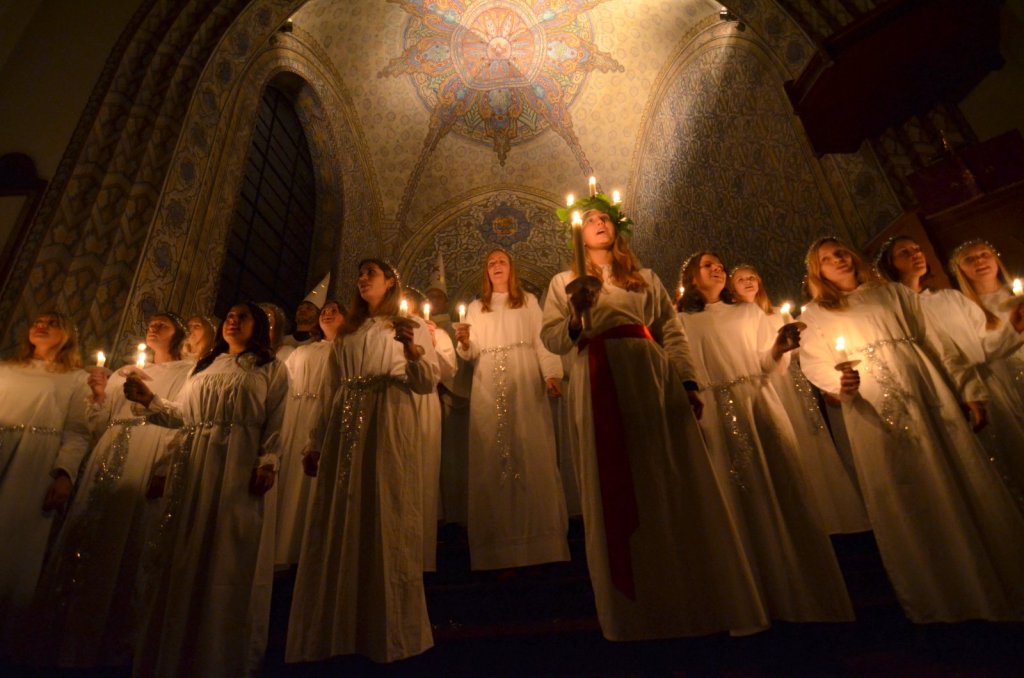
The root of Luzia’s name is luz, which means light. Across Europe, from Scandinavia to Sicily, Saint Lucia is honored as a bringer of light to the midwinter darkness. Luiza Frazão explained that before the Gregorian calendar reform altered the old Julian calendar, Luzia’s feast fell directly upon the Winter Solstice. John Donne’s 1627 poem “A Nocturnal upon St. Lucia’s Day, being the shortest day” bears witness to this fact—the Gregorian calendar wasn’t adopted in Britain until the 18th century!
Celebrating Santa Lucia in Sweden
Meanwhile, back in Portugal, Luiza and I met again around one month later, on January 17 for the Festa of Santo Antão, traditionally celebrated in an old hermit’s chapel on a hill outside the medieval town of Óbidos. This festa is traditionally a very large gathering, attracting thousands of people from far and wide in what the newspaper Caldas Gazeta describes as a pilgrimage for Christians and Pagans.
The Festa of Santo Antão in January 2020, before lockdown and all the rest
This festa, which is celebrated in the daylight, comes around the time of Imbolc in the old Julian calendar, Luiza explained. It celebrates the steadily increasing daylight and the promise of spring and new growth. It is also a feast focused on healing and blessing the animals that are so important in rural communities.
Santo Antão was a hermit who lived in the Egyptian desert. He is the patron saint and protector of animals. In the old days, farmers would bring their livestock to be blessed at this festa. But nowadays people are offered special blessed ribbons to take home to their animals. Traditionally a Mass is held in the chapel and there’s a market on the hilltop. However, in January 2022, the festa was officially canceled due to a spike in Covid infections. But that didn’t stop people hiking up the hill in small groups.
Our small group shared a picnic of the traditional grilled sausage along with halloumi, since I’m vegetarian. We lit candles outside the locked chapel and then raced down to Óbidos to get our blessed ribbons from the Church of Saint Peter before they closed at 5pm. As we left the hilltop, other people were hiking up with their picnic baskets and wine bottles. In previous years, the celebrations continued until early the following morning.
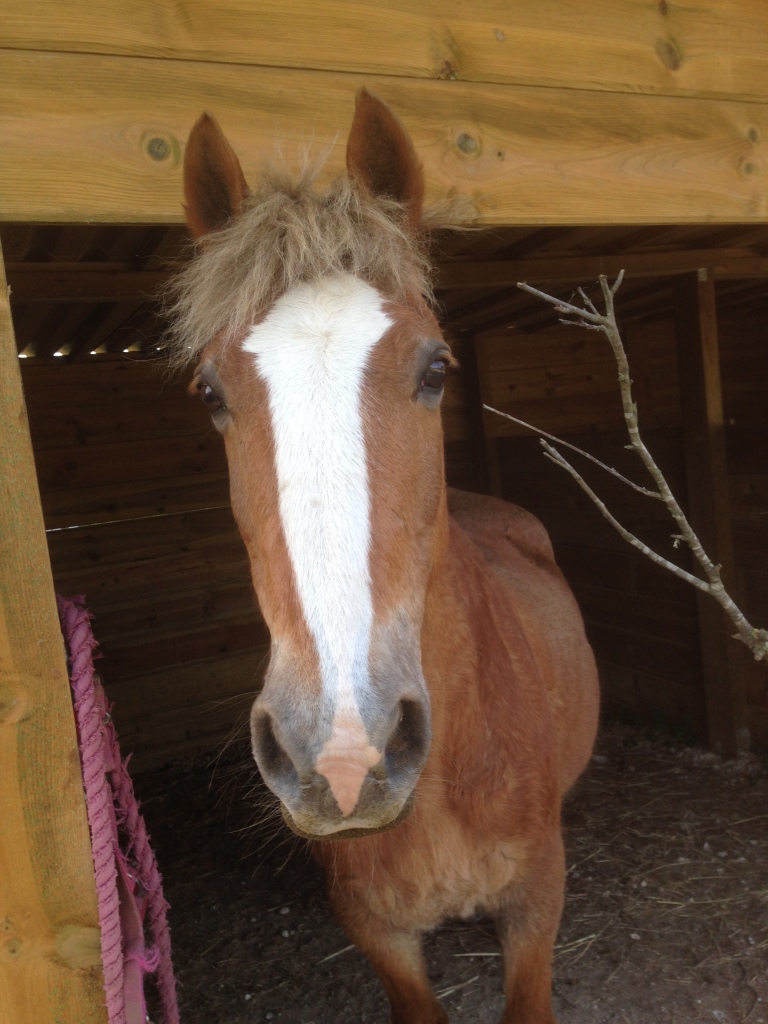
When we reached the church in Óbidos, five minutes before closing, I took two ribbons for my horses in exchange for a small donation. Back at home, I tied the pink ribbons in the horses’ manes, but the beasts had other ideas and rolled in the mud. So I rescued the ribbons and tied them to the field shelter instead.
Protected!!!
As the Spring Equinox approaches, I look forward to discovering more local festas.
Mary Sharratt is committed to telling women’s stories. Please check out her acclaimed novel Illuminations, drawn from the dramatic life of Hildegard von Bingen, and her new novelRevelations, about the mystical pilgrim Margery Kempe and her friendship with Julian of Norwich. Visit her website.





 Feminism and Religion