

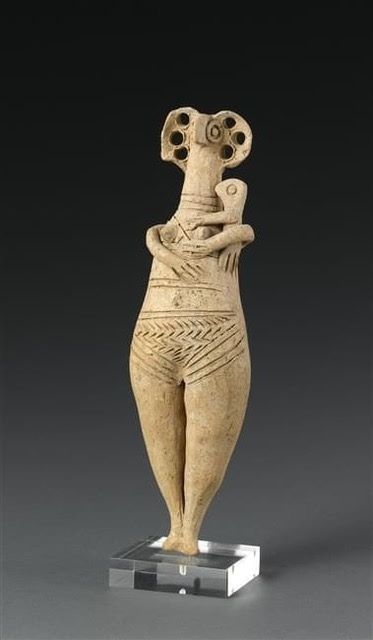
Bird migration has peaked. I am hearing less mating songs as the birds who are staying nest around the house, although in the deep forests the warblers’ poignant songs are still tearing my heart out. The two phoebes who nest above my door are busy preparing home. Just yesterday I found the most beautiful goddess image, one that I have not seen before, a Lebanese goddess figure dated 16-1400 BCE that seemed to embody the birthing and nurturing aspect of the goddess, women and birds…
Now I turn to wildflowers. I have finished transplanting more wild violets, lily of the valley and some pulmonaria and my rain barrels are already dry. The drought has begun. Because I no longer garden during the summer months, I am especially attached to all the wildflowers that cover the ground around my house popping up day after day. I want to be everywhere at once!
Last weekend I spent roaming through one of my favorite forests… I saw delicate starlike painted trillium with deep rose centers and dark crimson stems in the lowlands and highlands – it didn’t seem to matter (T. undulate). I have never seen a miniscule two – inch painted trillium until last Sunday. I couldn’t believe my eyes. I visit these areas every May but this year I was stunned by the masses of flowers I encountered including the trillium. I wondered if the flood had brought enough moisture before run off to produce so many wildflowers (the only rain we have had this spring lasted five days)? The dark purple trilliums (T. erectum) are usually the first to appear at least here at home but last weekend I found one near a seep that was two and a half feet high in deep forest. The biggest I have ever seen. Curiously, these purple trilliums attract pollinators in an unusual way. They do not produce nectar like the others I mention but rely on a rotten meat smell to attract pollinators who happened to be flies! I’ve seen bumblebees pollinating Grandifloras and the Painted trilliums are also pollinated by wild bees and other insects. The Bee Goddess still lives…

Here at home, I have three kinds of trillium two of which appeared by themselves. Grandiflora, the beautiful large white trillium I discovered about 30 years ago in an old, abandoned farmhouse near my home. There was a carpet of hundreds – maybe thousands – and so I thought it safe to take one plant. When it took so happily to its new habitat on my property, I went back two years later to dig two more. Too late. I was absolutely horrified to discover the whole area had been bulldozed that spring. Shades of the future were looming even then …
The Great White trilliums spread very slowly underground by rootstocks as do other trilliums. The seed produced (and all trilliums produce only one seed) will not bloom for five to ten years. From my field experience I have learned that all trilliums require some filtered morning or afternoon sun. Purple trilliums gravitate to lowlands. One fascinating aspect of this burgundy flower is that the single seed produced will be distributed by ants (or even mice). When the seed becomes sticky and mushy after falling to earth, the ants have a feast, depositing the waste in their garbage bins underground where the seed germinates in the richest soil! Ants don’t travel far, and this is probably one of the reasons we often find one species clustered together in somewhat haphazard drifts. These days except for my property I find all trilliums in rich deciduous and mixed protected forests – forests that have not been disturbed since the logging machine took over about 40 years ago putting hard working loggers who cared about their trees out of business.
What I love the most about these plants is that every part comes in threes. Three leaves, three petals, three sepals. With the flower standing up at the center of a whirl of leaves. Neolithic peoples (8000 BCE) considered three lobed flowers to signify a goddess in her spring aspect because every part of the flower repeats the number three – a sacred number for the ancient goddess. I lean into this myth because trilliums are one of the earliest spring woodland flowers. And if there was ever a time to celebrate the Great Mother in her blossoming or maiden stage it is in the spring…
According to the U.S. Forest Service from a morphological standpoint, trillium plants produce no true leaves or stems above ground. The stem is just an extension of the horizonal rhizome that produce tiny scale-like leaves. The above – ground plant is technically a flowering scape, and the leaf -like structures are bracts that underly the flower. All photosynthesize behaving as leaves.
Although trilliums are blooming earlier in the season it is still possible to enter protected forests where the soil has not been disturbed to find these glorious ephemerals throughout this month and early into June at least in northern climates…
Because trilliums take so long to produce a flower if you pick even one you are destroying the possibility of a seed finding home, so please enjoy but do not pick the trillium or any other wildflower because we are losing them all.
One day after this destructive age is spent, I believe there will be new wildflowers as the Earth rises out of the ashes of human destruction. Our Goddess will rise again.
Discover more from Feminism and Religion
Subscribe to get the latest posts sent to your email.

 Feminism and Religion
Praise her!
LikeLiked by 1 person
There was a time when we learned about nature in UK junior schools. We went on nature walks and prepared classroom nature tables. My mother had already taught me the names of some of the local wildflowers and I saved pocket money to buy an Observer Book to identify those I didn’t know. I remember a member of the British National Trust saying in a television interview that children need to be encouraged to embrace and understand nature because it’s impossible to really care about something we don’t interact with. All this technology and virtual living need to be balanced with the reality of the organic world. I would like to see parks and gardens given more importance in urban environments. The wild world is our soul and flowers represent for me the beauty and light in the earth. I agree with MiamiMagus that we must elevate and praise the Goddess. Sara your contribution to our Earth is inspirational.
LikeLiked by 1 person
Oh you are so right! “The wild world is our soul and flowers represent for me the beauty and light in the earth.”There was a time when we developed relationships with nature instead of using her as a commodity – without relationship nature remains the “Other”.
Just for that reason every single morning I post something on FB about my relationship with nature and include pictures – hoping to hook someone into seeing.
Here is my post – almost no one reads them but I keep trying…
LikeLike
When I was growing up in Michigan, my grandmother taught me that all wildflowers were to be treasured, but to find a trillium in the woods was a special gift, an almost magical, mystical experience and we were to never, ever touch one for fear of damaging it. I think part of it is just, as you say, that they take so long to bloom, which teaches us patience, and if you pick a flower you take away its one seed. But I agree that there is something about the threeness of trilliums that immediately connect us to the spirit of spring. Here is Massachusetts they are just as treasured by those who love wildflowers and finding one in the wild still gives me the same thrill many decades later. Bringing Goddess into our lives can sometimes seem abstract if we mostly read about Her in books, but when you sit next to a trillium, She is right there.
LikeLiked by 1 person
Yes to the mystical qualities of trillium Carolyn….you know the goddess never seems abstract to me – not until winter – then? well I have my little terrarium but I really need the other three seasons to feel her presence. Thanks.
LikeLike