

“If this isn’t the manifestation of the Great Goddess Greening the Earth I don’t know what is.” – Sara
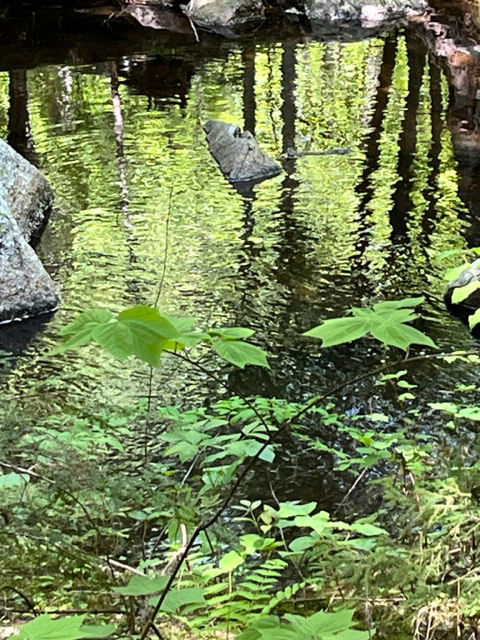
Time stretches, folds back on herself as I gaze out the window squared by the four directions. A slanted sun glows golden green in early twilight. How comforting to see the trees rotting on the ground and new green wrapped all around me like a cape. The hemlock branches are almost black against the sun that sets early in the gorge. The phoebes are still – a few leaves flutter – lemon lime emerald – we haven’t names for all the impossible hues of green. I am suspended. All thought disappears into shadowy sheltering hemlock and pine against a darkening sky – the day is fading into twilight…. To be steeped in green is to be blessed by the trees who will get to live out their lives as Nature intended because of the people who cared enough to save these forests – a gift for all who see…. Beyond the window a steep gorge has sprung to life – jewelweed and oxalis bubbling out of stone. Crystalline water flows down the hillside…It is clear to me why springs were experienced as holy places. The crisscrossing of downed trees fallen under wind and winter weather is nourishing the next generation of seedlings. Fallen birches send anti- bacterial mycorrhizal mycelial fungal threads to protect other trees and plants from disease. We know almost nothing except that the skin of this precious earth holds the seeds of new life. No wonder I can sleep…\
The last week in May is betwixt and between the first showering white stars and the burst of wild lavender blue. A flush of fragile wild columbine and corydalis spring up along the ledges of the mountain. Tiny white marsh violets appear in clusters here and there in the lowlands where I stay. Around me emerald is all I see. Along the road (recovering from logging devastation) young elderberry bushes appear among unfurling gray green ferns. Wild sarsaparilla is burnished almost dark crimson.
How easy it is to miss this time. In a week most of the understory will become an impossible joyful tangle of summer greens. Parting the veil, I enter the forest in light rain. The river is low. Green is reflected by gray skies and crystalline seeps streaming into a river of stones. One day these ledges and river stones will become specks of sand…
A swallowtail dips and soars into the understory. One mourning cloak too. Who might these two might be visiting? Only a couple of bumblebees are around. Most other bees avoid wet weather. A few anemones might be calling, starflowers too? The canopy overhead protects me from the raindrops that create widening circles in the still pools left behind when the water level dropped so low. An American toad hops across the path; almost invisible he is that well camouflaged. A Blackburnian warbler converses with an Ovenbird. Red eyed vireos and common yellowthroats – witchitu witchitu – provide musical accompaniment.
I keep my eye out for a particular fern that I don’t see anywhere. I hoped to take another look at yesterday’s astonishing find – an old, tarred pole lying on the ground sprouted unusual lacy ferns that I have only seen in the small terrarium that I created out of bits of this place. The pole is also festooned with red tipped moss, sheet moss, and two kinds of lichens, the very first plants to colonize dry land maybe 400 million year ago. That these plants including the ferns managed begin new life despite the poisoned tar demonstrates the power of nature to heal human devastation over time. However, this remark must be tempered by the powers of place; this is cherished protected land where burgeoning life has a chance. If only we hadn’t destroyed so much forest before we ran out of time. Now integrity demands that we must save what little is left.
I spy a cluster of blooming Starflowers, a few painted Trillium left over from the hundreds I saw last week capture my attention. Bluebead lilies and Indian cucumbers are not yet in bloom, but masses of wintergreen and partridge berry creep towards the river, or climb old moss covered tree stumps bursting with seedlings and lichens. Wild oats droop with pale bells gathering in convocation. I note a couple of twisted stalks on the hill. Lime green lungwort hugs a large maple near the water’s edge. This lichen is so sensitive to pollution that it is disappearing. Crushed lady slippers broken by blind feet before blooming sadden me. It will be years before they blossom again. Trailing arbutus is sinking into the ground now that its fragrant flowers have passed by. Giant ostrich Ferns are unfurling with all the others, and I am keenly aware of the roots of trees under each step I take… always wondering who supports who and by what means – nitrogen and carbon surely, water too, other nutrients, but only the fungus knows for sure. I peel back a small piece from a pine stump to gaze at extraordinary white threadlike patterning, replacing the bark gently. The workings of the mycelial network are a source of mystery to humans including me. We do not know how nature works, just that every twig and root is in some relationship with another or others.
Only under hemlocks does the earth seem relatively bare, with the hobblebush spreading her ribbed almond shaped leaves to cover moist earth S/he spreads underground. Hemlocks are a foundational tree that mediate flooding and keep the rivers full of trout because of her/his ability to keep the forest’s brooks and streams cool. These trees are healthy because they are part of a biome that has been left alone for more than forty years. I spend time between a hemlock and yellow birch whose roots are still visibly entwined in conversation because the flood tore away topsoil. Mosses hug stream edges. Gray tree frogs are still trilling but not as poignantly as they did the week before.
We carry the spirit and soul of the river in our bodies. Is this why rivers streams and oceans are always calling us to them? Is this the way home?
All I know is that here by this most beloved river I can smell the intoxicating scent of ongoing birth, death, birth, Nature in the Round…
Turning Stone to Sand
Soft gray skies
rising sun
a starburst
shimmering leaf green
clouds move in
tree frogs trill
phoebe sings love songs
unlike the fern
unfurling
I am
frozen
a tight spiral
petrified
shell
or stone.
Shamans bridge
the Night Flow
Magic birds do bind
Swift rivers sound
smooth jagged edges
craft sparkling sand
Nature lives in the Round
Discover more from Feminism and Religion
Subscribe to get the latest posts sent to your email.

 Feminism and Religion
The entire article is a poem! Thank you for so much beauty and honoring of our Mother.
LikeLike
Thank you!
LikeLike
So many beautiful images Sara. I had a home not far from the River Thames in London and now I live by the sea in Wales. I remember Elrond saying how the sea was calling the elves home, at the end of the Lord of the Rings trilogy, and how much I relate to that – it’s like a call to the soul when a life chapter closes. Thanks for reminding me.
LikeLiked by 2 people
Thank you so much
LikeLike
You do such a beautiful job of describing the woods and everything in them! I’m very sorry about the lady slippers. I had one in the woods behind my house but when I went to show it to a visitor it wasn’t there. I guess it was eaten. I haven’t seen one since.
LikeLike