

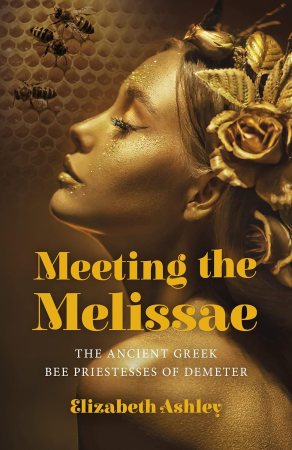
The Mysteries at Eleusis, a nine-day festival in ancient Greece based on the myth of Demeter and Persephone, has fascinated and baffled us for millennia. Here thousands of people from all over Greece and beyond came to understand, in the words of Plutarch, “an undoubted truth our soul is incorruptible and immortal” (277). Producing this festival was the task of the Melissae, the bee priestesses of Demeter, powerful and honored women in a society in which women had few rights, famous in their own time but almost unknown in ours.
In Meeting the Melissae: The Ancient Greek Bee Priestesses of Demeter, Elizabeth Ashley offers us not only facts about the Melissae and other ancient Greek priestesses gleaned from archaeology, art and literature from the period, and modern academic research but her own glimmerings of their deepest spiritual life. She explores what is known about the priestesses and their everyday lives, the goddesses whose temples they presided over, and bees themselves. An aromatherapy researcher, she began her journey to discovering the secrets of the Melissae when she kept reading references to them in ancient botanicals about the herb lemon balm (Melissa officinalis) but nothing more. (The connection between lemon balm and bee priestesses? Pheromones. That’s all I’m going to say).
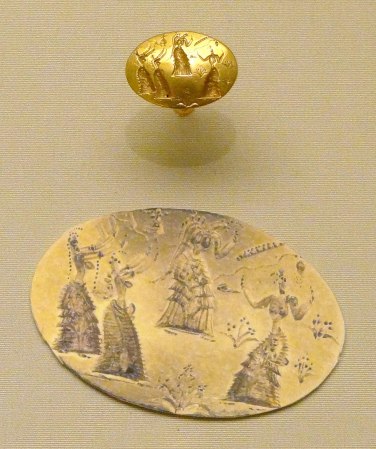
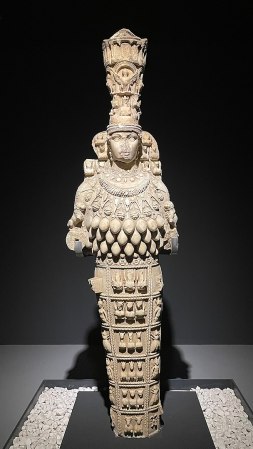
The Melissae were not only the bee priestesses of Demeter, but also other priestesses who “celebrated various aspects of the fertility goddess” that had bee associations, including Artemis of Ephesos, Cybele, Rhea, Aphrodite” (85) as well as moon goddesses, like Hekate. Ishtar of Babylonia, Inanna of Sumer, the Snake Goddess of Crete, and Neith of Egypt were also associated with bees. Other bee priestesses were associated with oracles, including the most famous one at Delphi where the oracle Pythia was known as “The Bee of Delphi.” (149).
Ashley notes that “not all Melissae were priestesses, and not every priestess was known as a Melissa” (the singular of Melissae) (85). “Any honorable woman would qualify as Potnia or Melissa” (21) and not all goddesses and their priestesses were associated with bees. The Melissa’s connection to bees was also expressed in her dress, in the way she progressed through various roles, in her drumming which imitated the bee’s humming, in her dancing, similar to the bee’s waggle to communicate with other bees, and so on. She notes that Demeter was like a bee in that she was essential to abundance of the land and Persephone was a psychopomp, just as bees were considered to be.
These connections between bees, deities, and priestesses are part of a larger pattern of reverence for bees as demonstrated by their relationship to myriad aspects of life in the ancient world. Ashley notes that the ideal of Greek cities “mirrors” the bee hive where everyone worked for the good of all and “the democracy of Athens was based on a communal imagining … as if they were bees and other insects” (72). In Malta, known to the ancient Greeks as “Melita, the Honeyed One,” the underground temple Hypogeum resonates sound at exactly the same frequency as celebratory buzzing bees ( 40). In Egypt, where beekeeping may have been invented, honey was essential to many aspects of Egyptian life and “bees were said to be the tears of Ra” (63). These are just a few among many examples Ashley gives.
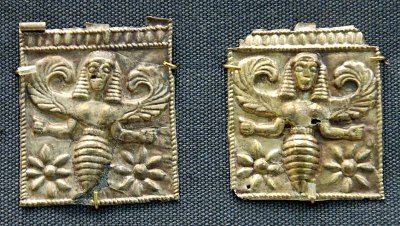
To Ashley, the Melissae were not simply temple caretakers of temples and presenters of rituals, but mediators between the world of bees and humans, and between the physical and spiritual worlds through such means as entering into ecstatic trances through drumming and dancing. She found as she delved deeper into her research that she was experiencing the Melissae on not only an intellectual, scholarly level, but also a personal, transformative, shamanistic one. She also describes her interactions with modern spiritual teachers whose work focuses on bees. She is clear when she is going beyond archaeological and scholarly sources to her own spiritual journeying and readers are free to find these personal connections in themselves or focus only on what she found in her scholarly research. She also recounts being brought up short when she comes across mention of a Minoan group burial of four women, including one elderly woman, who seem to have committed suicide together. Ashley wonders if they were priestesses following the bees’ model of a number of bees sacrificing the queen when she can no longer fulfill her duties. Suddenly these ancient priestesses become actual, real women to her.
Indeed, to me, Meeting the Melissae has other messages as well for our own time. For example, we, too, can learn from the bee hives, where sometimes tens of thousands of bees all work for their common survival, the importance of ensuring that the needs of all are collectively met.
The Melissae as Ashley describes them did not simply take on the bee as a symbol, but emulated bees in many ways, almost, it seems, becoming bees. This lack of a boundary between ourselves and non-humans, this understanding that humans are not separate from and superior to other other living beings, is one that we desperately need in our own time as we seek to find perspectives that work for a planet all living beings can share.
Finally, the Melissae are a model for 21st century women reclaiming the sphere of spiritual power even in societies in which every day women have little agency. Drawing on a spiritual lineage that was already millennia old by the time of classical Greece, they served selflessly but with confidence that their wisdom and spiritual expertise granted them the right of spiritual and secular power and standing.
I came to Meeting the Melissae with a curiosity that comes both from having a garden full of lemon balm and an interest in the Eleusinian Mysteries. I came away changed, with a deeper understanding of a different way of perceiving goddesses and women’s relationship to them from so many millennia ago, of relating to nature, and of appreciating the intense complexity of bees and how taking the time to truly engage with non-human beings can lead to both personal and societal transformation. Perhaps you will, too.
Discover more from Feminism and Religion
Subscribe to get the latest posts sent to your email.

 Feminism and Religion
Having had relationships with bees over the course of my life that has grown stronger since the demise of so many pollinators it is obvious to me that anyone interested in learning about what it’s like to be in community would be interested in bees! We could learn so much from these creatures. The ones I love best now besides my beloved bumblebees are the mud bees – teeny little bees that live in holes in the ground that emerge on sunny days even when snow is still present to feast upon the first flowers – usually snow crocus…. I have a background in the Mysteries having studied them in grad school and don’t recall much about bee goddesses being associated with this festival of Persephone’s that released all that participated from the fear of death – the use of a fungus of some kind is probable – so I found this review interesting – It never surprises me that any academic relationship that we develop with a non human being ( or in reverse beginning with studying natural history) ends up having a personal element – illumination attached – because when we focus on any aspect of nature s/he comes to life for us on a personal level… just had an experience like this with starlings…NATURE LOVES TO BE TRULY SEEN!
LikeLiked by 1 person
“when we focus on any aspect of nature s/he comes to life for us on a personal level” – this is so true. Nature is just waiting for us to recognize the many levels of meaning that every flower, every bird, every cloud, every little creature has if we will just look. And bees especially. I had known they had complex societies, but it made me tired just to read about all they do everyday.
LikeLike
you are so right – and so many of these wonders are in our backyard! Today I went to visit my friend Al who is a scientist at the Maine Mineral and gem museum and I collected some old bark hoping to find mycelia – even though winter is not exactly the season – Imagine my shock when we looked through the microscope and on the monitor and we found root tips and mycelia all over one little piece of old bark – wow – I was thrilled!
LikeLiked by 1 person
Fascinating! As a Hellenist this will be a joy to read!
LikeLiked by 1 person
Yes! I think you really will enjoy it, not just for the information but for the tone of excitement in discovery that the author brings.
LikeLiked by 1 person
That’s going to be an awesome read then 😎
LikeLiked by 1 person
I hope to send this post to my bee-keeper friends. If you’re interested in bees, check out The Bees by Laline Paull, which is the life story of a female bee. I am told that the science is accurate. (I once asked Layne Redmond, who was teaching her practice of bhramari, how I could learn when I couldn’t hear myself in the class. She said “hang out with the bees.” That’s still on my bucket list.)
LikeLiked by 2 people
I will definitely check out The Bees! I love what Layne Redmond told you. I used to take drumming classes and I know exactly what you mean about not being able to hear yourself in class. What a creative answer that changes how we think about drumming and listening!
LikeLike
Wow! Love! Love! Love! Just shared with a kindred. As I read your words HERe, Carolyn, my olfactory spirit rises and swells: literally and figuratively.
LikeLiked by 1 person
ps: That friend and her wife are bee-keepers in a large city.
LikeLiked by 1 person
Thanks for sharing with your beekeeper friends! Yes, I’ve been growing lemon balm for decades and to know that this scent that is so much a part of my spring and summer has such a history is a joy!
LikeLike