

Last week Sara wrote about her and her family’s personal connection to starling. You can read it here.
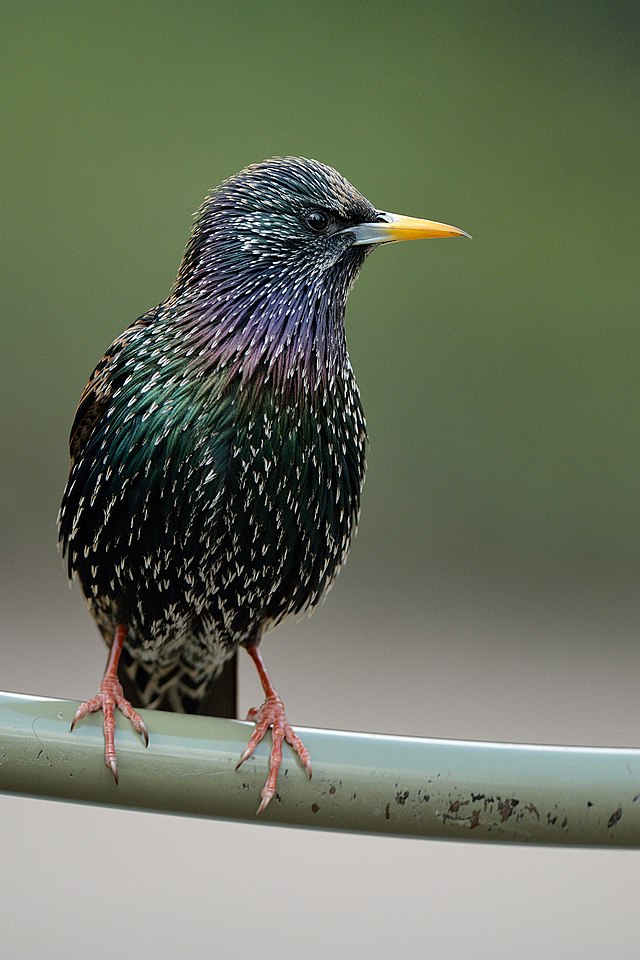
Amazingly, all the European starlings in this country descended from 100 birds that were deliberately set loose in New York’s Central Park in the 1890’s by colonists who wanted to see the birds they missed after immigrating to the US. Soon there were more than two million birds that ranged from Alaska to Mexico. All are closely related. Sometimes if a female misses the first nesting she will try to lay an egg in other bird’s nests. They are wonderful mimics learning the calls of up to 20 species of birds like the pewee, killdeer, wood thrush, red tailed hawk and robin to mention a few.
Starlings turn from spotted and white to glossy and dark each year without shedding their feathers. The new feathers that grow in have white tips. These are the spots that disappear by spring as the feathers turn dark and glossy. These birds are incredibly strong fliers as is evidenced by the extraordinary starling murmurations that still occur throughout the fall and winter all over Europe.
Starlings are omnivores that eat billions of insects, earthworms, vertebrates, including fruits and berries, the latter of which is why famers and agribusinesses hate and kill thousands each year with pesticides. There is even one starling killer called Starlicide on the shelves in Maine. “This pesticide is highly toxic to starlings but less toxic to other birds or mammals like humans and pets”. REALLY????
One resource admits: other toxic chemicals or Starlicides are lethal within one to three days, however, non-targeting birds like native songbirds, hawks and owls may also be affected.
In northern and western Europe the species is in decline. In the UK populations have declined 66 percent since the 70’s and “no one knows why” (Cornell). Are they serious? Between continued pesticide use, loss of habitat etc. how could it be otherwise?

The flocks or murmurations gather in the evening skies during the fall and winter in cities like Rome where Mediterranean temperatures are mild to ‘decide’ to roost in groups. They are also found in any open rural areas in the UK and throughout Europe. In the US it is possible to see groups of them around central park in NY, Florida, and in some rural lowland areas. The first small flock of 30 starlings was seen in Rumford early in the 1900’s. I remember clouds of them flying overhead in my grandparents’ field, but none of these citings compare to the European Starling murmurations.
My sense is that these birds are doing more than looking for a place to spend the night and that they soar through the skies creating stunning aerial dances because they like to! These displays are so astonishing that I suggest going to you tube to see one or try one of these versions. Here is a link to a Facebook video.
Cornell on extinction of birds:
“We are now witnessing the first signs of a new wave of extinctions of continentally distributed bird species,” said lead author Alexander Lees, senior lecturer at Manchester Metropolitan University in the United Kingdom and also an associate researcher at the Cornell Lab of Ornithology. “Avian diversity peaks globally in the tropics and it is there that we also find the highest number of threatened species.”
The study finds approximately 48% of existing bird species worldwide are known or suspected to be undergoing population declines. Populations are stable for 39% of species. Only 6% are showing increasing population trends, and the status of 7% is still unknown. The study authors reviewed changes in avian biodiversity using data from the International Union for Conservation of Nature’s “Red List” to reveal population changes among the globe’s 11,000 bird species.
Please note that Cornell does not address pesticide use.
The findings mirror the results of a groundbreaking 2019 study which determined that nearly 3 billion breeding birds have been lost during the past 50 years across the United States and Canada.
Discover more from Feminism and Religion
Subscribe to get the latest posts sent to your email.

 Feminism and Religion
For anyone who thinks that the natural history of starlings has nothing to do with feminism please read the following response posted along with this FAR article on FB
– An Adjunct to Starlicide:
“Starlicide…
is safe for cats, owls, and creeks; for Laundromats, pedigrees,
and flutes; for windbags, soothsayers, and windshield wipers,
but not for crows or blackbirds, nor of course, for starlings,
who are aggressive, super-smart, and clever, who can nest
anywhere and sing Mozart’s allegrettos, whose plasticity
of behavior causes millions in damage to farms;
whose strengths annoy, whose strengths too closely shadow
those of European-Americans: also invasive, also bullying out
native populations; also in turns abrasive and charming,
so it makes sense some white scientists invented Starlicide
to starve the mirror of its brute mimicry,
with assurances that Starlicide won’t enter the food chain
because it’s metabolized so fast you could say it flies
through starlings (and crows and blackbirds), plummeting
them to earth, upsetting all sorts of humans who once thought
bird crap on their cars nuisance enough. We’re assured
Starlicide has no known side effects aside from bird downpours
which, though problematic, won’t undercut the minimized
screeching and excrement, fewer flocks ravaging grain stores
and throwing themselves against sunset like intricate nets—
a habit particular to starlings but not crows and blackbirds
who pal around in smaller groups and thus can travel
together without swirling, which is impossible for starlings:
one wrong turn and they’ll break each other’s wings
and in that they’re like us too. Whenever a new batch
of Starlicide drops, crows and blackbirds whistle darkly
to their nestlings, warning them about humans,
even the girl who leaves seeds on a pedestal for a crow
who thanks her with broken key chains, glass shards, and tweezers;
wire and ribbon; bottle caps and dimes as if aware
of capitalism—an hypothesis scientists hope to prove
because while animals shouldn’t be too much like us,
it’d be convenient if they understood give and take,
the cost of doing business, if they could see our economy
as we often do, propped like a carefully wrought nest
at the top of a tall tree, removed from the dust
and squalor below, so that it’s easy to forget it matters
what happens to the roots, that leaf and branch,
sun and soil, heart and feather, flesh and sound
all fly or die together: which the birds know.
They have wings and feet, eyes and brains, and this
worries some scientists, who have learned crows
cling to grudges and dive-bomb humans
who do them or their loved ones wrong, then teach
these grudges to each other, just like we do.
A falconer was hired after the last Starlicide panic,
after the sky again spewed dead birds like a foul omen,
spurring some outliers to suggest we please try something else.
The local news is thrilled, smitten—a lady falconer!—
asking if she would please don a cape and long dress
for this outing. She wears her jeans and flannel and says no
comment before taking her bird below the roosting starlings
whose splintered chants seem to goad the falcon on—
as if they know fear is better than Starlicide, that poison
always ends up in the king’s chalice, their fragmented
symphony a prettier ‘fuck you’ than we deserve.”
~ Amie Whittmore
With profound thanks to Sherry Johnson for posting my arctcile with this response for the public on FB.
LikeLiked by 1 person
I see the loss of birds even in my own yard and even just in the past few years – fewer birds and fewer species. As for the effects of environmental degradation and feminism – environmental issues are absolutely women’s issues. According to the UN: “How does climate change impact women and girls? The climate crisis is not “gender neutral”. Women and girls experience the greatest impacts of climate change, which amplifies existing gender inequalities and poses unique threats to their livelihoods, health, and safety.” And the UN’s Office of Human Rights says that 80% of those displaced by climate change are women and climate change increases women’s poverty as well as violence against women.
LikeLiked by 3 people
Bless you Carolyn for naming the issue – climate crisis is NOT gender neutral…We are all suffering but women and non humans are being targeted in the worst possible ways…. as for the disappearance of birds – well – anyone that is paying the slightest bit of attention KNOWS how many birds are gone… what gets me is that we don’t bother to link the loss of birds with the end of the human species which will take longer but is coming our way unless we have a sudden reversal…. what I love about this poem is that it addresses this issue in a poetic and very brutal way. Will we ever begin to connect the dots?????
LikeLiked by 1 person
Thankyou for the article Sara.
Last week I was quite enchanted to a single starling at our feeders in the backyard.
I’ve noticed people decide which living beings upon this Earth are “relevant” and dismiss the “others”. It disgusts me.
LikeLiked by 1 person
Isn’t this exactly what we do with humans? We privilege the few and discard the rest – You are right – disgusting… I am thrilled that you were so pleased by the single starling that visited your feeder.
LikeLike
I watched the murmuring Sarah, thanks so much for letting me know about this, they do it to keep warm and protect themselves. Nature is all of it’s splendor, magnificent!
LikeLiked by 1 person
It is really astonishing this beauty and instead of taking to the sky these birds are circling to find places to spend the night on Earth… all too often now we see cosmic images – sky and more sky – nothing about coming to Earth. What do you suppose this might be saying about our culture?
LikeLike
I think seeing all the cosmic sky pictures means that “the collective” puts more value on the focus of heavens than the Earth.
LikeLike