

Every fall I look forward to the wild turkeys that visit me during the winter. This year visits are more sporadic but the friendship between the three male turkeys that I call the ‘kings’ or the three amigos has persisted for two years creating many questions for this naturalist regarding bird relationships (despite being ruthlessly hunted in spring and fall and randomly shot at).
These three friends still seem inseparable and last year I had a chance to get to know each individual. Two continue to defer to the king who is just a little larger than his friends, but I never witnessed conflict between any of these male birds. Last year they displayed and even mated together! This year there is a predator afoot and except for the king who acts as a protector standing watch while the mixed flock scratches for seed, the turkeys hide from me, so I am sure I am dealing with a human threat. Still, the turkeys come in to feed and that’s what matters. Only recently have the males begun to come separately. The flocks are splitting up for spring mating, still two months away. I am quite certain that the turkey friendships I am witnessing are replicated with the females but because they are more reticent it is harder to get to know them individually.
Friendships between birds that may be or not be related are not documented in the literature (except during mating and parenting). But I have also seen and written about chickadees, cardinals, and juncos exhibiting close personal relationships that have nothing to do with mating. Some wild birds like the turkeys, have occasionally included me.
I also have ruffed grouse, but these birds are shy and are loners. I see one most often around the edges of my field before dawn. They also fly into the fruit trees to eat the last of withered crabapple berries when the first snow settles on the trees. In the spring there is one male who drums on a log in the very same place in the woods but then he disappears. These birds are also aggressively hunted. Friendship has been restricted to offering grouse a safe haven and leaving it at that. However, each summer I have been fortunate to glimpse a grouse family because one mama nests here hidden in the hay ferns, and I see her leading her fluffy offspring up the hill to reach gravel while huddling close to the fence. Last year the mother that nested here had only one little chick.
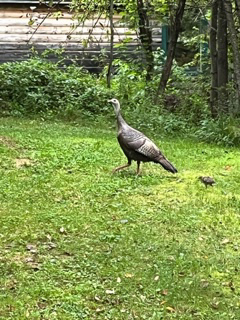
One turkey hen also nests here, but unlike the grouse mama turkey will proudly parade her young up the hill, settle into the moss and spread out her wings in the sun. Last year mama’s single chick was nestled under her wing.
The sound of the spring goose migration sometimes moves me to tears. During the summer I feed the geese at a local pond, admiring the protective males who stand watch while their mates are sitting on eggs and then being thrilled at the sight of the goslings when they start to swim. The geese I feed become friends, appearing out of cattails and reeds almost instantly after I leave my car. Goose families travel together with both parents taking an active role in raising their offspring.
Obviously, I have a penchant for ground birds, even those like the geese, ducks, and sandhill cranes who migrate long distances but spend a lot of time feeding either in fields, wetlands, or open water. Then there the ducks…
When I lived in NM I witnessed the sandhill cranes who arrived in late fall and spent winter nights at the edge of the river, with one male always standing watch. Every morning before dawn I was outside walking by the river, waiting for the families who travel as one related body (except during mating/ chick raising) to sound their haunting calls as they took to the air to feed in the fields for day.
I used to wonder why, instead of extolling even worshipping the predators – eagles, owls, and raptors that most folks adore – I preferred the company of those that were primarily vegetarian and unfortunately preyed upon by others. What follows are some reflections on this question.
Ground birds (1) live close to the earth even when they take to the skies during migrations. These are (2) peace loving birds who except for the grouse gather in family groups and migrate together. All but the grouse choose (3) communal living for most of year, (and I have to wonder how much hunting pressure has affected the behavior of these birds – I think immediately of the desert quail who also remain together). With the exception of the grouse, all the others have male (4) protectors who stand watch over their families. There’s a fifth reason I love them; (5) they are birds who fly that also are deeply wed to the earth which isn’t quite the same thing as living close to the earth. I think of them as being embodied in some way that other birds aren’t – difficult to explain.
When I put these behaviors together: earth loving, peaceful, living in community with males acting as protectors, embodiment, I Immediately think of the way Carol Christ described the peaceful agricultural societies of the past that flourished without war.
We could learn so much from Nature if we paid attention. Birds are at least 150 million years strong.
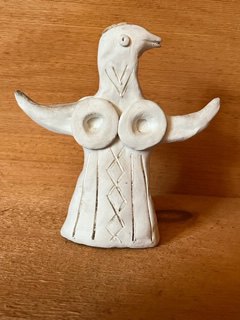
During these dark times I am calling upon the ancient Bird goddesses to guide us onto a path that will lead women back into a more conscious relationship with their bodies and that of the earth. I am also asking that these Ancestors help us create a global community one that births men that are protectors of the earth, women, children, animals, plants, fungi; men who are heavily invested in peace.
Discover more from Feminism and Religion
Subscribe to get the latest posts sent to your email.

 Feminism and Religion
I love the way you connected the characteristics of the birds to Christ’s description of peaceful agricultural societies. Your last paragraph was especially beautiful. Thank you.
LikeLike
I, too, love how you connect birds to ancient matriarchal societies – now that you make the connection I see it! I also love how you see each bird as an individual with their own characteristics. I have seen this in non-human beings also – when you relate to non-human beings just as themselves and not try to put them into the boxes we have made for them, we find ourselves in a world full of amazing, smart, caring beings who have their own friendships and family relationships. I think of a piping plover project that has stations all over the Great Lakes area where plovers are looked for as they come back each spring after migration south. Many people follow who has come back and with whom – whether couples are still together or whether one has been lost. Last year there was a situation where a couple split up and the female bird returned with another mate while the male bird came back alone. Many, many people were thrilled when the lonely male bird found a new wife. If only we could see all non-human beings through this lens of individuality and relationships! Your last paragraph is beautiful and may it be so!
LikeLiked by 1 person
I make the assumption that all creatures have complex relationships and this is why I probably notice….I remember the plovers. All these birds have attachments but we have to pay attention – and it also takes time. One year I raised two mallards. We had none of the pond then. By midsummer I set them free on an island on the pond…. they stayed and migrated with the others ducks… four years passed and then in the spring a female mallard returned with a mate… Since then mallards come every year. That female remembered me – there’s a whole story around that…It’s very life affirming to hang out with birds.
LikeLike
Thank you Beth. It is really amazing to me to see that some – I would say many animals, even some predators demonstrate these matriarchal/ matrifocal behaviors – when I spend time with animals I am more aware than ever that peaceful co habitation is more the norm than the exception – this red in tooth and claw shit is patriarchal nonsense. Of course now science is finally catching up… slowly. TOO slowly!
LikeLike
Birds do have an amazing ability to tolerate one another. I started several feeders in my backyard years ago. Blue Jays would fly in with their harsh call and the smaller birds would scatter… until they didn’t. The Jay may have been surprised at the birds’ failure to fly away, but continued to eat along side birds that normally feared it. Not only that, I’ve watched rabbits and chipmunks eat together side by side underneath the bird feeder.
I also have a trio of male blue jays that arrive together. Since the Jays normally maintain nests in the apple tree, I believe this trio consists of siblings. Not sure what the life span of a Jay is, but they’ve visisted the last three years together.
I love your observations. Keep writing and sharing.
LikeLiked by 1 person
This trio of bluejays reminds me of the wild turkeys that come… there are three that I call the three amigos that are inseparable – all males – I have had them for two years running – are they relatives? – maybe – like your bluejays or maybe they are just good friends – you are right – birds adapt – and so do animals – unless one is a predator – it is normal to see them eat together as long as there is no threat – the more you pay attention to animals the more they teach us about how to become human again! Thanks so much!
LikeLike