

Moderator’s Note: This post is presented as part of FAR’s co-operation with The Nasty Women Writers Project, a site dedicated to highlighting and amplifying the voices and visions of powerful women. The site was founded by sisters Theresa and Maria Dintino. This was posted on their site on November 7, 2023

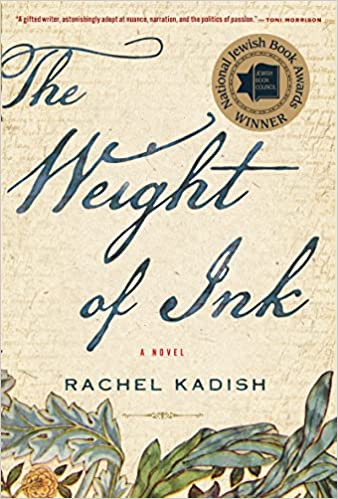
I love recognizing Toni Morrison’s influence on a writer as I am reading a book. Reading Rachel Kadish’s novel, The Weight of Ink, immediately sunk into Jewish reality, life, and experience without any explanation or apology, I sniffed a familiar point of view, a ghost of novels prior, detected the faint fingerprints of a giant. I liked it and when I recognized it for what it was, I thought to myself, Good for her.
Kadish had taken Toni Morrison’s advice to black writers that says you don’t have to explain yourself to white readers and applied it to not explaining herself to non-Jewish readers.
Why not?
Because, Morrison often asserted, referring to white writers that readers of all color, race and religion are expected to read, they never explain themselves to us.
So it was that I was swept up into the trajectory of the almost 600 page novel that is The Weight of Ink. It was amazing to have material that could have been dense and unreadable become a novel I could not put down. It was fascinating to move between the three narratives, Ester Valasquez, Helen Watt and Aaron Levy and alternate time periods between modern London and London and Amsterdam of the 1600s. It was a feat unexpected to watch Kadish bring to life the history of the Jews, telling it in a way it had not before been told, through the point of view of a female scholar in the 1600s with a feminist voice.
There was so much to this book, I could go back and read it again and I probably will because I was so taken up by the plot line, I knew I was passing by things I otherwise may want to sit and ponder.
I did need to stop and google some things because of my own ignorance and that is as it should be.
UNAPOLOGETICALLY JEWISH
I love the unapologetic Jewish reality of this novel and this writer. Here, the marginalized are the majority. Here, the Jews are not existing only to be a caricature or foil to another character. Here, Jewish reality is the reality and we all get to experience that for the length of these 600 pages and that is important. From the world Kadish allows herself to imagine, create and situate her story within, arises a woman who fights for her own imagination at a time where that was disallowed to most women, including Jewish women.
In the Western World the norm is Christianity and most often any other belief system is othered in the face of that. Not only othered but erased, disappeared and stigmatized at best, persecuted and annihilated at worst. Jews have long suffered under such oppression and the novel does not shy away from this truth.
And yet there are issues of discord within marginalized groups as well. We get to witness this up close within the Jewish communities of the novel through the many layers of time covered: issues of forced conformity and required obedience. Issues of sexism and a recurring position of ultra orthodox Judaism as a response to persecution often alienating their own. Kadish exposes this theme with the presence of Dutch philosopher Baruch Spinoza of Portuguese-Jewish origin, excommunicated by the community of Jews in Amsterdam in 1656 for heresy.
In a 2019 article published in Forward Magazine titled, “I Was Hesitant To Write About The Holocaust — Until Toni Morrison Lit The Path,” Kadish reveals that it is Morrison who advised her to give herself permission to write the Jewish experience. No one can give you permission but yourself, Morrison encouraged, inspiring Kadish to write her own story, the truth of her ancestors. And so she did and we are all better for it.
In that same article Kadish tells us:
“I’d grown up among Holocaust refugees, which meant that references to hiding in coffins, or sneaking across borders, or being in a Russian prison, or obtaining illegal Japanese visas, or jumping ship in Mexico might crop up in the middle of a mundane conversation. My relatives’ stories echoed so loudly with history that it felt nearly impossible to explain to an outsider why my agnostic mother insisted that my siblings and I receive a religious education, or why the simplest question about current events might prompt my Polish grandfather to set down his tea, sit back, and begin with, “To understand this, you first need to know that in 1364…”.
She was also influenced by Virginia Woolf whose famous question, “What if Shakespeare had a sister?” reverberates throughout the text, and whose advice to women writers to kill the “Angel in the House” telling them to be “nice,” thereby freeing themselves to write in the absence of the male gaze, encouraged Morrison to apply that same creed to the subject of race in her writing.
Read Nasty Women Writers’ post about the connections between women writers: Invisible Connections: The Hidden Web of Women Writers
Kadish writes in the absence of the Christian gaze as Toni Morrison writes in the absence of the white gaze as Virginia Woolf encouraged women to write in the absence of the male gaze. All these women writers inspiring and encouraging one another and so many more through time. Let’s keep it going.
Read Nasty Women Writers’ posts on Woolf and Morrison:
Women Writers on Writing: Virginia Woolf’s Angel in the House and What it Takes to be a #NastyWoman
Toni Morrison’s Sula: Available To and For Her Own Imagination—A Rare Kind of Freedom and a Black Woman Writer’s Manifesto
Part 2, tomorrow
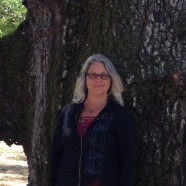
BIO: Theresa C. Dintino is the author of Membranes of Hope: A Guide to Attending to the Spiritual Boundaries that Keep Lifesystems Healthy from the Personal to the Cosmic, The Tree Medicine Trilogy which includes: The Amazon Pattern: A Message from Ancient Women Diviners of Trees and Time, Notes From a Diviner in the Postmodern World: A Handbook for Spirit Workers, and Teachings from the Trees: Spiritual Mentoring from the Standing Ones. She is also the author of The Strega and the Dreamer, a work of historical fiction based in the true story of her great-grandparents, Ode to Minoa and Stories They Told Me, two novels exploring the life of a snake priestess in Bronze Age Crete, and Welcoming Lilith: Awakening and Welcoming Pure Female Power. Find out more about Theresa at ritualgoddess.com
Discover more from Feminism and Religion
Subscribe to get the latest posts sent to your email.
 Feminism and Religion
Thank you so much for letting us know about what sounds like a powerful and compelling book. I loved your discussion of writing without the Christian, white, and male gazes. It made me ponder whose gaze is in the back and front of my consciousness when I write for a public audience. Thank you for that important self-reflection.
LikeLiked by 1 person
Thanks, Theresa, for alerting us to this novel. Looks like something I MUST read!
LikeLiked by 1 person