

Halloween, with its Celtic pagan roots in the sacred day of Samhain, which later morphed into a Christian holiday, is now mainly a nonreligious celebration in Europe and North America. It’s enjoyed by both young and old with scary outdoor decorations, parties, spooky costumes, haunted houses, carved pumpkins, and candy-giving.
From ancient times Samhain — the midpoint between the Fall Equinox and the Winter Solstice on the Wheel of the Year — has held great significance for Irish and Scottish Celts. At this liminal time of year it was believed that the veil between our world and the Otherworld is thinnest.
The Celts had a very different view of time and the marking of the seasons than we do today. Within the eternal cycle of day and night, and the cyclical changing of seasons, the Celts relished the darkness in a way that is foreign to us now—giving it primary importance. Darkness was associated with potentiality and new beginnings. Every day began at dusk, not dawn. The New Year began as the world turned toward the dark with the Samhain celebrations on October 31.
Beginning at sunset on October 31st with the lighting of bonfires and communal feasting, Samhain most likely lasted three days. People danced around the bonfire and acted out legends and tales. Many wore costumes to scare away any malevolent or angry spirits who had passed through the thin veil. Some left out food for the spirits, hoping to appease them. In addition it was believed that people could reach out to the fairies, goddesses and gods, and communicate their needs. It was also a time to commemorate loved ones who had died.
The Cailleach, an integral part of this tradition, is a primeval goddess revered long before the Celts arrived on the Emerald Isle. Her rule began on Samhain and lasted through Lammas on February 1, when Brigid, ancient Goddess of Healing, Smithcraft and Inspiration took over.
According to myth, the Cailleach was a creator goddess, creating mountains and valleys and controlling the weather. She ushered in winter every Samhain night — riding a giant wolf through the skies, then striking the ground with her rod to freeze it.
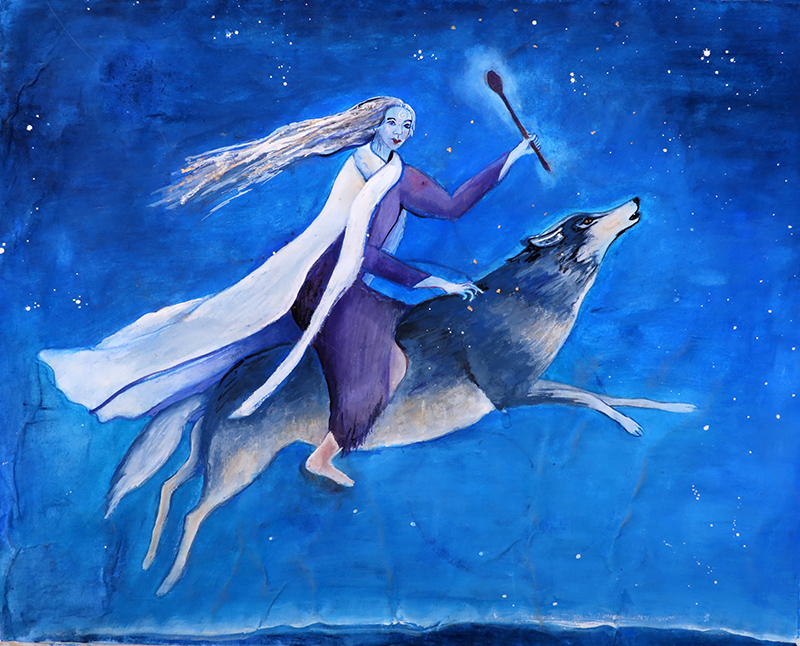
I love the interconnected symbolism in this story. Wolf, one of the Cailleach’s sacred animals, teaches us about the mysteries of nature. Wolf reminds us that within the cycle of birth, death and rebirth, something old must die for something new to emerge. The Cailleach carries the same message. Together, they ride through the sky, bringing hope to the people that, though the time of cold and darkness is at hand, new life will emerge from this period of rest.
She wielded power over the weather, using her rod, the slachdam, to unleash powerful, cleansing storms. and ensuring the start of winter at the dawn of each new year.
Symbolically, the rod represents authority, guidance, protection, and discipline. As a protector goddess, she ensured the preservation and rejuvenation of the land, embodying the cycle of birth, death, and rebirth.
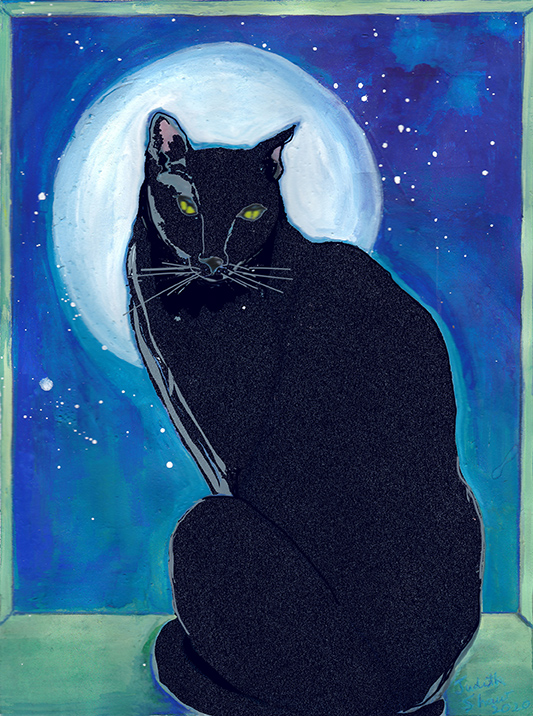
Another animal sacred to the Cailleach is the black cat, who is strongly associated with Halloween today. The English Britons referred to the Cailleach as Black Annis, believing her to appear in the form of a black cat with spring’s arrival, symbolizing hope and renewal.

Perhaps the strongest reason for the black cat’s association with Halloween comes from a Scottish legend, the Legend of Cait-sith. This tale likely originates from Celtic mythology where cats, associated with the Otherworld and seen as magical, were both revered and approached with caution. With its mention of witches, it most likely became prevalent well into the Christian Era.
The cait sith is a large black cat with a white chest patch, often depicted with an arched back—now a familiar Halloween image. This ghostly figure haunting the Scottish Highlands was feared for stealing souls and cursing cows by stopping their milk production. However, in one tradition, people left a dish of milk for the cait sith, hoping to receive blessings or gifts in return.
Black cats often get a bad rap, seen as unlucky omens or portents of doom. According to Greek myth, the servant Galinthias was turned into a black cat and joined Hecate, the Goddess of Crossroads, Birth, Death, and Rebirth. By the 5th century BCE, Hecate had become associated with witchcraft, the night, and the underworld. Through the story of Galinthias, black cats became linked to bad luck and death.
By the Middle Ages, black cats became increasingly linked to black magic and evil, likely due to their association with women, who were often vilified as witches by Church teachings. Their association with evil may also stem from the independent nature of cats, which contrasts with the Western view of nature as subservient to humanity. Cats, self-reliant and living on their own terms, disrupt this perceived order.
But in the minds of the ancients worldwide, the black cat was a positive symbol, often symbolic of good luck. This duality of symbolism—the cat as both an omen of fortune and a harbinger of the unknown—mirrors the deeper themes of Samhain.
The Scots believed that if a black cat visited your home you would win the jackpot. The Japanese believed black cats were portents of good luck, especially for single women who were considered more attractive if they owned one.
Sailors and fishermen often took black cats aboard as lucky charms to keep them safe, increase their catch and to help control the rat population.
In ancient Egypt cats, associated with a variety of goddesses, were revered as sacred. The beloved Cat Goddess Bastat, Goddess of Domesticity, Women’s Secrets, Fertility, Childbirth, Joy and Music was most often depicted as a black cat.
These interconnected symbols—the Cailleach, the wolf, and the black cat—reflect the complex relationships between life, death, and renewal. The wolf and the black cat, sacred to the Cailleach, serve as a bridge between worlds. As the Cailleach rides her wolf through the winter skies, she ushers in the dark season, embodying the mysteries of transformation.
Fears of the unknown can stir deep within us on Samhain, the day that marks the swift descent into the heart of winter’s darkness, the Winter Solstice. It’s no wonder stories of ghosts and goblins abound. Yet at this liminal time of year when the veil between the two worlds is thinnest, we have the goddess, the wolf, and the black cat leading the way into the dark mystery of our wild souls where the seeds of light lay resting, waiting for the moment of renewal.
Discover Judith’s Celtic Goddess oracle – click here
Discover Judith’s Animal Wisdom Oracle – click here
Here’s a direct link to “The Cailleach Rides” for prints and merch. Click here
Discover more from Feminism and Religion
Subscribe to get the latest posts sent to your email.

 Feminism and Religion
Thank you for this amazing post. Sharing now
LikeLike
Beautiful post, Judith. Words and paintings. I have had two beloved black cats in my life. We were warned by the vet to keep them inside at Halloween, because there are still malevolent humans that will prey on them. Later I adopted a tuxedo cat from a shelter and was given “a black cat discount” because black cats are often overlooked for adoption. Thank you for celebrating black cats in this post. All my black cats are in the Otherworld now. They visit me in dreams. I know they’ll be near when the veil is thin!
LikeLike
Elizabeth, Your post did come through. How wonderful to hear about the black cats you have shared time with. Your tuxedo cat sounds like a Cait-sith. I’ve always loved black cats too. I just lost a sweet long-haired feral orange cat who came with my house 3 years ago. We had gone through many stages as she built trust in a human, ultimately becoming very close. She was very old. I buried her in the backyard and planted an apricot tree on her grave. I love going to that tree and talking to her as I’m sure she’s frolicking about in the Otherworld. I’ll be sure to give her special attention on Samhain.
LikeLike
Glad the reply came through. I am sorry for the loss of your orange cat. Here is to all our beloved cats in the Otherworld
LikeLike
Just left a longish comment thanking you for this post and in praise of black cats, but it didn’t go through. I am having trouble posting today. Hope this gets through. Love the post!
LikeLike
Having trouble posting today. Want to thank Judith:
Just left a longish comment thanking you for this post and in praise of black cats, but it didn’t go through. I am having trouble posting today. Hope this gets through. Love the post! Elizabeth http://elizabethcunninghamwrites.com
Murder at the Rummage Sale https://elizabethcunninghamwrites.com/booik/murder-at-the-rummage-sale/ *and *All the Perils of This Night https://elizabethcunninghamwrites.com/booik/all-the-perils-of-this-night/ are back in print with all my other books https://elizabethcunninghamwrites.com/books/ The Maeve Chronicles are available in all formats https://rowecenter.org/a-prayer-for-all-seasons-with-elizabeth-cunningham/ New novel coming in 2025: Over the Edge of the World https://elizabethcunninghamwrites.com/booik/over-the-edge-of-the-world/
Come the darkness, come the dawn
beauty will go on, go on, beauty will go on…
-song of the beauty singers from Over the Edge of the World
LikeLike
Over the edge of the world…. can’t wait!
LikeLike
Beautiful Paintings and wonderful post Judith. The relationship between the Celts and and the Indigenous way (Native peoples everywhere) couldn’t be more obvious than it is at All Hallows – Here in the states and throughout South America – some version of this three day festival of the dead is celebrated by all Indigenous peoples and it is ‘religious’ in that it acknowledges the powers of the dead, honors the ancestors, etc – and also acknowledges the soul and bodily journey towards death.
LikeLike
So true Sara — I find a very deep connection and similarity between Celtic sacred traditions and those of indigenous people of the Americas. I guess it’s not surprising since the Indigenous Way honors Earth and our connection to her. And this time of turning toward the cold and dark is a perfect time to honor our ancestors. I had a wonderful experience in Mexico about 20 years ago staying with a local family during the Mexican Day of the Dead celebrations, where we spent the night in the graveyard saying goodbye to the beloved ones who had passed in the previous year and remembering those who has passed long before. Maybe I’ll write up a piece about that experience. At that time the locals were bemoaning the commercialization of their sacred time. Now it’s even worse of course.
LikeLiked by 1 person
Now it’s non existent – this honoring the dead and our ancestors. It is very scary that the US simply ignores death and dying… glad you agree
LikeLike
It seems to me that the US culture has always been afraid of talking about or acknowledging death. Maybe that’s why it’s such a youth culture and elders are kind of thrown away and discounted.
LikeLiked by 1 person
I know that you are right
LikeLike
A beautiful post and lovely paintings! I, too, had Elizabeth’s experience with my black cat. She was the last of her litter and the rescue people said that it was because she was a black cat and they let us take her home right away, instead of having us come back after their usual waiting period of a week, because they were afraid we would change our minds. She was a constant companion for 16 years and she is often on my mind. Your paintings remind me of her and I so appreciate that! Thank you also, as always, for all this information, much of which I hadn’t known and your connection of the Cailleach to Samhain and Halloween. Such a powerful Goddess!
LikeLike
Carolyn, Black cat lovers unite! I’m so happy that my painting reminds you or your cat.
The Cailleach is really a powerful goddess for sure! The more I delve into Celtic myth the more I learn about her. I find it interesting that her main concern is the land and providing a balanced Earth on which we can survive. Sometimes I think the Cailleach is at hand all around the world now creating cleansing storms. The consequences of these events can be devastating but the need for Earth to be balanced is what’s most important.
LikeLike
I really like the writeup, and the illustrations are magical! 🤩
LikeLiked by 1 person
Thanks so much
LikeLiked by 1 person
I’ve been having trouble posting but today its working for me. I really loved your article. I have owned 2 black cats in my life, both strays that turned up on my doorstep in my younger days. The pictures are wonderful – the Cailleach is close to my own visual interpretation of her and your painting carries a sense of joy and adventure with it. The cat looks so contented in the moonlight, like it is purring. Thank you and sorry this is late.
LikeLike
Iona, The problem with posting seems to happen randomly and frequently these days so glad you finally worked it out. You’ll see many visual interpretation of the Cailleach in which she looks like an old hag. I prefer to visualize her differently and very happy to hear that you feel the same way. Thanks so much for your kind words about my paintings.
LikeLike