

On August 12, 2018, I announced that I would begin my feminist reflections on Torah portions. I have seven left, but the timing of them are all in the beginning months of the year. This means, that the following seven posts about the parshot will not be aligned with the actual calendar dates in which they are read, especially since I only post once a month. But, in each post, I will note when they will be read next (in 2025). I hope that is not too much of a bother for the reader as I complete this project.
The parshah for Feburary 1, 2025 is Bo. It covers the final three plagues (locusts, darkness, and death of the firstborn males), the instructions for Pesach (Passover), and the beginning of the flight out of Egypt. The parshah makes two mentions of women. First, Moses includes the daughters of Israel among those who will leave Egypt (10:19). This mention comes in a list of opposites: young and old, sons and daughters, and (what I assume to have been considered opposites at the time) flocks and cattle. To me, this stylistic set-up signals that the entirety of the Israelite community would leave Egypt – a combination of seeming opposites thus represent the whole (that would be an interesting post for another time!). The second mention of women is in verse 11:2; men and women will ‘borrow’ gold and silver items from their (Egyptian) friends. This borrowing allows them to later leave Egypt with the items and thus rob Egypt of its riches (13:35). I do not find this necessarily all that interesting except to note that it helps to tell the story of how an oppressed, enslaved people had enough gold to build a golden calf (Ki Tisa), Exodus 32:2-3.
Yet, I want to focus here on language and the way in which nature and animals cooperate with the divine. Let’s start with the former specifically the meaning of the word Hebrew. The language ‘Hebrew’ in Hebrew is עברית (ivirit), which comes from the root עבר, meaning to pass over. It is used in parshah Bo verse 12:12 to describe how the divine will skip (and I (will) pass over ועברתי) the houses of the Israelites during the plague of the firstborn and in verse 12:23 ( ועבר) to describe how the divine will pass through Egypt to kill the firstborn. This word is also used as an adjective within the Torah. For example, Avram is identified as a Hebrew in Genesis 14:13; he leaves his home to pass over into another land. Jonah identifies himself as a Hebrew (Jonah 1:9), a member of a specific community tracing their roots to Avram and Sarai. Likewise, as the story of freedom from slavery in Egypt progresses after parshah Bo, the Israelites cross over the river Jordan and enter the Promised Land. The language, the people, and the content of the Torah itself could be called exercises, in various forms, of passing over. We will come back to this point shortly.
Now, let us look at the role of nature and animals within parshah Bo. Nature comes in the forms of locusts, the wind, darkness, dogs, and sacrificial animals. Beginning with the plagues, two of the three plagues in this parshah relate directly to nature: the locusts and the darkness. The deity uses an easterly wind to blow in the locusts and a westerly one to drown them in the Sea of Reeds. The death of the firstborn includes the death of firstborn animals, and the Israelites’ houses are passed over through the slaughter of a lamb and the use of its blood on their door frames. In addition, during the passing over, the deity silences the barking of the dogs (note 1) so that the Egyptians will not be warned of their impending doom.
It is possible to interpret these events as confirmation of a powerful, patriarchal deity. A deity who manipulates the wind, locusts, dogs, and even the Pharaoh himself. This bolsters an understanding of the divine as creator, a controller who uses power over creation to manipulate and command, aligning with a blood-thirsty deity who requires worship through animal sacrifice. Yes, this deity liberated a group of people from slavery, which is commendable, but also rejoiced in and prolonged the suffering of the Egyptians which certainly is not.

Yad Veshem toward Ein Kerem.
Yet, the previous discussion of language offers us another model of the divine. Divinity, humanity, and our sacred language share identities with movement, travel, boundary crossing, and action. We all belong fundamentally to the idea of עבר, passing over. To pass over or cross over is an active position within the world. Importantly, passing over brings positive change. For example, the divine passes over the houses of the Israelites to liberate a people from slavery (note 2). The wind, intimately connected to the divine, blows locusts into Egypt and again out to change the Egyptians’ minds. Avram, inspired by and deeply connected to the divine, passes over with his wife Sarai into a new land to become a new person, our first ancestor, and to found an entire holy people. These examples of passing over connect divinity, humanity, and nature in ways that blur the boundaries between where one ends and one begins.
To conclude, parshah Bo could be read, as it often is, in support of patriarchal understandings of the divine as one who wields power-over, controls, and is violent. This deity is one who favors one people while causing death and misery to another. However, within Bo, exists feminist potential, contained within the word עבר, or passing over, interpreted as an active movement that brings change. In this, we, humans, nature, and the divine, are all connected through shared activity and the way in which passing over blurs the boundaries between us and forges deep connections.
Notes:
- I came across a rather interesting take on this parshah and dogs. It reminds the reader of another way in which Hebrew is a beautiful language full of potential for religious insight, as it has been understood for millennia. As the blog explains, the word dog in Hebrew כלב (kelev) could be translated as ‘like the heart,’ as לב (lev) is heart and כ is a preposition meaning like or about. I think another translation could be according to or about the heart. As I have a dog who lives with me, I can confirm that he is all about the heart.
- This does not, of course, excuse the patriarchal violence within the parshah. I have addressed some of the violence in Bo, here.
Discover more from Feminism and Religion
Subscribe to get the latest posts sent to your email.

 Feminism and Religion
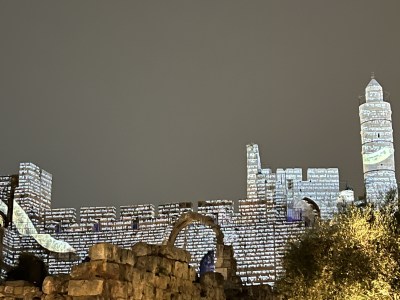
Thank you for this beautiful post. I love the connection between the word for Hebrew and passing over, I had no idea! Also love your note on the connection between the word for a dog and heart and I would love to learn more. Perhaps you could write another post about this. Also what a beautiful photo of the letters on the walls.
LikeLike
Thanks Rebecca. I have written about dogs here if you are interested. I also wrote about how my pets have inspired my vegan lifestyle here. Perhaps I have more animal posts yet to write. I’m also really glad you like the picture with the Hebrew. That was from a beautiful light show that I saw at the Tower of David. It included a brief history of Israel and the Jews. The illustrations and the way the walls were used was magical. I highly recommend it.
LikeLike
Sawbonna Ivy,
Your piece of writing is and is of Wisdom. Your words here, “..humans, nature, and the divine, are all connected through shared activity and the way in which passing over blurs the boundaries between us and forges deep connections,” are a balm of beauty and an exquisite articulation of the interconnectedness of being.
Margot/Raven Speaks.
LikeLike
“within Bo, exists feminist potential” “we, humans, nature and the divine, are all connected through shared activity”. I love the way you reframe Biblical stories through a feminist lens.
LikeLike