

ROSE WATER
I am the holy place somewhere in the stars of eternity,
someone’s daughter who seeks reprieve somewhere.
Yetta changed her name to Mary. She tried to erase her past, not as a Jew, well maybe some of that, but more as a Jew molested by her father—a frum[1], “Monster”, his daughters called him.
On my altar sits my tallit alongside a Menorah with seven brass holders. No stars of David—before or after the decimation of Gaza. Can rose water sweeten our hearts? We pour it graciously in our hands, hoping the lost petals heal our guts and brighten our thoughts. She searches hungrily for hope in glass bottles adorned with Farsi, that cost $4.29 each.
My grandmother on my mother’s side only came to me after she was dead, by then her secrets went with her until files were opened explaining my mother’s adoption. We went to her grave a few years ago. This was the first time I met her. She told me that my mother was conceived in love, not rape by a man she had an affair with most of her life. She couldn’t say the same of my aunt’s beginnings. She told me why she changed her name, why she never shared these secrets with her sisters, son, or grandchildren, how her mother forced her to give up my mother to a Catholic orphanage, far from strictly Orthodox Jewish bodies, and why she moved to Latin America, and how shame was the shroud she buried herself in. There was nothing to forgive once we heard her story. I didn’t find forgiveness for my mother.
(Did my grandmother hear her children being raped in the other room while she ironed the family’s tablecloth for Shabbos? Where do all of the cries of hurt children go, is there ever enough rose water to honey their throats, sore from silence?)
I fill my altar with stones from the nearby creek that was once devastated by an oil spill. The rocks watch me from the corner and tell me all we’ve done. I lovingly spit tap water on them and say, pu pu pu, to ward off the evil eye, and to lubricate my ancestor’s lost memories. Our fluids mingle in desperate delight.
The stone that I put on my grandmother’s grave when she assured me that my mother’s life was not born of violence, sits in a cemetery full of rocks on headstones.
(Are grandmother’s secrets unveiled to the living and the dead?)
ת נ צ ב ה: May her soul be bound up in the bond of eternal life.
Water reigns down reminding me not to freeze like the edges of the winter river that meets the Anthropocene daily. I have to keep moving, however slowly, so as not to become stagnant or apathetic to my kin in Palestine whose bloodshed spills out of screens into a dry lap.
(Will we soak or wash out the stains?)
Rose water still smells beautiful even though it’s trapped in a bottle. Make three wishes, I’m yours. Beg for mercy—if you must. Will we all survive? Say the Sh’ma each night when you go to bed—not for yourself but for the souls that don’t speak stone or find calm rivers. Call peace with justice into a pain-struck and panic-stricken world.
Concede to your history. Pile rocks high on your altar and remember all the grandparents—monsters and hiders, and those who got their tushies strapped. And those who beg for mercy from the weight of heavy rocks stuck in their throats.
Our love is not unbearable; we have become unused to peace. Swallow the pebbles, drink from the glacial-fed stream and remember why we’re here, together: To Tell Our Stories. Her story. Their story. All the stories that ever were. To sing, hum and vomit them up. To talk them out and to talk them through.
The stones—grandfather’s—hold them, not down, nor up, but here, right in your stomach, the place where you hide from yourself when you hope to be overlooked until you’re overlooked, then, rumble touches the sky, and thunder calls you back to sit on hoar snow mounds to speak to the stars.
Rose water, unopened, waits, to bless us, or something. She’s with us when we go on our journeys of growing up, moving out, moving up, moving on and moving along: when we finally embrace the rocks where they fall.
Our stories hide in bones and stones. Rose water kisses us back to life even when she’s still a rosehip, a seed yet to bloom.
[1] A Yiddish word originally referring to a person who is pious and observant of Torah but is more commonly used to refer to a person who is very religious or Orthodox.
Strawberries
Self-suffering is my mother tongue,
I learned it by seven.
It’s ugly talk—
hard on the ears,
hard on the heart,
and filled with homonyms that
crush worth.
I didn’t know there were other languages
and judged those who spoke self-sabotage,
until I unearthed
deafening rings of pain
that only I could hear.
I found you hiding in a dark corner,
pretending to be a soothing presence
but you were the monster in my bed.
You mocked me with care
and took away my innocence,
replacing it with your emptiness.
I learned to speak your language.
The blue wool blanket that you gave me to sleep with
was rough and itchy
but softer than your thirty grabs
that fingered me in my sleep,
the summer before grade four.
I hate that ring on your left hand
and the clicking in the back of your throat—
that sounds like ice cubes jingling
in an empty glass.
Howling with glee, you’d play the banjo for your drunk friends,
until they passed out,
then, stumbled passed my father’s door and your daughter’s room,
to commit your sins.
You’d try to vomit them up in the morning
but cottages remember the stench of Drambuie and shame.
It soaks into outdated furniture and wooden panelling.
What happened to you?
Your sisters seemed lovely, even the eldest one, Peggy, the one who heard, “the voice of God.”
Were you one of her demons too?
The hymns in your heart sang not of remorse but of desecration.
You took Mary’s virginity
hoping recitation of catechisms would keep you from her wrath
but you are the fiery hell we fear.
Eating the flesh of Christ
washed down with his blood,
I was your sacrament.
My girlhood marked your tatty baby blue sheets.
No stain remover can erase new blood and violations;
they don’t come out in the wash.
Fleshy folds begged for mercy.
Agony cried out seeking relief
but found none.
“Help!”, we cry, to beyond the heavens.
Will they hear us and cry back?
I left my torn swimsuit at the side of the chalet—
no time to bury it,
to hide what you did to me,
no one found the evidence
of what you slaughtered in me.
So, I swallowed the crime scenes whole, until
it swam up into my insomniac dreams
between midnight and dawn breastfeeding.
My husband and I ate the Irish stew that you made
on the same vintage kitchen table where you raped me—
it was sour like your breath but I ate it anyway,
good girls aren’t rude.
Force-fed your poison,
I finally found the antidote.
I am the medicine that cures.
This year I broke my fast on The Day of Atonement—Yom Kippur
with sweet, sun-kissed strawberries
that I picked from my grandmother’s garden.
Cherries are my favourite but their pits get caught in my throat and I’m done with choking.
More poems from Rebecca Rogerson tomorrow
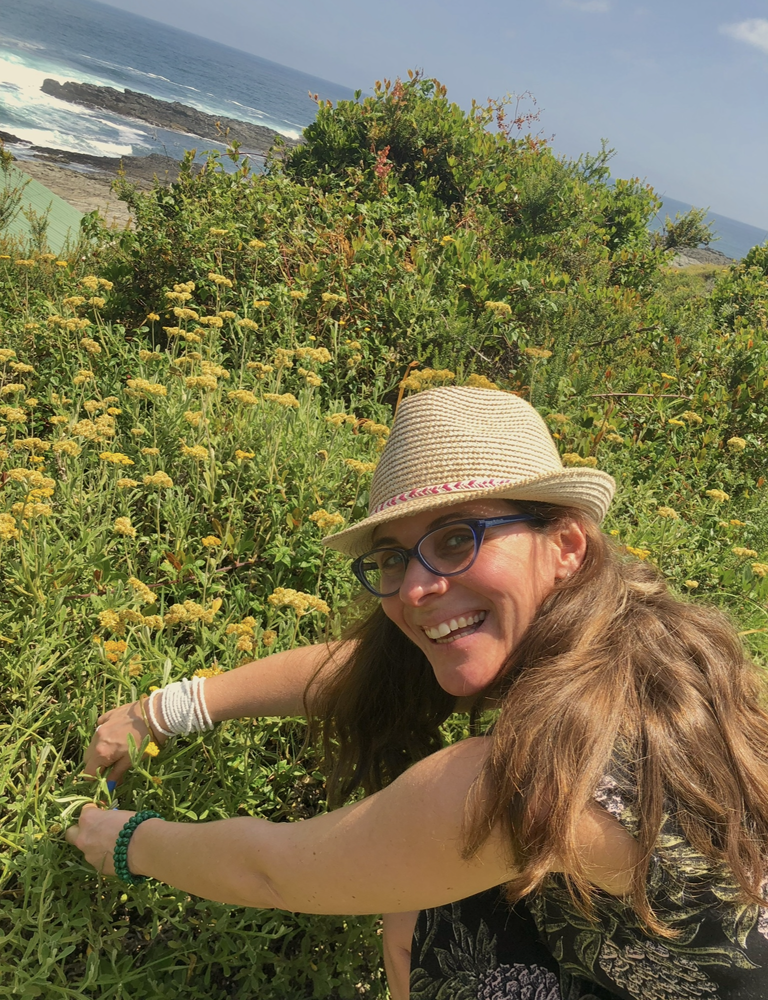
BIO: Rebecca Rogerson she/her is an anti-oppression-based scholar, author, folk herbalist and educator. She lived and worked for two decades in this capacity in South Africa, Botswana and Tkaronto. She taught in the Social Service Worker Program at Seneca College for a decade. She has authored multiple editions of HDEV, a tertiary-level textbook, and co-authored a neuroscientific-based paper about trance. Rebecca has a Master’s in interdisciplinary studies focusing on Bungoma healing practices as decolonization praxis. Rebecca, a neurodivergent who has an invisible disability, adores cultivating plants and channels her rage, despair, and healing efforts into creative writing, amateur opera singing, and disrupting systems of oppression in small but ever-growing ways in unceded Sinixt territory in British Columbia.
Discover more from Feminism and Religion
Subscribe to get the latest posts sent to your email.
 Feminism and Religion
This was hard to read. Not because the writing wasn’t excellent, and the poetry amazing. But because the subject matter was so painful. I truly felt as if stones were trapped in my throat. I’m sorry for what your Grandmother went through.
Unfortunately stories like this are all too common. Especially in religious communities. And in some cases like America, they don’t even have to hide. They have arranged marriages with little girls. And the government does nothing because it’s “religious freedom”.
I’m sorry you never got to know her in life. Perhaps one day you will meet here on the other side. And maybe share tales of happier times. For even in the shadows, you can find some ray of sunshine, or moonlight, through the cracks. That’s cold comfort right now.
But later it might not be.
M
LikeLike
Thank you for your empathy. The healing has been in finding out I had an aunt, leaning of my Jewish identity in my teens, and having a spiritual practice that centres ancestral healing.
LikeLiked by 1 person
That’s beautiful.
The Ancestor’s are (usually) always the way to go. Although some of my ancestors weren’t very nice lol. But you have created something beautiful and soul provoking. Something that makes people reevaluate life. I will be on the look out for your works in the future.
LikeLike
Powerful, heartrending, personal, transpersonal; this impossible suffering… I have no answers. Only prayers in my unknowing.
“Water reigns down reminding me not to freeze like the edges of the winter river that meets the Anthropocene daily.”
Your words and poetry speak to all – recognized or not.
I for one salute you and read the stories written in stones…
LikeLike
Thank you Sara. I’m glad to hear you read and listen to the stories in stones too!
LikeLiked by 1 person
I replied to today’s extraordinary post too – but they would not let me comment – your image cut through me like a knife – Mountain – well I came here for the same reasons you did only to watch my beloved trees disappear
LikeLike
Rebecca! Wow! Your writing here spills, vomits, screams, beckons trust too. The language you employ scares and scars and swells with redolent, sweating, swollen power. May 1st. A new month in a year already teeming with “newness” which in essence is the over and over again of what was, what is, what will and can be. The Hidden Letters of Velta B, Stones From a River, The Weight of Ink, along with The Tempest are marked in my bones of how and what and why words do as they do. Your piece of writing here is as their very sibling. “Our stories hide in bones and stones. Rose water kisses us back to life even when she’s still a rosehip, a seed yet to bloom.” Abundant gratitude to you and your choice to word.
Sawbonna,
Margot/Raven Speaks.
LikeLike
Thank you, Margot for your poetic response and for sharing works that have been definitive for you. I’m so grateful for this forum and for having a home for these works.
LikeLike