


This post was originally published on March 3rd, 2014.
Sometimes we think of Greek myth as a pre-patriarchal or less patriarchal alternative to the stories of the Bible. After all, Goddesses appear in Greek myths while they are nearly absent from the Bible. Right?
So far so good, but when we look more closely we can see that Greek myth enshrines patriarchal ideology just as surely as the Bible does. We are so dazzled by the stories told by the Greeks that we designate them “the origin” of culture. We also have been taught that Greek myths contain “eternal archetypes” of the psyche. I hope the brief “deconstruction” of the myth of Ariadne which follows will begin to “deconstruct” these views as well.
 Ariadne is a pre-Greek word. The “ne” ending is not found in Greek. As the name is attributed to a princess in Greek myth, we might speculate that Ariadne could have been one of the names of the Goddess in ancient Crete. But in Greek myth Ariadne is cast in a drama in which she is a decidedly unattractive heroine.
In the story told by the Greeks, Ariadne falls in love with Theseus, a handsome young man who was sent with 11 other Greek young people to be fed to a monster (who is half man, half bull) known as the Minotuar. The Minotuar is Ariadne’s half brother (see below). Because of her “love” for Theseus, Ariadne helps him to murder her brother. She then flees with Theseus on his boat.
However, this “love story” does not have a “happy ending” as Theseus abandons Ariadne on a nearby island–long before he arrives home in Athens. Theseus is ever after celebrated as a hero who killed a monster, while Ariadne is just another cast-off female. Whose story is this?
According the Greeks, the Minotaur demanded human sacrifice—6 boys and 6 girls sent from Athens to Crete every year. The mention of human sacrifice is a tip-off that this is a “tale with a point of view.”
The ancient Greeks were one of the originators of the “tall tale” that conquered peoples were “barbarians” who needed to be taught by “civilized human beings.” How can we tell a “barbarian” from a “civilized human being”? The Greeks had a simple answer to this question. “Barbarians” have weird sexual appetities and worse, they sacrifice and eat other humans. Sadly, this “tall tale” continues to be re-told up to the present day in order to justify conquest. (Who among us has not seen the movies and cartoons in which “half-naked” “natives” cook up other humans in stew pots?)
Where did the monster known as the Minotaur come from? Here the Greeks tell another “tall tale.” The Minotaur was the product of the “weird sexual appetites” of Queen Pasiphae. Like her daughter Ariadne, “Queen” Pasiphae was no heroine. Rather, she was cast in the role of ancient Cretan “porn star.”
According to the tale told by the Greeks, Pasiphae, like her daughter, “fell in love”—but in her case, not with a Greek hero. Pasiphae not only loved a bull, she lusted after it and desired to “mate” with it. The fantasy of women mating with large animals (with large “members”) is the stuff of pornography up to the present day.
Pasiphae’s “lust” for her bull incited her to engage the engineer Daedalus (of Icarus and Daedalus fame) to create a mechanical contraption that would enable her to mate with the bull. The result of this folly was a monster child—the Minotaur. As soon as she gave birth to him, Pasiphae abandoned her monster child in a cave where he grew up and began demanding human sacrifice.
The “tall tale” told by the Greeks about ancient Crete was concocted to “prove the point” that the ancient Cretans were barbarians. The weird sexual appetites of a “barbarian Queen” produced “a monster” who demanded the unthinkable—“human sacrifice.” Ipso facto—conquest was necessary and justified in order to save “the barbarians” from themselves.
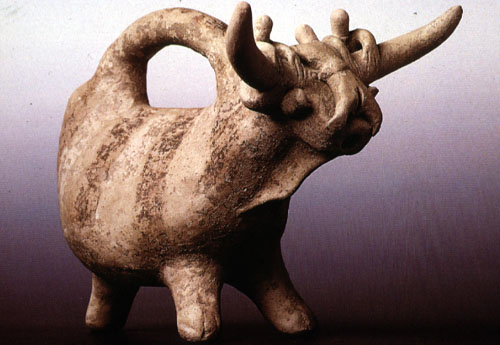 How might the ancient Cretans themselves have told these stories?
In the Greek story, Pasiphae is a twisted “Queen” in an ancient Crete imagined to have been ruled by her husband “King Minos.” But there is no convincing evidence that there ever was a King or a Queen in Crete before it was conquered by the Greek-speaking Mycenaeans. What if ancient Crete was a matriarchal culture in which grandmothers and their brothers created “participatory democracy” where there was no hierarchy of the sort that produces Kings and Queens? I have discussed egalitarian matriarchy (which is not the opposite of patriarchy) in an earlier blog. In ancient Crete the cave was not a place where fearful monsters dwelt. Rather, caves were understood to be the womb of Mother Earth, a place of birth, rebirth, and transformation.
Ancient Cretan art suggests that bull-leaping games were an important part of Cretan rituals. The major excavator of Knossos believed that both boys and girls participated in it. Could the memory of this have led to the notion that both boys and girls were sacrificed to the Minotaur?
It is often said that bull-leaping was a dangerous game and that the bull was sacrificed, but I imagine a different scenario. What if bull-leaping was a sort of “4-H” project in which young teen-agers raised bulls and trained them to play leaping and dancing games? The children who performed acrobatic feats with their pet bulls, would of course have loved them, but such love would have had nothing at all to do with lust.
Such a bull, as I imagine the story, would not have been sacrificed or eaten, but would have been set out to pasture after the games. He would have been prized for his “gentle” qualities and tameness and would have been allowed to sire other bull calves to take part in future games.
Ariadne may have been the name of one of the girls who took part in the bull games. Perhaps her name was remembered because she was the most agile and graceful of the leapers and dancers in the rituals with the bulls.

Here we can see how patriarchal cultures transform the symbols of earlier cultures and distort their meaning in order to drain the power from them. In so-doing they justify their conquest and make their domination of other peoples seem right and reasonable. In time, even the conquered and dominated come to believe that the myths told by the victors contain “eternal truths.” No more!
An earlier version of this piece was published with different format on Pagan Square/SageWoman Blogs.
Readers of this post might want to share Selene: The Most Famous Bull-leaper on Earth by Z. Budapest with the girls in their lives.
Discover more from Feminism and Religion
Subscribe to get the latest posts sent to your email.

 Feminism and Religion
My mother introduced me to Medusa and Greek mythology as a terrifying woman with a head full of snakes (my mother was afraid of snakes…) And when I began to study world mythology as an eco-feminist I bought in to these twisted stories with great discomfort that came to an abrupt end when I discovered that Medusa was victimized – not a figure to fear – Fortunately for me I was also studying Indigenous mythologies and after a while it became clear that Greek and Roman myths were so biased because of the fact that they ignited more patriarchal bull____.Does anyone remember the story of Ferdinand the Bull – the gentle creature? Well I latched onto him as a ‘friend’ – and this picture stuck – so I never got caught by Thesus etc…of course we may never know the original story but Carol deconstructs the craziness opening the door to the truth that both women and animals were used and victimized ad nauseum. Greek and Roman myths lead patriarchy on and feminists of all persuasions need to deconstruct these brutal stories – especially now when women have los so much power…..
LikeLike
These arguments will lead to nothing. Evans’ excavations were already biased and influenced by a pro-feminist point of view. They are biased. It is difficult to say what was there and how it was in Crete. Everyone pulls the blanket over themselves, trying to defend their PRECONCEIVED point of view. They abuse patriarchy and idealize matriarchy (a misnomer). Others try to follow a more objective point of view and do not make loud statements. It’s a pity Carol wasn’t in the second group.
LikeLiked by 1 person
I have a real problem with this comment. I do not know what issues you had with Carol but she had an open mind was learning up until the time of her death and understood patriarchy like few still do. As a scholar she unpacked all kinds of stories presented various points of view and her own – Carol was a LEARNER not a knower – her arguments were and remain sound.
LikeLiked by 2 people
Yes, I agree with you, Sara. Carol wasn’t “set in her ways.” She was open to scholarship, asking and asking questions about “what is.”
LikeLiked by 1 person
Oh wonderful Esther – thank you so much – Carol was the antithesis of being set in her ways.. I use the word’ wise’ rarely but Carol was wise in ways some can’t comprehend.I am baffled as to why this person would even bother reading our essays, Thank you for responding
LikeLiked by 1 person
These discussions are not for comment. You can worship her any way you want. I don’t see anything wrong with that. You and Carol have the same point of view. I have another one. And no, Carol understood patriarchy like any feminist. Her position is not unique (judging by the posts here). I’ve read her articles. About the goddess and that it is necessary to replace the modern god with a goddess. Her arguments are ridiculous. I would like to have a personal discussion with her, but it’s too late…
So what if she was a Student? Can’t a student be biased towards the same camp with data that she personally “enjoys”? Science has been partially politicized throughout its history. Modern science suffers no less from this. Just like Carol. Okay. This is really a very deep discussion and it is not for comments. I expressed my point of view. I don’t think Carol is bad. She had her own point of view. It’s just not a fact in the last instance. Especially with regard to the patriarchy (I have already commented on her posts on this topic).
P.S. In order to assert that her arguments are justified, a series of discussions with her participation with various other representatives of the movement unrelated to feminism is necessary. The validity of arguments is emerging in discussions. But like I said. She did not have a unique understanding of patriarchy. I’ve heard this point of view from many feminists. It’s not just unjustified. It is false.
LikeLiked by 1 person
I refuse to debate this issue any further – believe what you wish.
LikeLiked by 1 person
I fully support your point of view and wish you the same. Have a nice day.
LikeLike