

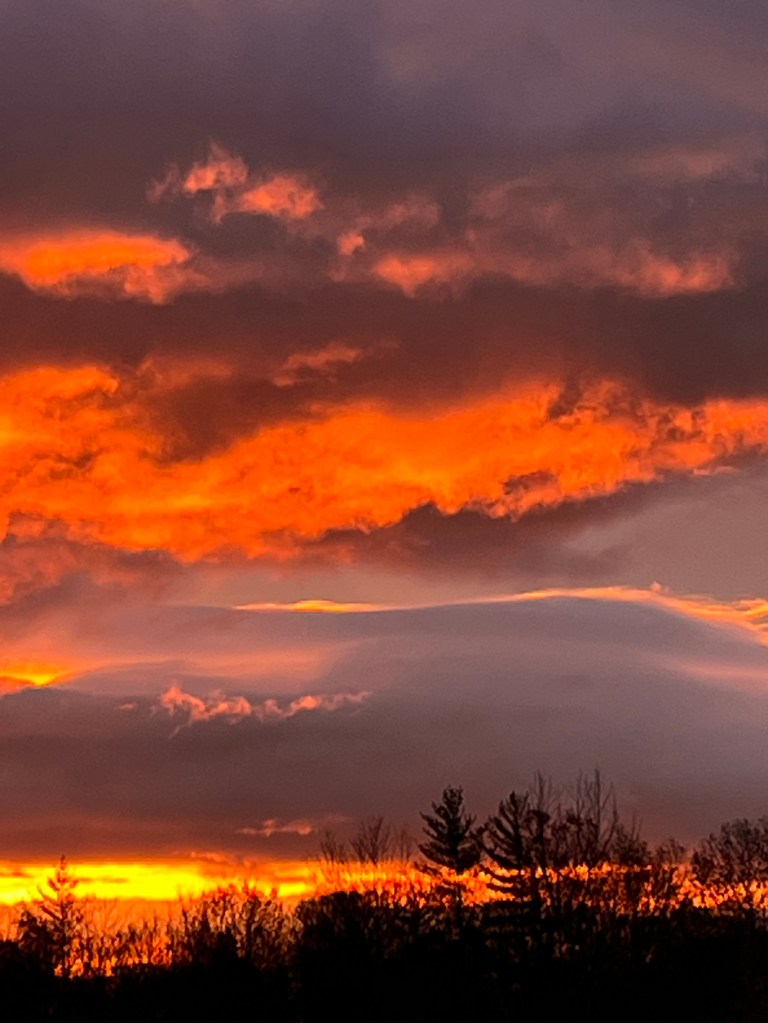
When I first heard the ‘trumpeting’ and ‘brrring’ it was less than an hour before dawn, but one aggregation was already on the wing headed west, away from the fields. Because their direction led away from the fields, I feared we would not see the Sandhills at all. It was All Saints Day, a time to give thanks to those creatures and people who have helped us along the way. (Sandhills have been been a beacon of Light in my own life). A bloody red sky turned deep rose as the sun shattered the charcoal outline of distant mountains, turning them carmen red. The wind was fierce as I walked up and down the sides of the open agricultural fields listening intently. Gunshots rang out and I wondered where these might be coming from. In Maine it is illegal to shoot migrating cranes. The sunrise was spectacular. Clouds spun themselves out of ruby, slate, and violet hues. Indescribable.
Although snow buntings, red winged blackbirds and two harriers were scrying the skies around the fields after dawn I only had eyes for sandhill sightings!
I had learned while living in NM that listening for cranes most often led to sightings in the fields nearest the river… and I structured my days around crane comings and goings so that I would not miss pre-dawn bugling and rattling, when the birds took flight from the riffles or witnessed their fantastic parachute -like touchdowns at dusk when I would welcome them home. I often spoke to them while they soared above me, thanking the birds for this gift of their presence. They settled in small family groups close to the river but always together. On a clear night I would walk to the river to discern the outline of the solitary crane who watched over the others so they could sleep safely through the night…Coyotes and Cougars were ongoing threats.
Back to my story. When my friend returned with the bird group I had not yet spotted the ones that I heard earlier but I knew from those rills that one group had to be around somewhere.
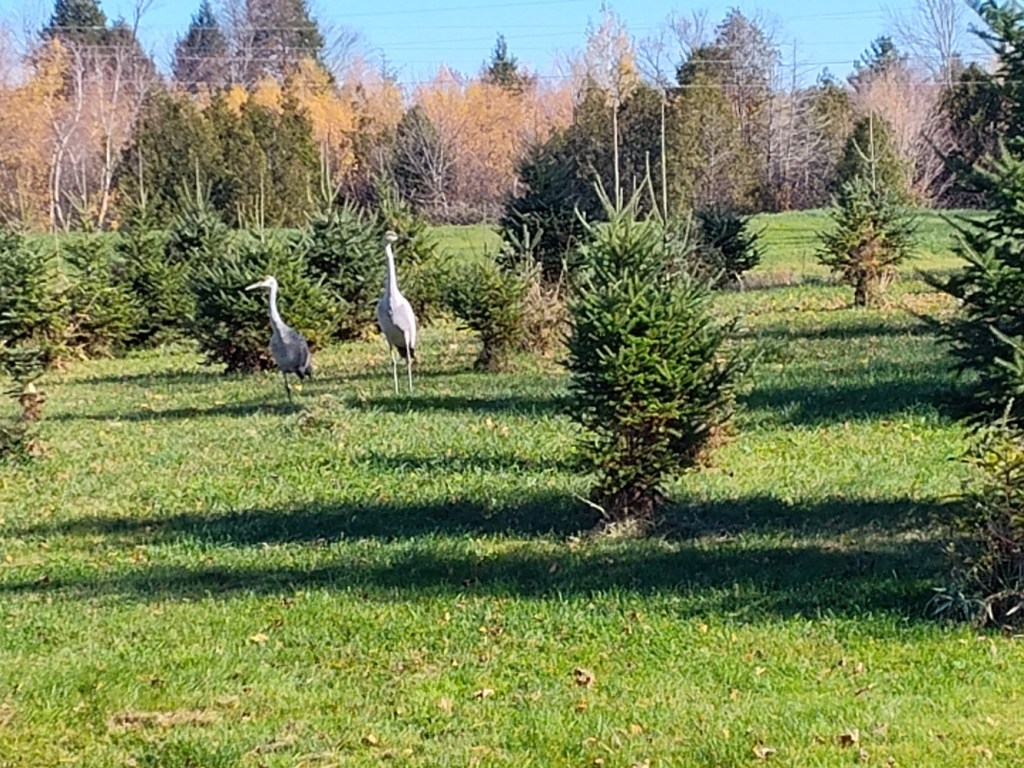
Finally! Well after dawn we discovered some feeding in the distance (the bird people counted 74 – I was lost in bird presence). Scopes appeared so it was possible to watch the cranes leaping, jumping, cavorting with each other while flapping their six- foot wings as they communed with their families, children and friends. Losing time in my excitement and joy I disappeared until their haunting cries rang out over my head. It is impossible to convey how I experience those collective cries as an inner bell that has something to do with hope, in addition to an outer vision of astonishing beauty.
These predominantly gray four feet tall birds with red top knots are migrating south in large families along the eastern flyway. We do not know where this aggregation might find their winter homes. But cranes fly by the thousands together during the day and on some moonlit nights.
New Mexico and central America provide winter home places for most who use the central flyway.
Unfortunately, the flyways are also open to hunting in most states. I am not sure why, but in NM at the Bosque Del Apache Reserve where thousands of cranes gather for the winter reprieve these birds are also under the threat of the Fish and Wildlife’s mandate to hunt.
In my opinion Fish and Wildlife folks seem to support and lean into the kill everywhere across the United States even while calling themselves a conservation agency. I think of the barred owls – half a million to be shot over the next 30 years to ‘save’ the spotted owl. Beyond comprehension. This behavior constitutes ‘good’ science???
Cranes are ancient birds. Some say these birds are sixty million strong, others suggest that they migrated over the bearing straight around 12,000 years ago.
I look to the stories of Indigenous peoples for more clues because these people learned about their relatives from keen observation of birds that were passed down intergenerationally.
The Anashinaabe (northern tribes) call the Sandhills ‘the echo – makers’ and consider this bird to be ancient spirit guides that assist with transitions from life to death, as well as a species capable of communicating with ancestors, human and otherwise). The Crane Clan is honored because they are the storytellers who pass the story on. It interests me that so many other peoples across the globe also see the crane in this light. These stories are older than any western theories but are not taken seriously because Indigenous peoples use the oral tradition instead of the written word. ‘Proof’ isn’t an issue to Native peoples who have been paying attention to the rest of their relatives for a very long time. My guess is that these birds are much older than conventual science suggests. The species itself is ancient, with a fossil record dating back 2.5 million years.
What new insights might we glean if we married conservative science, the work of naturalists, ethologists, ecologists, with Native Mythology?
I think this is a very important question to ask. Every lens tells a different part of the story, and we can never see the whole.
I close with a quote from Aldo Leopold’s Sand County Almanac and a poem of mine
“A dawn wind stirs on the great marsh. With almost imperceptible slowness it rolls a bank of fog across the wide morass. Like the white ghost of a glacier the mists advance, riding over phalanxes of tamarack, sliding across bog meadows heavy with dew. A single silence hangs from horizon to horizon…
“…High horns, low horns, silence, and finally a pandemonium of trumpets, rattles, croaks, and cries that almost shakes the bog with its nearness, but without yet disclosing whence it comes. At last a glint of sun reveals the approach of a great echelon of birds.
“On motionless wing they emerge from the lifting mists, sweep a final arc of sky, and settle in clangorous descending spirals to their feeding grounds. A new day has begun on the crane marsh.”
Here is a poem of mine:
Daughter of the Cranes
When I see them
I enter the Dreaming.
In the background
a jagged coat of barren
reptilian mountains
frames bountiful bodies
standing on stilts as
undulating necks,
crimson crowns
beaded eyes
dive below the surface
in search of last year’s grain.
Each deliberate step is taken
in syncopated rhythm
with those of nearby neighbors
Each three toed talon
pierces still waters.
Ruffling six foot wings
clasped close to form,
serpentine ropes dip and sway.
Cranes leap into thin air
when encountering old friends.
Parachute back down.
Relaxing into the calm mirror –
each one casts a silvery shadow
trilling, rattling, rolling, whirring,
brurrring with excitement
when greeting relatives.
Circling around before
making their descent,
cranes bounce off the field
as they land!
Always in communion
echo makers converse
with others in nearby ponds
in the hushed chamber
of the lowlands-
a Bosque of Cottonwoods, lakes,
and reeds –
Cranes are always listening.
No wonder one can trust them.
As twilight deepens,
they fall soundly asleep,
thin billed domes
nestled deep in warm flesh,
scaly feet sunk under oozing mud.
They dream an ancient language
tapping into fields
of primal patterning
Indigenous knowledge
Earth’s current keening.
Cranes know that
only by attending will they survive.
During the night,
One bird stands sentry…
Next month
they will begin
the great migration
a bi -annual flight made
year after year for millennia.
Cranes return to the same locations
thousands of miles traversed when
‘North Country’ calls them home.
Upon arrival, the birds
paint their plumage brown
blending into last year’s
wetlands to escape detection.
Mothers hover over two eggs
sinking onto nests
braided out of reeds.
A most attentive Protector
scans horizon and sky.
Nearby.
One chick might
survive to make the return journey…
But for now
these sentient Beings
celebrate community
by the thousands,
feeding in harmony…
The tranquil ponds echo
with a symphony of sound so
compelling, so enchanting
that I am swept
into the Heart of Creation,
folded into feathery down,
cupped by Primeval Wings
fringed ashen cloaks –
immersed in Natural Grace.
Discover more from Feminism and Religion
Subscribe to get the latest posts sent to your email.

 Feminism and Religion
For me when I see the cranes, I liken them to be messengers of Tehuti (Thoft). He’s a God of magic. And he does have a death aspect as well. Although almost all the Egyptian Gods do. They show up here in Florida as well. Very beautiful.
LikeLike
I feel a sense of shock that anyone would want to shoot these ancient birds. The way you have described them is magical and I love the way you touch souls with these creatures and blend into the landscape like an ancient tribal Grandmother. Your poem shows how these magnificent birds celebrate community, flocking and feeding in thousands. As you say, What lessons could be learned from cranes “if we married conservative science with the work of Naturalists, Ethologists, Ecologists with Native Mythology.” The poem is very evocative and I especially love the imagery of the last verse. Thank you for sharing this Sara, its beautiful.
LikeLiked by 1 person
Thank you so much!!!! – I love these ancient birds – and can never see them without thinking community – because this is how they live – and have lived for millennia – There is a soul charge attached to these birds – once you are in their presence nothing is the same. They are bridge makers…
LikeLike
I can’t comprehend the killing unless I remember that Patriarchy dominates and then it makes sense…. patriarchy is a disease we are all suffering from =
LikeLike
So beautiful. I am seeing and hearing the cranes through your words and Aldo Leopold’s. I hope to encounter them myself one day. Meanwhile thank you for this tribute, Daughter of the Cranes.
LikeLike
Oh Elizabeth I hope you do too – after living in NM I was heartbroken because I thought I would never see them again but now they are in Maine – maybe they will come to you too – if not – it’s worth a trip to see them at stopovers – there is something about them that ties us to the whole
LikeLike
Thank you for this, Sara. A great migration of Sandhill Cranes happens every year about an hour southeast of us. It is something to behold. Just yesterday we were trying to explain what an echo is to our two-year-old grandson. Next year we’ll take him to Crex Meadows so he can see the Sandhill cranes!
LikeLiked by 1 person
a wondrous event for a child at any age!
LikeLiked by 1 person