

It’s the last day of November and small groups Canadian geese are still drifting around on patches of open water. I saw two small groups on North Pond. Although many skeins have flown south along the Atlantic flyway – they can migrate south as far as Mexico and South America -some geese spend the winter along coastal areas in Maine if food resources are available. It’s hard to know whether these groups are migrators from Canada who have stopped over to rest or a few that winter over nearby on the Kennebec or elsewhere along the southern coast of Maine. With warming temperatures Canadian Geese migratory patterns are changing.
Soon after their arrival the female disappears to lay 8 – 10 eggs in her nest that is securely hidden in the reeds while her mate stands watch. When the goslings are born both parents escort them through the water, one parent in front, the other behind. If threatened the male becomes aggressive, a totally appropriate behavior from my point of view. When the little ones are big enough these birds join other families for the rest of the summer and some will probably migrate together. These are such community oriented birds. They make it a habit to get along. Geese are omnivores that will eat almost anything and they mate for life, returning to their designated ‘home’ places to breed year after year. Even before the chicks arrive geese are drawn to some of the 400 million lawns in this country (especially those that are close to water) much to the dismay of some.
Regardless, I think of the arrival of geese as harbingers of spring, and their migration/absence as nature’s way of ushering in the cold. In early spring I actively listen for their calls the moment a patch of open water appears and again before the ponds freeze over in fall.
Last spring on the night of April 14th one lone goose flew over my house honking with great enthusiasm. I was sure that this was ‘my gander’ and that he was letting me know that although he and his community were absent that he hadn’t forgotten me!
I was already missing my goose and his group that normally inhabit the marsh at the south end of North Pond. This year I was told they were chased away. I used to stop to visit and photograph the geese during the three seasons they lived here. I made friends with the gander who was the family watcher – a protector who kept a sharp eye on potential predators. I noticed that various ducks often shared the same area as the geese, and one year I saw this gander herding young ducklings off the road more than once. He would let me get within two feet of him before uttering a warning hiss when I photographed his progeny. If I stayed within a respectful distance he would respond to my voice with comments of his own. Year after year he spent his days keeping watch from same rock. His mate nested in the marsh closest to this stone. This year no geese nested in this wetland and I missed my friend.
Although I visited with other geese on other ponds all summer, I wasn’t there every single day, so friendships never had a chance to develop.
I was told that avian flu had affected some populations and was also a risk to people although there are no cases human cases recorded in Maine. The risk for transmission is so low as to be almost non – existent. I reached the conclusion that many people use health issues as an excuse to get rid of geese because they don’t like them.(mis- information has been normalized to such an extent that it is necessary to fact check everything one reads – annoying and time consuming).
I remember feeding geese as a child and watching how protective both parents were of their goslings with one goose leading and the other adult following and later how families intermingled with one another as well as with a variety of ducks that even included swans. Differences are tolerated in the goose world.
When I reflect on the role of the goose in world mythologies, I am struck by how many tales perceived the goose as mother, vigilant, protector, community oriented, a seasonal marker, a messenger from the beyond. Today when cartoons and robots carry the ‘divine spark’ these tales are relegated to nonsense but anyone who pays attention to live geese learns that these mythological qualities are based upon genuine geese behavior. Mythology is a valid lens through which to understand more about human or non-human species just as good science can.
My favorite story comes from the Anishinaabe peoples of the Great Lakes. In this tale Sky Woman investigates a hole that opens in the sky while holding onto a branch of the Tree of Life that suddenly breaks. Sky Woman falls into great chasm of darkness and keeps on falling. Far far far below her lies dark waters. When the animals glimpse Sky Woman’s fright the geese intervene breaking her descent by spreading out their wings to hold her. When the geese are exhausted water animals intervene, and the last little diver, a muskrat, brings a handful of mud to the surface and places it on a Great Turtle’s back providing purchase for Sky Woman who has finally found solid ground. As she seeds the earth all life on land begins again.
It seems to me that as a culture we have reached the place where Sky Woman fell, and that like her we may need the spirit of the geese to break our fall into chaos and darkness.
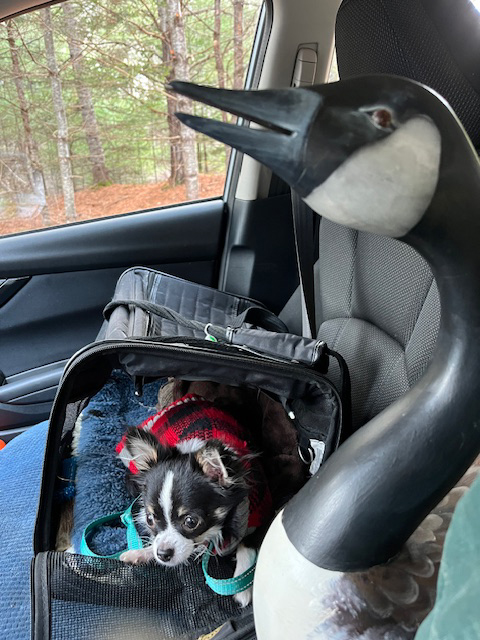
This brings me to an odd ending for this story that just happened two weeks ago when I went to the dump. Imagine my surprise when I noticed there was a goose sitting on the metal platform next to the grinder! Someone had rescued this decoy, a throw – a – way goose from being chewed up. Immediately I claimed him. Here was my goose! I put him in the car in between the two front seats, and there he remains, ever watchful scanning the countryside with two beady eyes even as winter sets in.
Discover more from Feminism and Religion
Subscribe to get the latest posts sent to your email.

 Feminism and Religion
“Differences are tolerated in the goose world.” When I was a child (in the ‘50s) I had a record with the story of the Churkendoose. The chicken, turkey, duck and goose took turns sitting on the egg, and a churkendoose emerged. He looks different from all of them, and sings “does the green grass ask the sky so blue, “I’m green, why aren’t you green too?”” A very early introduction to honouring diversity.
LikeLiked by 1 person
Oh wonderful!!!! gosh I look back and realize that I had no conception of needing diversity because I lived with so many other peoples… Latinos, Blacks Chinese etc and yet by looking like an ‘indian’ I was discriminated against and took the shame on as my own…so the diversity i was exposed to didn’t make room for Native peoples..
LikeLike
I love this goose tale. I also look for the flight and sound of geese as they fly south and north. For years some geese have wintered over here in open water. It is always so heartening to know that you keenly observe and understand not only the collective culture but individuals within a community. I am glad you have your own guardian goose as you travel.
LikeLiked by 1 person
Ha! I just woke up from a nap to see this post. And I said to myself,
“Oh Sara has adopted a Goose!”
And then I started to look closer and I realized it was a decoy
😆😆😆😆😆😆😆
LikeLiked by 1 person
I’d LOVE to have a goose family around but it’s too cold here in the winter…It’s sounds ridiculous but I love driving around with a goose! This guy is a gander – I think – but there is a fluidity so he might also be she!
LikeLiked by 1 person
That would be amazing. In my case what I have is an oppossum we’re feeding outside lol
LikeLiked by 1 person
I can totally relate to your love of geese. I am always lifted by the calls of the geese when they take off from the creek in the woods behind my house, and when they come back for the night. We seem to have a huge population here is Greenville County, SC. I have been able to see them at a lake on a college campus where they have their offspring and when they get a bit older, they go on ‘marches’ form part of the campus to the lake. And I’ve read that the goose is one of several birds associated with the Celtic Goddess Brigid (another is the swan). Some say they are intermediaries with the spirit world.
LikeLiked by 1 person
Geese are considered to be messengers from the beyond by a number of traditions including the Celtic goddess (they are for me) – They are remarkable birds – that ca teach us how to live – I’m happy you have them! Yes, I too love those marches!
LikeLiked by 1 person
Thank you for the reminder of the tale of Sky Woman. So much wisdom in it.
LikeLiked by 1 person
I think Skywoman’s story is our ‘hope’
LikeLiked by 1 person