

The Inuit make up about 88 percent of the people in Greenland, and most speak the Inuit language with the remainder speaking Danish.
Up until the present the greatest challenge the Inuit peoples have faced besides the threats to their culture/and massive environmental collapse due to climate change has centered around uranium mining and the ubiquitous Military presence.
Now an American Madman demands that the entire country be taken over to secure homeland security against the ‘enemy’ (himself?) What is rarely mentioned is that Greenland is also so rich in resources (so useful to ‘resource’ hungry America). This lunatic threatens to make everyone that refuses to support the takeover ‘pay’.
What never seems to make it into the news is that should this takeover happen the Inuit people who have subsisted in this harsh but magnificent peace of earth (peace used deliberately) for thousands of years will be destroyed. How is it possible that no one mentions that this is yet ONE MORE Indigenous culture that will go down under the tyranny of the colonizers? I repeat this truth for emphasis because Indigenous peoples are invisible in this culture, regardless of what is said. 500 hundreds year of oppression by foreigners isn’t enough?
The Indigenous Peoples of Greenland, Kalaallit Nunaat, are a self-governing country within the Danish Realm, and although Denmark has adopted the UN Declaration on the Rights of Indigenous Peoples, Greenland’s population continues to face serious challenges.
The Inuit Circumpolar Council (ICC), an Indigenous Peoples’ organization represents the Inuit from Greenland, Canada, Alaska and Chukotka (Russia), and is also a permanent participant in the Arctic Council.
Fishing is the primary industry of Greenland, whose diverse culture includes subsistence hunting, commercial fisheries, tourism, and the more recent emerging efforts to develop oil and mining industries.
The fishing industry is the largest source of income and is very important to the national economy. Also, it is the source of many people’s livelihoods across the country.
Those who are against uranium mining argue that the environmental and health risks for animals and humans are too high and that the community near the uranium mine will have to be relocated because of the danger of contamination. There is also a fear that the tailings from the uranium mining will contaminate the environment for thousands of years.
The uranium project led by Greenland Minerals and Energy is still under development.
The Inuit are a vibrant, self-governing society that blends ancient traditions with modern life, with strong cultural ties to hunting, unique art, and the Kalaallisut language. Traditional hunting fishing life also includes wage earning jobs. Hunting seal, narwhal, fish and reindeer remains vital for food and cultural continuity, with traditional skills passed down through generations. A thriving musical culture blends traditional styles with popular music. Some of this artistry has gained international attention. Traditional animal-skin clothing is worn with pride at festivals. There’s a strong movement to reclaim and promote heritage through art, food and storytelling.
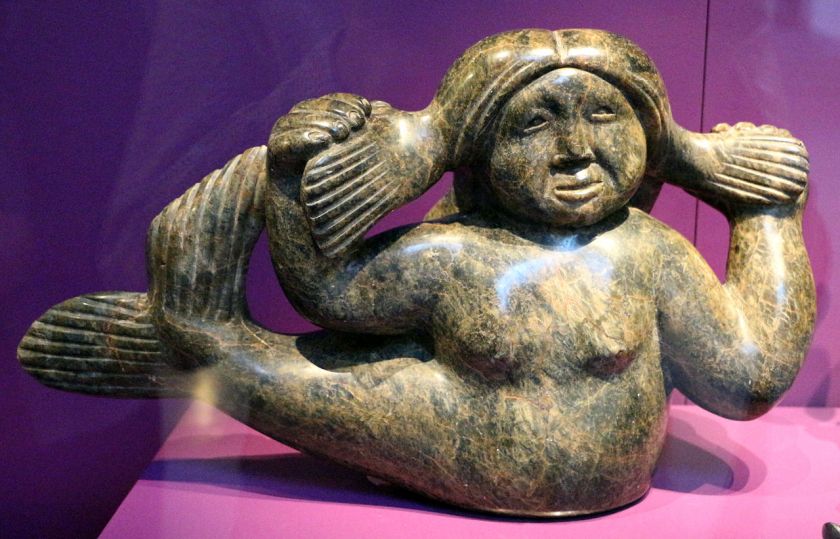
Since reciprocity with nature is a given hunting is a spiritual act. Hunters must follow specific rituals and taboos to respect the animal’s soul and ensure it offers itself as prey again in the future. In the most powerful hunting ritual of all shamans travel below the sea to entreat to the powerful Mother Goddess Sedna to release some of her sea animals so the people might eat. Combing her long hair helps her let go of her beloved animals; She is a protectress of all sea animals and those that spend part of their time on land.
Inuit spiritual practices are traditionally rooted in the belief that all people, animals, plants, and even inanimate objects possess a spirit (breath), For the Inuit, spirituality is a means of maintaining balance and harmony in a harsh and unpredictable environment. Every living and non-living thing has a spiritual essence that continues to exist after death. Spiritual inhabitants live in specific locations like mountains or lakes and humans are often viewed as having multiple soul components that depart after death. The personal soul can be reborn after death.
Shamans and their helpers (of either gender) mediate the human world with the spirit realm using drums, chanting, trance to enter other realms to meet with powerful spirits who can diagnose, heal, prophesize or influence the weather. Newborn children are often named after deceased relatives to inherit their spirit and personal qualities, a practice that resonates with reincarnation.
There is a growing movement in the 2020s to reclaim and openly celebrate traditional practices like drum dancing and facial tattooing though suicides are rising among the young, a world problem the root of which is still not being addressed. American psychologizing still reigns with every ailment tied neatly and stored in its own isolated box (see DSMR).
What I learned from writing this essay is that Inuit practices mirror those of other intact Indigenous peoples in the United States with the usual cultural variations.
Overall, the contemporary Greenlandic Inuit are a dynamic people, deeply rooted in their Arctic environment and history, yet embracing modernity and actively shaping their future with a unique blend of resilience, tradition, and innovation.
Until now that is.
Postscript 1
I had a shocking revelation just after I finished this essay while walking on too dangerous ice in my woods with my Coalie – ice too solidly frozen for a person who weighs under 95 pounds.
When I was 38-39, I worked for a year with a counselor who wasn’t – she asked us as a group to create special dolls out of string and the one I created shocked all the others. Mine had my grandmother’s piercing silver button eyes and instead of legs her lower half was woven into a long curving tail – her hair was untidy long straggly and unkept – I was embarrassed because all the other dolls were cute, most wore pastels, had flowers and curled hair, stars in their eyes. All wore smiles and had mouths – mine didn’t even have a mouth. My doll who sort of came to life as I made her also fascinated me because she emerged as a fish woman a kind of mermaid the likes of which I had never seen. But as soon as she joined the others, I thought her quite ugly and she definitely was NOT pink but a tangle of gray and green washed in pale blue and tawny string.
Today, 40 plus year later I’m quite astonished. I think Sedna might have been trying to make herself known to this devoted animal woman- lover and I threw her out. I hope I don’t miss her this time around.
Last week I had a dream that I was stuck on a round rock in the middle of a mostly frozen lake. Someone was swimming in the water to help me, but behind this person was a large FISH. I didn’t know if the fish was coming to me or just moving by. A Fish?
Postscript 2 Role of the Seal as Sedna:
‘The harp seal is a powerful symbol and direct manifestation of the Inuit sea goddess Sedna, as her fingers transformed into seals (and other marine animals like narwals/ whales/walruses) when her father cut them off, making seals her children and extensions of herself, thus representing her role as the provider and ruler of all sea life, with art often showing her with seal features or surrounded by them. She embodies transformation, sustenance, and the balance of life, with shamans sometimes visiting her in spirit to comb her hair to ensure the sea animals rise for hunters.
In many myths, Sedna’s severed fingertips become seals, making them her physical children and a source of food for the Inuit people.
Sedna is the Mother of the Sea, controlling all marine animals, including seals, whales, and walruses, and only releasing them when appeased.
Inuit carvings and art frequently depict Sedna with seal-like features, such as seal ears or flippers, or surrounded by seals and other sea mammals, blending her human form with marine life.
Seals are crucial for Inuit survival, and their availability depends on maintaining a good relationship with Sedna.
Like the seal, Sedna embodies both abundance (provider) and potential wrath (withholding animals), reflecting the unpredictable nature of the Arctic sea.
The above is taken from AI for my convenience. As a mythologist I am very familiar with this particular story for a number of personal reasons so I know this information is accurate.
Discover more from Feminism and Religion
Subscribe to get the latest posts sent to your email.

 Feminism and Religion
Thank you for this important post, Sara! Sharing!
LikeLiked by 1 person
OMG this is horrible! Thank you for making us aware of what is happening. It will be tragic if /when he gets his selfish capitalistic way.
LikeLiked by 1 person
Your story about Sedna inspired me to pick up a doll I made some 40 years ago at a workshop who now sits neglected on a shelf. She is sunshiny: made from a yellow washcloth with a golden crown/hair. And she has tiny seashell breasts and vagina! Thank you for this reminder to appreciate the support I have received along my path.
LikeLiked by 1 person