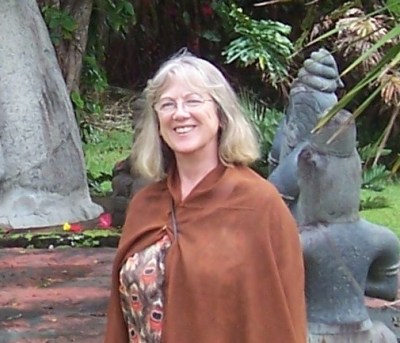
Corona: Reclaiming Sovereignty in a Culture of Addiction by Eirini Delaki

The moment we live right now is one of its kind in the history of humanity. There´s an expansive wave of uncertainty, fear of death, panic and, at the same time, an expansive wave of creativity, hope, compassion and unity. We´ve never been so isolated from each other and yet so close…

I believe that there´s a great opportunity in what is happening right now. The opportunity that the fear of death will awake us in realizing that we’ve already been living our lives “infected” by all sorts of habits that were taking life away from us.

There´s a symbolic frequency in the word Corona, like in Corona virus, that holds the key to transformation through this experience. Corona means crown. It also refers to the aura of plasma that surrounds the sun and other stars. When a baby is born, we call that “crowning”, since its head comes out first, if all goes well. This pandemia is a radical wake up call to recuperate our sovereignty, to shine, to be reborn into our authenticity. The seventh chakra, that is the vortex of our energy system, situated at the top of our head, is called Crown Chakra. When that vortex is balanced, we experience unity, the knowledge that there´s an intrinsic law underlying all of existence, serenity, joy, and deep peace about life, beyond intellectual knowledge. Continue reading “Corona: Reclaiming Sovereignty in a Culture of Addiction by Eirini Delaki”

Are Your Shackles Showing? Hyperbole, Metaphor or Shades of Reality? by Karen Tate

Note: These Comments Might Trigger You
You’ve been held in a windowless room for a long time.  So long, you can’t remember how long it’s been.  You have shackles on your ankles.  Sometimes you can see beyond your sleeping pad, sometimes not so much.  You’re instructed to perform tasks assigned to you according to the will of your captor.   Most days you work so long you feel as if you’ll drop.  Sometimes you have enough food to eat, other times not.  It’s cold and damp in this holding cell where you’ve lived most of your life.  You’ve been sick here, but you have no access to a doctor.  You’ve been beaten regularly, physically and verbally,  for infractions perceived by your captor.   You still have the bruises.  You’ve not been outside this place for so long you’ve stopped scraping the number of days you’ve been held captive onto the walls. 
But, sometimes, you can faintly hear a voice whispering to you from the outside.  It’s a voice that calls to you in quiet moments when the usual crushing noise more easily heard doesn’t drown it out.  It’s hard to understand the words the voice is speaking.  They sound so foreign to you.   The voice suggests there is something else outside this cell.  When you ask your captor about it, the reply is always the same…laughter, mocking, anger.  So you become afraid to listen.


Then one day your captor gets careless.  Or maybe you’re listening closer.  The incessant noise seems less.  Your captor forgot to lock the shackles on your ankles and bolt the door.  You hear the voice outside.  It offers you something else.  It sounds too good to be true.   You’ve heard your captor say as much.   You’d been told that the voice offers empty promises that will never become reality.   But you ask yourself how much longer you can go on here?  So, you stand up at your sleeping pad.  Your legs are shaking.  The hair is standing up on the back of your neck  and carefully, timidly, you walk toward the unbolted door.   You reach out.  Your hand is shaking as you place it on the knob.  You see the red marks from old bruises on your wrists.  Something inside you knows you no longer can tolerate this cell.  Only, it’s all you’ve ever known, or it’s all you remember.

It’s your moment of truth.  You might not get this chance again in your lifetime.  Do you turn the knob?  Do you step across the threshold and move toward the voice?  Or do you shrink back, fearfully choosing the familiar, the devil you know?  Do you choose the somewhat reliable crumbs  laced with indifference and resentment your abuser has been dishing out for years?  Can this really be all there is?  Or can you find it in yourself to take a leap of faith?  Are you going to continue a life of institutionalized abuse and exploitation or are you going to walk across the threshold into a different  life?

Continue reading “Are Your Shackles Showing? Hyperbole, Metaphor or Shades of Reality? by Karen Tate”

Insights on Sisterhood: An Offering to the Great Goddess by Eirini Delaki

I have been facilitating women’s circles in Europe since 2006. This has involved years of deep, challenging, thankful, and fun teaching and learning. During that time, I have collaborated with different facilitators in the fields of art and spirituality and connected with different cultures, experiences that have reinforced a vision of SISTERHOOD.

Let me clarify that in no manner am I excluding men from these reflections. On the contrary, I believe that many dysfunctional and suffering men have been shaped by women who haven’t managed to stand up for themselves. They harm their children through manipulation while not directly challenging an oppressive system out of fear or a need to feel accepted and to belong.

My students and I are going through an important transition. Most of us come from parents who have spent their lives seeking material possessions, safety, comfort, and success in terms of competition enforced through harsh discipline. Then we moved to the other extreme: we have a reactive attitude towards the previous patterns that is manifested as procrastination, avoidance of tasks that involve responsibility towards ourselves and others, being too permissive, confusing freedom with doing whatever feels right at the moment, and so on. Continue reading “Insights on Sisterhood: An Offering to the Great Goddess by Eirini Delaki”

Matriarchal Politics by Heide Goettner-Abendroth

Today’s blog is a sequel to: “Matriarchies Are Not Just a Reversal of Patriarchies: A Structural Analysis.”

On the basis of modern Matriarchal Studies, we can develop the vision of a new matriarchal, egalitarian form of society. This is called “Matriarchal Politics.”

The path to such a society has to combine matriarchal spirituality with politics, to create another kind of economy and another society. How this can be achieved is clearly portrayed by traditional matriarchal societies. Their economy, politics, social life and spirituality are inseparably connected: their goal is to provide a good life for all and this is assured through their structure and conventions.

Of course, we cannot go back and simply transfer historical patterns to the present.  It is unlikely that we will return to societies based on the blood-relatedness of clans or sole dependence on agriculture. History and its social development cannot be turned backwards. But for our own path into new matriarchal, egalitarian societies, we can gain much stimulation and great insights from patterns which have been tried and tested for millennia. Continue reading “Matriarchal Politics by Heide Goettner-Abendroth”

Beth March and the Courage of the Gentle Giver by Cathleen F

As someone who spent my prepubescent years watching director Gillian Armstrong’s “Little Women”, I was eager to see Greta Gerwig’s newly released version. Previously unexplored contours of each character, and of my changed perceptions, were made visible through this iteration. The most difficult and touching part of the film that lingers with me is the story of Beth, pianist and caretaker. Beth’s untimely death brings grief into the center of the March family narrative, and Gerwig’s portrayal brought up grief in me about my experiences with invisibility as a paced introvert in a culture that celebrates speed and extroversion.

I grew up wanting to be like Jo March, the outspoken, reactive protagonist. Jo was the rebel, the obvious feminist, and, mostly importantly to me, the brave one. Beth seemed to me to be boring, relegated to a life at home, bound by illness and a preoccupation with the needs of neighbors. Her steadiness looked to me like obedience; she could not fight away the disease that eventually killed her, and I wished to be everything besides her, the introvert who observed and cared and loved music and then died. As I grew into my own introverted, observant, caregiving tendencies, I began to wonder if I had been tricked by my culture, by my upbringing, to think I was Beth when I was really Jo! While social pressures certainly influenced my personality, as they do for us all, I didn’t want to believe that perhaps I was growing into my natural temperament, endowed by the Universe, expressed in my mind and body. As a woman in the 21st century, as a feminist, I was supposed to be like Jo, not the way I was (am). To have a deliberate or tender nature was, in my subconscious perception, to betray the spontaneous, assertive natures of those more worthwhile feminists who got things done. Continue reading “Beth March and the Courage of the Gentle Giver by Cathleen F”

Matriarchies Are Not Just a Reversal of Patriarchies: A Structural Analysis by Heide Goettner-Abendroth

Matriarchies are not just a reversal of patriarchies, with women ruling over men – as the usual misinterpretation would have it. Matriarchies are mother-centered societies. They are based on maternal values: care-taking, nurturing, mothering. This holds for everybody: for mothers and those who are not mothers, for women and men alike.

Matriarchal societies are consciously built upon maternal values and motherly work, and this is why they are much more realistic than patriarchies. They are, on principle, need-oriented. They aim to meet everyone’s needs with the greatest benefit. So, in matriarchies, mothering – which originates as a biological fact – is transformed into a cultural model. This model is much more appropriate to the human condition than the patriarchal conception of motherhood which is used to make women, and especially mothers, into slaves.

Within matriarchal cultures, equality means more than just a levelling of differences. Natural differences between the genders and the generations are respected and honoured, but they never serve to create hierarchies, as is common in patriarchy. The different genders and generations each have their own dignity, and through complementary areas of activity, they function in concert one other. More precisely, matriarchies are societies with complementary equality, where great care is taken to provide a balance. This applies to the balance between genders, among generations, and between humans and nature. Maternal values as ethical principles pervade all areas of a matriarchal society. This creates an attitude of care-taking, nurturing, and peacemaking. Continue reading “Matriarchies Are Not Just a Reversal of Patriarchies: A Structural Analysis by Heide Goettner-Abendroth”

I’m Going Over the Cliff: How About You? by A Friend of FAR

Standing on the Edge

It appears that I am getting a divorce.

My husband and I have struggled – well, we have struggled – our entire eleven year marriage. We’ve had a lot to deal with: court problems with my first husband, lost jobs, financial struggles, blended family issues, in-law issues.

Not health issues. We’ve been blessed that way. And we’ve been blessed with two daughters who are seven and ten years old now.

But it has been a rough ride. And we have been on ‘the edge of the cliff’ just about our entire marriage. And it seems as much as the both of us have been determined not to fall off the cliff for such good reasons: we cannot financially afford a divorce, we both love our children so much and do not want to ‘split’ them, we’re both ‘good people’ at heart. It’s hard enough trying to raise four children (two sons from my first marriage) with just the two of us. How do you do it on your own?

Continue reading “I’m Going Over the Cliff: How About You? by A Friend of FAR”

Who Owns the Sacred? A Personal Search beyond (European) Indigenous Knowledge by Eline Kieft

For almost 35 years nature has been my sacred place. As an 8-year old, I started to pray to Mother Earth even though the protestant tradition in which I grew up only recognised ‘God the Father’. I went outside in my inflatable rowing boat to seek solitude (as an only child in a quiet family!) on a small island in the lake of our local park. I practised rowing and walking quietly to not break the sacred silence. I collected herbs to brew infusions in my little thermos flask with boiled water brought from home. I sung to the moon, and danced my love for all creation back through my moving body. Over the last 15 or so years, I spent many days and nights at Neolithic monuments, dreaming in ancestral burial mounds, time traveling in stone circles in Cornwall, Wales, Scotland, England, Ireland and Brittany. This nature-based practice evolved naturally, and later incorporated my training with the Scandinavian Centre for Shamanic Studies and the School of Movement Medicine. Nature is where I reconnect most easily with the Sacred, and listen to the whispers on the great web of life in which all of nature is a great teacher. Nature, for me, is a strong place of prayer, solace, awe, reverence, gratitude, joy, guidance, reconnection, healing and transformation. 
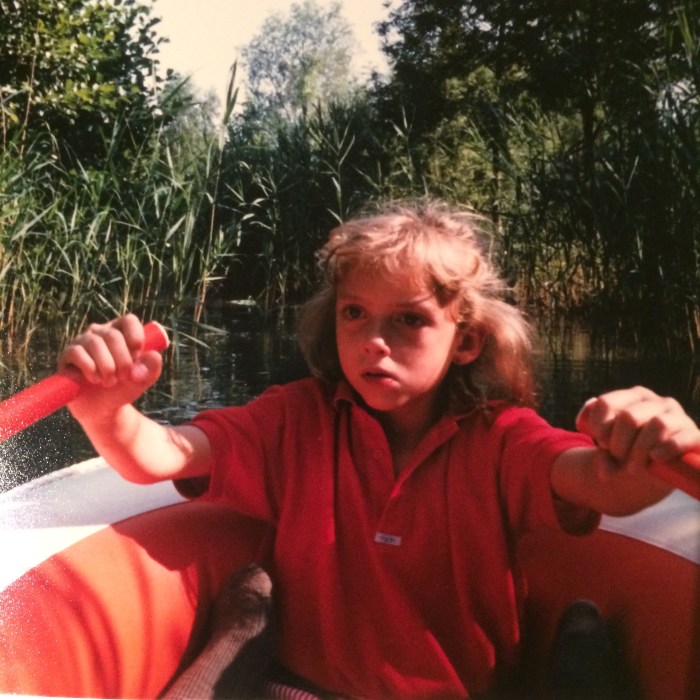
Rowing contemplation Image credits Henk Kieft

Yet I am confused. I am confused because although this way of connecting to the mystery feels the most natural and innocent thing in the world to me, my practice is criticised as “playing Indian” because I did not happen to be born into one of the indigenous traditions that kept nature-based (“shamanic”, for want of a better word) practices alive. Critique includes cultural appropriation in relation to colonialism and white privilege, as well as that any form of spirituality outside the five major religions is considered as empty, eclectic, post-modern consumerist product that lacks meaning and substance because of its diluted, selective ‘picking’ of traditions from other times and contemporary contexts.   Continue reading “Who Owns the Sacred? A Personal Search beyond (European) Indigenous Knowledge by Eline Kieft”

A Sword Will Pierce Your Own Soul by Mary Jane Miller

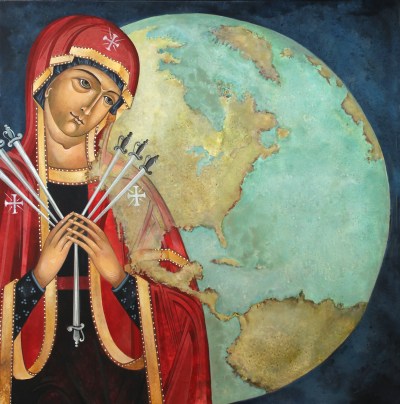
On Holy Ground is a collection of icons for this age of climate change. The collection of iconography opens with an image of Mary of Swords inspired by the number seven. This sacred number is associated with intuition, mysticism, inner wisdom, and a deep inward knowing. The ancient church speaks of seven deadly sins and seven holy attributes, and seven sacraments. The composition places the planet Earth beside Mary as she bows her head having been told, “ a sword will pierce Your own Soul ”
Mary of Sorrows or in this case, Mary the softener of Evil Hearts tilts her head lovingly towards our planet Earth. Seven swords pierce her heart; indicating the fullness and boundless sorrow, pain and “sickness of heart” that would have been experienced by Mary the Mother of Jesus at His crucifixion.
Muslims pilgrims circle the Kaaba in Mecca sevens times, and Egyptians had seven gods.

Continue reading “A Sword Will Pierce Your Own Soul by Mary Jane Miller”

Charity Is Not Enough by Susan de Gaia

Gift giving is an important focus this time of year, along with reflection, reconciliation, and renewal. This spirit of charity is needed now more than ever. And yet, charity is not enough.

Thousands of women, maybe even millions, re-experienced the trauma of sexual assault when the American public heard and ignored Donald Trump’s admission of grabbing women “by the pussy” and the accusations of forced kissing by numerous women, electing him to office in 2016. This was followed by additional revelations of his immorality and corruption and, in a show of conscience by one political party, his impeachment by the U.S. House of Representatives.

Many have wondered how such a man could get elected and remain in office despite the many revelations of illegal activities, and complete lack of honesty, repentance, and conscience. The recent response by Trump and his allies to an editorial in Christianity Today favoring impeachment yields a clue: criticize Trump, and risk losing politically, financially, or worse. Today, one can’t even speak out. How many of Trump’s accusers received death threats? How many of his extramarital liaisons received a bribe to keep quiet?

The waters are muddy in the Trump era: politics divide us into winners and losers, and “our” administration sides with those who praise one man and against those who dare to disagree, aided by conservative religious leaders and institutions. This is a situation that our founders meant to prevent. But it is happening.

Also happening are racial and gender inequality on the rise. To many feminists this seems nightmarish and unexpected. Some of us saw it coming, but the extent of its public acceptance and open justification was something few could foresee.

At the same time, women and men are coming together; I have seen my networks and others expand more than ever. The increasing support and understanding for women’s issues by people of conscience, and the promotion of compassion and activism for all those who suffer, is a form of charity, one that is greatly needed now.

But such charity is not enough.  And charity from those who remain quiet about the corruption, immorality, and bullying in and outside of our government is not even welcome.

What we need is acknowledgement. This would be an important first step. And it is that which Trump and his allies push against the hardest, perhaps because they realize it can lead to the next steps, repentance and then change.

Trump’s perfect flawless existence is a thin veneer that most of us can see through. And yet, here we remain, at a standstill that is supported by willful ignoring of his true face by those with something to gain.

Acknowledgement, not charity, is needed now. No one is perfect, least of all one who claims that he is.


Susan de Gaia teaches Religion and Philosophy online for Central Michigan University and is General Editor of Encyclopedia of Women in World Religions: Faith and Culture across History (ABC-CLIO, 2018/2019). Susan lives in California and is active in social and environmental justice, peace, and women’s spirituality movements. She works locally to promote environmental sustainability, cultural diversity, and political action. She holds a Ph.D. in Religion-Social Ethics with a Graduate Certificate in the Study of Women and Men in Society (USC), and B.A. in Women’s Studies (UCSB).