
“Morning” by Phillis Isabella Sheppard

This morning I awakened from yet another night of fitful unrest.

My sleep has been disrupted, again, because of the mistreatment of brown children.

How does it make sense to smile while separating children from their parents because they are neighbors and immigrants, but not white?

At the borders of this country, children and families are living a terror induced nightmare.

We call this holy sacred ground?

Those who read the Bible in its entirety know that it is complex but most of us cannot avoid the ethical demands that come with texts teaching us how to treat strangers and newcomers among us.

33 “When a stranger sojourns with you in your land, you shall not do him wrong.
34 The stranger who sojourns with you shall be to you as the native among you,
and you shall love him as yourself; for you were strangers in the land of Egypt:
I am the Lord your God.  (Leviticus 19:33-34 NSRV)

In this reading, the text only makes two demands for a moral life:  do not mistreat the stranger and love the stranger as yourself. Continue reading ““Morning” by Phillis Isabella Sheppard”
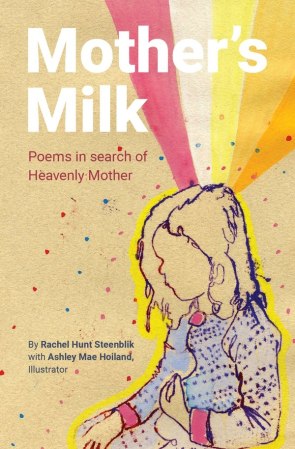
Finding Heavenly Mother with Rachel Hunt Steenblik by Caryn D. Riswold

Feminist theologies are filled with queries and questions about the divine feminine. Whether women need the Goddess. If She really is. Where herchurch might flourish. I have my own complicated views about the subject, and continue to be enriched by those who seek and find. Rachel Hunt Steenblik is the newest voice calling to and from the divine feminine, singing in a distinctively Mormon key.

If you read Mother’s Milk: Poems in Search of Heavenly Mother from front to back, you encounter what seem like scratches of verse and fragments of wisdom from a young mother catching time to write in the midst of her graced obligation to feed and sustain tiny bodies. If you read it back to front, you encounter a wealth and depth of engagement with Christian sacraments, feminist theology, sacred texts, Mormon history, modern philosophy, and children’s books and movies. This cacophony of source material and influence is distilled into sparse poems whose brevity bely decades of the author’s feminist engagement with vast religious history, philosophy, and theology.

In my review of Mormon Feminism: Essential Writings, edited by Steenblik along with Joanna Brooks and Hannah Wheelwright, I noted that feminists in many religious traditions “have had to document their history, make their theological case, and engage their scriptures as robustly as any conservative traditionalist would.” In Mother’s Milk, Steenblik offers us her contribution to the reconstruction of religious tradition. The words of her introduction state plainly: “These are the poems that I could write with my questions, my hurt, my hope, and my reading. Others could write other poems with theirs. I hope they will. We need them all.”

Continue reading “Finding Heavenly Mother with Rachel Hunt Steenblik by Caryn D. Riswold”

Celtic Myth, Moon Blood, and the White Beauty Standard by Marisa Goudy

My woman’s body is entering the dark time of the moon, even with blinding white snow lashing the windows, even with a full moon tracing its way far above thick clouds. My mood is black and soon I’ll be flowing red, and the snow will just drive on white, white, white.

In The White Goddess, Robert Graves tells us: “…the New Moon is the white goddess of birth and growth; the Full Moon, the red goddess of love and battle; the Old Moon, the black goddess of death and divination.”

The Celt in me feels cradled by this imagery, even if, as Judith Shaw and Carol P. Christ have pointed out elsewhere on this site, the idea of maid, mother, and crone is a modern invention, not gift from the past. I agree with Christ:  “My suggestion is that we give up the idea that the details of contemporary Goddess Spirituality are rooted in and authorized by tradition. We can instead acknowledge that though we are inspired by the past, we are the ones who are creating contemporary Goddess Spirituality.”

Continue reading “Celtic Myth, Moon Blood, and the White Beauty Standard by Marisa Goudy”

Brigid from The Goddess Project: Made in Her Image by Colette Numajiri

She is the reason BRIDES wear white, swan-like wedding gowns. Brides veil themselves like the Goddess herself, Whom all Bridegrooms honor, until revealing Herself to Her chosen groom. Tiny flowers and shamrocks are said to bloom in Her wake, She brings new life.

BRIDGET BRIGHT by Hedgewytch

She is known as Brigid Bright,
Goddess who shines against the night.
At Cille Dara, at the setting sun,
Her sacred flame is kept by one.
Nineteen times the earth turns round,
As sacred springs come forth the ground.
Twenty times the sun has burned,
And now the Goddess has returned.
Alone she tends her thrice-bright flame,
Born of her heart that bears her name.
The Dagda knows Brigid as Daughter,
Triple Blessed by fire and water.
Poets call her name to inspire.
And healers oft gain from her fire.
Wayland too would know her well
As hammer and anvil ring like a bell.
A sorrowful cry did she give meaning,
When first she brought to Eire keening.
Oh Sacred Fire against darkest night,
Burn for Brigid, for Brigid Bright!
Fire in the head…to quicken us.
Fire in the cauldron…to heal us.
Fire in the forge of the heart…to temper us.

Continue reading “Brigid from The Goddess Project: Made in Her Image by Colette Numajiri”

Creation by Sharon Humphries-Brooks

It seems to me to be appropriate that since I’ve received so many ideas to consider, wondrous gifts, and thought-provoking insights from many of the essays, poems, and stories in the Feminism and Religion blogs, I should also give something in return.  One of the most precious gifts that I can offer is my writing.  So. . .
A bit ago, I started working on the book Mushente.  It takes place, among other locales, on a planet called—you guessed it—Mushente.  Many people who live there “walk” in the Mushente Way.  Below, I’ve copied the poem that opens that work.  As you can see, I’ve been very influence by a feminist interpretation of early Taoism. Continue reading “Creation by Sharon Humphries-Brooks”

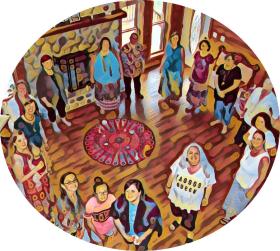
Creating Women’s Circles that Heal and Enrich Our Lives by Anne Yeomans and the Women’s Well

From 1994 until 2012, the Women’s Well, based in Concord, Massachusetts, offered thousands of women the opportunity to participate in women’s circles of all kinds. In the first and second parts of this series, Anne Yeomans, a co-founder of the Women’s Well, and others who co-created the Women’s Well, shared about their experiences with the power and wisdom of the circle and the use of altars and ritual. (Part I and Part II).  This third part, explains the guidelines that the Women’s Well developed for their circles. This post is adapted from the Women’s Well website at www.womenswell.org.

We often used the guidelines in our circles. Sometimes the facilitator or holder of the circle would speak of them and then place them around the circle on printed cards, to remind us of the quality of listening and speaking that we were trying to invite in.

These guidelines were originally drawn from the work of Tom Yeomans who developed a way of working in groups, called the Corona Process. It was an approach to group dialogue that came to him in a dream the night after attending a meeting with the great physicist David Bohn, who at the end of his life became interested in dialogue and world peace. Continue reading “Creating Women’s Circles that Heal and Enrich Our Lives by Anne Yeomans and the Women’s Well”

We Don’t Need Armed Guards, We Need Grandmas by Karen Moon

(Written the day after the Parkland high school, Florida shooting.)

Last night, my husband and I went outside to our driveway to sit in the car and have a beer.  Those of you with lots of children will understand that sometimes you just do not have the time, energy or funds for babysitting, but at least we have some uninterrupted time to talk to each other. Our youngest is six years old, so the older ones can easily watch her for twenty minutes.  We are not leaving toddlers to fend for themselves.  And it is cold out.  That is why we are in the car.

Only last night, there was no ‘unwinding’ going on. Somehow, we started speaking about the Parkland, Florida high school gun shooting, and his voice became raised.

He calls it ‘Meditarranean’ and ‘passionate’; I call it an ineffective way of communicating.  I would like to say that I replied calmly. But I did not. He had me, and my voice became raised in response.

Continue reading “We Don’t Need Armed Guards, We Need Grandmas by Karen Moon”

Sophia from The Goddess Project: Made in Her Image by Colette Numajiri

“Happy are those who find wisdom. . . . She is more precious than jewels, and nothing you desire can compare with her. . . Her ways are ways of pleasantness, and all her paths are peace. She is a tree of life to those who lay hold of her; those who hold her fast are called happy” (Proverbs 3: 13, 15, 17-18).

Sophia is DIVINE WISDOM, Her name comes from the feminine Greek word meaning Holy Wisdom. She is found all over the Bible (Proverbs, Sirach and the Wisdom of Solomon..) and in the Gnostic Gospels (unearthed at Nag Hammadi in 1947.) She has been called the MOTHER OF THE UNIVERSE, Mother of Yahweh and HOLY SPIRIT. The words: “Philosophy, theosophy and sophiology” all come from Sophia. The Bible links her to Christ: “Christ is the Wisdom (Sophia)” (1 Corinthians 1:24, 30). There is some evidence that Mary Magdalene was also called “Mary Sophia.”

Because She did not help advance the patriarchal scheme, Sophia was all but deleted from history. Hidden throughout the Bible and the Dead Sea Scrolls, knowledge of the DIVINE FEMININE all but went up in flames. Even a great cathedral build in Her honor in Constantinopole, Hagia Sophia (Holy Wisdom), was burned to the ground twice. It’s newest rebuild was a mosque and is now a museum. NOTRE DAME (Our Lady) has survived but they eventually claimed it was named after the Virgin Mary. (The famous Notre Dame rose windows are a common symbol of the Divine Feminine!). Some say there are secret societies that still exist to keep knowledge of Her alive.

Continue reading “Sophia from The Goddess Project: Made in Her Image by Colette Numajiri”

Centering Women’s Circles with Altars and Ritual by Anne Yeomans and the Women’s Well

 From 1994 until 2012, the Women’s Well, based in Concord, Massachusetts, offered thousands of women the opportunity to participate in women’s circles of all kinds. Here, in their own words in the second of this three-part series, Anne Yeomans, a co-founder of the Women’s Well, and others who co-created the Women’s Well, share with you how altars and ritual furthered the sacred inner and outer work of the circle.  The first part of the series discussed the power of women’s circles. This post is adapted from the Women’s Well website at www.womenswell.org.  

At the Women’s Well there was always an altar at the center of the circle. It became a place of great creativity, and meaning. Some women were uncomfortable with the use of the word altar. The Deep River groups, created by Abby Seixas, came up with the word “hearth” as an alternative. By whatever name it was called, a beautiful and conscious creation at the center became essential to informing the sacred space of the circle. Continue reading “Centering Women’s Circles with Altars and Ritual by Anne Yeomans and the Women’s Well”

Of Snakes, Genocide and Women by Guillermo C. Garcia

On February 23rd 2018, President Trump addressed CPAC (The Conservative Political Action Conference). He put aside his written remarks again and spoke extemporaneously for seventy-five minutes on other issues, including immigration. During that part of his talk, he once more told the story that has become his recurring parable on immigration, one he used on the campaign trail in 2016.[1]

Essentially, it tells the tale of a woman who has pity on a snake she finds in distress. She nurses it back to health, shows compassion and even embraces it. During the embrace, it bites her and as she is dying, she asks “Why?” As Trump told it, the snake answers: “Oh, shut up, silly woman,” said the reptile with a grin. “You knew damn well I was a snake before you took me in.” He continued, “And that’s what we’re doing with our country, folks. We’re letting people in. And it is going to be a lot of trouble. It is only getting worse. But we’re giving you protection like never before.”

What is that protection? A wall, to keep “them” out and “us” in? (In this, The Handmaid’s Tale is prophetic.) Deportation of those who were born before their parents brought them to the U.S.? A media that follows the Trump’s lead in stereotyping immigrants and refugees from the Latin America and other places as illegal aliens, drug dealers, rapists, gang members and terrorists?[2]

Continue reading “Of Snakes, Genocide and Women by Guillermo C. Garcia”