Ozymandias and Other Patriarchal Ego-isms by Janet Maika’i Rudolph

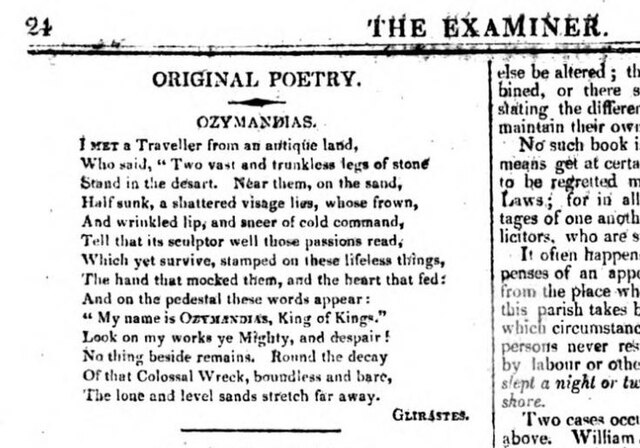
I met a traveller from an antique land
Who said: “Two vast and trunkless legs of stone
Stand in the desert . . . Near them, on the sand,
Half sunk, a shattered visage lies, whose frown,
And wrinkled lip, and sneer of cold command,
Tell that its sculptor well those passions read
Which yet survive, stamped on these lifeless things,
The hand that mocked them, and the heart that fed:
And on the pedestal these words appear:
‘My name is Ozymandias, King of Kings:
Look on my works, ye Mighty, and despair!’
Nothing beside remains. Round the decay
Of that colossal wreck, boundless and bare
The lone and level sands stretch far away.”

Percy Bysshe Shelley 1792 – 1822

There has been discussion of what to name Trump’s ever-expanding ballroom. Some have suggested naming it after Epstein. I would suggest naming it after Ozymandias from Shelley’s poem. 

There is something about building projects that feed to the patriarchal ego.  The Patriarchal ego stands on permanence, largess and if that involves crushing those “below” them, that is just how it is.  Pre-patriarchal pagan systems focus on the cycles of life and are based on an understanding that impermanence is what life is all about. Life works on cyclic movement. The seasons, the moon, the sun, the stars, all is in motion and all presages different aspects of the wheel of life.

Continue reading “Ozymandias and Other Patriarchal Ego-isms by Janet Maika’i Rudolph”

The Gendered Dimensions of the Water Crisis in Iran: Impacts on Women’s Health, Livelihoods, and Security

Moderator’s Note: This post has been brought to you in cooperation with the NCRI women’s committee. NCRI stands for the National Council of Resistance of Iran. You can learn more information as well as see this original article by clicking this link. A description of their Council can be found at the end of this post.

The water crisis in Iran has moved far beyond a simple environmental issue — it has become a humanitarian, ecological, and economic disaster.

While at first the problem seemed to be the result of drought and declining rainfall, its true causes ran much deeper: entrenched corruption and mismanagement at the heart of the ruling establishment. Until these systemic roots are addressed and removed, Iran’s present — and its future — will only become more precarious.

A significant number of researchers and international observers emphasize that 70 to 80 percent of the current crisis stems from mismanagement, unsustainable policies, lack of transparency, and corruption. As one report notes, “Iran’s water crisis is not a crisis of resources; it is a crisis of decisions—decisions that have made the land thirstier and the future darker. This crisis, alongside the erosion of public trust in governance, is a symptom of structural and managerial failure.” (Newsweek, August 1, 2025; The Times, December 8, 2022; Reuters, April 27, 2021)

Continue reading “The Gendered Dimensions of the Water Crisis in Iran: Impacts on Women’s Health, Livelihoods, and Security”

The Legacy of Carol P. Christ: Toxic Masculinity: “Masculinity Must Be Killed” by Carol P. Christ

This was originally posted on June 20, 2016

Carol Molivos by Andrea Sarris 2A few days ago I watched the movie An Unfinished Life starring Morgan Freeman, Robert Redford, and Jennifer Lopez. Though it was recommended as a sensitive psychological drama, and though on the surface level it criticizes (male) violence against women and animals, on a deeper level, it confirms the association of masculinity with violence, suggesting that violence is the way men resolve their problems with each other.

At the beginning of the film, Robert Redford, who lives on a ranch in Montana, picks up his rifle with the intention of shooting a bear who mauled his friend Morgan Freeman. This act of violence is stopped by local authorities who arrive to capture the bear. However, the bear is not removed to a more remote area, but rather is given to a local make-shift zoo where it is kept in a small cage. At the end of the movie, Redford frees the bear after Freeman realizes that it should not be punished for injuring him. The bear is last seen crossing a mountain ridge in the distance.

Redford is grieving the death of his only son who died in an automobile accident while his son’s wife (played by Jennifer Lopez) was driving. After being beaten by her current boyfriend, Jennifer Lopez escapes with her daughter and ends up on Redford’s doorstep, announcing that her daughter is Redford’s granddaughter.  Redford, who believes Lopez is responsible for his son’s death, grudgingly allows them to stay.

When Lopez’s boyfriend tracks her down in Montana, Redford drives him out of town, threatening to kill him with his rifle. When the boyfriend comes back, Redford shoots out the tires of his car, smashes the car’s windows with his rifle, and beats the boyfriend bloody before putting him on a bus out of town.

The movie asks us to condemn the boyfriend’s violence against Lopez and Redford’s desire to kill the bear, but it also asks us to condone and even to celebrate Redford’s violent acts against the boyfriend. After all, in this case, justice is done. Right?  Continue reading “The Legacy of Carol P. Christ: Toxic Masculinity: “Masculinity Must Be Killed” by Carol P. Christ”

Legacy of Carol P. Christ: Who Is Jephthah’s Daughter? The Cost of War

carol-christ

This post was originally published on Jan 13th, 2014.

In a provocative essay and heart-breaking painting, Angela Yarber asked us to consider who Jephthah’s daughter is in our time. Angela reminded us that Jephthah was a heroic warrior in the Hebrew Bible who swore in the heat of battle that if his people won, he would sacrifice the first person he would see on returning home. That person turned out to be his unnamed daughter.

Reading Angela’s post and looking at her holy woman icon of Jephthah’s daughter, my mind turned to the story of Agamemnon’s daughter.  In this case, the daughter is named: Iphigenia.  Agamemnon had gathered his troops to sail to Troy, but lack of wind prevented them from setting off.  According to the myth, Agamemnon was told by the Goddess Artemis that he must sacrifice his daughter if the ships were to sail. He did.

In his powerful rewriting of the myth of the sacrifice of Iphigenia, Daniel Cohen questions whether the Goddess requires human sacrifice Continue reading “Legacy of Carol P. Christ: Who Is Jephthah’s Daughter? The Cost of War”

Legacy of Carol P. Christ: Segregation

carol-christ

This post was originally published on March 17th, 2014.

As I think about the incarceration of young black men for relatively minor drug crimes, and the murders of Trayvon Martin and Jordan Davis, I cannot help but compare the astonishing progress that Americans have made in overcoming prejudice against gays and lesbians to the astounding lack of progress we have made in overcoming prejudice against black Americans.

It is often repeated that the reason for changes in attitudes about gays and lesbians is the process of coming out—most people in America now know a lesbian or gay family member, friend, or co-worker.  On the other hand, I would dare to speculate that many—perhaps most—Americans who are not African-American do not know a boy like Trayon Martin or Jordan Davis.  If you do—count yourself lucky!  Our society remains divided by race and class divisions (many of them a legacy of racism) that prevent many non-black Americans from knowing a single young black man. Continue reading “Legacy of Carol P. Christ: Segregation”

Legacy of Carol P. Christ: Who Is Jephthah’s Daughter? The Sacrifice of Women and Girls

This post was originally published on Jan 20th, 2014.

Last week I reflected on Angela Yarber’s insightful essay and painting on Jephthah’s daughter. For those who did not read the earlier posts, the story of Jephthah’s daughter is found in the Hebrew Bible.  Jephthah’s daughter was sacrificed by her father after he swore in the heat of battle that if his side won, he would sacrifice the first person he would see on returning home.  Angela called us to reflect on who Jephthah’s daughter is in our time.

In my earlicarol p. christ 2002 colorer midrash on the story, I invoked Daniel Cohen’s powerful retelling of the story of Iphigenia.  Cohen concludes that Artemis told Agamemnon that his ships would sail only if he sacrificed his daughter not because she wanted him to do it—but because she hoped this challenge would induce him to realize that the costs of war outweigh any possible gain.

I suggested that these words be spoken whenever the story of Jephthah’s daughter is told: Continue reading “Legacy of Carol P. Christ: Who Is Jephthah’s Daughter? The Sacrifice of Women and Girls”

Let’s Have The Talk – What Does “The Birds and The Bees” Actually Mean: By Zoe Carlin

Recently, I have thought about a common idiom that has been used to refer to sexual reproduction, the birds and the bees. I became curious why animals that appear in most gardens were used as an example to explain where babies come from, until I did some research. It turns out that since the birds lay eggs, that is their representation of the female body and the bees represent the sperm due to pollination. It is a very subtle, overlooked message that can be disguised as being more age-appropriate to young children. However, I decided to dig a bit deeper. Ed Finegan, a USC professor of linguistics and law, has stated that this phrase has existed a lot longer than one might think. There is evidence of it being used in a somewhat sexual context going back to at least two authors, Samuel Coleridge Taylor (1825) and an entry from John Evelyn’s The Evelyn Diary (1644). 

In Work Without Hope, Samuel Coleridge Taylor quotes, “All nature seems at work . . . The bees are stirring, birds are on the wing . . . and I the while, the sole unbusy thing, not honey make, nor pair, nor build, nor sing.” This separation of the birds and bees is indicating the loneliness and sadness of missing out on a potential romantic connection. When going even further back in time to 1644, it was noticed in the Evelyn Diary that there was an entry discussing the interior design of St. Peter’s in Rome: “That stupendous canopy of Corinthian brasse; it consists of 4 wreath’d columns, incircl’d with vines, on which hang little putti [cherubs], birds and bees.” This description is illustrating that there is a possible sensual or sexual meaning of the architecture in St. Peters.

Continue reading “Let’s Have The Talk – What Does “The Birds and The Bees” Actually Mean: By Zoe Carlin”

Patriarchy, Thy Name is Cruelty by Janet Maika’i Rudolph

Andrew Young famously said that ‘anything is legal if 100 businessmen decide to do it.” I would add a more modern take. Nothing is too low, too immoral, too illegal if 5 or 6 Supreme Court justices decide to allow it. 

Their recent decisions could fill a book on how corrupt they are. (I’ve discussed this before. But this post is looking at immigration and the cruelty that this administration is fomenting. We have always been a cruel nation. Patriarchy has honed cruelty as its worked to crush women’s bodies while silencing women. How else would women have agreed to our loss of power? Carol Christ has written eloquently about this. Immigration policy has blown the lid off this pot. Perhaps because it is too new, too shocking. Because ICE is in our faces with agents flooding neighborhoods and engaging in unfettered cruelty.

For example, when ICE raided an apartment building in the Bronx on Feb 24th, they arrested 19 year old Merwil Gutiérrez. When they realized they had the wrong person, their response was “take him anyway.” Read that again, “take him anyway.”

Merwil Gutiérrez was then deported to the notorious prison CECOT in El Salvador. For months, his family couldn’t find him.  He was eventually sent to his native Venezuela.

Continue reading “Patriarchy, Thy Name is Cruelty by Janet Maika’i Rudolph”

This is the time for good trouble by Marie Cartier

Marie Cartier performing this rant poem at the John Lewis Good Trouble Lives On Rally in Lakewood, CA July 17th. Photo by Mel Saywell

This I can guarantee you: there will come a day when it seems you cannot stop crying.

When will that day come? Today it came for me reading The Atlantic while I drank my morning coffee:

This is what they are reporting: the Trump administration has given the order to incinerate food instead of sending it to people abroad who need it. Nearly 500 metric tons of emergency food—enough to feed about 1.5 million children for a week—are set to expire tomorrow…the food, meant for children in Afghanistan and Pakistan, will be ash.

There will come a day.

And here we are in these United States with people in hiding, speaking of food. Why are they hiding? They are hiding from immigration officials and some of us are sending those people in hiding – food. Toiletries. Macaroni and cheese boxes line my grocery cart,

In these United States, we are building more prisons. And I read the detention center known as Alligator Alcatraz puts thirty-two people in a cage. Each person/prisoner costs the United States taxpayer approximately $275 a day. I guess I mean not prisoner, immigration detainee.

Continue reading “This is the time for good trouble by Marie Cartier”

The Erotic as Power, Notes on Audre Lorde by Janet Maika’i Rudolph

I’ve long kept a tract of Audre Lorde’s seminal piece The Uses of the Erotic near my computer. “The Erotic as Power” is her subtitle. If you haven’t read it, please do.  It is in her book Sister Outsider. And you can find it as a stand-alone here. It was written in 1978.

Lorde points out how the erotic is the opposite of pornography, in fact pornography is ultimately a denial of the erotic because it emphasizes sensation without feeling. “The erotic is a resource within each of us that lies in a deeply female and spiritual plane . . .” She goes on to note how it is through our bodies that we recognize and access this power. But she goes on, “We have been taught to suspect this resource, vilified, abused and devalued within Western society.”  In the hands of patriarchy this amazing and important resource often lies out of reach because it has become a source of shame and a sense of inferiority for women.[1]

I would add to the definition of patriarchy that one of its main goals is to damp down, even destroy, the erotic. We have seen this play out over thousands of years of history. Women are often viewed as either saints or sinners. Saints are denuded of this deep earthy power and sinners are those who flaunt it, or at least in the eyes of patriarchy.

Continue reading “The Erotic as Power, Notes on Audre Lorde by Janet Maika’i Rudolph”