Anne Hutchinson, America’s First Feminist Theologian: 1591-1643 by Carol P. Christ

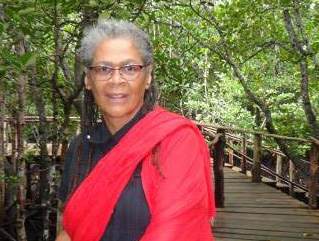
Carol Christ in Lesbos“She had rather been a husband than a wife; and a preacher than a hearer; and a magistrate than a subject.” Reverend Hugh Peter of Salem

Anne Hutchinson was banished from the Massachusetts Bay Colony for heresy in 1637 and excommunicated from the Puritan Church of Boston in 1638. Her banishment came just three years after she, her husband, and eleven living children arrived in America seeking the freedom to practice their religion as they saw fit. Governor Michael Dukakis pardoned her in 1987. Historian Howard Zinn called her a true American hero.

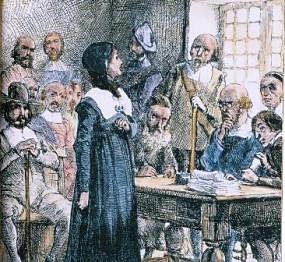
anne hutchinson trialI managed to get through graduate school in Religious Studies without ever having studied the theology of Anne Hutchinson,* though I vaguely remember references (probably with smirks of disapproval) to the “Antinomian Controversy” which is associated with her name. I recall Anne Hutchinson’s name because of an article published in Feminist Studies in the 1970s, when I had just begun to study women and religion. However it was not until recently that I learned of her place in history through reading American Jezebel by Eve LaPlante.

Hutchinson was accused of theological errors in her trials. The Calvinist doctrine of predestination figured heavily in the accusations. But the real issue at stake was that Anne dared to follow her own inner knowing, to articulate it theologically, and to teach her views against the grain of the Puritan authorities in Boston. Continue reading “Anne Hutchinson, America’s First Feminist Theologian: 1591-1643 by Carol P. Christ”

The Wages of Greed and Hubris by Barbara Ardinger

Barbara ArdingerHistorical note: I took the name Formosus (r. 891-896) from one of the popes of the Dark Ages. After his death, his body was exhumed, dressed in papal vestments, and put on trial for political crimes. The corpse was found guilty, and the vestments were torn off it. Then it was thrown into the Tiber. A monk pulled it out, and it is said that the corpse was then burned.

Of course, if the fisherman in this story resembles anyone in modern politics….

Near the bend of the great blue river where it empties into dark sea, there once lived a fisherman and his wife. Although they were so poor they lived in a rickety hovel on the bluff above of the river, the fisherman’s wife was smart and thrifty and the fisherman himself was unusually devout. He always managed to save a brass coin to drop into the basket at the church of the new religion in the town. Of course, the fisherman also found time to pay frequent visits to the public house in the town, where he had many friends with whom he often sang long into the night. He had also gained a bosom companion at the new church. This was a dwarf named Formosus, who held an ambiguous ecclesiastical office. The fisherman visited Formosus whenever he had a new thought, and the pair often retired to the public house to continue thinking together.

Every morning the fisherman climbed down the path to the riverbank to catch fish for his wife to sell. One morning, when he cast his line into the sparkling blue water, he felt something heavy on the hook. He pulled and pulled, and eventually a great, shiny dolphin rose out of the water. Now everyone knows that dolphins almost never leave the dark sea or swim in inland rivers.dolphin

“This is a great miracle!” said the fisherman. “I’ll have to tell my friend Formosus about this and get his interpretation of this miracle.” He took great care to pull the hook out of the dolphin’s lip without tearing it. After apologizing to the fish for hooking it, he released it back into the river. During that afternoon, he caught only a few small fish. “Oh, well, At least we can eat them for supper.”

When he stopped at the church to see Formosus on his way home, the dwarf was not there. The fisherman soon found his friend at the public house. When he told him about the dolphin, the first words the dwarf said were, “Fool! It must have been a magical fish. When you released it, why didn’t you ask it for a favor?” Continue reading “The Wages of Greed and Hubris by Barbara Ardinger”

The Season of Pilgrimage by amina wadud

amina - featureThis weekend those of us not performing the ritual pilgrimage, or Hajj, will enjoy the Festival of the Sacrifice of Eid al-Adha. Celebrated on the 10th day of the 12th lunar calendar month, it tends to creep up without warning, since we operate on the solar Gregorian calendar. The next day I jump a plane to Southeast Asia so my attention is already diverted.

The sacrifice here refers to Prophet Abraham’s botched contract with God over his first son. Muslims stick with the sheer biology that it was his first son, Ishma’il rather than Sarah’s first biological son, Isaac as recognized in Christianity and Judaism. It’s political, I won’t go there.

Instead I want to focus on this veneration of things masculine across all three Abrahamic faiths with the attention surrounding this particular patriarch. For example, I recall an Eid sermon which dwelt at length on Abraham circumcising himself in full adulthood without anesthesia. All I could think was, WHO should care about that? This particular manhood seems to excel over any reminder of his humanity, or of his devotion to monotheism in a community steeped in Idol worship. Continue reading “The Season of Pilgrimage by amina wadud”

Are You Ready for Some Football? by John Erickson

Although putting women in charge of drafting new policies that address the “woman problem” currently facing the NFL, it too reeks of the similar dismissive and patronizing actions women face when trying to obtain leadership roles in their religious traditions. Supercilious progress for the sake of progress isn’t progress and progress under the guise of silence is still misogyny. We need women in positions of leadership in both the NFL as well as in religious traditions. The culture of violence and silence will only continue, albeit with a Band-Aid firmly in place, holding the painful experiences and histories of women, long forgotten and often overlooked, until society values their rights just as much as the men leading the prayers and those that are being prayed for on Sundays across America.

John Erickson, sports, coming out.There is never a reason for physical violence.  There is never a reason to hit your partner or child to the point where they are unconscious or bruised.  There is never a reason to inflict violence against someone else, but apparently there are exceptions to these rules if you’re an NFL football player.

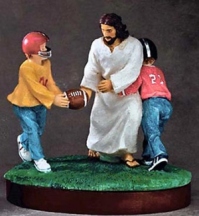
In my native state of Wisconsin, watching football on Sunday is synonymous with attending church prior to the game.  Watching football on Sunday is a cultural norm in many, if not all, different regions of the country where individuals, whether you like it or not, gather each Sunday to both praise and pray that your team ends up on top.
Football Jesus

In Wisconsin, you attend church with your family and head to your desired destination where you gather with friends and family to eat, talk about your life, and of course watch your local football team battle their weekly rival.  Although I am not much of a football fan these days, I have very fond memories of attending football games, watching them with my family and talking about the Green Bay Packers’ Super Bowl chances.  It was my time to both bond with the men of my family as well as catch up on the gossip the women would whisper back and forth to each other at the dinner table while the men were in the other room screaming at the TV.

Although I’m sure I will watch more games in my future, lately, all I do is cringe when I think about the growing violence that women and children face and have faced in the large shadow of an organization worth north of $9 billion dollars.

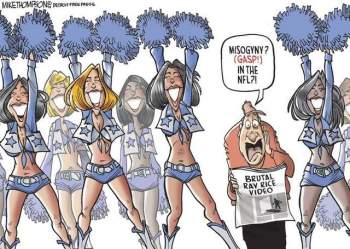
The biggest scandal to hit the news waves lately is that of Baltimore Ravens running back Ray Rice’s assault of his wife in an Atlantic City elevator.  Although Rice and the various other incidents regarding NFL players and violence is disturbing, the biggest problem facing the NFL isn’t just its treatment of women but its continual commodification of them as a disposable resource emblematic with the culture of violence that it has created.
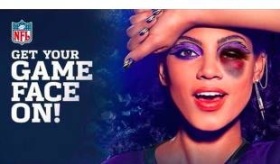
photo (1)

If you didn’t know, women make up an estimated 45% of the NFL‘s more than 150 million American fans and have, in recent weeks, become their most valuable resource and source of criticism.  However, after a long string of incidents stemming back from NFL teams underpaying cheerleaders to the Ray Rice incident, one needs to ask what the roles of women, if any, are outside of the disturbing images of the abused wife, hypersexualized cheerleader?  Is being dragged out of an elevator by your abusive husband the only way to get women’s issues addressed in the NFL by fans, league owners, and the NFL commission?

The roles of women in the NFL and religion have many similarities.  Aside from end zone celebrations where players praise God for his apparent direct role in helping them score a winning touchdown or certain players edifications as gods on Earth, women make up the crux of both NFL fandom and attendance but are responsible for the gatherings similar to the ones I, and many others, grew up with.
bilde

Although putting women in charge of drafting new policies that address the “woman problem” currently facing the NFL, it too reeks of the similar dismissive and patronizing actions women face when trying to obtain leadership roles in their religious traditions.  Supercilious progress for the sake of progress isn’t progress and progress under the guise of silence is still misogyny.  We need women in positions of leadership in both the NFL as well as in religious traditions.  The culture of violence and silence will only continue, albeit with a Band-Aid firmly in place, holding the painful experiences and histories of women, long forgotten and often overlooked, until society values their rights just as much as the men leading the prayers and those that are being prayed for on Sundays across America.

Ann Braude said it best in her foundational text Sisters and Saints that “if we want to understand the history of American women, we need to examine the religious beliefs and activities that so many have found so meaningful.” Without women, we wouldn’t have many, if not all, of the religions that are present throughout the world today and in case we forget, without women, we too wouldn’t have the millions of little boys who grow up being taken to and from practice by their mothers with the hope that they too could one day become the professional football players that fans scream and pray for.

Without women, there is no NFL and without women, there is no religion.  Kelly Brown Douglas said it best on this very blog when she stated, “It is the violence that violence creates.”  Although I agree with her, I would only add that while violence does indeed create violence, the real sin isn’t the violence itself but rather the silence that follows.

Let us pray that we will continue to not be silent and that we will rise up and fight for the millions of women (and men) each day who do not live in fear that their significant other’s multimillion dollar contract will not be reinstated but rather that they and their children may not see another day on this Earth.

 John Erickson is a Ph.D. Candidate in American Religious History at Claremont Graduate University.  He holds a MA in Women’s Studies in Religion; an MA in Applied Women’s Studies; and a BA in Women’s Literature and Women’s Studies. The LGBTQ and women’s rights movements, masculinity studies, gender theory, and the utilization of technology in forming communities and creating new teaching methodologies influence his research interests.  His work is inspired by the intersectionality of feminism, queer identity, LGBTQ history, and religious and sexual cultural rhetoric. He is a Non-Fiction Reviewer for Lambda Literary, the leader in LGBT reviews, author interviews, opinions and news since 1989 and the Co-Chair of the Queer Studies in Religion section of the American Academy of Religion’s Western Region, the only regional section of the American Academy of Religion that is dedicated to the exploration of queer studies in religion and other relevant fields in the nation.  When he is not working on his dissertation, he can be found at West Hollywood City Hall where he is the City Council Deputy and Chief of Staff to Councilmember Abbe Land. He is the author of the blog From Wisconsin, with Love and can be followed on Twitter @JErickson85

Muslim Separatists and The Idea of an “Islamic” State by amina wadud

amina 2014 - croppedThe other day, someone on twitter said she would not allow ISIS (known as the Islamic State of the Levant) use the name of “her” religion.  In fact, scholars in Egypt had proposed that they be called “the Separatist movement” and take the word “Islam” out of it. This question raised here is: what exactly is “Islamic” about what they are doing and how they are doing it?

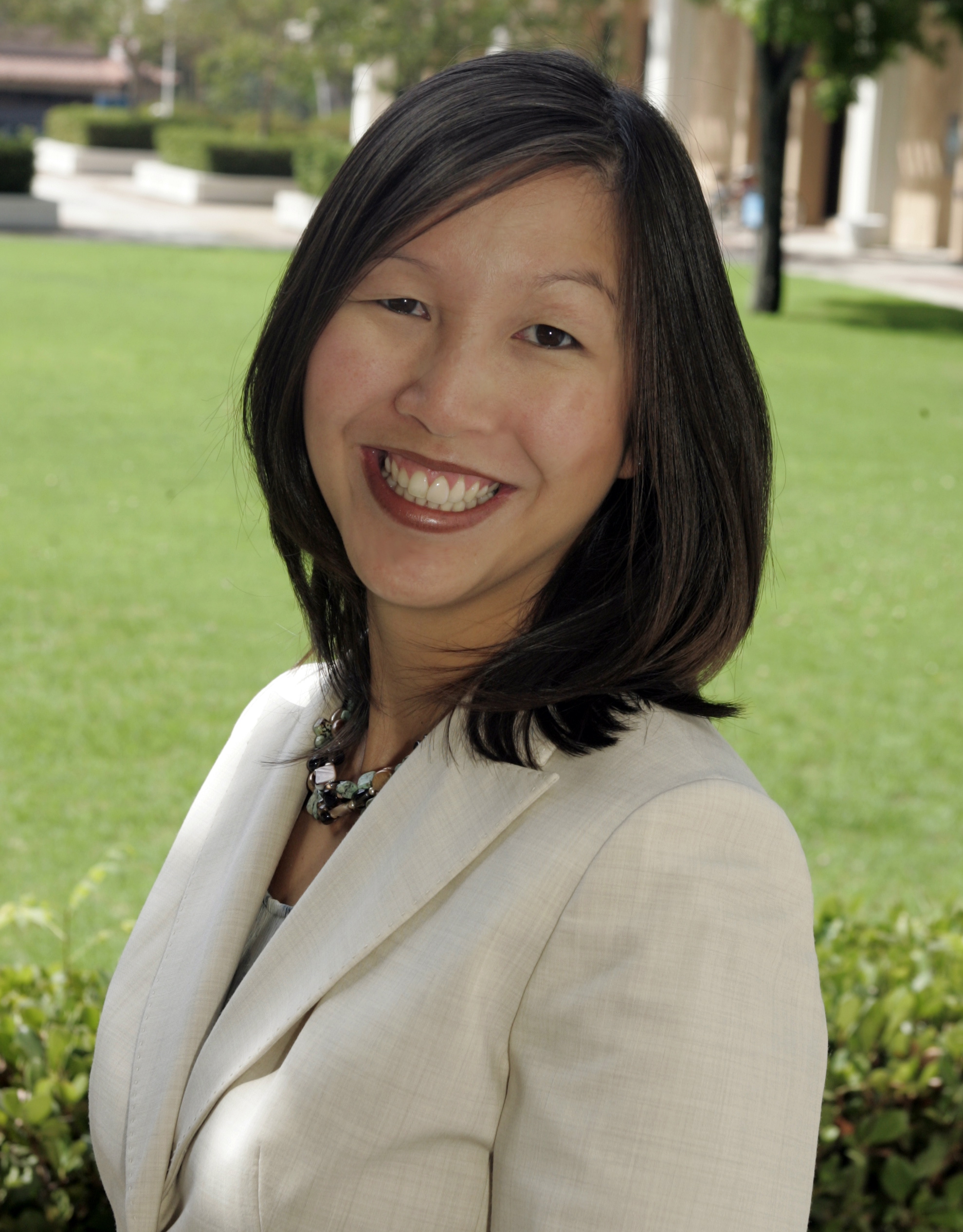
I have contended for at least 2 decades that people use the word “Islam” anyway they want to make any point they want.  More importantly, whoever has the power to assert their definition of the word “Islam” controls how it is used. I say the past 2 decades because I used to think I could somehow determine “pure” “Islam”—as opposed to cultural reflections, human imperfections, and intellectual genuflections.  I came instead to see that everyone has a definition of Islam and whose definitions held sway was less a matter of epistemology and more a matter of power.

So, I followed one of my intellectual mentors and agreed that for any discourse about Islam, a definition had to be established, agreed upon, and then consistently maintained. He suggested that a simple criteria referent be applied based on Islam’s two primary sacred sources: the text of the Qur’an and the normative practices of the Prophet Muhammad, called sunnah.  He juxtaposed these to “little traditions” in the multiple ways Muslims experience or live out their understandings of these two.

Part of the methodology of Islamic feminism and reformed Islamic thought has been to demonstrate a direct link to the two primary sources but with a different paradigm about key principles espoused there in- like justice, human dignity, and compassion.  From that point forward, I tend to provide my definition of Islam, give evidence to support that definition from the primary sources and then elaborate how it would work in application to whatever issue is at hand.  Continue reading “Muslim Separatists and The Idea of an “Islamic” State by amina wadud”

We Could Have Been Canadians and Other Thoughts about My New England Colonial Heritage by Carol P. Christ

carol mitzi sarahMy 2x great-grandparents Nathaniel Searing and Louisa Caroline Martin were pioneers who cleared the land and built a log cabin in Lyons, Michigan in 1840. They were descended from English Puritan Colonial settlers in New England. At least two of my ancestors are recognized by the Sons and Daughters of the American Revolutions. Other members of my family who were Quakers proudly refused to take part in the Revolutionary War.

My great-grandfather James Augustus married a woman of German descent, his daughter Lena Marie married a Swede, and my mother married a man who was German, Irish, and Scottish. As the descendants of Nathaniel Searing and Louisa Caroline Martin moved around the United States and married into the families of newer immigrants, the succeeding generations also lost touch with their history. Our family’s connections to the New England Colonists were not even mentioned at Thanksgiving! Continue reading “We Could Have Been Canadians and Other Thoughts about My New England Colonial Heritage by Carol P. Christ”

Good Muslim, Bad Muslim by amina wadud

amina 2014 - cropped

No doubt about it, the news of late has been dismal, heart breaking, soul crunching. Pick a place or theme and see where you end up: Ebola in parts of Africa, Israel and Hamas; Ferguson, Missouri; Ukraine, U.S., and Russia; unaccompanied minors from the south crossing over into U.S. borders; the assault of the Islamic State of Iraq and Levant (ISIS) on Christians, Kurds, Yazidis, Shi’ahs and journalists. This list could (should) be augmented by many other conflicts and areas of strife which have been on-going for longer than the last several weeks.

I don’t know about you, but I draw my weary attention to the latest news each morning with knots in my stomach and a heavy weight on my shoulders. Meanwhile, even if I am not directing my attention to the news per se, the same events are all over social media and I confess I check into facebook and twitter each day even when I try to maintain a casual posture over usage and to keep upbeat attitude in how I engage (or ignore) the latest hash tag or hot button issues.

For weeks I have been thinking I should blog about an important lesson I have learned as best articulated in the book by Sharon Welch: A Feminist Ethic of Risk. In a world riddled with problems of proportions greater than can be solved by any one person, one group, one country or over one life time, how does one continue to be ethically engaged, avoid crippling despair and pointless cynicism, or just plain fall into apathy? Continue reading “Good Muslim, Bad Muslim by amina wadud”

What Feminists of Color Taught Me In the Wake of the Michael Brown Shooting by Grace Yia-Hei Kao

Like many others, I’ve been following the aftermath of the recent shooting death of an 18-year old black teenager by a police officer in Ferguson, Missouri with a mixture of shock and horror. Mainstream news coverage and my Facebook newsfeed have been appropriately flooded with commentary about systemic racism, racial profiling, civil unrest, and the militarization of the police. As several African American thought leaders have noted, Brown’s death was not an aberration but “just the most recent example of police officers killing unarmed black men.” Continue reading “What Feminists of Color Taught Me In the Wake of the Michael Brown Shooting by Grace Yia-Hei Kao”

Systemic Violence and the Killing of Michael Brown by Xochitl Alvizo


Xochitl
Photo by Chris Pinkham

Oppression is systemic. Injustice is systemic. It pervades the whole – it seeps into everyday actions and becomes habits and patterns that function as default. As a result, the actions that fall within these patterns hardly need justifying. If anything, the questioning of them is what is put on the defensive. And those who stand against injustice must usually do so in the face of militarized policing, before vast forces that serve to preserve the status quo.

I can’t help but see the similarities between the everyday existence of young black men, of boys in this country, and that of women. The lack of safety in public places; the need to always be aware of one’s surroundings; the lack of trust in the intentions of another; living with the knowledge that people like you experience violence at much higher rates than others. It is a racist, violent, patriarchal world we live in. And, yes, it is also other things, good and beautiful things, but sometimes the hard reality of everyday life blocks out that light. Continue reading “Systemic Violence and the Killing of Michael Brown by Xochitl Alvizo”

A Radical Conclusion: We Are Our Own Authorities by Carol P. Christ

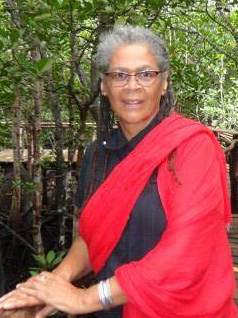
Carol Christ in LesbosElisabeth Schussler Fiorenza articulated a widely held tenet of feminist theology when she stated that feminism places a question mark over all inherited texts and traditions. This means that feminists cannot and must not accept any teaching or traditional way of performing religious acts simply because “the Bible [or the Koran or the minister or the priest or the rabbi or the imam or the guru] tells me so.”

Instead, feminists must question every text and tradition and the words of every religious leader to see whether or not they promote the full humanity of women. The implication of this is that we must acknowledge and take responsibility for becoming our own authorities—as individuals and in communities.

A tongue –in-cheek letter that began circulating on the internet in 2000 under the title “Why Can’t I Own a Canadian?” makes the point that even those who claim to be adhering to every “jot and tittle” of the Holy Book are in fact choosing to accept some aspects of tradition while rejecting others. Continue reading “A Radical Conclusion: We Are Our Own Authorities by Carol P. Christ”