Being Scared: Fear and Authenticity by Ivy Helman

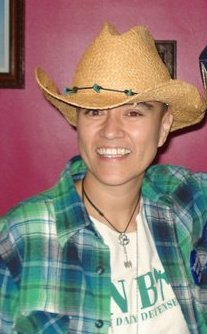
meblogMy partner is a lawyer who works with asylum seekers and other immigrants here in the Czech Republic (ČR). She’s amazing at her job and I’m constantly in awe of her passion and commitment along with her righteous anger at systematic injustices. In fact just last week, her workplace, together with a consortium of other immigration organizations in the ČR, helped organize a demonstration in the center of Prague to protest the Czech Republic’s refusal to admit Syrian children and their families into the country. She invited me to attend the event with her. I went.

It was my first time attending a public demonstration in Europe. It was moving to see many of her co-workers there and inspiring to listen to the passionate speeches against xenophobia, Islamophobia, racism, the plight of the Roma people as well as the need to come together and welcome diversity. In addition, there were signs in Czech, German and English saying “No One is Illegal,” “End Xenophobia,” “Do Syrian Children Have to Wait for their (Nicholas) Winton?” “I want to have a Syrian Friend!” and “Refugees Welcome!” I wanted to hold each one of those signs! Continue reading “Being Scared: Fear and Authenticity by Ivy Helman”

The Work of Justice-Making by Xochitl Alvizo

Incarnation, Goddess spirituality, Xochitl Alvizo, god became fleshWritten two weeks ago on December 5, 2014, but offered still as some food for thought:

I’m supposed to be writing my dissertation. Hand on the plow, no looking back. I have even left town for the whole month of December in order to minimize the everyday distractions that are part of my life in Boston and increase my focus on writing. I’ve set up shop in my friends’ living room, surrounded by multiple windows, perfect natural lighting, and festive Christmas decorations. But, two days in, and I have yet to get into my dissertation writing groove.

So I am writing this blog post instead in an effort to work my way back to the dissertation. I read somewhere that writing is thinking – which is why dissertations, and every other kind of writing project, often change direction along the way. If writing is thinking, then, I’m hoping that writing this post will help me think my way back to the dissertation, because at the moment, all I can of think is, I can’t breathe, I can’t breathe, I can’t breathe. Continue reading “The Work of Justice-Making by Xochitl Alvizo”

The Cop on the Beat is Not Ice-T, the Prosecutor Is Not Sam Waterston, and Mariska Hargitay and S. Epatha Merkerson Are Not in Charge, by Carol P. Christ

carol at green party 2014 croppedI have watched every episode of Law and Order and Law and Order SVU, and most of them more than once. Though there is police violence on these programs, it is usually investigated, and viewers are given the sense that it is not OK. Not living in black America or even in the United States, I guess I was under the illusion that police forces are no longer primarily white and male, that police reforms advocated decades ago have had some effect, and that cops cannot get away with murder.

This despite the fact that I knew that inmates in US prisons are far more likely to be black than their numbers in the population warrant, and that I knew that stop and frisk and arresting black men for petty crimes are ordinary police policies.

For readers who don’t watch MSNBC as avidly as I do, stop and frisk, now banned in New York City, is the policy of searching (primarily) young black men hanging around on street corners to see if they have illegal drugs or weapons on their persons. This policy can lead to the incarceration of young black men for having one or two marijuana cigarettes intended for personal use in their pockets. Stop and frisk is not a policy on college campuses, where police are just as likely to find young white men and women in possession of illegal drugs. Why? Because college authorities and parents of white college students simply would not allow it. Continue reading “The Cop on the Beat is Not Ice-T, the Prosecutor Is Not Sam Waterston, and Mariska Hargitay and S. Epatha Merkerson Are Not in Charge, by Carol P. Christ”

On Believability, Oppression and Ferguson by Sara Frykenberg

Sara FrykenbergLast week, Amina Wadud wrote an important post,Justice for Mike Brown,” discussing Mike Brown’s death in light of Brown vs. The Board of Education, Plessy vs. Ferguson and the injustice faced by African American Communities, particularly in the US legal/ criminal justice system. She highlights the dehumanizing practices that lead us to criminalize black bodies, beginning in childhood.

Considering her post and many, many other articles and news reports over the past several months, and particularly this last week, since the Grand Jury failed to indict Darren Wilson, I felt compelled to speak about a certain quality of kyriarchal oppression: that of rendering the oppressed “unbelievable.” I will not recount the details of the case here (please see the link above for links to court documents through NPR), nor will I try to “speak for” African American communities– nor can I. However, I think it is important that we bloggers and readers at feminismandreligion.com continue to consider the recent verdict and the critical justice issues it raises, as well as remember the tragedy of Mike Brown’s death, and so many men and women like him.

Actor and activist Jessie Williams, who many know from the popular TV show Grey’s Anatomy, gave a passionate and salient interview on CNN’s “State of the Union,” back in August after Michael Brown was killed. You can watch most of the interview with Williams, LZ Granderson and Tara Wall here; you can watch here for the clip I mention below.  Like Wadud, he too discusses the criminalization of black bodies, drawing from the everyday experience of Black men in the United States to make his case. At the end of the interview, Williams powerfully asserts, “We’re not making this up.” Continue reading “On Believability, Oppression and Ferguson by Sara Frykenberg”

Justice for Mike Brown? by amina wadud

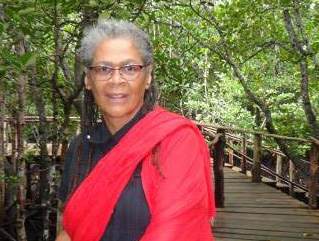
amina - featureI was born the year the Supreme Court of the United States of America began to hear Brown v. Board of Education of Topeka; a case that ought to be known to all as a matter of US history. Here is a precise, but telling history of how that case came into being. This historical account lacks hyperbole, perhaps because one feature of legal-eeze carries the technical title (and appropriately so) of being a brief.

In case blog readers don’t do background research or follow footnotes, I raise these salient points: The Declaration of Independence states “all men (sic) are created equal.” At the same time as it was written and signed into law, the legal enslavement of Africans was in full practice. This incongruence required further legal action to change that in the form of 13th Amendment to the US Constitution which made slavery illegal.

It should be no surprise that “equality” did not result from this and thus the 14th and 15th Amendments attempted to address inequities in more specific terminology. All of these Amendments were ratified the 19th century.

The last decade of the 19th century, Plessy v. Ferguson reached the Supreme Court. Plessy was an unsuccessful challenge, attempting to point out how manifest inequality– the “separate but equal” doctrine in practice across the United States– violated the constitutional notion of equality before the law. Judge Brown sums up the majority opinion which went against Plessy:

The object of the 14th Amendment was undoubtedly to enforce equality of the two races before the law, but in the nature of things it could not have been intended to abolish distinctions based upon color, or to endorse social as distinguished from political, equality..if one race be inferior to the other socially, the Constitution of the United States cannot put them upon the same plane

It would take more than half a century before Brown v. Board of Education brought out the many subtle ways, over the century since the legal end of slavery, that the racial divide had been enforced. It started very early in life, in the form of separate educational systems that only perpetuated the impossibility of constitutional consistency and equality before the law.

We still have a long way to go. Continue reading “Justice for Mike Brown? by amina wadud”

Anne Hutchinson, America’s First Feminist Theologian: 1591-1643 by Carol P. Christ

Carol Christ in Lesbos“She had rather been a husband than a wife; and a preacher than a hearer; and a magistrate than a subject.” Reverend Hugh Peter of Salem

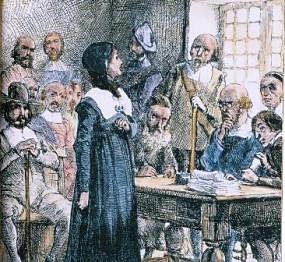
Anne Hutchinson was banished from the Massachusetts Bay Colony for heresy in 1637 and excommunicated from the Puritan Church of Boston in 1638. Her banishment came just three years after she, her husband, and eleven living children arrived in America seeking the freedom to practice their religion as they saw fit. Governor Michael Dukakis pardoned her in 1987. Historian Howard Zinn called her a true American hero.

anne hutchinson trialI managed to get through graduate school in Religious Studies without ever having studied the theology of Anne Hutchinson,* though I vaguely remember references (probably with smirks of disapproval) to the “Antinomian Controversy” which is associated with her name. I recall Anne Hutchinson’s name because of an article published in Feminist Studies in the 1970s, when I had just begun to study women and religion. However it was not until recently that I learned of her place in history through reading American Jezebel by Eve LaPlante.

Hutchinson was accused of theological errors in her trials. The Calvinist doctrine of predestination figured heavily in the accusations. But the real issue at stake was that Anne dared to follow her own inner knowing, to articulate it theologically, and to teach her views against the grain of the Puritan authorities in Boston. Continue reading “Anne Hutchinson, America’s First Feminist Theologian: 1591-1643 by Carol P. Christ”

The Wages of Greed and Hubris by Barbara Ardinger

Barbara ArdingerHistorical note: I took the name Formosus (r. 891-896) from one of the popes of the Dark Ages. After his death, his body was exhumed, dressed in papal vestments, and put on trial for political crimes. The corpse was found guilty, and the vestments were torn off it. Then it was thrown into the Tiber. A monk pulled it out, and it is said that the corpse was then burned.

Of course, if the fisherman in this story resembles anyone in modern politics….

Near the bend of the great blue river where it empties into dark sea, there once lived a fisherman and his wife. Although they were so poor they lived in a rickety hovel on the bluff above of the river, the fisherman’s wife was smart and thrifty and the fisherman himself was unusually devout. He always managed to save a brass coin to drop into the basket at the church of the new religion in the town. Of course, the fisherman also found time to pay frequent visits to the public house in the town, where he had many friends with whom he often sang long into the night. He had also gained a bosom companion at the new church. This was a dwarf named Formosus, who held an ambiguous ecclesiastical office. The fisherman visited Formosus whenever he had a new thought, and the pair often retired to the public house to continue thinking together.

Every morning the fisherman climbed down the path to the riverbank to catch fish for his wife to sell. One morning, when he cast his line into the sparkling blue water, he felt something heavy on the hook. He pulled and pulled, and eventually a great, shiny dolphin rose out of the water. Now everyone knows that dolphins almost never leave the dark sea or swim in inland rivers.dolphin

“This is a great miracle!” said the fisherman. “I’ll have to tell my friend Formosus about this and get his interpretation of this miracle.” He took great care to pull the hook out of the dolphin’s lip without tearing it. After apologizing to the fish for hooking it, he released it back into the river. During that afternoon, he caught only a few small fish. “Oh, well, At least we can eat them for supper.”

When he stopped at the church to see Formosus on his way home, the dwarf was not there. The fisherman soon found his friend at the public house. When he told him about the dolphin, the first words the dwarf said were, “Fool! It must have been a magical fish. When you released it, why didn’t you ask it for a favor?” Continue reading “The Wages of Greed and Hubris by Barbara Ardinger”

The Season of Pilgrimage by amina wadud

amina - featureThis weekend those of us not performing the ritual pilgrimage, or Hajj, will enjoy the Festival of the Sacrifice of Eid al-Adha. Celebrated on the 10th day of the 12th lunar calendar month, it tends to creep up without warning, since we operate on the solar Gregorian calendar. The next day I jump a plane to Southeast Asia so my attention is already diverted.

The sacrifice here refers to Prophet Abraham’s botched contract with God over his first son. Muslims stick with the sheer biology that it was his first son, Ishma’il rather than Sarah’s first biological son, Isaac as recognized in Christianity and Judaism. It’s political, I won’t go there.

Instead I want to focus on this veneration of things masculine across all three Abrahamic faiths with the attention surrounding this particular patriarch. For example, I recall an Eid sermon which dwelt at length on Abraham circumcising himself in full adulthood without anesthesia. All I could think was, WHO should care about that? This particular manhood seems to excel over any reminder of his humanity, or of his devotion to monotheism in a community steeped in Idol worship. Continue reading “The Season of Pilgrimage by amina wadud”

Are You Ready for Some Football? by John Erickson

Although putting women in charge of drafting new policies that address the “woman problem” currently facing the NFL, it too reeks of the similar dismissive and patronizing actions women face when trying to obtain leadership roles in their religious traditions. Supercilious progress for the sake of progress isn’t progress and progress under the guise of silence is still misogyny. We need women in positions of leadership in both the NFL as well as in religious traditions. The culture of violence and silence will only continue, albeit with a Band-Aid firmly in place, holding the painful experiences and histories of women, long forgotten and often overlooked, until society values their rights just as much as the men leading the prayers and those that are being prayed for on Sundays across America.

John Erickson, sports, coming out.There is never a reason for physical violence.  There is never a reason to hit your partner or child to the point where they are unconscious or bruised.  There is never a reason to inflict violence against someone else, but apparently there are exceptions to these rules if you’re an NFL football player.

In my native state of Wisconsin, watching football on Sunday is synonymous with attending church prior to the game.  Watching football on Sunday is a cultural norm in many, if not all, different regions of the country where individuals, whether you like it or not, gather each Sunday to both praise and pray that your team ends up on top.

Football Jesus

In Wisconsin, you attend church with your family and head to your desired destination where you gather with friends and family to eat, talk about your life, and of course watch your local football team battle their weekly rival.  Although I am not much of a football fan these days, I have very fond memories of attending football games, watching them with my family and talking about the Green Bay Packers’ Super Bowl chances.  It was my time to both bond with the men of my family as well as catch up on the gossip the women would whisper back and forth to each other at the dinner table while the men were in the other room screaming at the TV.

Although I’m sure I will watch more games in my future, lately, all I do is cringe when I think about the growing violence that women and children face and have faced in the large shadow of an organization worth north of $9 billion dollars.

The biggest scandal to hit the news waves lately is that of Baltimore Ravens running back Ray Rice’s assault of his wife in an Atlantic City elevator.  Although Rice and the various other incidents regarding NFL players and violence is disturbing, the biggest problem facing the NFL isn’t just its treatment of women but its continual commodification of them as a disposable resource emblematic with the culture of violence that it has created.

photo (1)

If you didn’t know, women make up an estimated 45% of the NFL‘s more than 150 million American fans and have, in recent weeks, become their most valuable resource and source of criticism.  However, after a long string of incidents stemming back from NFL teams underpaying cheerleaders to the Ray Rice incident, one needs to ask what the roles of women, if any, are outside of the disturbing images of the abused wife, hypersexualized cheerleader?  Is being dragged out of an elevator by your abusive husband the only way to get women’s issues addressed in the NFL by fans, league owners, and the NFL commission?

The roles of women in the NFL and religion have many similarities.  Aside from end zone celebrations where players praise God for his apparent direct role in helping them score a winning touchdown or certain players edifications as gods on Earth, women make up the crux of both NFL fandom and attendance but are responsible for the gatherings similar to the ones I, and many others, grew up with.

bilde

Although putting women in charge of drafting new policies that address the “woman problem” currently facing the NFL, it too reeks of the similar dismissive and patronizing actions women face when trying to obtain leadership roles in their religious traditions.  Supercilious progress for the sake of progress isn’t progress and progress under the guise of silence is still misogyny.  We need women in positions of leadership in both the NFL as well as in religious traditions.  The culture of violence and silence will only continue, albeit with a Band-Aid firmly in place, holding the painful experiences and histories of women, long forgotten and often overlooked, until society values their rights just as much as the men leading the prayers and those that are being prayed for on Sundays across America.

Ann Braude said it best in her foundational text Sisters and Saints that “if we want to understand the history of American women, we need to examine the religious beliefs and activities that so many have found so meaningful.” Without women, we wouldn’t have many, if not all, of the religions that are present throughout the world today and in case we forget, without women, we too wouldn’t have the millions of little boys who grow up being taken to and from practice by their mothers with the hope that they too could one day become the professional football players that fans scream and pray for.

Without women, there is no NFL and without women, there is no religion.  Kelly Brown Douglas said it best on this very blog when she stated, “It is the violence that violence creates.”  Although I agree with her, I would only add that while violence does indeed create violence, the real sin isn’t the violence itself but rather the silence that follows.

Let us pray that we will continue to not be silent and that we will rise up and fight for the millions of women (and men) each day who do not live in fear that their significant other’s multimillion dollar contract will not be reinstated but rather that they and their children may not see another day on this Earth.

 John Erickson is a Ph.D. Candidate in American Religious History at Claremont Graduate University.  He holds a MA in Women’s Studies in Religion; an MA in Applied Women’s Studies; and a BA in Women’s Literature and Women’s Studies. The LGBTQ and women’s rights movements, masculinity studies, gender theory, and the utilization of technology in forming communities and creating new teaching methodologies influence his research interests.  His work is inspired by the intersectionality of feminism, queer identity, LGBTQ history, and religious and sexual cultural rhetoric. He is a Non-Fiction Reviewer for Lambda Literary, the leader in LGBT reviews, author interviews, opinions and news since 1989 and the Co-Chair of the Queer Studies in Religion section of the American Academy of Religion’s Western Region, the only regional section of the American Academy of Religion that is dedicated to the exploration of queer studies in religion and other relevant fields in the nation.  When he is not working on his dissertation, he can be found at West Hollywood City Hall where he is the City Council Deputy and Chief of Staff to Councilmember Abbe Land. He is the author of the blog From Wisconsin, with Love and can be followed on Twitter @JErickson85

Muslim Separatists and The Idea of an “Islamic” State by amina wadud

amina 2014 - croppedThe other day, someone on twitter said she would not allow ISIS (known as the Islamic State of the Levant) use the name of “her” religion.  In fact, scholars in Egypt had proposed that they be called “the Separatist movement” and take the word “Islam” out of it. This question raised here is: what exactly is “Islamic” about what they are doing and how they are doing it?

I have contended for at least 2 decades that people use the word “Islam” anyway they want to make any point they want.  More importantly, whoever has the power to assert their definition of the word “Islam” controls how it is used. I say the past 2 decades because I used to think I could somehow determine “pure” “Islam”—as opposed to cultural reflections, human imperfections, and intellectual genuflections.  I came instead to see that everyone has a definition of Islam and whose definitions held sway was less a matter of epistemology and more a matter of power.

So, I followed one of my intellectual mentors and agreed that for any discourse about Islam, a definition had to be established, agreed upon, and then consistently maintained. He suggested that a simple criteria referent be applied based on Islam’s two primary sacred sources: the text of the Qur’an and the normative practices of the Prophet Muhammad, called sunnah.  He juxtaposed these to “little traditions” in the multiple ways Muslims experience or live out their understandings of these two.

Part of the methodology of Islamic feminism and reformed Islamic thought has been to demonstrate a direct link to the two primary sources but with a different paradigm about key principles espoused there in- like justice, human dignity, and compassion.  From that point forward, I tend to provide my definition of Islam, give evidence to support that definition from the primary sources and then elaborate how it would work in application to whatever issue is at hand.  Continue reading “Muslim Separatists and The Idea of an “Islamic” State by amina wadud”