ESCORT SERVICE by Esther Nelson

These days, I spend most of my time in Roanoke, Virginia.  I moved here—a three-hour drive west—from Richmond, Virginia.  One of the ways I’m settling into my new community is by volunteering as an escort at Planned Parenthood.

The job is straight-forward:  Greet people as they exit their vehicle when they arrive at the medical facility’s parking lot.  Usually, there are several protestors in front of the building, and clients must drive past them before turning right into the driveway.  Protestors wave pink, plastic bags filled with anti-abortion literature as well as pamphlets that outline a specific, Christian view of “salvation.”  Not many drivers stop.  If they do, I walk over to the line that divides Planned Parenthood property from public space and wave the cars forward.  The drivers are grateful.  So many clients are nervous, upset, and unsure of protocol.  One woman asked me if I was associated with “those people out there,” pointing to the protestors.  “Not at all,” I assured her.  She smiled with relief.

Continue reading “ESCORT SERVICE by Esther Nelson”

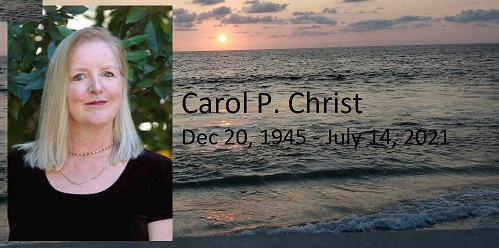
Legacy of Carol P. Christ: When Violence is Normal and Normalized

This was originally posted on January 14, 2019

Warning: this blog discusses spanking and bodily violence

“No Whips, No Punishments, No Threats: Women’s Control of Social Life” is the title of one of the chapters in Iroquoian Women, Barbara Alice Mann’s stunning reconstruction of female power in a matrilineal society. According to Mann, the European settlers were “unsettled” by the lack of strict punishment systems for children in Indian societies. “Spare the rod and spoil the child” was the backbone of European child-rearing practices. The settlers viewed Indian children as naughty, disobedient, disrespectful, and horror of horrors: self-possessed.

It is perhaps no coincidence that after reading this chapter, bodily memories of violence inflicted on me as a child began to resurface. My strongest bodily memory is of being hit repeatedly on my left upper arm by my younger brother’s fist. It is as if my arm is still stinging in that particular place. My mother wanted us to play together, but when we did, we usually ended up fighting. My brother, who was two and a half years younger, was later diagnosed with dyslexia and given “little red pills” to help him control his temper. I was a quiet child (there must have been reasons for that too), and though I soon realized that if I hit back I would only be hurt more, I learned to use my tongue against my brother. This too was a form of violence and my brother remembers my cruelty to this day. Once when I asked my mother what she wanted for her birthday, she responded, “Two children who do not fight.” I didn’t even try to give her that because I didn’t know another way.

Continue reading “Legacy of Carol P. Christ: When Violence is Normal and Normalized”

Remember! by Mary Gelfand

“There was a time when you were not a slave, remember that.
You walked alone, full of laughter, you bathed bare-bellied.
You say you have lost all recollection of it, remember! ….
You say there are no words to describe it;
You say it does not exist.
But remember.  Make an effort to remember.
Or, failing that, invent.”

From Les Guerilleres, by Monique Wittig, mid-20th Century French feminist writer

The first time I heard this quote from Wittig was in the mid-1990s when I took ‘Cakes for the Queen of Heaven,’ an introduction to feminist thealogy and the Great Goddess, created by the Women & Religion committee of the Unitarian Universalist Association.  Cakes was my introduction to Carol Christ, feminist thealogy, and the Goddess.  It changed my life forever.  I’ve been teaching this program for close to twenty years now and as my understanding of women’s history and the role of patriarchy in our suppression has deepened, I continue to find new resonances with Wittig’s words.

“There was a time when you were not a slave, remember that.”  This statement is relevant to all oppressed peoples and especially to women.  History tells us that enslavement was a part of European culture long before Africans were kidnapped into slavery on this continent.  Enslavement of the defeated was a common aspect of war, dating back to Biblical times.  Many aspects of the feudal system dominant in western Europe for centuries were little better than slavery. 

Continue reading “Remember! by Mary Gelfand”

From the Archives: Recognizing Abuse by Karen Tate

This was originally posted on March 8, 2019

I’ve been thinking a lot about abuse. Of course, most of us know about the domination, exploitation and  need for control meted out by patriarchy, but I wonder if we have actually normalized many abuses? Abuse in the home, in the workplace, in our culture. Perhaps  we accepted it unconsciously because so many of us are conditioned by religions that tell us to make noble sacrifice and tolerate suffering silently. I wonder if we’re calling it out when we see it – often and loudly – or if we’ve become conditioned to quietly accept the abuse with little push back.

My intent is not to offend anyone with this. I want to find common ground and defeat the polarization we find around us, but our President is the poster child for abusive behavior.  Do we recognize his lies and fear-mongering and so many of the ideas he gives credence and license to as abuse?  Not only is he eroding our democratic institutions but he poisons the political, social and cultural arena with negativity, fear and hate, rather than uplifting us and encouraging us to evolve and be the best version of ourselves. I equate him to poison in a well from which we must all drink.

Continue reading “From the Archives: Recognizing Abuse by Karen Tate”

The Patriarchy Strikes Back by Janet Maika’i Rudolph

I suppose no one is all that surprised but it is still stunning how quickly certain politicians are rushing to pull back women’s rights. It’s become a race to regulate women’s bodies of with draconian and cruel laws.

Each law is more extreme than the next. In South Carolina it has even been proposed to make abortion a crime subject to the death penalty.

Commentators say the bill isn’t going anywhere.  But it was still proposed. It is now in the eco-system of abortion politics. It is being imagined and that opens up all possibilities of where it can go from here. We never thought, after all, that Roe would be overturned.

Continue reading “The Patriarchy Strikes Back by Janet Maika’i Rudolph”

PATRIARCHY’S OFFSPRING by Esther Nelson

Elvis Presley (1935 – 1977) popularized the song “In the Ghetto” written by Mac Davis in 1969.  The following TikTok video, featuring an artist with whom I am not familiar, is better—in my opinion—than any other rendition I’ve heard.  Such depth!  Such raw passion!  Such strength!  Such vulnerability!

https://www.facebook.com/100064420368301/videos/1352885832113207/

Here are the lyrics:

As the snow flies
On a cold and gray Chicago mornin’
A poor little baby child is born
In the ghetto…

Continue reading “PATRIARCHY’S OFFSPRING by Esther Nelson”

Marketing in the New World and Karen Tate’s New Book on Normalizing Abuse by Caryn MacGrandle

Marketing was my thing in college.  And my first professional job out of college was in Marketing at the Regional Headquarters of Canon in Dallas.  And then my life took me out into the weeds: a marriage to an Airforce pilot following him to the snow filled tundra of North Dakota, the swamps of Mississippi, two divorces, four children, twists and turns and ups and downs all landing smack dab to where I sit in front of my computer at the moment outside of Huntsville, Alabama at 53 finally feeling like I’ve got somewhat of a handle on this crazy ride called Life or at least a better idea of how to buckle in and enjoy the ups and get through the downs.

Continue reading “Marketing in the New World and Karen Tate’s New Book on Normalizing Abuse by Caryn MacGrandle”

Legacy of Carol P. Christ: Religions and the Abuse of Women and Girls: God Is the Problem

This was originally posted on November 12, 2018

At the 2009 meeting of the Parliament of World Religions, former US President Jimmy Carter called the worldwide abuse of girls and women the greatest unaddressed human rights crisis of our time. In the book that followed the speech, he compared sexism to the racism he witnessed in the US South, stating:

There is a similar system of discrimination, extending far beyond a small geographical region to the entire globe; it touches every nation, perpetuating and expanding the trafficking in human slaves, body mutilation, and even legitimized murder on a massive scale. This system is based on the presumption that men and boys are superior to women and girls.

Continue reading “Legacy of Carol P. Christ: Religions and the Abuse of Women and Girls: God Is the Problem”

Legacy of Carol P. Christ: “What Would Happen If One Woman Told the Truth about Her Life?”

This was originally posted on September 24, 2018

According to poet Muriel Rukeyser, “the world would split open.”

This poem accurately describes what many women experienced in consciousness raising in the 1970s and what many women experience today in the #MeToo movement.

For many of us the world did split open. We began to take ourselves and our experiences seriously. To do so we had to question received wisdom encoded in such questions as: “What was she doing there in the first place?” “Was she drinking too?” “Why didn’t she change out of her bathing suit?” Underlying these questions is the assumption that: “whatever happened, she must have asked for it.”

A lot of people are wondering why congressmen and voters who claim to uphold Christian principles are not more outraged about credible allegations of sexual assault against a child whose name was Christine Blasey. What this question fails to address is the fact that the Christian principles (if any) held by conservatives are steeped in patriarchy. Liberals may argue that Jesus would have cared about the girl, and I believe they are right. But the Christianity that developed after his death was centered on the Father, Son, and Holy Spirit, all of whom are male. This Christianity is patriarchal to the core: its deep message is that power belongs the hands of males and that male power is not to be questioned.

Continue reading “Legacy of Carol P. Christ: “What Would Happen If One Woman Told the Truth about Her Life?””

The Patriarchal Dilemma by Janet Maika’i Rudolph

I was listening to a newscast when it was reported that the Ukraine sent missiles into Russia. My initial thought was “it’s about time they took it to the Russians.” The next moment I was horrified at myself.  I am a pacifist.  I think the proliferation of weapons is one of humankind’s great evils and here I was cheering on an attack.  One that could escalate an already nasty war, lead to nuclear weapons use and possibly even a world war. And yet when I look at what is happening in Ukraine, my mind simply can’t comprehend what the people are going through. The trauma of the children cuts particularly deeply. And I can see no sane reason behind the strikes other than rank cruelty.

There it is in a nutshell, what I have come to call the patriarchal dilemma. It’s a no-win situation with no right answer. While life might place us in such positions all on its own, the patriarchal form of this is created by design. It is nasty, it is cruel, and loss of human life and ecological destruction are not glitches but features.

Continue reading “The Patriarchal Dilemma by Janet Maika’i Rudolph”