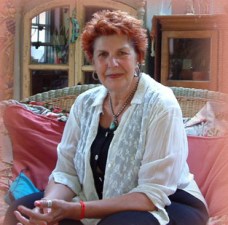
Thus Saith Eve BOOK REVIEW by Katie M. Deaver

“I am the Queen of Sheba and I am not impressed.”  This is the first line of one of the monologues from chris wind’s book Thus Saith Eve.  This book features 18 stories of biblical women, and a 19th, Lilith, from Jewish mythology.  Each monologue offers a new interpretation and gives a voice to the women that we think we know.

In this book the voices and personalities of women such as Noah’s wife, Mary of Bethany, Zipporah, and Vashti are reimagined in an exciting and empowering way.  Each of the stories also features an appendix where the reader can learn more about the biblical or mythological context of the woman who is telling her story.

As in her other works, wind uses historical people, events, and understandings to build a truly wonderful source of feminist fiction.  In addition to being an extremely enjoyable and thought provoking read, the monologues can also be used for audition and performance pieces.  On her website wind explains that two of the monologues, “I am Eve” and “I am Mary” can be performed with specific musical selections in the background.  You can find those selections linked to her website above.


Continue reading “Thus Saith Eve BOOK REVIEW by Katie M. Deaver”
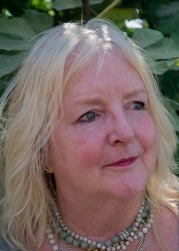
Walk in Love and Beauty: A Touchstone for Healing by Carol P. Christ

Nurture life.

Walk in love and beauty.

Trust the knowledge that comes through the body.

Speak the truth about conflict, pain, and suffering.

Take only what you need.

Think about the consequences of your actions for seven generations.

Approach the taking of life with great restraint.

Practice great generosity.

Repair the web


In Rebirth of the Goddess, I offered Nine Touchstones of Goddess Spirituality as an alternative to the Ten Commandments. The Nine Touchstones are intended to inform all our relationships, whether personal, communal, social, or political.

The second touchstone, “Walk in love and beauty,” derives from the insight that love and beauty are the great gifts of bounteous earth. Just recently at a meeting of the Green Party Greece, one of our representatives in Parliament, Giorgos Dimaras, said to me, “It all begins with love.” He understands that our Green Party principles of environmental sustainability, social justice, no violence, and participatory democracy are rooted in the prior value of love. If we do not love nature, then why would we care about saving it? If we do not love others, why would we care about injustice and suffering? If we do not love the world, why would we care about creating peace on earth? If we do love others, why would we care about creating ways to ensure that everyone’s voice is heard in our families, communities, and societies? Continue reading “Walk in Love and Beauty: A Touchstone for Healing by Carol P. Christ”

Interdependence Day by Mama Donna Henes

I was recently invited to address a gathering of resident chaplains in the pastoral care department of a major urban medical center. Specifically, they asked me to present the shamanic point of view of team building with an emphasis on creating alliances and community.

There is no such thing! From a shamanic point of view (as well as quantum scientific thought) separation is a false concept. It is redundant to think of reaching out to build teams, alliances, and communities, since we are already all connected, allied, joined together as one. The fact is there is no such thing as opposing sides.There is only one side: just us folks, all of us everywhere, trying to live life as best we can, much more alike than different. There is no us and them. There is only us. We — all of us who occupy this planet: organic and inorganic; living and not; past, present, and future —are the world. Continue reading “Interdependence Day by Mama Donna Henes”

Spinning the Fire, Shifting the Current by Chris Ash

Christy at the beachSeventy-two hours out of every week, I carry a hotline phone. While calls come in waves and some shifts are silent, my everyday and professional lives are peppered with reminders that evil doesn’t just pierce reality through acts of power, control, and violence – it seeps through in discrediting voices and disbelieving questions. It rolls into us off the well-meaning tongues of community members who’d rather protect the status quo than hold people accountable. It wraps its tendrils around us as we walk through each system we are forced to navigate – systems that are not set up to protect our vulnerable hearts and human dignity. Evil powers the backlash wave that tries to knock down every survivor who speaks out about gender, sexual, or intimate partner violence, and it also is in the fear we swallow when we choke down our own stories, press them down deeper, grasping to avoid yet another assault on our integrity, intelligence, and truth.
Evil stains our flags with the undeniable imprints of genocide, slavery, and continuing racial injustice and then demands that we wave those flags, smiling and allegiant, as The American Dream itself is held hostage, torn from its family, held in a cage. Continue reading “Spinning the Fire, Shifting the Current by Chris Ash”

Nurture Life: Ethics of Goddess Spirituality by Carol P. Christ

Nurture life.

Walk in love and beauty.

Trust the knowledge that comes through the body.

Speak the truth about conflict, pain, and suffering.

Take only what you need.

Think about the consequences of your actions for seven generations.

Approach the taking of life with great restraint.

Practice great generosity.

Repair the web


In Rebirth of the Goddess, I offered Nine Touchstones of Goddess Spirituality as an alternative to the Ten Commandments. The touchstones are not commandments delivered from outside the world, nor are they accompanied by the promise of reward in heaven or the threat of punishment in hell. Rather, the Nine Touchstones are based upon observation of the world and rooted in the insight that human and other beings are connected in the web of life. They are intended to inform all our relationships, whether personal, communal, social, or political.

As I review the Nine Touchstones two decades after I first intuited and reflected on them, I marvel at my younger self. When I write, I often enter into a kind of trance in which words emerge from a place in myself that lies deeper than my conscious rational mind. I do not know that I know something until the words take shape on the page, and even then, their meaning unfolds over time. Something like this must have happened with the Nine Touchstones. I was drawn to the Native American teachings expressed in several of the touchstones even though I did not fully understand their context or meaning at the time. I was drawn to maternal values without knowing that they are the basis of ethics in egalitarian matriarchal cultures. Continue reading “Nurture Life: Ethics of Goddess Spirituality by Carol P. Christ”

America’s Two National Goddesses by Barbara Ardinger

I bet almost no one knows this secret: the United States is being watched over by two goddesses! One of them stands on top of the Capitol dome in Washington, D.C. The other stands on an island in New York harbor.
The goddess standing above our congressional building is named Libertas, or Freedom. She’s a Roman civic goddess whose sisters are Concordia and Pax. Although the Romans hardly ever experienced freedom, civic harmony, or peace, they always kept their eyes on the possibilities. Libertas was sometimes merged with Jupiter, sometimes with Feronia, who was originally an Etruscan or Sabine goddess of agriculture or fire. In Rome, Feronia became the goddess of freed slaves. Libertas is shown on Roman coins as a matron in flowing dress and wearing either a wreath of laurel leaves or a tall pilleus, which is called a “liberty cap” and looks like a witch hat without the brim. And there’s also a bird—is it a raven?? She holds either a liberty pole (vindicta) or a spear, and in some paintings of her (she was a popular subject in the 19th century) there is a cat at her feet. Continue reading “America’s Two National Goddesses by Barbara Ardinger”

Ethics of Goddess Religion: Healing the World by Carol P. Christ

Nurture life.

Walk in love and beauty.

Trust the knowledge that comes through the body.

Speak the truth about conflict, pain, and suffering.

Take only what you need.

Think about the consequences of your actions for seven generations.

Approach the taking of life with great restraint.

Practice great generosity.

Repair the web.


In a recent interview on Voices of the Sacred Feminine on “Gratitude and Sharing: Principles of Goddess Spirituality,” Karen Tate asked me to review the “Nine Touchstones” of Goddess religion I offered in Rebirth of the Goddess as an alternative to the Ten Commandments. Tate expressed concern about the lack of social and political ethics in New Age spirituality and in some parts of the Neo-pagan movement at a time when ethical discernment and action is more necessary than ever.

Before discussing the ethical principles of Goddess feminism, it is necessary to dispel a common assumption that there can be no ethics in Goddess religion because ethics stem from a transcendent principle of justice that stands outside the world. Christian liberation theologians usually identify this transcendent principle with the commanding “Word of God” in the prophetic traditions of the Bible. They often assume that this word comes from outside ourselves and outside nature and as such is the only firm basis for ethics. Continue reading “Ethics of Goddess Religion: Healing the World by Carol P. Christ”

When “Interfaith” Started Losing its Luster for Me by Valentina Khan

Interfaith, a wonderful term that brings only happiness to my mind. So many days spent sitting and planning out events at the local coffee shop (shout out to The Lost Bean in Tustin, CA. which was one of the first small businesses to support “interfaith work”)  and attending many meetings at various houses of worship. We worked year after year to promote one another. To get to know each other, to promote peace, and community building. I sat in living rooms, hearing different faith perspectives from many voices, from the young up to the old and wise. Each time it was refreshing to see the dedication and respect the participants had.

But, after 10 years of advocating for interfaith work, my light dimmed. For me in particular, Islamaphobia was on the rise. Terrorist attacks were plentiful, and I was out of excuses. How many times could I say “this isn’t Islam. These aren’t Muslims, this is not what the religion teaches, I would not be a part of a religion that promoted violence.” I was getting tired of showing up, explaining, defending, and leaving wondering if I made a difference or if another terrorist attack would simply negate everything I just said?  Eventually, I retreated into the cocoon of motherhood, and building my career. My days of community service within the interfaith context were done. I had no more mojo, encouragement or inspiration. I really didn’t. I was just done. My last speaking engagement was over a year ago to a group of Catholic moms, such a great talk but I didn’t feel the urge to go back and talk more. It’s like a flower that wilted. Petals fell off, and nothing was left to blossom.

Continue reading “When “Interfaith” Started Losing its Luster for Me by Valentina Khan”

Celebrating Pride: Honoring the Spiritualities of Queer Holy Women of Color by Angela Yarber

With rainbow colors erupting from even the big box stores, I find my super queer-feminist-self scratching my head at the way Pride has transformed into a capital enterprise. I mean, I’m pretty stoked that the cultural climate seems to be slightly more affirming of queer people, but as queer culture is commodified, I cannot help but think of what is being lost or forgotten. And I want to shout from the rooftops that the rich spiritual history of Pride rests firmly on the shoulders of queer women of color who have marched and meditated, prayed and protested long before rainbow Pride headbands were available at chain stores across the land. It is for this reason that, in honor of Pride Month, the Holy Women Icons Project (HWIP) has launched a 7-Day Online Queer Spirituality Retreat that celebrates seven different queer holy women of color.

HWIP’s 7-Day Online Queer Spirituality Retreat is an opportunity to subversively queer your spirituality, and for the LGBTQ+ community to celebrate our spirituality without having to translate it through the lens of heteronormativity. Open to everyone, the Queer Spirituality Retreat features seven different queer women of color: Pauli Murray, Frida Kahlo, Perpetua and Felicity, the Shulamite, Marsha P Johnson, Guanyin, and Gloria Anzaldúa. Each retreat day takes about 20 minutes and includes an inspirational quote, an icon image, a reflective essay, a guided writing exercise, a ritual exercise, and a closing blessing. The most important part of the retreat is, of course, the revolutionary queer women who make it possible. So, allow me to briefly introduce you to seven queer women of color who should make us all proud…

Continue reading “Celebrating Pride: Honoring the Spiritualities of Queer Holy Women of Color by Angela Yarber”

Beyond Human Rights by Esther Nelson

For way too long, the only meaning I found in my life happened when peering through one specific, religious prism. Then I discovered what’s called the academic study of religion.  Observing the many ways people find meaning through their own experiences with God (or their “ultimate concern”) shattered the tightly-sealed insulation around my worldview.  Those things that comprise religion (stories, concepts of the holy, ritual, symbols, social structures), coupled with our individual experiences create a powerful reality affecting us individually and communally.

Some of my students identify as agnostic or atheist. They’re happy to have shed (or never put on) garments they perceive as obstacles.  Rarely do they realize that religious “truths,” because they are taken to heart by people and implemented into the social fabric, shape the world they inhabit. When we discuss the ways religion affects women within society, they are far more likely to think about women’s lived realities in terms of human rights, not religious identity.  Religion is seen as something superfluous (at best) or an impediment towards progress (at worst).

Continue reading “Beyond Human Rights by Esther Nelson”