The Hershee Bar: Saving A Lesbian Sacred Place (While there is still one left) by Marie Cartier (Part II)

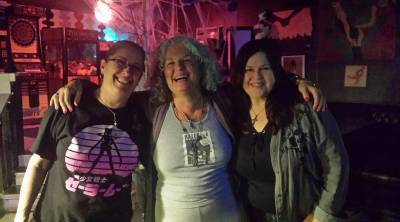
(l to r) Bartender Burt, Marie Cartier, and owner Annette Stone

Why is this bar still important? (Read Part I)

For the gender queer, marginalized community who are testing the waters of gender difference by frequenting this bar, many for the first time, for the pool leagues, and yes, the college folks, but also the working class people, and the tentative younger folks, this may be “the only place.” For the democracy of a gay bar creates a conversational cauldron for marginalized people to “hear themselves into speech” to quote the theological Nelle  Morton.

I am quoted in an article done by Virginia Pilot report Amy Poulter saying that “LGBTQ bars are also tasked with filling in the gaps as religious spaces, support groups and the go-to location to celebrate milestones and mourn losses. Bars like Hershee are often the only place LGBTQ people feel at ease and comfortable in their own skin.”

And I added, “And the council, they need to realize what they have before they destroy it.” Continue reading “The Hershee Bar: Saving A Lesbian Sacred Place (While there is still one left) by Marie Cartier (Part II)”

The Hershee Bar: Saving A Lesbian Sacred Place (while there is still one left) by Marie Cartier (Part I)

(l to r) Bartender Burt, Marie Cartier, and owner Annette Stone

I spent last weekend in Norfolk, Virginia.  I was brought there by the folks at Old Dominion University; my visit was brainstormed and facilitated by y Professor Cathleen Rhodes who teaches in the Women’s Studies Department and also manages a magnificent archive of historic LGBTQ+ spaces The Tidewater Queer History Project. This project has a walking tour of significant LGBTQ+ spaces in the area, an online archive, and graduate students intensely interested in archiving the remains of past and current LGBTQ+ sites for study, and community.

I was brought to the area because I wrote the book Baby, You Are My Religion:  Women, Gay Bas and Theology Before Stonewall. The thesis of my book is that gay bars before 1975 (pre-Stonewall) served as alternate church spaces and community centers for people exiled from all other spaces. There was literally no other public space for gay women to go in the 40s through the early 70s, as so attested to by 100+ informants that I interviewed for the book. Continue reading “The Hershee Bar: Saving A Lesbian Sacred Place (while there is still one left) by Marie Cartier (Part I)”

Fierce Heart: The Power of Women’s Voices by Elizabeth Cunningham

“Women, when you begin to make fierce sounds on your own, don’t be surprised if it’s difficult at first. Start gently. Get close to the earth. These sounds may bring up memories, emotions. Have a way to work with them. When you get together to make fierce sounds with other women, experiment. Try a growl, a howl. You are sounding for all the beings that have no voice. It’s bigger than your personal story. The sounds of outraged women have not been heard collectively on this planet for a long time. Let them out. We are a force of nature. It’s time to quit being afraid of our power. Many women are terrified of their outrage. They confuse it with anger. Anger is a small, though intense, emotion. Outrage is rooted in love.  It’s ok. Understand it’s time. Time for these sounds to come out.”Rebecca Singer, founder of the Fierce Heart movement

One hot summer day my friend Rebecca and I both participated in local marches in different towns in support of immigrants’ rights. A lively band called Tinhorn Uprising led our march in song. At Rebecca’s march there were choruses of an oft heard call and response: “Tell me what democracy looks like! This is what democracy looks like!” Nothing wrong with the sentiment, but Rebecca suddenly knew she was done with the old chestnuts, chants and songs. A powerful vision came to her:

Thousands of women in the streets, roaring, howling, banging pots and pans, beating drums, sounding their outrage on behalf of the planet. Women in an ancient lineage of women, raising their voices together, making fierce sounds beyond words. Continue reading “Fierce Heart: The Power of Women’s Voices by Elizabeth Cunningham”

We Have 12 Years. Luckily, Climate Lovers Are Usually Feminist by Tallessyn Grenfell-Lee

Climate scientists have been screaming the alarm for literally decades. Despite global efforts, they now say we have 12 years left to contain the damage: the difference between 1.5°C and 2°C warming means tens of millions of lives lost, not to mention the death of all coral reefs and half the world’s plants and insects. In the USA, our oligarchic, oil-funded government seems determined to drive our country off a cliff and take the rest of the world with us. What on this good, green Earth are we to do?

I have been thinking about this a while. Below is a seven-fold strategy that I pray may bring help, comfort, and inspiration to those who, like me, can feel utterly overwhelmed.

Face Reality

It astonishes me to have to include this, but so much money has poured into distractions and strategies to discredit climatology that we must still spread the word. We now know which approaches actually bring people along; a little bit of doom and gloom goes a very long way. Focus on empowerment, action, and most importantly, connection: how do climate issues affect people directly? How do they intersect with issues people already care about? (Hint: the climate affects all life and every place on Earth!) Continue reading “We Have 12 Years. Luckily, Climate Lovers Are Usually Feminist by Tallessyn Grenfell-Lee”

The Cost by John Erickson

Brett Kavanaugh is a piece of shit.

Brett Kavanaugh is a piece of shit.

KavaNope

There, I said it. I know that we are supposed to “use our words” or “take the high road” but I no longer can. I am completely and totally done with the fact that it is Sunday night and I sit here wondering whether or not our Democracy will be around by the end of the week.

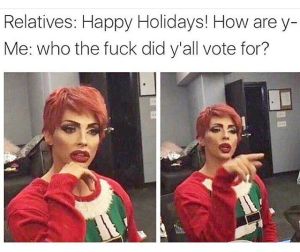
If you are like me, you have found yourself, more times than one I am guessing, watching the news, mouths agape, mind in disbelief, and your heart heavy with grief and sadness. While these great travesties occur, I find myself wondering what is the cost? How many children must be locked in cages? How many women must come forward with accusations of sexual assault and rape? How many more people must accuse the President of harassment and assault? How many more anonymous op-eds and faulty promises must be made before we finally all see that the real cost, is that these great travesties themselves (too many to recall here) are what it really takes to take down imperialist white supremacist capitalist patriarchy. Continue reading “The Cost by John Erickson”

EcoJustice and Our Relationship with God by Gina Messina

Version 2This semester I am teaching the course EcoJustice and chose Sallie McFague’s A New Climate for Theology as our foundational text. Something I greatly appreciate about McFague is that she continually calls us to radically redefine our understanding of the Divine and of our roles as human beings — fundamental questions that could easily lead to an existential crisis as one student reminded me. 

My class and I ponder these questions, discussing our own interpretations of God, why we exist, what it means to pray, and understandings of salvation. Not surprisingly, many of us have an anthropocentric theology — one that puts ourselves at the center. We are so focused on what we need from God, we forget to ask what God needs from us.  Continue reading “EcoJustice and Our Relationship with God by Gina Messina”

Sex is a Feminist Issue: An Interview with Rev. Dr. Beverly Dale by Jera Brown

Sex is a feminist issue. Harmful perspectives on sex and our physical bodies have been used to disempower and invalidate the sexuality of women, LGBTQIA folks, and people of color. It runs through our theology and cultural traditions within the church.

I run a personal blog which speaks positively about sex and queerness. And when folks find it, frequently, their first questions to me is what other resources are out there that teach a better Christian perspective? I often tell them to start with The Incarnation Institute for Sex and Faith.

IISF offers “inclusive, science-friendly, sex-positive” educational programming for church leaders and lay people. Founder Rev. Dr. Beverly Dale, affectionately known as “Rev Bev,” is ordained through the Christian Church (Disciples of Christ) and currently teaches courses on sexuality and religion at Lancaster Theological Seminary.

The institute recently released a four-part web series, Reading the Bible with Sex-Positive Eyes, which includes the topics: “Introduction to Christian Sex Negativity: The Beginnings,” “Discerning Truth, Discerning Culture,” “Sex in the Bible: The Good, The Bad & the Ugly,” and “Sex: Whether, When, and How.”

I interviewed Rev Bev about the new series.

Continue reading “Sex is a Feminist Issue: An Interview with Rev. Dr. Beverly Dale by Jera Brown”

Israel Francisco Haros Lopez by Sara Wright

Borderless Haiku:

We have forgotten the names of each other underneath the shedding skin those names written in our blood that have danced to tonantzin tonatiuh before they knew they were lovers. (IFHL)

Last week I was fortunate to have attended a poetic reading and performance by a remarkably gifted young Mexican man named Israel Francisco Haros Lopez who was born to immigrant parents in Los Angelos. He is both a visual and performance artist, and his work transcends borderlands of all kinds. Israel believes that it is critical to honor and remember the ancestors so that we may once again become one with the winged ones, all those who crawl or walk on this earth, the Four Directions, Earth Air Fire and Water,  Tonanztin and Tonatiuh – the Aztec Earth Goddess and the Sun God – Israel’s expression of unity in divinity, and the universe as a whole. His visual motifs are drawn from Pre – Columbian America and his work is an attempt to search for personal truths within the context of today’s world incorporating Mexican/Indigenous stories into the whole.

Continue reading “Israel Francisco Haros Lopez by Sara Wright”

A Prophet in Our Midst: Vandana Shiva by Carol P. Christ

She is not crying in the wilderness. She is not railing in the streets.


She sits quietly and speaks softly and with absolute clarity and certainty.

To let all the water systems and food systems and planetary climate systems get destroyed. That is the stupidity which rules us today.

No fire and brimstone, no angry God.

I do not think the planet will die. I think the earth is too powerful.

A simple truth.

We need to protect our home.

Men have lost the way.

Going to war and killing was considered important. Making profits at the cost of others was considered important.

Women must lead.

The values we need are in the knowledge of how to live with nature. That’s what women’s knowledge is. We need knowledge of how to care. That’s knowledge: it’s … called emotional intelligence now. We need knowledge of how to share.

We are part of the earth.

Working with our hands is not a degradation.

Could it really be as simple as that?

Some gender scholars will protest. “This is essentialism,” they will say. “This will keep women in the home where they have always been,” they will say.

If they say this, they will miss the point. This is not gender essentialism. The situation Shiva describes is a product of history. A history in which powerful men determined that war, killing, and profit are the highest values. It may or may not be in women’s nature to know how to live with nature, to care, and to share. These values are part of “women’s knowledge”* because they derive from the work women have been doing while men were making war and making profit on the backs of others.

Shiva is not telling women to stay in the home. She is telling women to confront “deceitful, dishonest, brutal power.”  She is telling women to teach those who rule the world how to live with nature, how to share, how to care.

If women are can teach what they know, how to live with nature, how to care, how to share, women’s knowledge will become human knowledge once again and we may be able to save our home.

If not,

. . . we are dispensable. She’ll find a way.

A prophet is speaking. listen to her words. Etch them on your heart. And save the world.

*Shiva has stated that women do most of the farming in the world. Women who are not farmers care and share and may tend gardens. Women’s knowledge is a relative term. Some women in industrialized countries place ambition, competiton, and profit above caring and sharing. Even in this situation, women generally care for children. See Shiva’s Staying Alive: Women, Ecology, and Development.

Carol P. Christ is an internationally known feminist writer, activist, and educator currently living in Lasithi Prefecture, Crete. Carol’s recent book written with Judith Plaskow, Goddess and God in the World: Conversations in Embodied Theology, is on Amazon. A Serpentine Path: Mysteries of the Goddess is on sale for $9.99 on Amazon. Carol  has been leading Goddess Pilgrimage to Crete for over twenty years: join her in Crete. Carol’s photo by Michael Bakas. Carol will be speaking at the 25th Anniversary Celebration of the Re-Imagining Conference at Hamline University in St. Paul Minnesota on November 1 and 3 and at the Parliament of World Religions in Toronto, Canada on November 5.

The Ninth Touchstone: Repair the Web by Carol P. Christ

As I reflected on the Nine Touchstones again recently, I was pleased to discover that the first and the eighth touchstones are articulations of the central values of egalitarian matriarchal societies. Few of us live today in egalitarian matriarchies, and it would not be possible for all of us to return to cultivating the land. I offer the Nine Touchstones in the hope that they can help us to find a way to express and embody the values of egalitarian matriarchal cultures in the modern world. The touchstones are intended to inform all our relationships, personal, communal, social, and political.

Nurture life.

Walk in love and beauty.

Trust the knowledge that comes through the body.

Speak the truth about conflict, pain, and suffering.

Take only what you need.

Think about the consequences of your actions for seven generations.

Approach the taking of life with great restraint.

Practice great generosity.

Repair the web

The ninth touchstone is based on the Jewish “commandment” to repair the world. It is derived from the mystical tradition in which prayers were directed towards reuniting the broken sherds that became the created world with their transcendent source. It was reinterpreted by liberal Jews in America as a commandment to create justice in this world through social and political action. I rephrase it as “Repair the web,” to underscore to the need to repair not only the human community, but also the web of life in which it is situated.

To nurture life is to protect the weak and the vulnerable and to create the conditions in which human beings and all beings can experience the joy of living.

To walk in love and beauty is to love yourself, other human beings, and all beings in the web of life, and to appreciate the beauty that is found in all of our diversity and difference.

To speak the truth about conflict, pain, and suffering is to recognize that everything is not love and light in the modern world: to speak the truth about that which is broken is the path to healing.

To take only what you need is to recognize the interdependence of life: when we take more than we need, we take from others without reason.

To think about the consequences of your actions for seven generations is to recognize that what we do today will affect the next generations and the planet as a whole, in good ways, and in bad.

To approach the taking of life with great restraint is to think about what we eat, never to kill unnecessarily, and not to react with violence when there are other ways to resolve conflict.

To practice great generosity is to recognize that none of us has the God-given right to own anything, and to learn to give and receive in the grace of life.

To repair the web is to always act to create a better life for ourselves, for the next generations, and for the species with which we share life this earth.

The Nine Touchstones help us to imagine the way to a better world. Can we join together to create it?


*Parts of this blog will be included in my keynote address at The Parliament of World Religions on November 5, 2018 in Toronto, Canada.

*Also see: Ethics of Goddess Religion: Healing the World , Nurture Life: Ethics of Goddess Spirituality,  Walk in Love and Beauty: A Touchstone for Healing,  Trust the Knowledge that Comes through the Body: Heal Yourself, Heal the World,  Speak the Truth About Conflict, Pain, and Suffering, Take Only What You Need, Think About the Consequences of Your Actions for Seven Generations, Approach the Taking of Life with Great Restraint,  Practice Great Generosity


Carol P. Christ is an internationally known feminist writer, activist, and educator currently living in Lasithi Prefecture, Crete. Carol’s recent book written with Judith Plaskow, Goddess and God in the World: Conversations in Embodied Theology, is on Amazon. A Serpentine Path: Mysteries of the Goddess is on sale for $9.99 on Amazon. Carol  has been leading Goddess Pilgrimage to Crete for over twenty years: join her in Crete. Carol’s photo by Michael Bakas. Carol will be speaking at the 25th Anniversary Celebration of the Re-Imagining Conference at Hamline College in St. Paul Minnesota on November 1 and 3 and at the Parliament of World Religions in Toronto, Canada on November 5.