The Greek Elections and the 1% by Carol P. Christ

Alexis Tsipras of Greece & Pablo Iglesias of Spain hope to change Europe for the 99%

On January 1, 2016, 1% of the world’s population will own 50% of the world’s wealth, according to Oxfam.

On January 26, 2015 Alexis Tsipras will be in the process of forming a new anti-austerity government in Greece. Some believe this will be a new beginning not only for Greece, but for the world–if others follow the Greeks in resisting the domination of their economies by the international monetary interests that represent the 1%.

The bondholders and the international press tend to portray the Greek economic crisis as a morality play in which foolish Greeks borrowed too much and must suffer the consequences to pay back their loans. If Greece were a lazy teenager appearing on Judge Judy, tough love might be the answer.

But this simplistic equation cannot be made to work for a country of 10 million people, only some of whom colluded in taking out loans they could not pay back. Continue reading “The Greek Elections and the 1% by Carol P. Christ”

Sequana and Blessed Water by Deanne Quarrie

deanne_2011_B_smWater is the daily necessity for earth’s creatures.

When the Continental Celts were looking for a new homeland, they ventured west from the known river valleys of the great landmass we call Eurasia. Just beyond the great mountains, the Alps, they discovered sweet and abundant water, fertile soil, expansive woodlands, and the plentiful fish, game, berries, grasses, fungi and broad-leafed plants necessary to support their tribe.

We know that Celtic spirituality was, in its roots, animistic (spirit was alive in every living thing), non-anthropomorphic (the source of life and death was water, land, plant and animal-life), tribe-specific (in France alone there is evidence of several hundred deities) and a spirituality of place, of the major landforms that defined the world (rivers, springs, forests, animals, heavenly bodies). To the extent that Celtic spirituality was theistic, the creator/sustainer/destroyer of life was typically a goddess. Continue reading “Sequana and Blessed Water by Deanne Quarrie”

What is the F-word Anyway? by Kile Jones

kile jonesSocial justice. Progressive politics. Improper media depictions. What exactly is the F-word (feminism) about?

I have always understood feminism as a project that casts a very wide net, the goals and values of which can keep quite a few people dry under the shade of its umbrella. But more and more, I see a narrowing of who can count as a feminist. There are a few reasons for this constriction. First, the more the F-word becomes a pejorative in contemporary society, the greater the need is to circle the bandwagons and set up camp. Second, when a particular group has elevated levels of in-fighting occurring, it makes sense to start psychologically splitting people into “feminist” and “not feminist.” Or, on a spectrum, “strong feminist” vs. “weak feminist.” Third, there is a pragmatic need for groups to find an optimal tension with society. When social groups are too counter-cultural or revolutionary, they get branded extremist and fanatical, but when they are wishy-washy and lukewarm, they become another extension of the status quo and lose their prophetic fire.

As an atheist, I see all of this occurring in non-believing circles as well. And I’m not really sure how to navigate it. There is also no shortage of men in this social group–from Dawkins to Boghossian–who think of feminism in the negative. All of this has to do with what they think the F-word amounts to. Continue reading “What is the F-word Anyway? by Kile Jones”

Painting for the Earth by Jassy Watson

JassyI have spoken about the Social Responsibility of the Artist on numerous occasions. This blog approaches similar subject matter, but in relation to using art as a potent tool for change and as a platform for raising awareness of important environmental and ecological issues that all of humanity is currently faced with.

All forms of art have the potential to be tools for healing. I believe that through the creative process the relationship with self and the environment can be transformed. Why? Because when creative work is approached from a place of passion and purpose and art is brought to life with intention, great shifts can occur. Not only for the artist, but also for the viewer. I believe wholeheartedly that I can approach the canvas and paint intentionally to heal the earth and deepen my connection to it, and in doing so inspire others to deepen and honour a connection to the earth creatively.

There are many contemporary artists who are agents of environmental change and who are using their creative gifts and talents to build awareness and provoke thought through their work and process. Many artists, such as myself are working with transformative approaches and processes towards a new vision that is ecological and participates with the living cycles of nature. Many topics are approached such as oceans, climate change, water quality, recycling, water purification, natural disasters, de-forestation, endangered species and more.

Artists today are finding all sorts of inventive ways to call attention to the problems facing our environment, as corporate greed and profit impose destruction on our planet. While each artist works very differently and explores diverse territories, they share awareness about the critical loss of natural resources and a desire to save the planet from human destruction.

Take the words of Nigerian painter Jerry Buhari:

“Today the talk of the world is about an endangered Earth. One often wonders how much of the talk is backed with genuine concern and the will to take positive steps. But it should not surprise the world that artists are in the forefront of the discussion on the environment.”

Eco-feminist artist Ann T. Rosenthal and activist artist Steffi Domike have been collaborating on environmental installations for years. Their wall installation, Watermark: Wood, Coal, Oil, Gas (2011) consists of four panels that illustrate an evolutionary timeline of energy resources—wood, coal, oil and natural gas.

shallow-ann-rosenthal-200x300

Dominique Mazeau is a poet and artist from Santa Fe, New Mexico. She has made an exquisite journal of poems and drawings of cleaning up the Rio Grande River over many years. She has made sculptures from the trash and she teaches school children about the river with her poems and her art.

There are many more Eco-feminist and Environmentalist/Activist artists such as Charla Puryear and Helene Aylon using their art to raise awareness of ecological issues. These few examples alone demonstrate that art, in its myriad of forms, has the capacity to effect positive change on the earth and its environments.

Artists are catalysts for change, and this “change” takes place when we feel deeply for a precious cause. I feel deeply for the state of the earth and feel that it is largely humanity’s spiritual disconnection from the earth and from the earth as sentient that has contributed to the current state of not only the health of the earth body, but also the health of our bodies.

Coming up in October I will be presenting an exhibition ‘Voices for the Earth’ in Bundaberg, QLD Australia. This exhibition will feature the works of select regional artists who are using their art to speak for the earth. It is held in conjunction with RONA-16 an Earth Arts Festival as part of the The Rights of Nature Tribunal that is taking place the same month. Artists of all genres from around Australia are participating in creative activities to raise awareness of the urgency required to make the necessary changes so that ways can be found to make the health of our planet an absolute priority.

I know that more has to be done, and some might see ‘art’ as a hedonist, self absorbed way to attempt to bring about change – but the power of image should NEVER be underestimated.

I am Painting for the eARTh.

This Earth is my sister
I love her daily grace
Her silent daring
And how loved I am.
How we admire this strength in each other
All that we have lost
All that we have found
We are stunned by this beauty,
And I do not forget
What She is to me
And what I am to Her.

(from Susan Griffin, Woman and Nature – The Roaring Inside Her, p.219, caps added).

'The Earth is my Sister'
‘The Earth is my Sister’

Jassy Watson, who lives on the sub-tropical coast of Queensland Australia, is a Mother of four, passionate organic gardener, Intuitive/Visionary & Community Artist, Teacher, Intentional Creativity Coach and a student of Ancient History and Religion at Macquarie University, Sydney. She is the Creatress of Earth Circle Studios; a school for the Sacred Creative Arts. Jassy teaches regular painting workshops in person, nationally and internationally, and online based around themes that explore myth, history and our connection to the earth. 

Great Hera! Wonder Woman and Taking Women’s Power Back from the Mainstream Media by Carolyn Lee Boyd

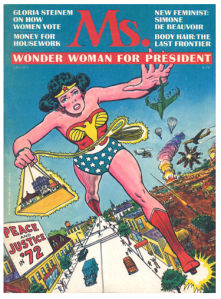
Carolyns new lookWhen I was a teen in the 1970s, Wonder Woman was everywhere. A feminist cheerfully determined to right the world’s wrongs, especially against women, she boldly sprinted onto the cover of Ms. Magazine’s 1972 inaugural issue. Her tv series spun off toys, t-shirts, action figures, lunch boxes, and more. Now she’s back. Jill Lepore’s new book, The Secret History of Wonder Woman, tells of her bizarre 1940s creation and subsequent history. In 2016, a revamped Wonder Woman will be sword-fighting her way into movie theaters worldwide in Batman v Superman: Dawn of Justice.

ms coverWonder Woman is just one of many currently popular women warriors or superheras, including the X-Men series’ female super-mutants, the Hunger Games’ lead character, the women warriors in the Avatar tv series, and many more, whose power comes from the ability to fight.  Even Snow White became a martial arts expert in 2012’s Snow White and the Huntsmen. Like Wonder Woman’s recent regeneration, however, these characters seem grimmer, and more deadly, violent, and dystopian than the earlier Wonder Woman with her optimistic, colorful comic book style, and an innocence that would now seem naive. Continue reading “Great Hera! Wonder Woman and Taking Women’s Power Back from the Mainstream Media by Carolyn Lee Boyd”

The Spirit of Capitalism vs. the Spirit of Traditional Rural Life by Carol P. Christ

marika's rakiIn this picture, Marika from Skoteino Crete toasts our group and downs a glass of her homemade raki. Marika, who is best friends with Christina who makes lunch for us, has just returned from her home next door with her gift of a glass of raki for each of us.

Marika, who has little, is eager to give to us. Hers is but one of many gifts from the heart we receive on the Goddess Pilgrimage to Crete. Why is it that we who have so much do not give as spontaneously?

One answer is that capitalist individualism has taught us to count our worth by how much we have and to fear for the day when we will have nothing.

These words may be a cliché, but they hold a profound truth nonetheless.

Heide Goettner-Abendroth tells us that in matriarchal societies with small-scale sustainable agricultural economies, people did not hoard or save for a rainy day. With the labors of their bodies and minds, they took only what they needed from the land. When there was a surplus, they gave parties, sharing what they had with others. Even with the coming of patriarchy, ancient matriarchal customs of generosity survived among rural farmers. Continue reading “The Spirit of Capitalism vs. the Spirit of Traditional Rural Life by Carol P. Christ”

“Justice, Justice You Shall Pursue:” Finding Hope in Justice-Seeking Movements. by Ivy Helman

20140903_180423For the past few weeks, there has been a lot of discussion about racism in the United States and rightly so. It is clear from the lack of charges and the repetition of similar crimes across the United States by different members of various law force communities that some people because of the color of their skin are immune to the consequences of their actions and others, also because of the color of their skin, are often the victims of such actions. Criticism, here, in the forms of protests, federal inquiries and outrage are essential.

I am reminded of oft-quoted part of the Torah: Devarim (Deuteronomy) 16:20, one that I saw on some of the signs Rabbis carried with them in the protests. “Justice, justice shall you pursue, that you may thrive and occupy the land that the Lord your God is giving you,” (from the JPS translation). G-d tells those early Israelites that justice is a requirement not just for their survival in the Promised Land, but also if they want to have good, long lives. Later tradition, from the Talmud to Rashi and beyond, interpret this passage as a call for a just court system within Jewish society.  Likewise, all who use the system should have the principle of justice in mind.  There is also a lot of conjecture as to why justice is said twice. Many modern scholars call attention to the way in which religion and state were considered one in same for this time period and much of human history. Continue reading ““Justice, Justice You Shall Pursue:” Finding Hope in Justice-Seeking Movements. by Ivy Helman”

Awake! Awake! A Reflection on the Awakening of Conscience and Advent by Elise M. Edwards

Elise Edwards‘Tis the season to be…?

For me, this has not been a season to be jolly. I teach at a university, and again, I’m in the midst of the most hectic time of year of grading and exams and wrapping up projects due at the end of the calendar year. There have been moments of joy and rest. But I’ve been more reflective and sorrowful. This year, my heart and mind and soul have been opened up in new ways and I feel more urgency and need for social change. I’ve been experiencing “conscientization” during the time of year many Christians refer to as Advent.

I was introduced to the concept of conscientization in the work of Christian feminist and womanist ethicists like Beverly Wildung Harrison and Stacey Floyd-Thomas. Other feminist and liberationist thinkers had already convinced me of the vital role that critical thinking, consciousness-raising, and action occupy in ethical reflection and social change. In a chapter on “Feminist Liberative Ethics” in a textbook on liberative approaches to ethics, Michelle Tooley explains the meaning of conscientization:

“Activists speak of conscientization as waking up to the injustice in the world—or seeing it for the first time. It is not that the injustice is beginning; it is that you encounter oppression, injustice, violence yourself or you see it in a person or situation. You may have seen the same situation many times before, but for some reason you begin to connect the event with a deeper recognition that the injustice is wrong.”

(p. 185, Ethics: A Liberative Approach, Miguel A. De La Torre, Editor)

I was conscientized the night I heard that a grand jury did not indict Darren Wilson for killing Mike Brown, an unarmed black man. I was horrified to learn that this police officer doesn’t even have to stand trial for his violent and deadly act. Now it wasn’t like before grand jury’s decision I thought that black lives were given equal value in the US justice system. After all, for months I have been researching and preparing a paper called “When the Law does not Secure Justice or Peace” about artistic and religious responses to the dishonoring of black male personhood. I have been mourning the loss of Trayvon Martin and others as I write. But this decision left me sobbing in a hotel room as I watch the events unfold in Ferguson, Missouri. I gained a deeper social awareness about the depths to which the demonization and disregard of the lives of black women, men and children are entrenched in American life and the institutions within it.

I gained deeper self-awareness too. One reason the tragedy of the grand jury’s decision became so palpable to me is that just hours prior, I witnessed former president Jimmy Carter address the American Academy of Religion. He spoke passionately about the proliferation of violence, mistreatment of women, climate change, and other social concerns. To put it plainly, I was floored to see a white man in his 90s who was raised in Georgia and was a Southern Baptist until his 70s state without any qualms that people in power intentionally misinterpret religious texts to support the domination of women and nonwhites because those they do not want to lose their privilege. Yet he also called himself, like Archbishop Desmond Tutu, a “prisoner of hope.” He believes that things will change, and draws from his Christian convictions to sustain hope and motivate his work to fight injustice.

I was electrified by his words. I, too, had hope. In the days prior, I had gotten a break from my daily life, connected with friends, and conversed with like minds. I had been thinking about art and love. I had learned strategies for de-centering dominant narratives in the classroom and I was hopeful that I could use them to make a difference in my students’ lives. But mere hours later, while watching the news, the self-awareness I came to is that my hope is more fragile than I wish it to be. Futility consumed my hope.

A few weeks later, I can assert that my faith in God is not shaken, but my hope in humanity’s goodness has as much stability as a house of cards. In my present state of mind, I’m grateful that we are at a point in the church year that provides me with an opportunity to mourn the brokenness of our world. Christmas is approaching, but that doesn’t mean I have to sing merry carols. Advent is a season when Christians reflect on why the world needs God’s miraculous action and what it means to wait for light to emerge in the darkness. In the church calendar, it is a time when Christians re-enact and re-experience the anticipation of Jesus’ coming. Advent songs have a different character than Christmas carols. Many of them have a haunting tone or an eerie, sad, or mysterious sound. The lyrics of these songs place exhortations to “Rejoice!” next to pleas of “O come, o come, Emmanuel!” Emmanuel, also spelled Immanuel, means “God with us.” Christians draw this name from the Hebrew prophecies in Isaiah that are cited in the Gospel of Matthew’s account of Jesus’ birth. Matthew describes Jesus’ birth as the fulfillment of prophecy.

My conscientization allows me to hear these prophecies anew. They are familiar to me, as they are repeated often this time of year in Christian settings, but I hear them in new ways. I hear Isaiah 9:6 quite differently: For to us a child is born, to us a son is given, and the government will be on his shoulders. And he will be called Wonderful Counselor, Mighty God, Everlasting Father, Prince of Peace.

“The government will be upon his shoulders” likely means that this child will have authority. But as I hear those words this year, I imagine the Prince of Peace in the choke-hold of a law enforcement officer. I think of a little baby who are welcomed into the world with joy but who grows up only to be killed at a young age by threatened authorities and crowds of supporters. This is the story Christians tell about the God who is with us, the God who is also fully human. And this is the story we tell about Michael Brown, Eric Garner, Tamir Rice, Alesia Thomas, Aiyana Stanley-Jones and far too many others.

This Advent, I’m making a real effort to hold hope and despair together. I don’t want to become hopeless. I don’t want to think that my work in the classroom, in my church, in my community, on this site and in the printed page have no meaning. Hope is what sustains us to work for justice. I want to believe in that transformation of hearts and minds and souls is possible and immanent even when it emerges through sorrow and struggle. Suffering, sorrow, and killing without consequences must not be acceptable. With my new eyes, I see just how terrible they are.

Elise M. Edwards, PhD is a Lecturer in Christian Ethics at Baylor University and a graduate of Claremont Graduate University. She is also a registered architect in the State of Florida. Her interdisciplinary work examines issues of civic engagement and how beliefs and commitments are expressed publicly. As a black feminist, she primarily focuses on cultural expressions by, for, and about women and marginalized communities. Follow her on twitter, google+ or academia.edu.

The Cop on the Beat is Not Ice-T, the Prosecutor Is Not Sam Waterston, and Mariska Hargitay and S. Epatha Merkerson Are Not in Charge, by Carol P. Christ

carol at green party 2014 croppedI have watched every episode of Law and Order and Law and Order SVU, and most of them more than once. Though there is police violence on these programs, it is usually investigated, and viewers are given the sense that it is not OK. Not living in black America or even in the United States, I guess I was under the illusion that police forces are no longer primarily white and male, that police reforms advocated decades ago have had some effect, and that cops cannot get away with murder.

This despite the fact that I knew that inmates in US prisons are far more likely to be black than their numbers in the population warrant, and that I knew that stop and frisk and arresting black men for petty crimes are ordinary police policies.

For readers who don’t watch MSNBC as avidly as I do, stop and frisk, now banned in New York City, is the policy of searching (primarily) young black men hanging around on street corners to see if they have illegal drugs or weapons on their persons. This policy can lead to the incarceration of young black men for having one or two marijuana cigarettes intended for personal use in their pockets. Stop and frisk is not a policy on college campuses, where police are just as likely to find young white men and women in possession of illegal drugs. Why? Because college authorities and parents of white college students simply would not allow it. Continue reading “The Cop on the Beat is Not Ice-T, the Prosecutor Is Not Sam Waterston, and Mariska Hargitay and S. Epatha Merkerson Are Not in Charge, by Carol P. Christ”

Belonging to the Land by Carol P. Christ

Carol Christ in LesbosI believe that we can restore our hope in a world that transcends race by building communities where self-esteem comes from not feeling superior to any group, but from one’s relationship to the land, to the people, to the place, wherever that may be.—bell hooks

In these words from her poignant memoir-reflection-analysis Belonging, bell hooks suggests that rather than creating identity by comparing ourselves to others, whether in the academy, in communities, or in the larger society, we would do better to root our identity in the land.

Hooks “left home” in rural Appalachia in order to pursue “higher” (why do we call it that?) education including a Ph.D. which enabled her to teach at prestigious universities in the urban north. Despite her considerable success as an academic and a black feminist, hooks suffered persistent depression in the cities where she taught. Eventually she diagnosed her dis-ease as a longing for the home she had left behind, specifically as a need to connect with the traditions of her ancestors, the mountains, and the land that had sustained them since the end of slavery. Continue reading “Belonging to the Land by Carol P. Christ”