Keyvermestn by Janet Madden

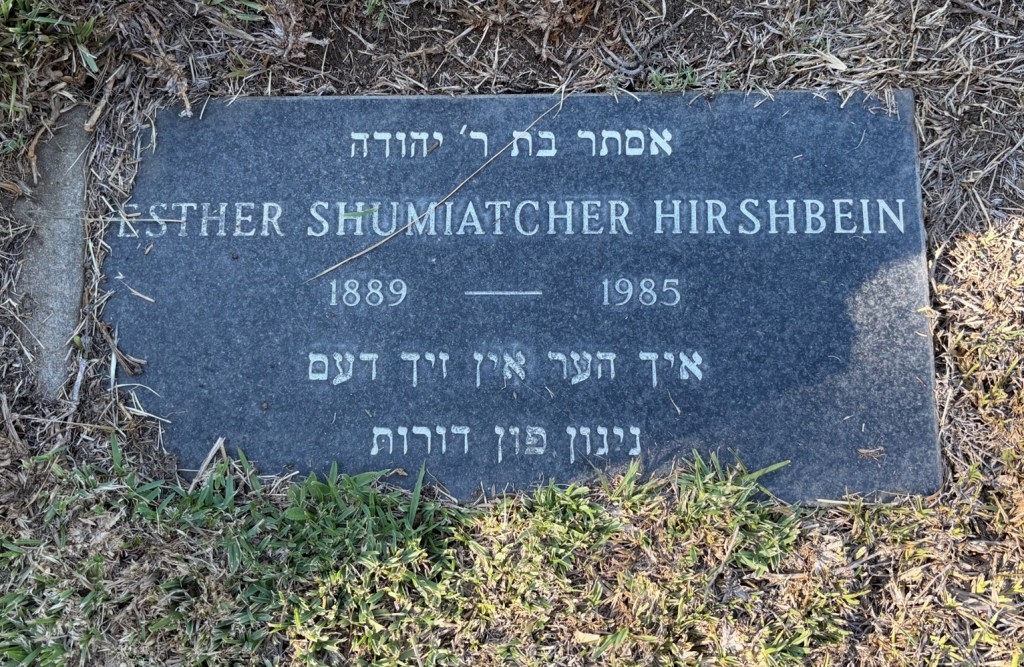
in memory of Esther Shumiatcher-Hirschbein

1.
On a sunny Elul afternoon
I kneel at your grave
a sprig of rue in my pocket.
I recite a tkhine for visiting the graveyard
and imagine that you know this ritual–
stretching string to calculate
the space your body inhabits.
The unspooling wick rests gentle
on rough-cut grass, touching
the edges of mortality,
its twists separating and connecting worlds:
the dead and the living
the past and the now
mine and yours,
a woman I never met,
a writer dead these 40 years.

Continue reading “Keyvermestn by Janet Madden”

Elemental Grannies: Snippets from Over the Edge of the World, A Fairytale Novel by Elizabeth Cunningham

Introduction: An old woman, Rose begins spinning the tale the children never tire of hearing. Grannies Sweep, Spark, Dirt, and Brine, were old, so old, they forgot who they were and how they came to live where they did: a sheer pinnacle, a walking forest, an old shoe, a ship moored off a hidden shore.

But Rose has never told the whole story—to anyone. The story of a world these children have never seen, where the rich lived inside a vast dome, protected from heat and cold, rain, wind—and hunger. Nor do the children know about madness or cruelty. She has never told them about Noone, the power behind the dome, his obsession with immortality.

If she never tells these stories, who will remember the bravery of the beauty singers who daily risked the ultimate penalty—being thrown over the edge of world. Who will remember the intrepid children who danced defiantly on the dung heaps. If Rose does not tell her own story, who could imagine her birth deep inside the dome, the dangerous secret of her existence. A secret guarded her two huge aunties, once ragged outside boys, who became outrageous bodyguards in towering wigs and heels. To protect the new world and the people she loves, it is time for Rose to tell…

Continue reading “Elemental Grannies: Snippets from Over the Edge of the World, A Fairytale Novel by Elizabeth Cunningham”

Divining Goddess: Tattooed Sawbonna & Serpent by Margot Van Sluytman/Raven Speaks/Heyoka

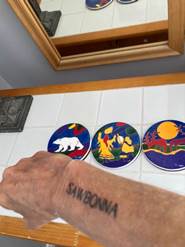
Tattooed upon my body. Residing in my soul. Sawbonna. Serpent. Snake. SHE who is. Was. Always will be. Like waking from a solemn sleep. I walked with the intention of heading to my home where I have been building houses. Papier-mâché mansions and tiny, tiny shacks. Sheds too, that speak of shelter. Of warmth. Of community.

After time with Jess and Benn in Emma’s office, heading in the direction of my cozy cave of light. My sanctuary. Where silence rarely slumbers. I looked up.  Above me there, right there, blue, blue, sky. Fat potent clouds. One errant, silent-speaking breeze redolent with hope. Reeking of Sawbonna. I knew that the time had come.

I knew what I had do.
I did not return home.
I turned left on to Hunter Street.
Wended my way to Simcoe Street.

After conversation with Nelson at Henry’s Barber Shop, Riverside Tattoo and I became acquainted. It was mid-afternoon.

Continue reading “Divining Goddess: Tattooed Sawbonna & Serpent by Margot Van Sluytman/Raven Speaks/Heyoka”

“Over the Edge of the World” by Elizabeth Cunningham: A Book Review by Judith Shaw

Elizabeth Cunningham’s new book is a marvel you won’t want to miss. It’s subtitled, “A Fairytale Novel” which lets you know you are in for a magical experience. Fairytales have meaning and contain wonder, beauty and truth.  Fairytales awaken new insights for the reader, inspiring us all to think more deeply about our world.  “Over the Edge of the World” certainly does all that. It will leave you pondering the difficult reality of our world today and the sacrifice and grit needed to create it anew. 

Continue reading ““Over the Edge of the World” by Elizabeth Cunningham: A Book Review by Judith Shaw”

Let’s Have The Talk – What Does “The Birds and The Bees” Actually Mean: By Zoe Carlin

Recently, I have thought about a common idiom that has been used to refer to sexual reproduction, the birds and the bees. I became curious why animals that appear in most gardens were used as an example to explain where babies come from, until I did some research. It turns out that since the birds lay eggs, that is their representation of the female body and the bees represent the sperm due to pollination. It is a very subtle, overlooked message that can be disguised as being more age-appropriate to young children. However, I decided to dig a bit deeper. Ed Finegan, a USC professor of linguistics and law, has stated that this phrase has existed a lot longer than one might think. There is evidence of it being used in a somewhat sexual context going back to at least two authors, Samuel Coleridge Taylor (1825) and an entry from John Evelyn’s The Evelyn Diary (1644). 

In Work Without Hope, Samuel Coleridge Taylor quotes, “All nature seems at work . . . The bees are stirring, birds are on the wing . . . and I the while, the sole unbusy thing, not honey make, nor pair, nor build, nor sing.” This separation of the birds and bees is indicating the loneliness and sadness of missing out on a potential romantic connection. When going even further back in time to 1644, it was noticed in the Evelyn Diary that there was an entry discussing the interior design of St. Peter’s in Rome: “That stupendous canopy of Corinthian brasse; it consists of 4 wreath’d columns, incircl’d with vines, on which hang little putti [cherubs], birds and bees.” This description is illustrating that there is a possible sensual or sexual meaning of the architecture in St. Peters.

Continue reading “Let’s Have The Talk – What Does “The Birds and The Bees” Actually Mean: By Zoe Carlin”

Offerings to the Labyrinth on Papoura Hill, excerpt from the novel by Sylvia V. Linsteadt

Sylvia’s discussion of Papoura Hill was posted yesterday; read it here.

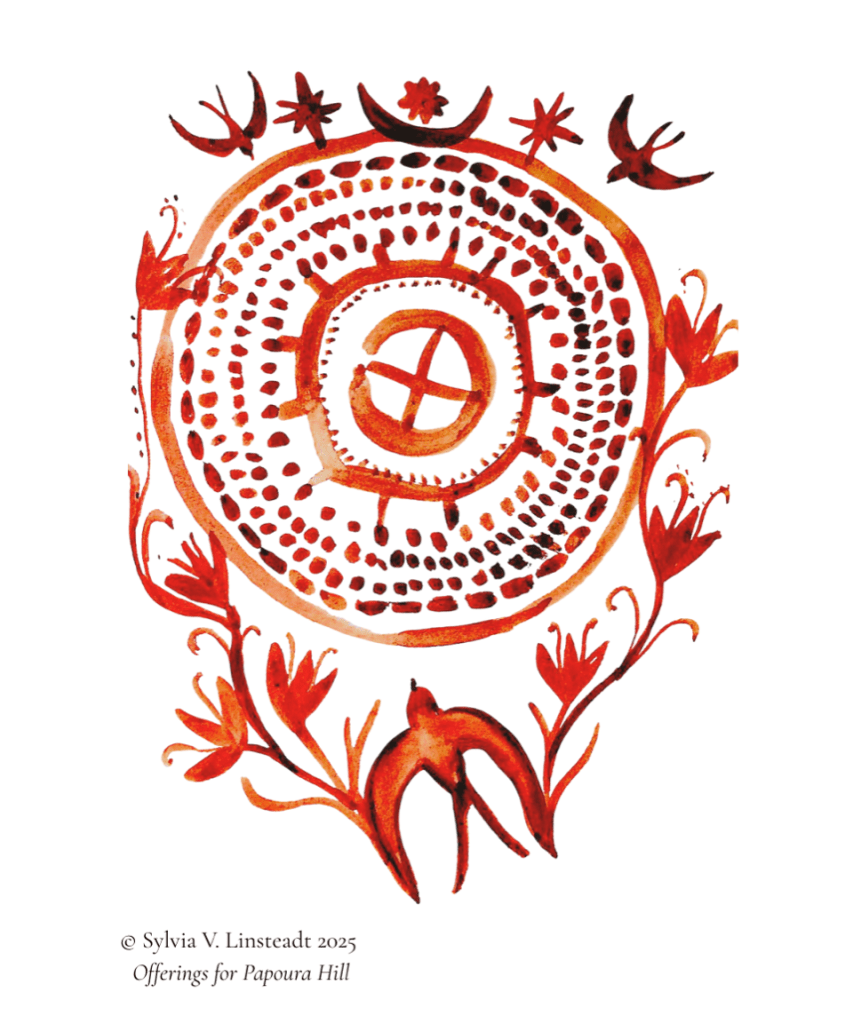
I have so many words I want to pour out of my vessel of milk and honey upon Papoura Hill, on the big scar in Crete’s earth where the airport is being carved, on all the places slated for the construction of electricity pylons, and into so many other scars left by millennia of conquest and occupation, but for today what follows is just one song to her. These words are not full of fighting rage or defiance, but of praise, and softness, and memory. Of motherlines that cannot die, and fatherlines almost lost, but not quite. These words come from the beginning of a novel that I began writing during my first season living in Crete almost seven years ago now, a novel that has metamorphosed with me across these many years, shedding skins and growing new ones— both me, and the novel. The book is still in process, close to being born, but here is one of her many skins, laid at the center of the labyrinth on Papoura Hill with my love.

Moonrise Over Old Crete
an excerpt

The earth tilted toward dusk.
Along the shores of Crete, the Aegean turned for a moment to gold.

Women flocked down to the sea like dark birds to pour jugs of oil and wine into the water. Amphitrite of the cockle crown, they murmured, Aphrodite mother of vessels, mother of the foam and deep, bring our men home safe. The sun lowered under the edge of the world, leaving the last light along the coast. Threads of it pooled in sea-caves and in the inlets where fishermen kept their summer boats. The old storytellers said that in lost times, when the queen was called the Ariadne and her king the Bull, the women of Crete could gather up the last light from the sea onto their distaffs and take it home to spin golden thread for their skirt hems and finest vests.

Continue reading “Offerings to the Labyrinth on Papoura Hill, excerpt from the novel by Sylvia V. Linsteadt”

Offerings to the Labyrinth on Papoura Hill by Sylvia V. Linsteadt

Rhea, mother of Demeter, is coming down upon the seven mountain ranges of her Crete. Ariadne, granddaughter of Rhea, is coming up from her ten thousand perfect caverns inside those mountains with clear water in her arms. They have been quiet a long time, but they are not quiet now. Between them comes Demeter across the wide plateaus where her stones and soil are being stripped for profit, where her bees are dying from pesticide use in their hives, where her grain and oil are sold out from under her, the farmers who grew them cheated by countries with fatter economies and shinier marketing schemes.

They are gathering on Mt. Juktas and Mt. Dikti and Mt. Ida and on Papoura Hill, on all the old holy mountain places where nereids and kouretes were born, where midwives danced, and the dead were buried, and the priests and queens held night-long vigils to take divinations from the procession of the stars. From those divinations they turned the wheel of Crete’s festivals so that they continued year by year as precisely as Earth turned around her axis, so that Earth knew that she and her gifts were respectfully received, and truly loved.

Continue reading “Offerings to the Labyrinth on Papoura Hill by Sylvia V. Linsteadt”

Legacy of Carol P. Christ: Is the Spirit of Great Generosity in Crete a Survival of Ancient Matriarchal Values?

This was originally posted on October 28, 2013

carol-christAt a coffee shop in Agios Thomas, Crete last month a perfect stranger offered to pay for the coffees and sodas of the 16 women on the Goddess Pilgrimage to Crete. This spirit of great generosity is rarely experienced in the United States or other parts of Europe, but it is still common in rural Crete and some parts of Greece.

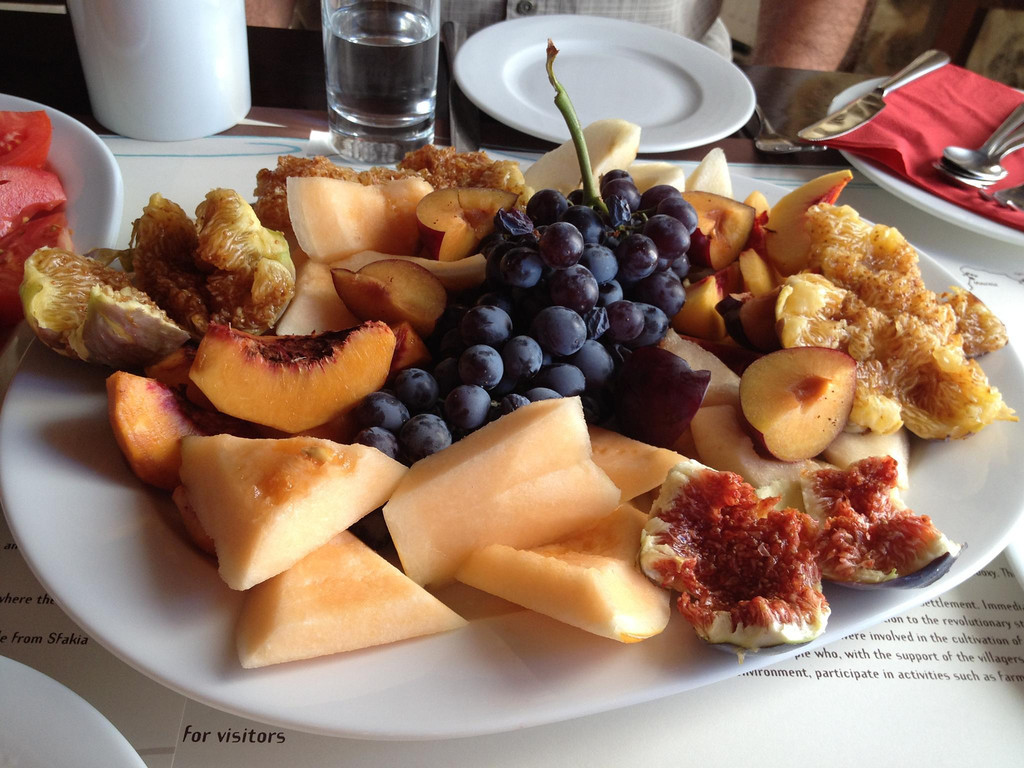
 In fact our group was in Agios Thomas because our bus driver Babis, also in a spirit of great generosity, insisted on stopping to show us his village when we were passing nearby. He guided us to see Roman rock cut tombs and arranged for the early Byzantine church to be opened. At the end of the our pilgrimage, Babis stopped the bus at a wooded glen beside a small church where he offered us his own homemake raki, wine, and olives, accompanied by local sheep cheese he had purchased while we were climbing a mountain. After every meal that we ate in local tavernas, we were offered bottles of cold raki, fruit, and sweets.

crete fruitsThis spirit of great generosity has long been commented on by travelers in Greece, who often speak of it as unexpected (for them) hospitality to the stranger or traveler. That it is, of course. Through the work of Heidi Goettner-Abendroth, I now understand that the famous Greek hospitality to the stranger has deep roots in matriarchal cultures. According to Goettner-Abendroth, equality of wealth is assured through the widely-practiced custom of gift-giving in matriarchal cultures. Continue reading “Legacy of Carol P. Christ: Is the Spirit of Great Generosity in Crete a Survival of Ancient Matriarchal Values?”

Legacy of Carol P. Christ: SACRED RHYTHMS OF THE OLIVE HARVEST

This was originally posted on December 2, 2013

carol-christOlives are being harvested in the fields outside my town these days.  We have been having the first rains of the season.  The roads are wet and muddy, and the trees are partially shrouded in mist.  The fields are spread with black plastic nets, and people are hard at work, the men hitting the trees to make the olives fall, and the women picking up the olives from the nets.  The harvest will continue throughout the winter.

The olive press is busy. Cars and trucks come and go, unloading heavy bags filled with olives.  These days the bags are white, made of sturdy woven plastic. In Crete this fall several of us bought canvas olive bags, hand-woven by women.  These, along with baskets hand-woven by men, were still in use only a few decades ago.

olive harvest in Lesbos early 20th century by Theofilos Hajimichael

A friend who died a few years ago told me that “in the old days” there were no nets. The women and the children had to pick the olives up from the ground, often cutting their hands on thorns and stones.  The nets are a Goddess-send.  Between harvests, the nets are simply folded up and placed in the crotch of the tree. Here no one steals them.

In the fields where I walk some of the trees have enormous trunks. Some of them have two trunks, growing like sisters.  Many of them are 300, some perhaps 500, years old.  A man emerges from a field that has some particularly old trees.  I ask him how old they are. “Older than I am,” he replies. “They were here before I was born.  They will be here after I die.” Continue reading “Legacy of Carol P. Christ: SACRED RHYTHMS OF THE OLIVE HARVEST”

Legacy of Carol P. Christ: IS THE SPIRIT OF GREAT GENEROSITY IN CRETE A SURVIVAL OF ANCIENT MATRIARCHAL VALUES?

carol-christ

This post was originally published on Oct. 28th, 2013

At a coffee shop in Agios Thomas, Crete last month a perfect stranger offered to pay for the coffees and sodas of the 16 women on the Goddess Pilgrimage to Crete. This spirit of great generosity is rarely experienced in the United States or other parts of Europe, but it is still common in rural Crete and some parts of Greece.

 In fact our group was in Agios Thomas because our bus driver Babis, also in a spirit of great generosity, insisted on stopping to show us his village when we were passing nearby. He guided us to see Roman rock cut tombs and arranged for the early Byzantine church to be opened. At the end of the our pilgrimage, Babis stopped the bus at a wooded glen beside a small church where he offered us his own homemake raki, wine, and olives, accompanied by local sheep cheese he had purchased while we were climbing a mountain. After every meal that we ate in local tavernas, we were offered bottles of cold raki, fruit, and sweets.

crete fruitsThis spirit of great generosity has long been commented on by travelers in Greece, who often speak of it as unexpected (for them) hospitality to the stranger or traveler. That it is, of course. Through the work of Heidi Goettner-Abendroth, I now understand that the famous Greek hospitality to the stranger has deep roots in matriarchal cultures. According to Goettner-Abendroth, equality of wealth is assured through the widely-practiced custom of gift-giving in matriarchal cultures. Continue reading “Legacy of Carol P. Christ: IS THE SPIRIT OF GREAT GENEROSITY IN CRETE A SURVIVAL OF ANCIENT MATRIARCHAL VALUES?”