Parshah Vayigash covers Genesis 44:18 to 47:27. It involves the reunification of Joseph with his brothers and his father, the immigration of Jacob’s entire family to Egypt and Joseph successfully leading Egypt through famine. In other words, the parshah provides the backdrop for how the Israelites become slaves in Egypt.
Any mention of women is confined to verses 46: 14-26. They are not active participants, but are remembered as mothers and (a few) daughters and help explain the size and development of Jacob’s family. It is most striking that they are mentioned at all as the text is heavily preoccupied with sons. Nonetheless, according to the account, Jacob’s family has 70 members and a seemingly very small number are women and daughters.
Clearly it comes as no surprise that this text is highly influenced by its patriarchal roots and we could dismiss it for that reason. Nonetheless, it has become a project of mine in this blog over the past few months to find redeeming qualities and food for thought within these texts. In other words, despite its sexist pitfalls, there are still holy insights and life lessons as my previous blogs attest. Continue reading “Vayigash: Lessons from Joseph’s Behavior by Ivy Helman”
Even though Jesus was born during the reign of Augustus, first Roman emperor, the empire didn’t celebrate that birth until three centuries later when his birth date was moved to mid-winter to match the birth date of the sun god Mithra. The Romans already had a long tradition of celebrating the winter solstice. This celebration was called the Saturnalia. Here are three days in December, taken from my daybook, Pagan Every Day. (When I wrote this book in 2003, I wrote longer days. The publisher demanded that I reduce every day to 300 words. I edited them all down to 301 words.)
December 17: Saturnalia begins
Saturn, who was conflated with the Greek Titan, Cronus, was an ancient Latin agricultural god whose name may derive from satur, “stuffed,” or sator, “a sower”; in either case he stands for abundance. He was a working god who oversaw viniculture and farming, the king of Italy during the golden age. When Jupiter conquered him, he hid himself (latuit) in the region that came to be called Latium. The Romans said Saturn’s body lay beneath the Capitol in Rome. Because his reign brought prosperity to the city, the state treasury and the standards of the Roman legions were kept in his temple when the army was at home. Saturn’s statue was bound in woolen strips to keep him from leaving Rome.
In Rebirth of the Goddess, Carol P Christ offered Nine Touchstones of Goddess Spirituality as an alternative to the Ten Commandments. The Nine Touchstones are intended to inform all our relationships, whether personal, communal, social, or political.[1] In this four-part blog (here are parts 1-3 Part 1, Part 2, Part 3) I am exploring ways in which these Nine Touchstones are inherently embodied in traditional women’s ritual dances of the Balkans, which has been my spiritual practice for over thirty years.
Carol’s Fourth Touchstone is: ‘Speak the truth about conflict, pain, and suffering.’ Many women’s dance songs which allow the women to speak and sing their grief and pain. When we bring that pain into the healing container of the circle, sharing simple steps, Dancers in the circle simultaneously give and receive support for their own and others’ sorrow. Ultimately, the sense of community and solidarity in the circle transforms our grief so that the burden becomes manageable. Many historical songs, too, tell stories of women being abducted or abused, and how they fought back or got away – or not – so that they are remembered and honoured by future generations.
This parshah contains the account of Jacob’s marriages to Leah and Rachel, (who happen to be his cousins) as well as the birth of his 11 sons and one daughter. It describes the long amounts of time Jacob worked for Laban in order to marry Laban’s daughters, and recounts the trickery of Laban giving first Leah, the older daughter to Jacob, before allowing Jacob to marry who he wanted to, Rachel.
Like the relationship between Hagar and Sarah, there is animosity between Leah and Rachel over Jacob’s love as well as the ability to bear children. This animosity spreads to the maids of Leah and Rachel, Zilpah and Bilhah respectively, as they are used by the sisters to conceive children on their behalf. One can see also this animosity in how Leah and Rachel name their sons. Yet, the parshah also contains two aspects that seem at odds with such a patriarchal perspective. First, there are five named women who play key roles in the goings-on. Second, Rachel is an active agent. Continue reading “Vayeitzei: Rachel and the Practice of Niddah by Ivy Helman”
Come with me in your imagination to an old land, a Demi-Olympus, a fabled and possibly invented land to the north of Mount Olympus, home and throne of the fabled Olympian gods. It is to this Other Olympus that the gods have retired. Now they reside in the Divine Rest Home whose proprietor is a black goddess. Not African black, She is as black as space, and if we look closely at Her, we can see galaxies and constellations and comets in Her. She is the Ur-Goddess, the Divine Creatrix, eldest of all, and She answers to the name Mama. (Note: many years ago, I actually saw this goddess after an all-day asthma attack that nearly killed me. She was in the ER with me.)
Helping Mama run the Divine Rest Home are Gaea, the mother of all life, and the Titans and Titanesses, who are older than all the gods who have come to the Divine Rest Home to…well…rest. The Titans and Titanesses held numerous important stations in the primeval universe and should probably retire, too, but they just keep going. That’s probably a good thing, as most of the retired gods need a great deal of attention.
I am dressed in a white cloak that obscures all but my face. The robe is splattered with paint and blood. I am awash in every color of the rainbow and dripping paint. I have been raped by strangers and no one is accountable.
This morning I could not get this frightful image out of mind but I had the strong sense that it had an impersonal aspect that had nothing to do with me.
This weekend at the Pueblo of Abiquiu the community celebrates the feast day of the first official saint of the Americas, Santa Rosa, and I planned to attend…
The people of Abiquiu call themselves Genizaros. Representing Apache, Navajo, Comanche, Kiowa, Pawnee, Ute and Wichita, detribalized Native peoples from the Plains that were captured and traded during the Indian wars of 18-19th centuries, and sold to New Mexicans as slaves and servants where they were stripped of their identity, instructed in Hispanic ways, and baptized as Christians. The People survived by incorporating Hispanic and Christian cultural practices into a distinct Genizaro consciousness, one that is distinct from the Indigenous Tewa speaking peoples (descendants of the Anasazi) who also live here in six pueblos along the Rio Grande. Continue reading “In the Shadow of Santa Rosa by Sara Wright”
The parshah for this week is Lech Lecha (Genesis 12:1-17:27). I’ve actually written about Lech Lecha on this forum before, concentrating on the parental aspects of the divine. See here. However, this time I want to look at the Torah portion from a different angle: what happens to the women?
While I’m concentrating on this theme, the parshah is rich with other material on which one could comment. For example, the Holy One asks Abram to leave his home and all he’s known to travel through and eventually live in a foreign land. There seems to be much fighting and strife between various rulers in the area through which they travel. Abram too goes to war when Lot is kidnapped. The first covenant between G-d and humanity takes place. The deity promises many blessings (from land and material prosperity to innumerous descendants) for Abram and Sarai if they obey the terms of the covenant. We also learn of the markers of the covenant: name changes and circumcision. Continue reading “The Women of Lech Lecha by Ivy Helman.”
It is October, the veil is thin the year is waning the leaves are turning I am trying to say goodbye to my grandmother she is dying. I do not know what to say.
The leaves are red the sky is blue I saw a crow in the tree behind the house.
The threads of this year are becoming thinner.
The threads of her life too are becoming thinner
What do I say to the one who breathed life into my father who wove his cells into being who cradled him as a baby who wept into his hair.
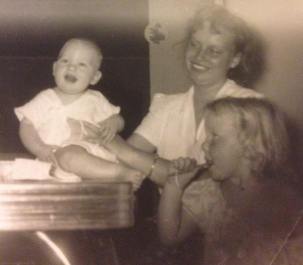
Twyla with my dad, Tom, in 1953.
Carrying the cells
of the generations The chain of life
continuing to spiral through time, and place,
and distance and falling leaves.
What do I say as life thins, as breath fades
What do I say when all that remains is the space between us
What do I say
when I catch a glimpse of the swift unraveling of time the wrinkles in eternity
What do I say
as time folds in on itself and now it is me in the bed and my son, gray-haired, blue-eyed is reading to me in a quiet voice
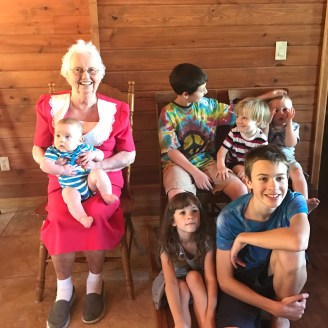
Grandma Johnson with her great-grandchildren in April, 2017.
as the chapter comes to a close.
Part 2: The Answer
That night, I dreamed of my grandmother she shrank to the size of a small child I picked her up and held her against my body We looked in the mirror cheek to cheek and smiled together I kissed her face and told her: “You are wonderful.” Then we danced around the room together her head against my shoulder I kissed her again on her white hair and no more words were needed.
Part 3: The Memorial
At this time last year, as the leaves fell and the wheel of the year dipped into darkness, my last grandparent died. I recognize that I am fortunate in having reached nearly forty while still having a living grandmother, but there is still such a sensation of finality and ending in saying goodbye to the final grandparent. Twyla was my paternal grandmother and I was not as close to her as I was to my maternal grandmother who died in 2013, but she is the woman who wove my father’s bones into being, and her death left a hole in our family and a sensation of an ended section in the tapestry of generations.
After the dream I write of above, I went back to see her a final time, five hours before she took her last breath. This time, I sat with her alone. I kissed her on her white hair and told her she was wonderful. I played her a song (Beyond the Gates by T. Thorn Coyle and Sharon Knight). I spoke to her of her good work in the world, that she had done it, that she’d finished her work, and that she had given so much and done so well. As a mother myself, the sensation of how powerful it is to have seen all your babies through to adulthood and into grandparenthood themselves filled the room. My dad, her second child and only son, has teenage grandchildren now himself. My grandmother’s youngest child of her five children is in her mid-fifties (and also a grandmother to teenagers). Sitting in the darkened room, listening to the song play, I was staggered by the magnitude of having seen each of your own children through their lives and into grandparenthood. While there are many ways to leave a legacy and it is not a “failure” by any means to not see all of your children into grandparenthood or to not have children yourself, what a gift it must be to bear witness to these generations if it does, in fact, unfold in that way, and to see your own tiniest baby have grandchildren of her own. This is something I hope to see for myself.
My dad holding his youngest grandchild at the memorial.
I then had the blessing, the honor, the privilege of being asked to prepare a memorial service for my grandmother. Five years ago, I was also asked to facilitate the memorial ceremony for my other grandmother. The unique, uncommon blessing of fulfilling this role for both of my grandmothers is not lost on me, as I know no one else who has had the experience of serving both sides of their family of origin in this way. I felt so honored to be trusted to help guide my family through both of these experiences of loss and grief. I spoke to my husband of how humbled, grateful, and fortunate I feel that I have a family who would let me do this, not just for one grandma, but for both of them, and he said, “you know, honey, maybe we should all be grateful to you that you’re willing to do this for us.” So, I received that recognition into my heart with appreciation as well.
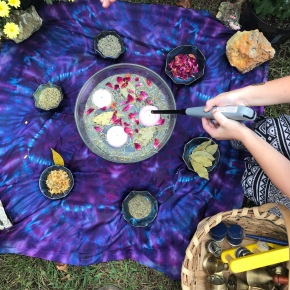
My daughter, then six, keeping the candles lit and tended on the altar space during the memorial.
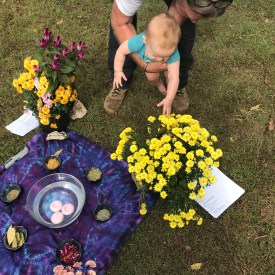
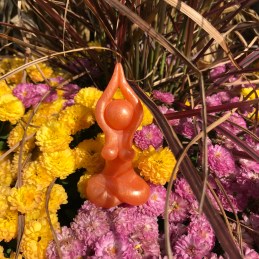
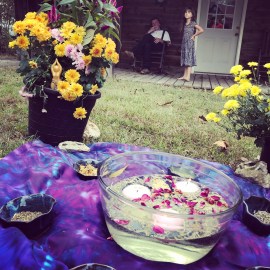
It is powerful to create ceremonies that acknowledge transitions within the life of your family. During this ceremony for my grandmother we each had time to speak of her, I had poems I had written, and readings to share. We had a centerpiece with flowers, floating candles, and photos of her, and we each held handfuls of herbs that we offered into the bowl of water as we shared our stories and memories. Each person took time to do so and spoke with care, tenderness, love, and laughter. Sharing this time and space together and creating a container for people to be heard in their grief and love rather than participating in the type of “canned” or impersonal memorial service that may be more commonly offered by religious groups, was what we needed to say goodbye to this woman who wove a part of our souls. My aunt said: this is the kind of send-off that everyone needs, and that felt very true and real.
My extended family is not pagan or liberal or alternatively religiously minded and as I planned the memorial I was conscious of not wanting it to be “too much” for them. As I typed my outline, I’d first included a song and other practices common to other rituals and retreats I lead and when I heard that my aunts and cousins were coming, I’d removed the song and some ritual elements, fearing making them uncomfortable. They then said they weren’t coming, so I added the singing back in. On the day of the memorial, they did in fact come, and I decided we would sing anyway, whether comfortable and familiar or not. We sang the same song to begin and to end the memorial (“We Are a Circle”) and when I looked around the circle the second time we sang and saw that everyone there holding hands, their faces wet with tears, were all singing too, I knew that it had worked.
If you have the opportunity to create ceremonies and rituals of personal meaning for your own family, please do it. It holds so much value, such life and power and love, in a way that is difficult to create by someone outside of the family. A small group of people who really care and who are willing to connect with each other in a meaningful, connected, vulnerable way, births so much real magic together. This container can be created by you, for you, and for the ones you love the most.
“Everyone can do the life-changing, world-renewing work of magic…the Dalai Lama said, ‘It’s not enough to pray and meditate; you must act if you want to see results.’ We are called to offer real service to others, to the Goddess. That service may take many forms: mopping the floor after the party, priestessing rituals, healing, planning, teaching, carrying the heavy cauldron from the car, sitting with a dying friend, writing up the minutes for a neighborhood meeting, organizing a protest to protect a sacred place from development, writing letters to Congress, training others in nonviolent civil disobedience, growing food, or changing the baby’s diapers. All of these can be life-changing, world-renewing acts of magic…”
—Starhawk and Valentine, The Twelve Wild Swans
There is a companion audio recording available about this memorial service preparation, the death of my grandmother, and about how to weave a strong “ritual basket” to carry a ceremony. The first part is an audio ritual for my online circle with thoughts about claiming your magic, fear of the label of witch, etc., so if you want to skip past that only to the memorial information and ritual theory, skip to 16:20 in the audio:
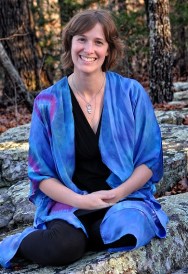
Molly has been “gathering the women” to circle, sing, celebrate, and share since 2008. She plans and facilitates women’s circles, seasonal retreats and rituals, mother-daughter circles, family ceremonies, and red tent circles in rural Missouri and teaches online courses in Red Tent facilitation and Practical Priestessing. She is a priestess who holds MSW, M.Div, and D.Min degrees and wrote her dissertation about contemporary priestessing in the U.S. Molly and her husband Mark co-create Story Goddesses, original goddess sculptures, ceremony kits, and jewelry at Brigid’s Grove. Molly is the author of Womanrunes, Earthprayer, and The Red Tent Resource Kit and she writes about thealogy, nature, practical priestessing, and the goddess at Patreon and at Brigid’s Grove.
This semester I’m teaching a course titled “The Abrahamic Traditions: Women and Society.” Because I believe story is one of the best ways to understand a point of view, I use a novel or memoir to accompany each tradition. The novel I use in the Judaism unit is Anita Diamant’s, The Red Tent.
The Red Tent focuses on Dinah, Leah and Jacob’s daughter. Early in the novel, the narrator says, “My name [Dinah] means nothing to you. My memory is dust….The chain connecting mother to daughter was broken and the word passed to the keeping of men who had no way of knowing.”
The biblical account (Genesis 34) tells us that Shechem, King Hamor’s son, “seized her [Dinah] and lay with her by force.” It also says that Shechem’s “soul was drawn to Dinah” and “he loved the girl,” and insisted that his father arrange things so Dinah could be his wife. Nowhere in the biblical account do we hear Dinah’s voice. She’s portrayed as a victim and used as a bartering tool by Jacob and his sons in their attempt to gain power in the region. Jacob and his sons required that Hamor and all the men within his kingdom be circumcised as a condition for the marriage between Dinah and Shechem. King Hamor agreed, but on the third day after the men were circumcised and in pain, Simeon and Levi, two of Jacob’s sons, entered the city “and killed all the males,” for “defiling” their sister. “Should our sister be treated like a whore?” Dinah then disappears from the narrative.
We have forgotten the names of each other underneath the shedding skin those names written in our blood that have danced to tonantzin tonatiuh before they knew they were lovers. (IFHL)
Last week I was fortunate to have attended a poetic reading and performance by a remarkably gifted young Mexican man named Israel Francisco Haros Lopez who was born to immigrant parents in Los Angelos. He is both a visual and performance artist, and his work transcends borderlands of all kinds. Israel believes that it is critical to honor and remember the ancestors so that we may once again become one with the winged ones, all those who crawl or walk on this earth, the Four Directions, Earth Air Fire and Water, Tonanztin and Tonatiuh – the Aztec Earth Goddess and the Sun God – Israel’s expression of unity in divinity, and the universe as a whole. His visual motifs are drawn from Pre – Columbian America and his work is an attempt to search for personal truths within the context of today’s world incorporating Mexican/Indigenous stories into the whole.


 Parshah Vayigash covers Genesis 44:18 to 47:27. It involves the reunification of Joseph with his brothers and his father, the immigration of Jacob’s entire family to Egypt and Joseph successfully leading Egypt through famine. In other words, the parshah provides the backdrop for how the Israelites become slaves in Egypt.
 Last night I had a nightmare.
 The parshah for this week is Lech Lecha (Genesis 12:1-17:27). I’ve actually written about Lech Lecha on this forum before, concentrating on the parental aspects of the divine. See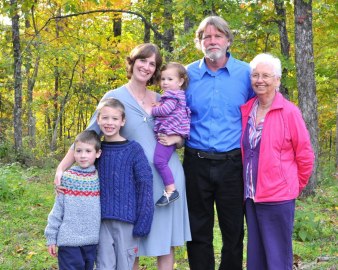
 comfortable and familiar or not. We sang the same song to begin and to end the memorial (“We Are a Circle”) and when I looked around the circle the second time we sang and saw that everyone there holding hands, their faces wet with tears, were all singing too, I knew that it had worked.
 ‘It’s not enough to pray and meditate; you must act if you want to see results.’ We are called to offer real service to others, to the Goddess. That service may take many forms: mopping the floor after the party, priestessing rituals, healing, planning, teaching, carrying the heavy cauldron from the car, sitting with a dying friend, writing up the minutes for a neighborhood meeting, organizing a protest to protect a sacred place from development, writing letters to Congress, training others in nonviolent civil disobedience, growing food, or changing the baby’s diapers. All of these can be life-changing, world-renewing acts of magic…”
 She plans and facilitates women’s circles, seasonal retreats and rituals, mother-daughter circles, family ceremonies, and red tent circles in rural Missouri and teaches online courses in

 Feminism and Religion