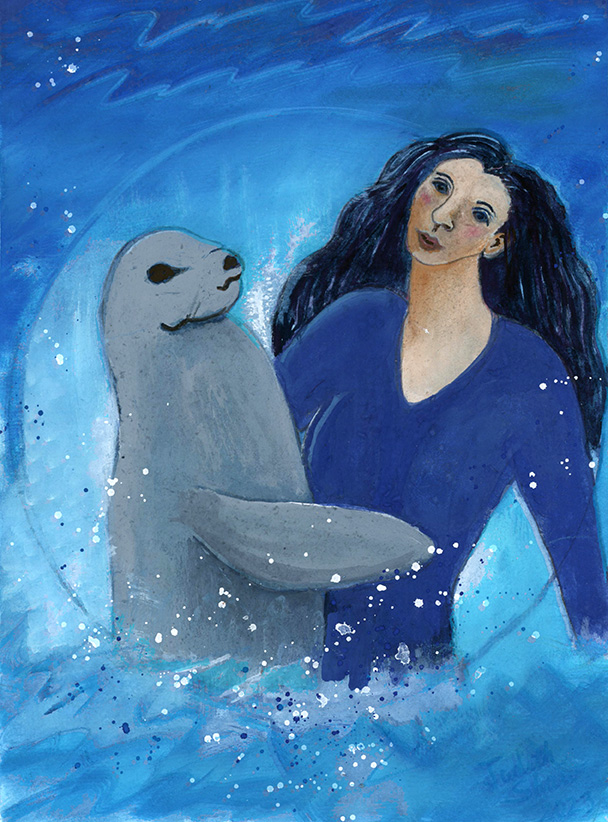
I’ve known of the existence of the Sabian symbols for a long time, but not much about the details or meanings – which is kind of surprising considering how much I love symbolism. Sabian symbols, which first emerged in 1925 from clairvoyant Elsie Wheeler are written symbolic meanings of each degree of the astrological zodiac. Recently I heard astrologer, Heather Ensworth, speaking about the new moon of March 21 at 1° Aries and the Sabian symbol attached to that lunation which is – “A woman rises out of the water, a seal rises and embraces her.”
Upon hearing that Sabian symbol recited, my inner eye exploded with an image to match the words and then buried itself deep in my heart. I fought the urge to paint it as I have other projects which need completion. But ultimately the woman and the seal would not leave me, so I began to visualize it resulting in this painting, which might or might not be finished.
But why did it strike me so deeply and what might it mean?
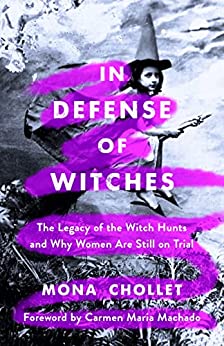
In this article I reframe my understanding of feminism through the lens of Mona Chollet’s In Defence of Witches, and reflect on how my psyche as a woman today is still deeply influenced by the effects of the witch hunts in mediaeval times.
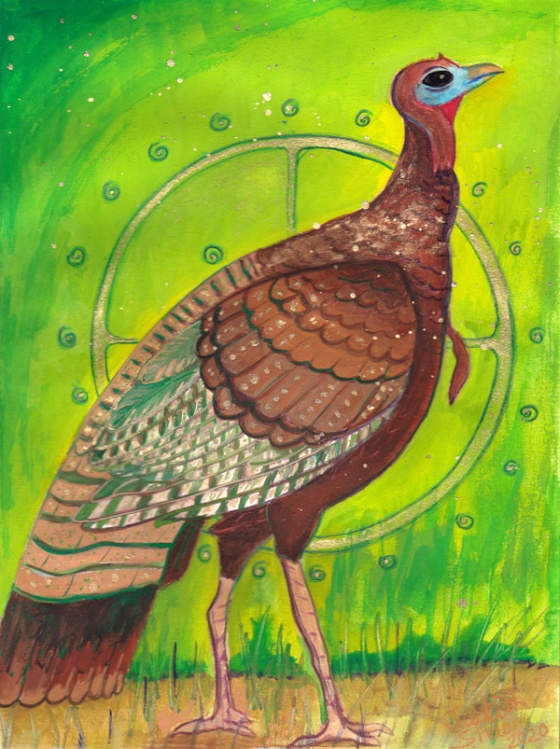
In the United States turkeys are equated with Thanksgiving. But there is so much more to Turkey – a gentle creature who forms strong attachments. Reputed to be dumb, Turkey is in fact quite intelligent and curious, with the ability to solve problems. Turkeys have an excellent understanding of the details of their location which makes them so successful at feeding themselves. They also love to play and to cluck along with music.
photo by Tony Castro
Turkeys, indigenous to North America, evolved over 20 million years ago and share a common ancestor with grouse, pheasants and other fowl. Two species of wild turkey exist today – the wild turkey of eastern and central North America of which there are 5 sub-species and the ocellated wild turkey of the Yucatan.
Yet why is turkey named turkey? Strangely enough it was a mistake. English colonial settlers thought turkeys were a type of guinea fowl which England imported from Turkey – thus the name. The Spanish word for turkey is guajolote which is derived from the Nahuatl (Aztec) name huexolotl.
For those folks in the southern hemisphere who are entering fall as we the northern climates enter spring I offer this next personal narrative.
Every Autumn I buy a smooth skinned crimson pomegranate to celebrate the Fall Equinox. But until this fall I have never intentionally bought a pomegranate to acknowledge the Persephone in me although her cyclic journeys to the underworld have also been my own. I have resisted my alignment with Persephone because I have come to fear my own descents. In the last few years these periods of depression have become more severe.
The September I turned 70 on the last day of the ancient celebration of Persephone’s Eleusinian Mysteries. I spoke out loud as I set my birthday intention. I am aligning myself with Persephone. I held a pomegranate in the open palm of my hand, thinking of the fruit as a symbol of my willingness to take this step. I also saw the beautiful round fruit as the Earth, imagining the ruby –like seeds imbedded in the soft white flesh as Earth’s possibilities. As I surrendered and finally accepted my mythic identity/alignment with Persephone, I experienced a subtle energy shift. I thought about the maiden goddess who becomes Queen of the Dead, and the one who makes predictable cyclic descents into the Underworld. As I breathed through my body I experienced a palpable sense of relief… I recalled the recent dream that informed me that the “Way of the Goddess” was my way, and that I had to choose her again. Not surprisingly within a few days I once again entered a state of profound depression during which time I suddenly remembered my first encounter with a pomegranate…
Note: If you’ve been reading Athena’s story for the past two days (link to Part 2 here), you know what’s happened to her before her third birth. You’ve read her version as I heard it in my mind and wrote it down. Part 3, here, is mostly speculative, based on hints in books I’ve read during the past twenty-plus years. If you’ve read The Greek Myths by Robert Graves (who is said to be The Authority), you’ve met Medea in the context of the yarn about the Golden Fleece, but I’m leaving Jason out of this story. I’m also leaving Theseus (also associated with Medea) out. These boys have no role in Athena’s story of her meeting and her shamanic rebirth at the hands of the great Medea, who is sometimes called a sorceress. Read on.
Athena
And so with the help of the great Hera, who remembered how I had once loved her (and she still loved me), I left Zeus’ stony kingdom. Hera helped me depart, though I soon forgot her help. I suppose she is still there. After all, her own lands had been taken long before, her own throne stolen long ago, her temples and altars supplanted. I suppose she has nowhere to go now. For all I know, great Hera remains at the declining god-king’s side, where poets still deprecate her and laugh at her and call her a nagging wife. A god-king as impotent as he is now needs such a strong wife, does he not? I regret that I no longer know her.
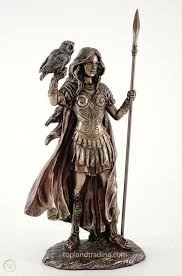
But I could find no other kingdom that would give me charity or honor, found no other king or god who would wed me or let me speak for him, and so I become disillusioned with kings and gods and epic tales. I put down my spear and shield and abandoned my armor and helmet, though I always kept my owl (who often flew above me) and my ragged plume.
And so, twice homeless, twice born and twice dead, friendless and scorned by the men I had so harshly judged, I wandered through the world, and all anyone saw was a woman, a gray, anonymous woman carrying a stick and a drooping feather. I walked up and down in the world and had no home. I had neither friends nor sisters nor protégées to honor me, neither priestesses nor queens to love me. I had no one at all. I had nothing at all. I wandered alone through all the lands around the wine-dark sea, alone in the lands around the central sea, alone in the lands along the ocean sea and the northern sea. For uncounted years I wandered alone, stopping here and there, but never staying anywhere, searching for what I never found and no longer remembered. I went in a plain gray cloak with my stick in my hand, my sad plume in a pouch at my belt. Sometimes I ate, but more often I went hungry. Up and down upon the earth I walked, and so my pride and anger began to be worn away.
Note: This part of the story concerns what nearly everybody who has read the mythology knows about the Goddess of Wisdom. But what you’ve read in, say, Edith Hamilton or Robert Graves is the patriarchal version. What would the story be like if Athena told it herself? That’s what I imagined as I wrote her story. Read on to learn more about her Greek incarnation.
Athena
After our tribe was conquered by the warriors who lived across the seas, I wished to die, and I was indeed close to death when I was carried off by the bloody hero who fancied me. I longed to die every time he violated my body, every time he crushed my mind. But I was carried away alive, a living trophy for that warrior-king. I was secured in his warship as it sailed across the sea to his hard and stony land. Weak though I was, men still fought over me. Eventually I was claimed by their god-king Dyaus, whom you may know by his commoner name, Zeus. I was claimed as his prize of war, dragged up the stony mountain that came to be called Olympus, and flung into his harem until I should become strong enough to bear his weight upon me in mating. And still I longed to die.
Note: Inspired by Mary Sharratt’s excellent post on February 13 about the heroine’s journey and by Elizabeth Cunningham’s beautiful novel The Wild Mother (who is Lilith), I took a dive into my archives and found this story about Athena, which I first wrote back in the late 1980s. That was about the time the Goddess rapped me on the head, so to speak, and said, “Pay attention.” The story is based on research I did at the time. I’ve now done some rewriting for FAR. Read on and hear the voice of Athena not as a player in the usual Greek myths but as a goddess of wisdom who is one-unto-herself.
Athena
My first birth was in the dark continent to the south of the Black Sea, always described by Homer (who invented much of what you take as true in his two long stories) as the wine-dark sea. That is, I was born in what is now Libya in northern Africa. I was born in a many-chambered palace beside a clear lake and received into the world by a tribe of strong women. I was the first-born child of Metis the Wise. You may have read that Metis was the daughter of Oceanus and a Titaness of great cunning; that’s what the “traditional wisdom” says about her. Not true. Metis was one-unto-herself, the queen of a great tribe, holder of the sacred serpents, and painter of wild scenes on tall red cliffs that exist into your day. I was the daughter of daughters from the beginning of the earth, whom some have called Amazons. I knew nothing of that name, however, for I was simply a much beloved child of a thousand thousand foremothers and a hundred living mothers.
Last night I was thinking about the giant western toad that is living in my garden when I had a peculiar thought: Write a story about the Toad and an Old Woman and call it A Tale for a Life Lover. At this very moment I heard my toad’s rasping guttural cry outside my window. I was so shocked I got up and went out on the porch, hoping to hear the call again, but the toad only spoke once. Afterwards, I wondered if I had imagined it.
When the giant western toad appeared in my yard last week I had been in a state bordering on despair over baffling health issues and the ravages of Climate Change. Maybe it is no longer possible for me to separate the two? After the visitation I sensed that the toad’s abrupt appearance meant something beyond the amazing fact that I had met a giant toad who apparently had been living here all along. Continue reading “Toadwise: A Tale for a Life Lover – Part I by Sara Wright”
In the United States turkeys are equated with Thanksgiving. But there is so much more to Turkey – a gentle creature who forms strong attachments. Reputed to be dumb, Turkey is in fact quite intelligent and curious, with the ability to solve problems. Turkeys have an excellent understanding of the details of their location which makes them so successful at feeding themselves. They also love to play and to cluck along with music.
Sing to the LORD, all you godly ones! Praise his holy name.
Psalm 30:4 (New Living Translation)
Therefore I will give thanks unto thee, O LORD, among the heathen, and I will sing praises unto thy name. 2 Sam 22:50
Let them praise the name of the LORD: for this name alone is excellent. Psalm 148:13
The wording of these passages is very odd. After all, why is God’s name always being praised? It’s like saying to someone, “you must be a wonderful person because you have a lovely name,” or “the LORD must be great because ‘he’ {sigh} has such a great name.” Actually though, as I began to go deeper into my own personal practices of spirit work and chanting, I found that there is a profound truth to this use of praise. Most, if not all, of the ancient names of deities are made up of power syllables. By this I mean certain sounds that have a vibrational essence which not only resonate within our bodies but connect us with all the vibrations that surround us. Sounds made by these syllables are a bridge between worlds created by our breath.
Mystically speaking we could say that the breath of creation and our own breath interfuse. We can experience this through the vibration of power syllables. The most common syllables in the west are familiar ones – AL LA HA AH YA LO WAH and the mighty HU. Think of all the names of divinity that can be created by experimenting with these syllables. Continue reading “The Sacred HU by Janet Maika’i Rudolph”






 Sing to the LORD, all you godly ones! Praise his holy name.
 Feminism and Religion