
Remembering Ginny by Esther Nelson

My husband’s stepmother, Ginny, died last week.  She lived several months past her 97th birthday.  Here is her obituary.

Ginny shared her life with three husbands, outliving each one.  Three sons were born from her first union.  She then married John, my husband’s father, and warmly welcomed us (John’s family) into her life.  When John died, Ginny married Fred.  After Fred’s death, Ginny told me, “Of all my husbands, Fred was my favorite. He was fun.”

Ginny lived at the Brethren Village Retirement Community in Lancaster, Pennsylvania—a home with several levels of care—for over 30 years, moving there a few years after marrying my father-in-law.  She said, “We made a good decision.  I never wanted to be a financial burden on my children.”  And she wasn’t.

Throughout her life, Ginny attended a fundamental, evangelical church.  Had she been able to vote in the 2016 national election, she would no doubt have voted Republican.  She had no use for feminism (women who rail against God’s ordained order), liberalism (the Devil’s message), homosexuality (perversion of God’s perfect creation) and immigrants (they siphon resources from hard-working Americans).

Yet, at the same time, Ginny was generous, giving to causes that fit with her ideological worldview such as missions.  It was important to her that people come to understand the “truth” as seen through the prism of the theology she embraced.  Within her community, she was loving, actively engaged, and caring, helping people in practical ways—donating food and other necessities to organizations sponsored by her church.
Continue reading “Remembering Ginny by Esther Nelson”

Medieval Torture Devices and the Goddess by Colette Numajiri

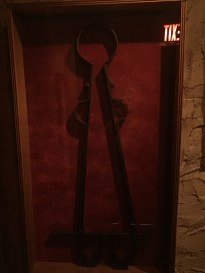
There is a campy dinner and tournament “castle,” Medieval Times, in our city in which you can eat and watch a fully- costumed period play complete with stunning Spanish horses in an indoor arena. Inside of this building, for a mere additional $2, there is a “torture chamber” attraction, a mini museum with a dozen or so of actual torture relics used in the Medieval Inquisition (or accurate looking replicas of them!) along with illustrations from the era.

In this collection they have what appears to be an authentic orifice-expanding “pear” and a “breast ripper” (see and read photo below) among other devices meant to inflict pain and often death to those with the misfortune to be accused.

The actual “Medieval Times” period was a horrific and bloodstained era when the NEW ORDER (the established Catholic and new Protestant churches) set out to “Christianize Europe.” They succeeded and became beyond wealthy by creating a WIDESPREAD FEAR of WOMEN, gaining power over more than half of the population and confiscating their money and land.

There is an hour long film funded by the Canadian government called: “THE BURNING TIMES” that tells the story of the people (85% women) that were brutally killed over a 300 year period in what was the WOMEN’S HOLOCAUST.

Continue reading “Medieval Torture Devices and the Goddess by Colette Numajiri”

Did You Have to Make Her a Prostitute? by Elizabeth Cunningham

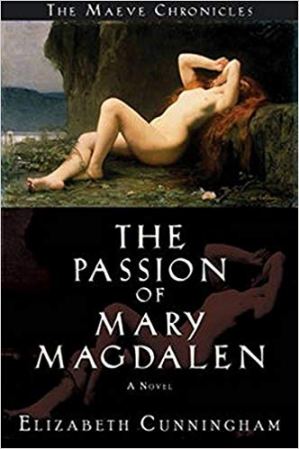
When I toured with The Passion of Mary Magdalen, opening by belting out the first paragraphs of the novel’s prologue in song, (ending with the line “when only a whore is awake!”) that question almost always came up.  In celebration of Mary Magdalen’s feast day, I’d like to offer answers that continue to evolve.

There is no scriptural evidence that Mary Magdalen was a prostitute. In a sermon, 6th century Pope Gregory I gave as his opinion: “This woman, whom Luke calls a sinner and John calls Mary, I think is the Mary from whom Mark reports that seven demons were cast out.” (This confusion and proliferation of Marys inspired me to make a joke. Q: How many holy Marys does it take to change a lightbulb? A: I don’t know. I keep losing count.)

In fact, very little is known about Mary Magdalen. There are fourteen references to her in the Gospels, then she disappears from the New Testament. The possibly Gnostic gospel of Mary dates to the 2nd century CE, and there is no scholarly consensus as to which Mary is the source of the tradition. Early on Mary Magdalen gave history the slip and took on an extended life in legends, which take her to Ephesus as well as to France where her alleged fingernails, bones, and skull reside and continue to be venerated.

Continue reading “Did You Have to Make Her a Prostitute? by Elizabeth Cunningham”

The Pub Church, Boston by Xochitl Alvizo

At times I am invited to speak about The Pub Church. When I lived in Boston, I was part of a church that met in a pub. A church in a pub is not a typical form of church, obviously; so, people curious about or interested in forming an alternative form of church invite me to speak about it. The invitation is usually for me to share how I started The Pub Church – and that is how people first think of it, that it was started by one person, which was definitely not the case. So, in those moments, I stumble as I try to disabuse people of that idea and try to find the best way to enter the topic of how a new church starts, a topic about which I have strong opinions (more on that later). The Pub Church, Boston grew unexpectedly out of its context. It began with three friends venturing to the local pub to eat fish and chips on Fridays and ended in an experience of community that caused someone to reflect, “why can’t church be more like this?” Continue reading “The Pub Church, Boston by Xochitl Alvizo”

My Church Won’t Let Me Call the Divine “Father” by Trelawney Grenfell-Muir

I had a startling experience in church recently. It was Father’s Day, and the pastor was talking about how “God is our heavenly Father.” For the first time in 17 years, that idea held some appeal to me. But no sooner did the thought enter my mind, then it was ripped away by the realization that my church will never allow me to symbolize the divine as a “father.”

I grew up with “God the Father” language saturating my churches. I also grew up with a rageful, unsafe, sometimes abusive father, who was also wonderful, empowering, and feminist in many ways. Seventeen years ago, I attended my first seminary lecture on the topic of Feminist Theology. That day changed my life, as did my exposure to feminist theology throughout seminary and at a queer Methodist congregation. My journey took me through more scholarship and liturgy, jobs as chaplain or as assistant pastor struggling to convince my communities that sexism matters, parenting young daughters who lament their own subconscious male divine programming, and finding a prophetic call to speak, write, and sing the Female Divine. Continue reading “My Church Won’t Let Me Call the Divine “Father” by Trelawney Grenfell-Muir”

Following My Dreams by Natalie Weaver

Dreaming has always been a huge part of my life.  When I was a little girl, I would run to my mom in the morning, before I was even completely awake, and tell her what I had been dreaming,  It would seem very important, I mean, desperately, terribly important, to share whatever journey I had been on.
I would have repeating dreams; dreams with choose-your-own-adventure options; dreams with strange symbols and images and words.  I must have known that my dreams were valuable in a particular way to my waking mind, my manner of knowing, and even my concepts of reality because quite early on in my life I started to try to understand what dreaming actually was.  I remember getting a book called Far Journeys (or something like that) about lucid dreaming.  I remember learning about dream paralysis, which was a cause of great relief, since I occasionally experienced it and had to overcome the sense of terror it created.  I developed an early and avid interest in dream symbolism and psychology.  I was relieved when I finally learned the name Carl Jung.  In short, dreaming was central to my total experience of mind. Continue reading “Following My Dreams by Natalie Weaver”

The Blessing of Spiritual Direction by Elise M. Edwards

elise-edwardsFive years ago, I moved to Texas from California. In that time, my spiritual practice and my feminist and womanist worldview has grown through contemplative practices.  It’s ironic. “Everything’s bigger in Texas!” the saying goes, but in the presence of big, sweeping landscapes and open skies, big storms, and big egos, I’ve found the sacred in the small things.  I have deepened my connection to God through a small group of women who practice group spiritual direction.

This past Sunday evening, I gathered with these women at my church for our spiritual direction group.  We sat comfortably in  a circle, relaxing on a couch and chairs around a coffee table, as the evening sun streamed in from a large picture window and lit the room.  As we read a passage from the Bible (Mark 3:34-35) in which Jesus looks at the people sitting around him and says, “Here are my mother and my brothers! Whoever does the will of God is my brother and sister and mother,” I saw my companions more clearly.  Although my eyes were closed, I had a vision of these women sitting around me, halos made of sunbeams shimmering over their heads.  I thought, “Here are my sisters!”

Continue reading “The Blessing of Spiritual Direction by Elise M. Edwards”

I’m not proud to be Christian – and no one else should be, either by Trelawney Grenfell-Muir

I hear a lot of people talking lately about how they are no longer proud to be Christian. They point to the vocal conservative churches and leaders who support Trump, condemn and exclude LGBTQ people, oppress female bodies and sexuality, exhibit breathtaking racism, classism, sexism, nationalism, and ecocide… and they struggle to call themselves “Christian” anymore, in light of these shameful behaviors by modern American “Christianity.”

I completely understand. The most visible examples of self-identified Christian organizations and leaders in the US today make me cringe— or pale in horror. How could any ethically responsible moderate or progressive Christian want to be associated with such bigotry, violence, and dysfunction? Continue reading “I’m not proud to be Christian – and no one else should be, either by Trelawney Grenfell-Muir”

Reflection for the End of the Year by Sara Frykenberg

At my school, a religious institution, we start every faculty meeting with a reflection, meant to inspire us, make us think, help us to connect, etc.  I am admittedly, sometimes very uncomfortable with these reflections. I don’t always like corporate ‘prayer’ because of my  past experiences in an abusive faith. They make me uncomfortable, defensive; even though I understand the value of collective ritual. Challenging me to face these feelings, my department chair asked me to give a reflection for our faculty assembly. So I did so by sharing the way I know how to share (in a collective way) best: in a blog. And here I present these reflections, my blog, with all of you as well. My thoughts about taking the year apart, and putting ourselves back together again at the end of the year:

(Reflection has been edited slightly in terms of length and clarification for presentation to this online audience.)

Faculty Assembly Reflection: Sara Frykenberg, April 2018 Continue reading “Reflection for the End of the Year by Sara Frykenberg”

On Belief and Action by Ivy Helman

29662350_10155723099993089_8391051315166448776_oMy birthday was last Wednesday.  Perhaps more than any other time of the year (yes, even more than Rosh Hashanah and Yom Kippur), the days and weeks leading up to my birthday are filled with personal reflection.  Not that religious and secular new years don’t give me pause to reflect, but I think the lack of buzz around this personal event seems to offer me more space and time to think.

This year more than past years, I’ve been thinking about beliefs: what I believe in; how ideas and concepts that were important to me last year are less so this year and vice versa; how beliefs motivate me to act or not; what role belief plays in my life; why some beliefs demand solid resolve and others not so much; and so on.  I wanted to share with you some of my personal reflection. Continue reading “On Belief and Action by Ivy Helman”