Winds of Change in the Roman Catholic Church by Michele Stopera Freyhauf

Michele FreyhaufIn 2007, I had a conversation with a professor who felt that change was in the air for the Roman Catholic Church. The basis of this opinion was based on language. The words and the context used in writings that emerged from the Vatican were changing and somehow different – a difference that went beyond personal writing styles of Pope John Paul II and Pope Benedict XVI. This professor was hopeful that positive change for women could be coming. He was right about change in the Church, however, the changes surrounding women that emerged have not been positive.



As I continue to reflect on these words, I ponder the issue of language; specifically the impact words have and the way they are used to facilitate subtle changes in thinking, opinion, and beliefs. The method of persuasion that seems to be employed is the Aristotelian Rhetorical Theory that utilizes the five canons of rhetoric: invention, organization, style, delivery, and memory.

An example of this can be seen clearly in the changes in the liturgy that occurred last year. First, the teaching comes out with the rationale as to why the liturgy needs to change. From there a discussion, especially through the media, addressing the upcoming modifications are followed by subtle changes in the liturgy beginning with the call – response and the language in the creed. Next, the language of the celebrant began to change. Finally, the full implementation of changes is made with the addition of new gestures or movements. When I discussed the mass changes with a family member, there was an admittance that the changes no longer affect them – the changes were no longer noticeable. Their memory was impacted because the routine is now second nature.

In order to come to grips with the issue of language and the observation of my professor, I wanted to do a cursory review of the writings issued by the Vatican during this period. Admittedly, with a blog post, there is a limitation as to the depth and breadth of information that can be disseminated. It is my hope to eventually complete a thorough review of the modification of language used during Pope Benedict XVI’s papacy. For now, I want to address a few observations.

Continue reading “Winds of Change in the Roman Catholic Church by Michele Stopera Freyhauf”

Pantspocalypse: It’s Time for Conversation about Mormon Gender Norms by Caroline Kline

Kline, CarolineA little over a week ago, hundreds if not thousands of Mormon women across the world participated in Wear Pants to Church Day, a movement orchestrated by some feminist Mormon women in an effort to bring attention to issues of gender inequity in the Mormon faith. Pants were the chosen symbol because there are strong cultural norms against women wearing pants to church. This event was conceived as an opportunity to make visible the fact that Mormons are questioning traditional sex-segregated customs in the LDS Church and want to dialogue about these issues. Supportive men were asked to wear purple shirts or ties to signify their solidarity.

What surprised everyone in the Mormon feminist community was the vicious response by some other Mormons to this proposed action. On the event’s Facebook page, other Mormons attacked idea, hurling insults at the women. One man even made what sounded like a death threat, saying that people who participate in activists movements like this “should be shot … in the face … point blank.” The negative reactions centered around two issues: 1) that it’s inappropriate to engage in any form of protest – no matter how subtle — in church and 2) that it’s inappropriate for women to wear pants to church. Continue reading “Pantspocalypse: It’s Time for Conversation about Mormon Gender Norms by Caroline Kline”

Cancel Christmas? By Elise M. Edwards

Elise EdwardsDespite the time and energy it takes to participate in the religious and social rituals associated with Christmas, the result is that I am spiritually grounded, emotionally provoked, mentally rested, and physically fed.   Advent, Christmas, New Year’s, and the last week of the year are times when I reconnect to what is important to me, and the holiday rituals help me do this.

The “holiday season” is upon us, and I’m still busy and exhausted, as I’m sure many of you are.  Although my life isn’t as stressful as it was in October, I am still juggling multiple commitments while trying to make significant progress on my dissertation.  This past weekend, I spent some time with other dissertation writers in the same predicament, and quite a few of them were thinking of cancelling Christmas in their households in response.

My immediate reaction to canceling Christmas (or another alternative they mentioned, micro-Christmas) was to inwardly scream “THAT’S RIDICULOUS!!!!”  To be honest, I’m not sure my facial expression didn’t make my reaction plain.  But since I value my relationships with these people and I genuinely respect their insights, I decided to keep my reaction to myself and to give the matter more thought.  I realized later on that all of the “cancel Christmas” advocates were women.  So I began to consider what the implications of cancelling Christmas would be for women. Continue reading “Cancel Christmas? By Elise M. Edwards”

Don’t Worry, I Won’t Marry Your Girlfriend: Sexuality, Identity, and the Easy Laugh

No longer having to deconstruct the larger cultural and sexual narratives, heterosexuals who do not support marriage equality or feel threatened by homosexuals return to their one source of power that reinforces the ideology that they are on the right path: the Bible. “Marriage is between a man a woman,” or “A man shall not lie with another man as he would a woman,” becomes the newly reinforced heterosexual rallying cry and the progressive progress that occurred in the past becomes nothing more than a joke.

johnI must say, I will be the first to admit that the recent outbreak of videos promulgating the idea that gay men will marry a straight guy’s girlfriend or lesbians will marry a straight girl’s boyfriend all for the sake of marriage equality left me stifling my laughter as I attempted to pay attention in class.

However, after the calamity died down I took a moment to reflect upon the intrinsically embedded aspects of misdirected norms of sexuality, gender, and misogyny latent within the laugh lines and the guffaws throughout each video. Continue reading “Don’t Worry, I Won’t Marry Your Girlfriend: Sexuality, Identity, and the Easy Laugh”

The Impact of Excommunication in the 21st Century (Part I) – Spiritual Redemption or Hegemonic Power by Michele Stopera Freyhauf

The Lord loves everyone and died for everyone, and He wants all to be saved…the best lesson that can be learned from everything that has happened is that one finds happiness, joy and satisfaction in obedience to the Church.”Bishop Bruskewitz

One of the most misunderstood concepts in the Catholic Church is excommunication.  Many believe that excommunication is a complete termination or separation from the Catholic Church.  To say this another way, if excommunicated, you are no longer Catholic or part (a member) of the Catholic Church.  None of these statements are true.  By baptism, you are a member of the Catholic Church and no one can take that away.

Much of the misunderstanding stems from the way excommunication was used in the Middle Ages; a means of coercion to control kings and other high ranking officials.  Obedience to the Church meant that you will spend eternal life in heaven.  Disobedience to the Church meant a complete separation from the Church; a ban against  receiving Eucharist, a banishment of your soul to the eternal flames of hell.  Excommunication was the highest form of punishment and the most meaningful (and effective) tools of control.  When a person was excommunicated, there was even a public ceremony –  a bell tolled for the excommunicant, as a bell that would chime for the dead, the Gospels were closed, and a (baptismal) candle would be extinguished.  This ceremony signified eternal darkness and death. Continue reading “The Impact of Excommunication in the 21st Century (Part I) – Spiritual Redemption or Hegemonic Power by Michele Stopera Freyhauf”

This is Why I Don’t Pray by Erin Lane

Like most Americans, I hold the overblown belief that a book about my life would be worth reading.  And, like most Americans, I have had the gumption to title it before I’ve even lifted a finger. It’s called “Should I Be Praying Now?”

Erin LaneAs if you’re surprised, it has an obnoxious subtitle that helps marketers at Barnes & Noble know whether to put it on the Christian living shelf with the likes of Beth Moore or drop it behind the David Sedaris memoir with the naked barbie on the cover. It will read, “Moments of indecision during mealtime, bedtime, teeth-brushing, love-making, test-taking, baptisms, funerals, and the opening few minutes of small group.” It’ll be like Anne Lamott’s “doesn’t that make you feel better about  your own spiritual life” kind of writing but more pedestrian. Continue reading “This is Why I Don’t Pray by Erin Lane”

Why I am a Mormon Feminist by Emily U.

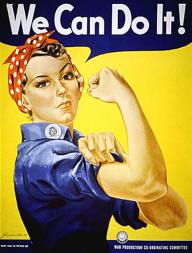
We can do it! RosyI’m not a historian or sociologist, but I’ve noticed something about civilizations.  They always seem to think they are more special than other civilizations.  It’s not important to my purpose here to name names, but so many groups have had a superiority complex of one kind or another that I wonder if a need to feel more special is written into human DNA.

There may be biological explanations for why people draw distinctions and make rankings for each other, but I’m going to speculate about a psychological or spiritual one.  I wonder if this hunger for superiority stems from a lack of security about one’s value as a human being.  The first temptation of Christ started with the words “If thou be the son of God…” and if we are to believe Christ’s temptations were real it means that even Jesus must have, at least momentarily, been able to question his identity.  He was tempted to believe the lie that he was not who he knew himself to be.  We mere mortals experience that temptation not infrequently, and unlike Jesus, we sometimes succumb to it.

One strategy people have for dealing with insecurities about their identity is to artificially elevate themselves above others.  As in, if I’m not special at least I’m more special than (fill in the blank).  This has caused so much pain and injustice.  And regardless of culture, time, or place, women seem to always be on the losing side of this equation. Continue reading “Why I am a Mormon Feminist by Emily U.”

What Was Your Childhood Religious Tradition And Do You Still Follow It? by Carol P. Christ

Recently, in an interview with the Women’s Living History Project of Claremont Graduate University, I was asked: What religious tradition did you identify with as a child and how did it impact your childhood? and: Is your tradition the same today that you had when growing up?

I was surprised that the interview questions didn’t ask anything about feminism, experiencing exclusion in patriarchal religions, or belief.  My religious and political convictions, which are intertwined, have alienated me from family members.  Therefore, I was suspicious of questions that seemed to have been formulated by someone for whom religion and family go together, and for whom believing or not believing (!) did not seem to be an important issue.

After expressing criticism of the questions, I agreed to work with them.  My answer to the first question was that I did not have a single religious tradition as a child. I had four.  Continue reading “What Was Your Childhood Religious Tradition And Do You Still Follow It? by Carol P. Christ”

Feminism + Catholicism = ? By Dawn DiPrince

Oh, so many people cannot figure out why/how in the hell I can be a feminist AND a practicing Catholic. And, I must admit there are days when I, too, am perplexed.

For example, one recent Sunday after Mass I waited outside the Cathedral while my children ran and climbed and smelled flowers around a statue of St. Therese. After a few minutes, two modestly dressed women with clipboards walked up to me and asked: “Would you like to sign a pro-life petition?” I snappishly said no. (Still wishing I would have asked more questions. How do you define pro-life? What good will a petition do?)

I sensed a little surprise from them. I’m sure I was the picture of Catholic motherhood, if you didn’t notice the electric blue toe nails. Only about 30 minutes earlier, I was on the altar reading Scripture to the congregation — something I’ve done since I was 17, when I realized that was likely the closest I would get to priesthood. Also during Mass, my two older children were altar servers (the gender-neutral of “altar boys). And, we were waiting outside because my husband was washing chalices as part of his duties as Eucharistic minister.  So, I certainly appeared to be someone who would gladly sign their petitions. Continue reading “Feminism + Catholicism = ? By Dawn DiPrince”

Blessed Are The Organized, by Amy Levin

It was a humid yet windy day in Broward County, South Florida. My long pants and sleeves were becoming hostile towards me as I proceeded to slip off my shoes, don my borrowed headscarf, and set up shop just outside the modest mosque in Pembroke Pines.  I waited patiently for prayers to end, hoping that my “Register to Vote” sign was placed in optimal eyesight of the female worshippers as they exited the prayer hall. All of my hope to expand the Florida electorate to help re-elect President Barack Obama was bundled in my mix of clipboards, voter registration forms, pens, and volunteer sign-up sheets.  Just moments after the Imam wrapped up the Friday afternoon prayers, two young women wearing full hijab sauntered out. “Oh, I’ve been meaning to register to vote,” one of them said. “Perfect.” Continue reading “Blessed Are The Organized, by Amy Levin”