Caitlyn Jenner is a Friend of Mine

To speak ones truth is oftentimes a difficult and nearly impossible act. However, to live one’s truth, on a day-to-day basis, is an aspect of life that has become so foreign to individuals who have become so comfortable in their own skin that I fear the activist and social justice roots that we all claim to hail from have fallen at the wayside and been replaced by complacency and reductionism.
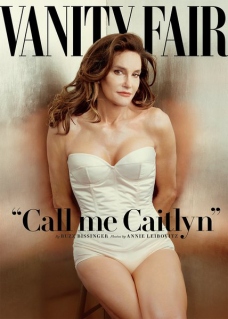
caitlyn-jenner-transformation-high-cost-surgery-clothes-house-5I’m deeply troubled by some of the anti-trans and anti-queer commentary that has been taking place on some of the comments on this blog in recent months. I’ll never forget when this project first began—talking with the founders about its original purpose: to bring the “F” word back into the mainstream religious discourse and more importantly, to be a place where scholars, young and old, senior or junior, could write, collaborate and eventually converse with across cyberspace.

However, in recent months, I’ve found myself being more of a watchdog rather than a frequent commentator on issues pertaining to feminist religious discourse. I’ve found myself reading comments about issues I may not frankly identify or agree with just to make sure that the cisgendering or anti-trans narratives do not become symbolic of what this blog is now rather than what was supposed to be at the beginning.

When I sat down to write my very first post I was scared. I was terrified that feminists from all communities would see me only as I appeared and not for whom I actually was. I was afraid that all I had worked for throughout my life would be moot with the first bad comment on one of my posts. While all of those fears were real and valid they quickly faded away as I was embraced by this community and many others for my passion rather than my gender; my life’s work rather than my privilege; and more importantly, the personal mission to make the world a safer and better place for women and girls everywhere.

To speak ones truth is oftentimes a difficult and nearly impossible act. However, to live one’s truth, on a day-to-day basis, is an aspect of life that has become so foreign to individuals who have become so comfortable in their own skin that I fear the activist and social justice roots that we all claim to hail from have fallen at the wayside and been replaced by complacency and reductionism.

Caitlyn Jenner’s story is one that many individuals, often not highlighted on this blog, know all too well. Caitlyn Jenner’s story and personal experiences are valid and for members of the feminist community to refer to her as not “feminist” or merely as a man “masquerading” as a woman while still utilizing his privilege from being biologically born as a man is troubling and the root of the problem facing many trans individuals today when they’re negotiating coming out as their true selves.

Trans individuals face a cadre of other horrible social, physical and mental statistics that oftentimes lead them to be more likely to self-harm.   However, as feminists, isn’t it our job to make sure that all groups have access to the same freedoms rather than working towards denying it for certain groups while trolling the comments sections of posts?

Shakespeare said: “To thine own self be true” and for those of us who identify with the Golden Rule, if we no longer treat others as we would like to treat ourselves, then we really have failed as feminists; and if the comments on recent blogs are any indication, we still have a long way to go before all voices can feel welcomed not only on FAR but also in the world at-large.

John Erickson is a Ph.D. Candidate in American Religious History at Claremont Graduate University. He holds a MA in Women’s Studies in Religion; an MA in Applied Women’s Studies; and a BA in Women’s Literature and Women’s Studies. He is a Permanent Contributor to the blog Feminism and Religion, a Non-Fiction Reviewer for Lambda Literary, the leader in LGBT reviews, author interviews, opinions and news since 1989 and the Co-Chair of the Queer Studies in Religion section of the American Academy of Religion’s Western Region, the only regional section of the American Academy of Religion that is dedicated to the exploration of queer studies in religion and other relevant fields in the nation and the President of the University of Wisconsin Oshkosh’s LGBTQA+ Alumni Association. When he is not working on his dissertation, he can be found at West Hollywood City Hall where he is the Community Events Technician and works on policies and special events relating to women, gender, sexuality, and human rights issues that are sponsored or co-sponsored by the City of West Hollywood. He is the author of the blog From Wisconsin, with Love and can be followed on Twitter @JErickson85

Violent and Non-Violent Protest by Sara Frykenberg

Sara FrykenbergFor those of you who have read my blogs before, you may have gathered that my approach to justice-making is not entirely non-violent. Researching and writing about the movement away from abusive community paradigms in my dissertation, I argue that we need to care for the kind of refractory violence or counter-violence that arises in our movements away from abuse.
The idea here is not that violence should be a goal, or even that violence is “good”—but rather, that we are in (close) relationship to violence of all kinds. All violence, as I define the term, is destructive in some way; but as many religions of the world remind us, destruction, like creation, is an important part of life. Not all violence is “bad.”

Continue reading “Violent and Non-Violent Protest by Sara Frykenberg”

Spouse for Life & the Fight for Gay Marriage by Marie Cartier

marriage
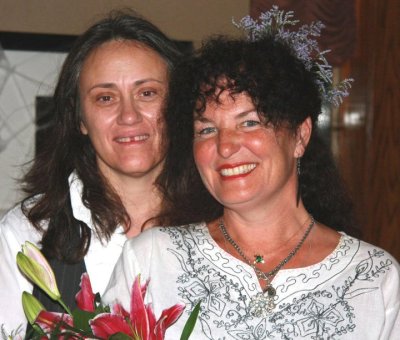
Marie & Kim’s Legal Marriage California 2008

Today, I am exploring the following question set:

What is the shifting conception of religious liberty as religious groups carve out exemptions in complying with laws on LGBTQI rights, particularly as they relate to marriage? As gay marriage becomes “normative” how does it change the structure and study of religion? How did the anti-gay rights movement in California, regarding Proposition 8, funded largely through religious organizations such as the Church of Latter Day Saints and the Catholic Knights of Columbus, have a direct impact on state decisions, and animate new conversations about the juncture of religion and politics?

Let’s start with this information:

Sociologist Brian Powell posed the question of why people were opposed to gay marriage. Do what people say match the legal arguments that justify the opposition to gay marriage? Since legal arguments are based on public policy, what public policy was shaping the legal arguments? The findings, published recently in Social Currents, show that the most common reason for gay marriage opposition was given as: “Because I don’t believe God intended them to be that way.” Running a close second was: “Well, they’re sinners.”

If public opinion drives public policy, then the motivation for banning same-sex marriage is moral disapproval. Or as stated in Powell’s findings—religious disapproval—and the belief that God is not “on the side” of the homosexuals; casting homosexuals as sinners in the faith choice of the person formulating the public policy critique. With these formulations, Powell suggested that public discourse —based on religious formulations such as “sinner” and what “God intended” are the primary agents erecting state laws that ban access to civil rights- such as marriage- for the LGBTQI population. Continue reading “Spouse for Life & the Fight for Gay Marriage by Marie Cartier”

Role Play: In Search of the Authenticity of My Being by Elise Edwards

Elise Edwards“I stood in the authenticity of my being: Black, preacher, Baptist, woman. For the same God who made me a preacher made me a woman, and I am convinced that God was not confused on either account.”
– Reverend Dr. Prathia Hall

These words came across my Facebook feed on Sunday in celebration of International Women’s Day. Reconciling Ministries Network put the statement on its Facebook page, along with a picture of Prathia Hall preaching from the pulpit, in remembrance and honor of women leaders who contributed to the US Civil Rights Movement. This past Sunday, March 8, when the quote was displayed, marked the 50th anniversary of Selma’s Bloody Sunday. Prathia Hall was a leader in the Student Non-Violent Coordinating Committee (SNCC) and one of the activists on the Edmund Pettus Bridge who were attacked as they began to march from Selma to Montgomery, Alabama. Later in her life, she became an ordained minister, professor, and womanist theologian.

For me, this past weekend was about remembrance through many forms. While there were many events commemorating Selma and the important events that unfolded there 50 years ago, my family and I were focused on a more intimate form of remembrance. On Saturday, we held a dinner and informal memorial service for my godfather who passed away last month. I got the news of his death on a day when I’d been doing some deep soul-searching and reflecting about the image I present to the world and its correspondence with who I am and desire to be. Just a few days prior, I’d spoken to my godfather about his health and subsequently, I had been questioning how I might be more connected to him. We lived several states apart, and I wondered how I could be a good goddaughter to him despite the distance. Those questions are left unanswered in the wake of his death. Continue reading “Role Play: In Search of the Authenticity of My Being by Elise Edwards”

Moral Accountability, Prophetic Responsibility, and Selma by Kelly Brown Douglas

Rev.-Dr.-Kelly-Brown-Douglas - Version 2I have been struck in this new year by the reactions to the recently released movie Selma. There has been a palpable recognition by those of who have seen it, that “the more things change, the more they stay the same.” Many have wondered if they are watching about events some 50 years ago, or events some five months ago in Ferguson. The question is why do we remain trapped in this same cycle of sin, where we are alienated from the god who is freedom and thus alienated from our own humanity.
While the answer to this question is complex, one of the reasons we remain trapped in this cycle of sin is because of the way we deny the past and dismiss the future. I have no doubt that until we hold ourselves morally accountable to our past and dare to take prophetic responsibility for our future, then our present realities will continue to be defined by the worst of who we are and not the best of who god calls us to be. Continue reading “Moral Accountability, Prophetic Responsibility, and Selma by Kelly Brown Douglas”

What is the F-word Anyway? by Kile Jones

kile jonesSocial justice. Progressive politics. Improper media depictions. What exactly is the F-word (feminism) about?
I have always understood feminism as a project that casts a very wide net, the goals and values of which can keep quite a few people dry under the shade of its umbrella. But more and more, I see a narrowing of who can count as a feminist. There are a few reasons for this constriction. First, the more the F-word becomes a pejorative in contemporary society, the greater the need is to circle the bandwagons and set up camp. Second, when a particular group has elevated levels of in-fighting occurring, it makes sense to start psychologically splitting people into “feminist” and “not feminist.” Or, on a spectrum, “strong feminist” vs. “weak feminist.” Third, there is a pragmatic need for groups to find an optimal tension with society. When social groups are too counter-cultural or revolutionary, they get branded extremist and fanatical, but when they are wishy-washy and lukewarm, they become another extension of the status quo and lose their prophetic fire.

As an atheist, I see all of this occurring in non-believing circles as well. And I’m not really sure how to navigate it. There is also no shortage of men in this social group–from Dawkins to Boghossian–who think of feminism in the negative. All of this has to do with what they think the F-word amounts to. Continue reading “What is the F-word Anyway? by Kile Jones”

Justice for Mike Brown? by amina wadud

amina - featureI was born the year the Supreme Court of the United States of America began to hear Brown v. Board of Education of Topeka; a case that ought to be known to all as a matter of US history. Here is a precise, but telling history of how that case came into being. This historical account lacks hyperbole, perhaps because one feature of legal-eeze carries the technical title (and appropriately so) of being a brief.

In case blog readers don’t do background research or follow footnotes, I raise these salient points: The Declaration of Independence states “all men (sic) are created equal.” At the same time as it was written and signed into law, the legal enslavement of Africans was in full practice. This incongruence required further legal action to change that in the form of 13th Amendment to the US Constitution which made slavery illegal.

It should be no surprise that “equality” did not result from this and thus the 14th and 15th Amendments attempted to address inequities in more specific terminology. All of these Amendments were ratified the 19th century.

The last decade of the 19th century, Plessy v. Ferguson reached the Supreme Court. Plessy was an unsuccessful challenge, attempting to point out how manifest inequality– the “separate but equal” doctrine in practice across the United States– violated the constitutional notion of equality before the law. Judge Brown sums up the majority opinion which went against Plessy:

The object of the 14th Amendment was undoubtedly to enforce equality of the two races before the law, but in the nature of things it could not have been intended to abolish distinctions based upon color, or to endorse social as distinguished from political, equality..if one race be inferior to the other socially, the Constitution of the United States cannot put them upon the same plane

It would take more than half a century before Brown v. Board of Education brought out the many subtle ways, over the century since the legal end of slavery, that the racial divide had been enforced. It started very early in life, in the form of separate educational systems that only perpetuated the impossibility of constitutional consistency and equality before the law.

We still have a long way to go. Continue reading “Justice for Mike Brown? by amina wadud”

Voting Day by Sara Frykenberg

Sara FrykenbergCan we think of the voting place as an altar where we hole-punch a prayer to the honored dead?

This past Sunday, Barbara Adinger wrote a beautiful blog entitled “November, a Silent Month?” While welcoming the November darkness and a “delicious melancholy composed of silence and rest” settling over her home, Adinger reminds us that: no, we are not silent.

As human beings protesting invisibility and the erasure of the history of the marginalized, we are not silent. Given special command(ment)s to be silent in far too many patriarchal and kyriarchal religions, we cannot silently accept the violence, abuse and invisibility forced upon us or upon those whose struggle is different than our own.

At times, silence is a survival strategy. But this year and last, I am striving to thrive instead.

At times, silence is an important place of meditation: a spiritual necessity, an oasis and praxis in the creation of peace. But, today, my meditations lead me to speak.

When first reading “a silent month,” in the title above, I thought to myself: “I hope not.” I am glad that Barbara agrees. Today—November 4th, aka, “voting day”—those of us living with the privilege of citizenship in the United States have a responsibility to speak. As a woman, I also have a responsibility to my feminist sisters and brothers who won me this right—an inheritance that has become increasingly important to me. Continue reading “Voting Day by Sara Frykenberg”

Fannie Lou Hamer’s Commitment to Life by Elise M. Edwards

Elise EdwardsA few weeks ago, I came across a postcard that I was given at a conference last year. I got the postcard (advertisement?) because it has a picture of Fannie Lou Hamer on it, and in my home and office, I like to display images and quotes from inspirational women, especially black women. Hamer was a sharecropper from rural Mississippi who became a leader within the civil rights movement in the United States. I was happy to have something with her likeness on it. It was only later that I looked at the text on the front and back of the card, which read in part, ”Often called the ‘spirit of the Civil Rights Movement,” Hamer worked tirelessly on behalf of the rights of others—including the unborn. [She said,] ‘The methods used to take human lives such as abortion, the pill, the ring, etc. amounts to genocide. I believe that abortion is legal murder.’” I realized then that the card was distributed by an organization called Consistent Life, who, in support of a “consistent ethic of life,” is “committed to the protection of life threatened by war, abortion, poverty, racism, capital punishment and euthanasia.”

I was conflicted about the ushamere of Hamer’s image for this organization’s purposes. It is true, Hamer did have those views about abortion and birth control. But I did not know if her image and story was being manipulated for a particular political and religious agenda—one I do not align myself with. I put the card in a box of other images and quotes. I didn’t display it, but I didn’t throw it away, either, which is why I came across it again a couple weeks ago as I was cleaning and decorating my home office. I had the same misgivings about the image as before, and I set it aside again. Continue reading “Fannie Lou Hamer’s Commitment to Life by Elise M. Edwards”

LGBTQI Muslims and International Movements for Empowerment by amina wadud

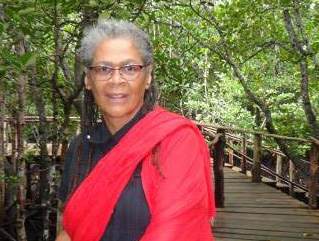
amina 2014 - croppedI am currently in Cape Town South Africa at a Queer Muslim International Retreat.  Next month I will go to Jakarta Indonesia for a workshop focused on the same agenda: reform in Muslim communities towards the lives of dignity for lesbian, gay, bi-sexual, transgender, Queer and Intersex Muslims.  It has been a long road and the end of the struggle is nowhere in sight. Still, there are important developments worth noting.

I am the fifth of eight children.  My brother, just older than me, is gay. Although we are both in our 60’s now, it was evident that his sexual orientation was not normative heterosexual from very early. My first nephew, son of my older sister is also gay. Now in his mid-40’s his was also not a question of lifestyle choice.  I love these two men and always have. That did not mean I was devoid of homophobic tendencies and subtle acts of discrimination against queer people. I wasn’t against them, but I did not see why I, who lived as a straight heterosexual woman, should have to pay any attention to the particularities of their life struggle.  It was their problem and I could ignore it. So I did.

I was never guilty of vicious acts – teasing, name calling or bullying; I just put it out of my mind. As a Muslim, I would come to encounter a much greater awareness how the convenience of sitting on the fence was inadvertently a tacit approval of gross homophobic violations and that all I believed about a Merciful and Compassionate Creator of Justice required me to support the struggles to establish that divine justice and cosmic harmony and beauty everywhere and for everyone. Continue reading “LGBTQI Muslims and International Movements for Empowerment by amina wadud”