My daughter Joy, in so many ways, is like my mother Vera–competent, feisty, determined, smart, no-nonsense, generous, gracious, and loving. Many of her mannerisms mimic Vera’s as well, yet Joy barely knew my mother. She died soon after Joy’s fifth birthday. Unlike both my mother and me, though, Joy came into the world wired with a feminist vision. Comfortable in her own skin from the “get-go,” she did not shrink from asserting her right (quietly–she’s an introvert) to participate in whatever caught her fancy “out there.” She always had a strong sense of autonomy and resists, along with other feminists, when men (or to be more accurate–the patriarchal social system that informs us) attempt to shape public policy based on (primarily) men’s experiences and political agendas.
It took some time for me to understand the structured (and toxic) nature of gender inequality within our society, and even more time to learn to “speak that truth to power.” During Joy’s formative years, I tried my best to instill into her what I had been taught–women were created primarily to be “help-meets” for their husbands and by extension, men. Joy never bought into that “truth.” I could tell by the way she lived. For example, Joy liked to cook. When she prepared a dish, she balked if (when) family members just helped themselves to the fruits of her labor. She insisted they first ask to partake of the food she prepared. She would not be taken for granted. Continue reading “My Tribute to Joy and Vera by Esther Nelson”
We find our versions of home in these communities and it is within these spaces where our home not only begins to define who we are but we, as a reflection of that space, begin to outwardly redefine the spaces we exist in. If we slowly begin, through our experiences to shape our homes based on privilege and power without self-reflection and acknowledgment of others, then we are no better than those oppressive forces we say we’re against.
This post is a response to a recent blog entry titled “Who is Gender Queer?” on this site from Carol Christ. The post can be read by clicking here.I want to thank my friend, advocate, and upcoming scholar Martha Ovadia for reasons only she knows! Stay brave, speak up, be heard! _________________________________________
It is terrifying to know that something is wrong but not be able to speak truth to power.
It is even more terrifying to know something is wrong, be able to speak to it, and then silence those voices that do not have that same privilege, power, or position.
The struggle that many of us in positions of privilege and power face is not just that of being ostracizing and essentializing forces—it is that we, as allies, members of communities, or even those dedicated to a cause, can ourselves participate in the oppression we are fighting against and can do harm.
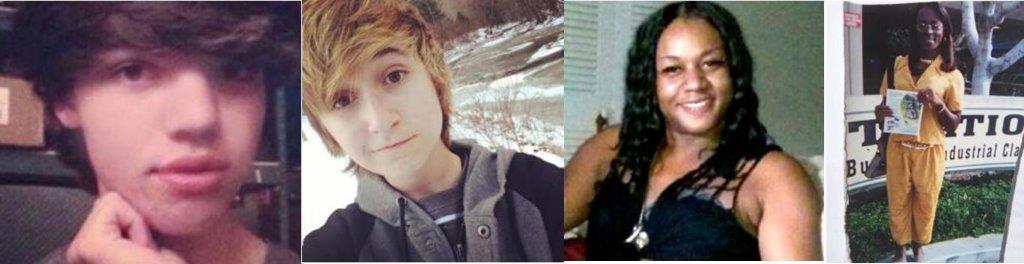
It’s taken me a long time to not only be comfortable with who I identify as, but also how I go about fighting and defining my life based on said identity and experience. However, the one thing that I have the ability to do is choose that identity more freely than others. Unlike Leelah Alcorn, Ash Haffner, Aniya Knee Parker, or Yaz’min Shancez pictured above, I did not have to face the types of oppressions they did, to which they sadly lost their lives, as a result of the fact that we exist in a society that can’t deal with the inability to leave things undefined or to allow people to define who they are on their own terms.
It is vital that although my lived experiences could never meet nor match the same types of oppression that these brave individuals had to face, I, as a white, cisgendered gay male, do not become part of their oppression through my own position and privilege.
As a man who exists in the world of feminism and within various women’s communities, I walk a daily tightrope of privilege and power to insure that I do not silence those that I consider allies, friends, mentors, or colleagues. As a man who exists in the world of the LGBTQ community, I walk an additional tightrope to additionally not take away from or diminish the experiences of those members of our community that do not have the same type of lived experiences as myself. Even within minority communities, there are positions of hierarchy and within these hierarchies of knowledge, identity, or power, comes a responsibility to insure that the oppressed do not become the oppressors.
We find our versions of home in these communities and it is within these spaces where our home not only begins to define who we are but we, as a reflection of that space, begin to outwardly redefine the spaces we exist in. If we slowly begin to shape our homes based on privilege and power without self-reflection and acknowledgment of others, then we are no better than those oppressive forces we say we’re against.
I can’t speak for what identity feels like –I can only speak for what essentializing does, and what it does is reflected in the deaths of Lelah, Ash, and the many others who die nameless. It is our responsibility, as allies, members of communities, and those fighting to end sexist, patriarchal, and, even now, homonormative oppression, to make sure that no more deaths occur on our watch or that truth is spoken to power even when power is masquerading around as truth.
John Erickson is a Ph.D. Candidate in American Religious History at Claremont Graduate University. He holds a MA in Women’s Studies in Religion; an MA in Applied Women’s Studies; and a BA in Women’s Literature and Women’s Studies. He is a Non-Fiction Reviewer for Lambda Literary, the leader in LGBT reviews, author interviews, opinions and news since 1989 and the Co-Chair of the Queer Studies in Religion section of the American Academy of Religion’s Western Region, the only regional section of the American Academy of Religion that is dedicated to the exploration of queer studies in religion and other relevant fields in the nation and the President of the University of Wisconsin Oshkosh’s LGBTQA+ Alumni Association. When he is not working on his dissertation, he can be found at West Hollywood City Hall where he is the Community Events Technician and works on policies and special events relating to women, gender, sexuality, and human rights issues that are sponsored or co-sponsored by the City of West Hollywood. He is the author of the blog From Wisconsin, with Love and can be followed on Twitter @JErickson85
While many Universities last week held massive protests and walkouts on campus, I realized when planning my own protest that if I walked out, I would probably be standing outside on the lawn with very few other protesters. There are plenty of adjunct faculty on my campus—75% to be exact, the national average for all college and university campuses— but I know very few of my adjunct peers and we have no organized voice at the school. Weighing my options (admittedly last minute), I found a great power point presentation on the National Adjunct Walkout Day Facebook page prepared by a Texas adjunct professor, Dr. Jenny Smith, and made available for use by all through Slideshare. Instead of walking out, I taught-in; and I was surprised by how little my students knew about this issue, though I was incredibly heartened by their responses.
I know that you all will be reading this the day after Christmas…so this is my Christmas and/or winter holiday gift to you. I so love the Feminism and Religion (FAR) community—its discourse, intelligence, and its community of like minds. And I appreciate that so many of us offer lessons to each other on how to live—wild. For in some ways the very juxtaposition of the words “feminism” and “religion” posits an out of bounds existence. What does it mean?
I was recently asked how I would teach a class on “women and religion.” Among my first responses was that I would, among other texts, use the book The Feminine Face of God: the Unfolding of the Sacred in Women by Sherry Ruth Anderson and Patricia Hopkins (1992). Although this book was published over two decades ago it still holds, perhaps unfortunately, as true today as then. The text is based on interviews with women regarding the “unfolding of the sacred” in their lives. This book was required as part of my graduate program in the first class I took at Claremont Graduate University (CGU) “Women’s Studies in Religion.” CGU was the first program in the country where you could get your Ph.D. in Religion, with an emphasis in Women’s Studies in Religion, and I believe it is still the only program where you can do so.
My professor for that class, Dr. Karen Torjesen, challenged us to write, if we could, the “theology” in the book—was there one? She challenged us to see if there was a “theo” “logo” word of God in this idea of the “unfolding of the sacred” in women. I took up her challenge—and so one of my first big graduate papers was to unpack this book of interviews and see if I could find a theology in these lives/stories. This is what I found—what is sacred to women—right now (in 1992 and still today)—is the chance to find the sacred. Continue reading “Be Wild this Holiday and Find the Face of God(dess) by Marie Cartier”
Although the specific reasons elude me, I do get nostalgic for “holiday music” during the Christmas season. I’ve written before about growing up in a fundamentalist, Protestant, missionary family. My parents left their homeland (USA), their respective families, and everything familiar to them in order to preach the gospel of Jesus Christ to people (mainly Jews) in Buenos Aires, Argentina, believing Jews had been blinded to the “truth” of Jesus being THE Messiah. My parents’ job (as they saw it) was to be catalytic in removing the scales from blind eyes.
The community they (and I, by default) belonged to and worked with was loosely structured, however, a dour-faced, albeit sincere, Scotsman quietly exerted his will into the day-to-day running of the organization, claiming that his decisions were in fact God’s decisions. Missionaries who disagreed with him could easily find themselves “placed” (all God’s will, of course) several hundred kilometers away to carry on “the Lord’s work” in a remote location–up the Parana River, for example. From the community’s viewpoint (informed by the dour-faced Scotsman), Christmas was a “pagan” (heathen, idolatrous) holiday. We (the church–cult?) did not “esteem one day above another” (see Romans 14:5). Our church community did not celebrate holidays. Continue reading “What’s in a Community? by Esther Nelson”
Every year, several churches in my area set aside a Sunday morning service to celebrate “The Blessing of the Animals.” Parishioners bring animals (mostly dogs) with them to church. The service centers around St. Francis, a Catholic friar and preacher (1181-1226), known for giving us the Christmas crèche, an artistic display prominently figuring Mary, Joseph, shepherds, and angels. St. Francis soon added cows, donkeys, and sheep to his art. He said, “Surely the animals praised the new Messiah just as the shepherds and angels did.” The bulletin of one of the local churches participating in the celebration said, “In honor of this blessed saint [St. Francis] of the church we gather today with our animals, here and in spirit–our pets, our service animals, police dogs and horses, zoo animals and all God’s creatures and give thanks for what they do for us and for what they mean to us.”
The collective prayers that followed thanked God for “animals that comfort us, delight us and give us companionship.” Also, “thank you, Lord, for animals that give us wool and feathers to keep us warm. We thank you for animals that give us milk, cheese and eggs to help us grow and to keep us healthy. We thank you for horses, donkeys and oxen that work hard on farms around the world.” True enough, we do delight in an animal’s companionship. We also benefit from animal products and their labor. However, it seems to me that today, in industrialized societies (especially), we view animals predominately for their instrumental use, ignoring their intrinsic value. In other words, our concerns center around how we can use animals to further our own wealth and well-being. Isn’t that called exploitation? Continue reading “Let’s Begin With Compassion by Esther Nelson”
According to the United States Holocaust Memorial Museum, the Jewish population of Czechoslovakia numbered some 357,000 in 1933. By 1950, it was recorded to be 17,000. To be sure, some escaped to Israel or the United States. Yet, within the modern boundaries of the Czech Republic, some 77,000+ perished. You can find the names of the dead inscribed on the walls of Prague’s Pinkas Synagogue. The Jewish community here remains extremely affected by the effects of WWII and the lingering legacy of communism.
How much of that did you know? Did you know that Prague is home to what the Nazis once wanted to call the “Museum of an Extinct Race”? Did you know that most of the synagogues in this entire country are boarded up, torn down or used for something else? Did you know that the entire Jewish Quarter of Prague was almost destroyed until someone stepped in and persuaded others to preserve it? Did you know that Western media is saying that Jewish life in Prague is undergoing a grand rebirth, while at the same time, most tourists leave Prague thinking there are no Jews here anymore? Continue reading “Ignorance and Invisibility by Ivy Helman”
Can we think of the voting place as an altar where we hole-punch a prayer to the honored dead?
This past Sunday, Barbara Adinger wrote a beautiful blog entitled “November, a Silent Month?” While welcoming the November darkness and a “delicious melancholy composed of silence and rest” settling over her home, Adinger reminds us that: no, we are not silent.
As human beings protesting invisibility and the erasure of the history of the marginalized, we are not silent. Given special command(ment)s to be silent in far too many patriarchal and kyriarchal religions, we cannot silently accept the violence, abuse and invisibility forced upon us or upon those whose struggle is different than our own.
At times, silence is an important place of meditation: a spiritual necessity, an oasis and praxis in the creation of peace. But, today, my meditations lead me to speak.
When first reading “a silent month,” in the title above, I thought to myself: “I hope not.” I am glad that Barbara agrees. Today—November 4th, aka, “voting day”—those of us living with the privilege of citizenship in the United States have a responsibility to speak. As a woman, I also have a responsibility to my feminist sisters and brothers who won me this right—an inheritance that has become increasingly important to me. Continue reading “Voting Day by Sara Frykenberg”
Let the creative word romp begin! Our exercise will be simple, yet challenging. I invite you to write one devotional poem per day for the next seven days about whatever moves you spiritually that day in whatever poetic format the words emerge.
Your goal for the next seven days is to let loose a little- step into the creative flow and allow your Bardic Soul to speak. What we will not be going for is perfect, publication-ready material. I know whenever I undertake something like this, I have to remind myself of that. And I have to muzzle that horribly devious little fellow known as my Inner Critic in order for my Courageous Bard to spring free.
Poetry is the creative form which attempts to capture in words and sound the mystery which lies beyond language. We are all capable of writing poetry.
Look for divine poetic inspiration in any and everything around you during next week. Step with intention through your days. Let the whole world sing to you. Dance with language- FEEL it move you! Do not bludgeon yourself with repeated editing. Write, share, and be brave enough to let it be. Continue reading “Devotional Poetry: You’re Invited to a Community Bardic Exercise”
You are the most powerful intelligent inspirational
Woman
Close to my heart.
You continue to become exponentially more amazing.
Always giving others the step UP.
Force of the cosmos connecting the Web
You are.
Thank you.
–Phanie
Last week, my friend sat on the floor during my mother blessing ceremony and wrote the above poem for me. When she gave it to me she said, “I’m not like you, I don’t write things and share them on the internet.” It was very powerful to receive the gift of written word from someone who does not often write, but who knows how deeply writing speaks to me. Continue reading “Mother Blessings and the Power of Ritual by Molly”



 I know that you all will be reading this the day after Christmas…so this is my Christmas and/or winter holiday gift to you. I so love the Feminism and Religion (FAR) community—its discourse, intelligence, and its community of like minds. And I appreciate that so many of us offer lessons to each other on how to live—wild. For in some ways the very juxtaposition of the words “feminism” and “religion” posits an out of bounds existence. What does it mean?
 Can we think of the voting place as an altar where we hole-punch a prayer to the honored dead?
 Let the creative word romp begin! Our exercise will be simple, yet challenging. I invite you to write one devotional poem per day for the next seven days about whatever moves you spiritually that day in whatever poetic format the words emerge.
 Feminism and Religion