To Work and to Pray in Remembrance by Elise M. Edwards

Elise EdwardsOne hundred years ago, Jesse Washington was lynched downtown in Waco, Texas. Next week, on March 20th, some of my colleagues and I are organizing a memorial service to remember this horrific event and pray for a better future for our city.

We invited submissions of original prayers, poems, spoken-word pieces, music, drama, and other pieces of liturgy for this ecumenical memorial event.  We received a number of thoughtful, heartfelt submissions, but we also a question:

“Why in the world do we need a memorial for one person who was lynched?!?! In the reality of things, Jesse Washington was one of thousands of Blacks that were lynched in America during the time period.”

I thought the answer was so obvious that I initially brushed off the question. But as our group proceeded with the plans, I thought about the question and wondered whether our university community would understand why we are doing this. And honestly, in moments of exhaustion when I put off responding to emails, I wondered, too. Why am I doing this?

To remember. We memorialize one person who was lynched to remind us that every single one of the thousands who were lynched was a human being who was killed unjustly.

In the speech “Lynch Law in America,” from 1900, Ida B. Wells-Barnett describes the injustice: “Our country’s national crime is lynching. It is not the creature of an hour, the sudden outburst of uncontrolled fury, or the unspeakable brutality of an insane mob. It represents the cool, calculating deliberation of intelligent people who openly avow that there is an “unwritten law” that justifies them in putting human beings to death without complaint under oath, without trial by jury, without opportunity to make defense, and without right of appeal.”

Wells-Barnett was an African-American journalist and activist for civil rights and women’s suffrage. Her writings and activism advanced anti-lynching campaigns adopted by Black women’s clubs and the NAACP. Unsurprisingly, her work was controversial, even among women’s groups. Wells-Barnett argued that lynching began after the emancipation of slaves to repress “race riots.” When a constitutional amendment permitted black men to vote, lynching was used to violently prevent their participation in state and national elections. When fraud, intimidation, and local policy succeeded in suppressing the black vote, the brutality continued in the name of avenging or preventing rape and assault of white women.[1] For this argument, lawmakers, ministers, and women’s groups accused Wells-Barnett of defending rapists and subverting “justice” for their alleged victims.

She did not defend rapists. (Neither do I.) She condemned a system that used allegations of rape of white women to legitimate hanging, burning alive, shooting, drowning, dismembering, dragging, and displaying black men’s bodies. Some allegations may have been true. Many were false. Despite the veracity of the allegations, the vigilantes tortured and killed men, women, and children in brutal, public ways, and we must not mistake that for any form of justice. Lynching apologists explicitly valued white lives over others. Lynching was, and remains a crime against humanity.

In our own age of campaigns against the impartiality of law and law enforcement, we should remember the lynching victims and the tensions within earlier waves of feminism and the temperance movement over anti-lynching campaigns. We do not have to condone criminal behavior to call for humane law enforcement or prison reform. We can affirm the humanity of accused and convicted criminals in the pursuit of justice. So we remember Jesse Washington and the other lynching victims to engage more consciously in the activism of our time. We remember so that we don’t lose sight of the complexities of our work. We work in remembrance of the many victims of injustice.

We also gather to pray. For some people, prayer is about making requests to the divine. But in a more expansive sense, prayer is communication with the divine. In prayer, we set time aside to connect to something greater than ourselves. It’s our hope that gathering as a community to pray for the future of our city prompts us to see beyond individual concerns. In a liberation ethics framework, as explained by Miguel De La Torre[2], prayer is not limited to individual, private conversations with God in hopes of gaining wisdom and guidance. De La Torre presents prayer as a communal activity that brings together different members of the spiritual body. It involves the critical application of the biblical text to the situation at hand. This involves critical analysis of the social context that gave rise to the text or its common interpretation. So we pray to give us time to come together, to read scripture, to seek God and hear God through other members of our community.

So why are we gathering? Why do we memorialize one person when there are so many others who have been harmed, not just in my local community but all of our communities?

To remember past wrongs.

To commemorate.

To honor.

To inspire.

To call attention to persisting injustices.

To make us mindful in our work.

To provoke us to pray.

[1] This argument about the reasons for lynching is found in several of Wells-Barnett’s essays, but is quite developed in The Red Record: Tabulated Statistics and Alleged Causes of Lynching in the United States (1895).

[2] See Miguel A. De La Torre’s Doing Christian Ethics from the Margins (2nd Edition, 2014).

Elise M. Edwards, PhD is a Lecturer in Christian Ethics at Baylor University and a graduate of Claremont Graduate University. She is also a registered architect in the State of Florida. Her interdisciplinary work examines issues of civic engagement and how beliefs and commitments are expressed publicly. As a black feminist, she primarily focuses on cultural expressions by, for, and about women and marginalized communities. Follow her on twitter, google+ or academia.edu.

Seasons in Church and Life in the Company of Women by Elise M. Edwards

TElise Edwardshis week, the Christian season of Lent began. Ugh. Lent can be so somber and serious and gloomy. Last year, I didn’t want to place myself in that frame of mind. I was experiencing grief and self-doubt and loneliness, and felt that an extended period of reflection about self-denial, Christ’s suffering, and the sinful condition of humanity might pull me into an unhealthy depression. Also, I questioned why I should seek silence and solitude when I was already experiencing too much of it. I felt isolated.

This year is different for me. Once again, I’m entering the season with a grieving heart. I’m mourning the death of my cousin. But I do not feel isolated. I am not self-doubting. This January, I spent four continuous days with mentors and peers in academia who poured love and wisdom and inspiration into me. The women in our group sought each other out and had honest and authentic conversations about the successes and struggles in our lives. We affirmed self-care. We affirmed milestone birthdays. We affirmed our bodies, despite the physical limitations we sometimes feel. We affirmed the tough decisions some had made, the transformations some were pursuing, and the exciting opportunities that had developed for others since we last met over the summer.

It was a powerful experience, but there was pain, too. We confronted fear, rejection, anxiety, exhaustion, and frustration. I felt blessed—divinely gifted—to have an opportunity to speak honestly with my sisters in the spirit about the people and issues on our hearts: challenges with students, systemic racism and sexism, menopause, children, research questions, financial decisions, romance, and health.

I was on an emotional high from the power that comes from being truly known and loved and I was reveling in the power of that love. Continue reading “Seasons in Church and Life in the Company of Women by Elise M. Edwards”

Inspiration From a Sea Goddess in the Desert by Kayla Bonnin

KaylaBonninStanding as a stark and graceful contrast to the corruptions of freedom of religion, expression, and human rights we hear about every day, there was a grand display of feminine empowerment and beauty at the most recent Burning Man festival, an event in Black Rock City, Nevada. It was a magnificent temple created for Mazu—the Chinese Goddess of the Sea. Her temple and its towering lotus flower were built, and soon thereafter ritualistically burnt, in the simplistic beauty of the desert.
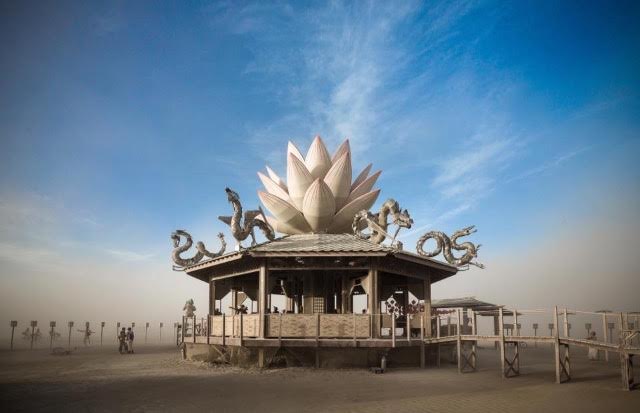
An aesthetically calming temple honoring her came about by the collaboration of Project Manager Nathan Parker and Taiwanese arts foundation, the Dream Community. When I arrived at Burning Man and first saw the temple, I was in awe. The open, octagonal building created from bamboo was rustically elegant. It was designed to be indicative of a structure floating in water. Two piers stretched outwards on either side, while an eye-catching arbor framed the path to the entrance. Blue LED lights flickered on the ground in wave patterns around the temple to create the essence of water encircling the goddess’s temple. A towering 40-foot pink lotus flower sat atop the structure, while fire breathing dragon statues flanked the four corners. Once inside, a center pillar held burning incense, notebooks and pens for reflections, and small strips of papers inscribed with prayers for people to take.

Mazu


Continue reading “Inspiration From a Sea Goddess in the Desert by Kayla Bonnin”

Remembering to Be Thankful by John Erickson

Remembering to be thankful may just be a privileged illusion that individuals in positions of power get to write about in the December of each year to self-congratulate themselves about being actually able to be able to be thankful. It may just seem like people who write about being thankful are complaining or pontificating that being thankful is in itself a chore.

WEHO CA (June 7, 2015)©2015 Rebecca Dru Photography All Rights Reserved    www.rebeccadru.com
WEHO CA (June 7, 2015)©2015 Rebecca Dru Photography All Rights Reserved
http://www.rebeccadru.com

With the holidays just around the corner and the frazzled, crisp ping of anxiety, rush, and panic take over the air around us, it is easy to forget to stop and “smell the roses.”  In times where teaching positions continue to shrink and more universities switch to adjunct labor, fees and class costs continue to rise, or just simply life becomes a little more complicated, due to the nature of balancing life, activism, work, friendships, or relationships, remembering to remind myself to be thankful is another task, I find adding to the never-ending list of stuff I always seem I have to do.

However, remembering to be thankful, scheduling it into one’s daily schedule are vital to our success as new and emerging faculty or activists or just in general because being thankful reminds us that we have aspects of our lives that are worth being thankful for.  Remembering to be thankful proves that we are in some way, connected to a larger sense of life that, at times, grants our wishes, wants, or desires, brings us despair, and then allows us to get through it, or even makes us feel alive.

As I sit back and look at the personal and professional landscape around me I understand that I have a lot to be thankful for both consciously and unconsciously.  Most recently at AAR, I participated on a panel in response to Bernadette Barton’s Pray the Gay Away.  During the course of our panel, the conversation of chosen vs. biological families came up.   Most recently, my mentor and panel moderator, Dr. Marie Cartier, talked about the same topic here on FAR and the difficulties many of us experience in regards to our chosen families vs. our biological families.   With the holiday season all around us, and regardless of what or if, you celebrate it or not, it is quite hard to get away from it all without realizing who your “family” is and whether or not you’re close or connected with them can be traumatizing during these times where we’re taught or expected to be with them.

After our discussion on the panel and then at the hotel bar, people discussed the pains and traumas in relation to not having a biological family to go home to during the holidays.  Sitting there and listening to the conversations, I realized that, for once in my life, I had nothing to say. Continue reading “Remembering to Be Thankful by John Erickson”

Creating Families and Traditions of Choice—and Saving Your Life by Marie Cartier

thanksgiving 3Last week I went out to eat with a group of insightful scholars at the American Academy Religion 2015 Conference held in Atlanta, Georgia. We had just participated on a remarkable panel which was an “Author Meets Critic” session with Bernadette Barton, author of the book Pray the Gay Away: The Extraordinary Lives of Bible Belt Gays. One of our panelists was in Georgia after years of estrangement, not only from his biological family, but also from the geography of his birth because of the biological familial estrangement. He was experiencing the geography of his hometown for the first time in many years. He spoke eloquently in the panel about how much being in the geography itself again was triggering, but also how somatically it was necessary for his own healing. He needed to revisit and be embodied on the actual land—which was very different than re-remembering the hurt from a geographical distance. Also, in order to fully participate in the life of a scholar, which he was now choosing, he had to reconcile being able to revisit this geography in order to attend this particular conference. And frankly, to be able to participate on the panel which was so close to his heart—being a person who was from the Bible Belt and had literally been “prayed” over so that his “gay would go away.”

I have moderated many panels, but this is the first one where I wrote “Congratulations!” on a piece of paper to one of the panelists and passed it to him after his reading. Overall it was a great session of papers and as mentioned we all adjourned for drinks and conviviality. And to celebrate that our gay had not been prayed away.

We began to discuss holiday plans. I said to the young man who had presented his paper so courageously that I was very proud of him not only for his work, but for his ability to return to the geography in which he had experienced so much harm. I said that I was from a very abusive biological home in New England and I had not been north of New York since leaving at age 30 (I am now 59); that for me, putting my embodied self into the actual geography where I had experienced so much harm had not been possible, except for attending my mother’s funeral- its own extreme event.

Some folks at the table expressed surprise and much sadness—how could those of us without biological ties to family handle the holidays? I realized that for me it has been almost thirty years since I began creating “alternatives” to the family I was born in—my biological family- and that I have successfully created chosen family and chosen traditions instead. One of the ways I first learned to deal with holidays which had expected traditions and attendance at biological family functions was to create alternate plans well before the expected day (Thanksgiving, Christmas, etc.) and stick to that plan. I learned that once that day was “here,” I would be triggered and would not be able to create spur of the moment alternatives in the midst of those feelings.

thanksgiving 2One tradition I created 20 years ago was the tradition of “Pie Day” with a good friend of mine. We realized this year that we have been doing that for 20 years! Now that is my “tradition” and that is my “family.” We bake an inordinate amount of pies on Pie Day—a very specific recipe—green apple with golden raisin reduction— and people and friends come over. We celebrate. We eat pie with cheese (a New England tradition) and salad- I call it “a French meal” after my Canadian heritage. Whoever bakes or drops by, eats. Some folks walk away with a pie. We freeze a bunch and have “pie nights” throughout the year. Various girlfriends, friends and friends of friends have helped throughout the year make our estimated 15-20 pies per year, complete with hand rolled, all butter crusts every year.

Continue reading “Creating Families and Traditions of Choice—and Saving Your Life by Marie Cartier”

We are Mauna Kea: The Continual Protest for Maintaining Sacred Land by Anjeanette LeBoeuf

AnjeanetteIt seems like there is a perpetual debate over acquiring land for progress and growth versus the protection of land that has ties to religion, customs, and cultures. The history of America is littered with stories and events that deal with acquisition of land. The sake of growth, expansion, and progress takes precedence in the history of America. Our country’s geography is a road map of acquired land and the pushing aside sacrality.

Continue reading “We are Mauna Kea: The Continual Protest for Maintaining Sacred Land by Anjeanette LeBoeuf”

#LoveWins by John Erickson

On Saturday, September 19, 2015 I married two of my best friends Andrea and Cindy in holy matrimony in Appleton, WI.

John Erickson, sports, coming out.Don’t urge me to leave you or turn back from you.
Where you go, I will go, and where you stay, I will stay.
Your people will be my people and your God my God.
Where you die, I will die, and there I will be buried.
May the God deal with me, be it ever so severely, if even death separates you and me.
Book of Ruth 1:16-17

On Saturday, September 19, 2015 I married two of my best friends Andrunnamedea and Cindy in holy matrimony in Appleton, WI.  Having been ordained since 2009, I truly never thought I’d ever get the chance to use these credentials until they asked me a few months back.  Although my answer was an automatic yes, I sought to make sure that my homily and the words of advice I gave them on their special day were something unique, not always heard at wedding ceremonies. Continue reading “#LoveWins by John Erickson”

Two Wrongs Don’t Make a Right by John Erickson

Kim Davis does need a lot of things but saying of suggesting that she needs a haircut, a makeover, or even to lose weight, makes you and those that continue to repeat it no better than she is; to state such statements doesn’t purport the ideal that #LoveWins, which took over social media just mere months ago, but changes the whole narrative to symbolize that sexism and hate are more important than love and equality.

John Erickson, sports, coming out.Kim Davis, the defiant county clerk, is currently sitting in isolation in a jail cell after refusing to issue marriage licenses to same-sex couples in Rowan County, Kentucky, even after she was ordered by a judge to comply with the Supreme Court’s ruling on same-sex marriage or be held in contempt of court.

Everywhere I turn on both social media or in person people are talking about Ms. Davis, her actions, personal history and for some weird reason her hair and looks.   I’m all for individuals taking a virulent stand against an individual who chooses to not uphold the law of the land as well as continually acting in an unjust discriminatory way but bringing her looks or anything else about her physical appearance into the narrative is not only just plain wrong it is sexism in its worst form. Continue reading “Two Wrongs Don’t Make a Right by John Erickson”

Restoring Ourselves to Ceremony: Red Tent Circles, by Molly

April 2015 103
At a Red Tent Circle this spring.

I believe that these circles of women around us weave invisible nets of love that carry us when we’re weak and sing with us when we’re strong.”

–SARK, Succulent Wild Woman

Seven years ago, a small postcard at the local Unitarian Universalist church caught my eye. It was for a Cakes for the Queen of Heaven facilitator training at Eliot Chapel in St. Louis. I registered for the training and went, driving alone into an unknown neighborhood. There, I circled in ceremony and sisterhood with women I’d never met, exploring an area that was new for me, and yet that felt so right and so familiar.

I’d left my two young sons home for the day with my husband and it was the first time in what felt like a long time that I’d been on my own, as a woman and not someone’s mother. At the end of the day, each of us draped in beautiful fabric and sitting in a circle around a lovely altar covered with goddess art and symbols of personal empowerment, I looked around at the circle of women and I knew: THIS is what else there is for me. Continue reading “Restoring Ourselves to Ceremony: Red Tent Circles, by Molly”

Caitlyn Jenner is a Friend of Mine

To speak ones truth is oftentimes a difficult and nearly impossible act. However, to live one’s truth, on a day-to-day basis, is an aspect of life that has become so foreign to individuals who have become so comfortable in their own skin that I fear the activist and social justice roots that we all claim to hail from have fallen at the wayside and been replaced by complacency and reductionism.

caitlyn-jenner-transformation-high-cost-surgery-clothes-house-5I’m deeply troubled by some of the anti-trans and anti-queer commentary that has been taking place on some of the comments on this blog in recent months. I’ll never forget when this project first began—talking with the founders about its original purpose: to bring the “F” word back into the mainstream religious discourse and more importantly, to be a place where scholars, young and old, senior or junior, could write, collaborate and eventually converse with across cyberspace.

However, in recent months, I’ve found myself being more of a watchdog rather than a frequent commentator on issues pertaining to feminist religious discourse. I’ve found myself reading comments about issues I may not frankly identify or agree with just to make sure that the cisgendering or anti-trans narratives do not become symbolic of what this blog is now rather than what was supposed to be at the beginning.

When I sat down to write my very first post I was scared. I was terrified that feminists from all communities would see me only as I appeared and not for whom I actually was. I was afraid that all I had worked for throughout my life would be moot with the first bad comment on one of my posts. While all of those fears were real and valid they quickly faded away as I was embraced by this community and many others for my passion rather than my gender; my life’s work rather than my privilege; and more importantly, the personal mission to make the world a safer and better place for women and girls everywhere.

To speak ones truth is oftentimes a difficult and nearly impossible act. However, to live one’s truth, on a day-to-day basis, is an aspect of life that has become so foreign to individuals who have become so comfortable in their own skin that I fear the activist and social justice roots that we all claim to hail from have fallen at the wayside and been replaced by complacency and reductionism.

Caitlyn Jenner’s story is one that many individuals, often not highlighted on this blog, know all too well. Caitlyn Jenner’s story and personal experiences are valid and for members of the feminist community to refer to her as not “feminist” or merely as a man “masquerading” as a woman while still utilizing his privilege from being biologically born as a man is troubling and the root of the problem facing many trans individuals today when they’re negotiating coming out as their true selves.

Trans individuals face a cadre of other horrible social, physical and mental statistics that oftentimes lead them to be more likely to self-harm.   However, as feminists, isn’t it our job to make sure that all groups have access to the same freedoms rather than working towards denying it for certain groups while trolling the comments sections of posts?

Shakespeare said: “To thine own self be true” and for those of us who identify with the Golden Rule, if we no longer treat others as we would like to treat ourselves, then we really have failed as feminists; and if the comments on recent blogs are any indication, we still have a long way to go before all voices can feel welcomed not only on FAR but also in the world at-large.

John Erickson is a Ph.D. Candidate in American Religious History at Claremont Graduate University. He holds a MA in Women’s Studies in Religion; an MA in Applied Women’s Studies; and a BA in Women’s Literature and Women’s Studies. He is a Permanent Contributor to the blog Feminism and Religion, a Non-Fiction Reviewer for Lambda Literary, the leader in LGBT reviews, author interviews, opinions and news since 1989 and the Co-Chair of the Queer Studies in Religion section of the American Academy of Religion’s Western Region, the only regional section of the American Academy of Religion that is dedicated to the exploration of queer studies in religion and other relevant fields in the nation and the President of the University of Wisconsin Oshkosh’s LGBTQA+ Alumni Association. When he is not working on his dissertation, he can be found at West Hollywood City Hall where he is the Community Events Technician and works on policies and special events relating to women, gender, sexuality, and human rights issues that are sponsored or co-sponsored by the City of West Hollywood. He is the author of the blog From Wisconsin, with Love and can be followed on Twitter @JErickson85