Nitzavim-Vayeilech: Inspiration for a More Egalitarian Judaism.

The Torah portion for yesterday was a double one: Nitzavim-Vayeilech (Deuteronomy 29:9-31:30).  I have already written about Vayeilech here, yet as with any parshah there is always more to say. Nonetheless, I will mainly focus on the motifs that are more particular to Nitzavim (Deut. 29:9-30:20).  Some we have seen before like an obsession with idolatry, threats and punishments in the forms of disease, plagues, destructions, and annihilations, the Israelites’ persistent betrayal, and this-worldly rewards for good behavior.  Yet, there are some ideas we haven’t seen yet.  I want to focus on three: the Torah referring to itself; the idea of the Torah being heard; and the freedom of people to choose their own heart’s inclinations.

Deuteronomy 29:20 refers to the book of the Torah.  However, it is only in verse 31:9, that we learn that Moses is the author of the Torah.  More orthodox versions of Judaism adhere to this belief that Moses wrote the Torah (except for perhaps the last 8 verses or so since he had died), but according to biblical historians, the Torah was compiled out of a myriad of sources during the Babylonian exile.  Nonetheless, I find it interesting that in Vayeilech-Nitzavim, the Torah refers to itself eight times (29:20, 21, 27, 30:10, and 31:9, 12, 24 and 26).  To some extent, it seems to be setting itself up to be an equal to the ten commandments within Israelite temple worship as there are also instructions to put this book of Moses next to the ark of the covenant within the tent of meeting (31:26).  While Moses may not have written the Torah, it is clear that its authors intended for it to be a religiously significant book within Israel.  And, it has become for Jews, the religiously significant book.

Continue reading “Nitzavim-Vayeilech: Inspiration for a More Egalitarian Judaism.”

Snapshots from the Parliament of World Religions by Janet Maika’i Rudolph

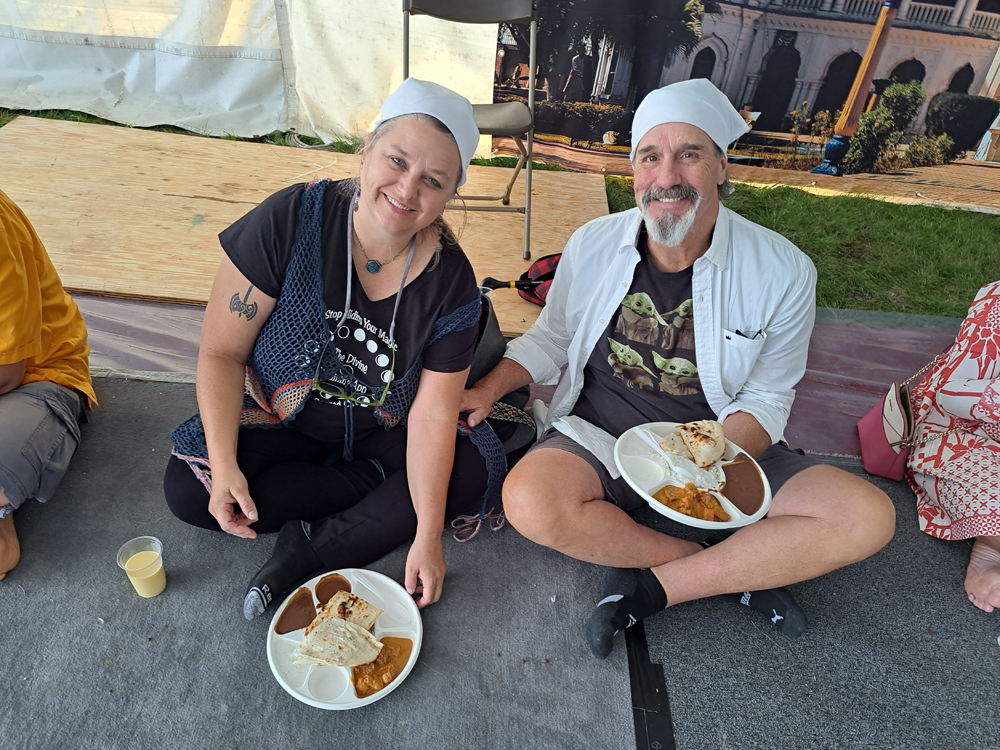
The Parliament of World Religions ran from Aug 14th to the 18th  in Chicago.  I returned with my head spinning having met new people, connected with inspiring beliefs, discussed fascinating ideas, watched meaningful performances, engaged in sacred play, danced, sang, cried, ate, and mostly experienced . . . just experienced. It is still overwhelming to sort out individual experiences. I am going to write up a few of my impressions, snapshot style. They scratch the surface, not only of my individual experience but of the Parliament in general where upwards of 7,000 people attended. It was incredible

Setting the tableau: As I was going down the escalator, a woman was followed by 2 groups were heading up. The woman was beautiful and young in full Mayan dress with white blouse, long orange skirt along with headdress and belt with Mayan symbols. Her thick dark hair was flowing down her back.

She was followed by five Sikh men who were dressed head to foot in white. Their heads and hair were covered by white turbans.

They were followed by two Buddhist nuns dressed in grey robes carrying beads. Their heads were shaved.

Such scenes were common.

Continue reading “Snapshots from the Parliament of World Religions by Janet Maika’i Rudolph”

Archives from the FAR Founders: Learning Compassion from Inmate Number 74799 by Cynthia Garrity-Bond

This was originally posted on July 21, 2017. This is the first post of our new series to highlight the work of the four founders of FAR, Garrity-Bond, Caroline Kline, Gina Messina and Xochitl Alvizo

Technically I was employed as a lab assistant at our community

Considered standard prison procedure, Michael was scheduled for an autopsy the following day. While my grief over Michael’s death was considerable, it was the pending autopsy that caused my immediate concern. As I pictured Michael on the cold table of steel, the crude instruments sawing and cutting into his already weathered body, I took it upon myself to somehow ease this last assault. I phoned the Tucson corner’s office, hoping to speak to the pathologist who would be performing Michael’s autopsy. With surprising bureaucratic ease, I was transferred to him. After introducing myself, I explained he would be receiving Prisoner 74799, my brother, from Tucson General, and that by all appearances this was just another disposable inmate whose criminal past simply caught up with him, sort of a karma-like ending. His thin, emaciated body, I warned, is covered in tattoos, which I feared might induce a harsher judgment upon this cast away soul. I asked the pathologist that when he begins the post, he please remember Prisoner 74799 was somebody’s son, somebody’s brother, father and friend and more importantly, that this man was loved. “Please” I pleaded, “try to see beyond the obvious signs of poor choices mapped onto his body, instead see he is more than his prison issued number and that Michael Paul, while far from saint, was a man who loved and was loved.”

Continue reading “Archives from the FAR Founders: Learning Compassion from Inmate Number 74799 by Cynthia Garrity-Bond”

The Czech Tradition of Čarodějnice (Witches).

This post is a follow-up, in a way, to the post I published here on September 11, 2016, entitled “Continuing Pre-Christian Traditions in the Czech Republic,” and will be a combination photo essay* and elaboration on one of the rituals mentioned in that first post.  On April 30th, I was in the small village where my partner’s family has their summer house.  Yes, that same village that has inspired posts like this.  There, we celebrated Čarodějnice, or Witches. This holiday seems to be related to what is called May Day or Beltane in other countries. What is unique about this tradition isn’t necessarily the májka (May Pole) although it is different than other places May Pole, but the burning of the witch.

Throughout the day, everything is gendered.  The women and girls have certain tasks; the men and boys have too.  The women and girls create and decorate.  First, they create a witch to be burned on a large bonfire; the construction and shape of both can vary.  After creating the witch, the women and girls (although it should be virgins – but no one really follows that tradition) decorate the top of a cut-down, very tall pine tree with strips of brightly colored fabric and crepe paper, tying them on to create what will become vertical streamers blowing in the wind, thus creating what is called a májka.  

Continue reading “The Czech Tradition of Čarodějnice (Witches).”

Into the HEaRt of De-Criminalizing Indigenous Worldviews by Margot Van Sluytman

In prisons in Canada and around the world, a large percentage of criminalized people, who are more often than not, victimized people, Indigenous people make up significant percentages. In a recent *talk I gave, accompanying Indigenous Elder and Artist Philip Cote, we addressed what happens when colonial narratives and patriarchal narratives collide. The result is that our worldviews are shattered. When our worldviews, which are our foundational way of meaning-making, are dismissed, denied, and in the case of
cultural genocide: decimated, our heart health fails. Our bodies, our minds, our souls become disconnected become dissociated. Become imprisoned. Imprisoned in the figurative sense and eventually over time, in the literal sense.

Continue reading “Into the HEaRt of De-Criminalizing Indigenous Worldviews by Margot Van Sluytman”

Poem: A Valentine’s Wish, 2023 by Marie Cartier

What if everyone said everyone was their Valentine?
I mean you are walking down the streets telling strangers:
You are adorable.
You are my love.
Kiss. Kiss.
Well, maybe not, I am thinking of those candy hearts, with the sayings, my favorite Valentine’s candy.

But what if everyone in the world on Valentine’s Day, February 14th,
decided that that the world, the Earth, was their lover?
Squishy hugs and smacking kisses,
and loving her with what she wants.

What if we all decided for twenty-four hours to love everyone
in the way they wanted, in the way they needed?
To respect women?
To say please and thank you and excuse me?
To honor difference and listen to all these voices
who have been silenced?
To give the sweet chocolate of understanding to those
who have been so misunderstood?
To take fifty Happy Meals to downtown L.A. and pass them out to the homeless,
yelling, “Happy Valentine’s Day!”?

Continue reading “Poem: A Valentine’s Wish, 2023 by Marie Cartier”

On Mishpatim, Feminism and A Caring Community by Ivy Helman.

Mishpatim (Exodus 21:1 – 24:18 and 30:11-16) is the Torah portion for February 18, 2023.  Its name, mishpatim, means laws or ordinances, and the portion is essentially just that – a list of laws to be followed.  It is not the easiest parshah to follow as it jumps around, backtracks numerous times, and sometimes contradicts itself, particularly in the sections with Moses. 

That being said, there are two main themes in Mishpatim; both of which I have discussed in past blogs.  First is the death penalty.  There is an overabundance of crimes that result in the death penalty in this parshah.  Way, way too many.  Another theme is idolatry.  In many ways, that is a theme in the Torah itself.  For more on these themes from my feminist perspective, see here: Sh’lach; Ki Tisa; Shofetim ; and on b’tzelem Elohim.

Continue reading “On Mishpatim, Feminism and A Caring Community by Ivy Helman.”

Re-imagining the Ritual of Communion by Xochitl Alvizo

I remember the words so clearly: “I know what it’s like to have my body broken, I know what it’s like to have my blood spilt. I won’t celebrate anyone else’s broken body or spilt blood, and I don’t want anyone doing that on my behalf.” Sitting in the pew next to me, my friend spoke her truth in a soft and tentative, but somehow still firm, voice. She then slumped in her seat and folded up her legs, hugging them against her body. While everyone else got up to take communion, I stayed in place beside her.

There was a period of time in my life when I was not willing to participate in communion. My friend’s words stayed with me, transforming the communion table from one of hospitality to one of violence. “Celebrating” communion didn’t feel celebratory anymore. I chose not to take communion for several years. I let my friend’s words guide and deepen my reflection on the practice of communion—especially in light of the trauma suffered by all too many bodies.

Continue reading “Re-imagining the Ritual of Communion by Xochitl Alvizo”

From the Archives: Christmastime for the Self by John Erickson

This was originally posted on December 25, 2018

We’ve all been there.

Sitting around the tree watching the kids open presents.  Attempting to enjoy a holiday meal with extended and immediate family that you may or may not have traveled thousands of miles to see.  Trying with every fiber of your being to not talk about the elephant, or red hat, in the room.

Alyssa Edwards

I get it.  It is hard to not go home for the holidays. It’s also hard to sit at home and watch every one of your friends post online about their dinners, get-togethers, and other joyous events while you sit at home.  I also understand that many of us, as a result of our sexual and/or gender identity, or maybe our political preference, don’t feel comfortable going home or, can’t go home.  This is not ok and that is why it is so important that we all have our chosen families to be with during these times of communal gathering or more importantly, ways to cope while we are at home in these uncomfortable situations to make sure we take care of ourselves and make it out the other end.

Continue reading “From the Archives: Christmastime for the Self by John Erickson”

Building Community:  Starting a Local Sacred Circle K & Letting It Go by Caryn MacGrandle

In January of this year, I put out the call for a Sacred Circle at a local Healing Arts Center. Over 150 people responded interested from a Facebook invite. Thirteen showed up.

From strangers, we have become friends and a community.

One was on the verge of checking herself in to a rehab. 

She celebrated six months sobriety the other month in Circle.

We’ve had our share of potential drama. Egos and self-esteem issues and the potential pitfalls of being human. But we’ve made it through. Returning again and again to love to hope to dreams.

We’ve watched each other change and grow and open up.

Continue reading “Building Community:  Starting a Local Sacred Circle K & Letting It Go by Caryn MacGrandle”