Death is a Gift, and Christ is a Hag by Trelawney Grenfell-Muir

My father is dying, and I am haggard with grief and exhaustion. Over a month of frantically arranging child care, driving to the ICU in the middle of the night, fighting to protect my Dad from neglect and malpractice, chasing case managers, begging doctors, negotiating with nurses, sensitive, depleting, agonizing family debates about hospice and DNR, and hour after hour sitting and holding my Dad’s hand, singing, comforting, soothing, reassuring. Washing his face. Massaging salve into his feet and legs. Continually checking to see if he is too cold, too warm, in pain, breathing ok. Weeping as I drive home through snow and rain and dark, watching car accidents happen just one lane over, trying to soothe my frazzled and anxious little children, support my husband in his degree program, and not lose my own career entirely.

So when my daughter asked me, “Mummy, why does Grampy have to die?” I felt dizzy for a moment with my exhausted, overwhelmed, haggard inability to have an instant, perfectly formulated response to provide comfort and meaning for my child. Finally, I said, “Because, darling, if no one died, no one could live. All of us, our bodies are made from the food we eat, which is made from plants, which is made from dirt, which is made from everything that has died. Death is the only way for life to exist. Death allows life, births life, IS life. Death is our only path and connection to eternity.”  Continue reading “Death is a Gift, and Christ is a Hag by Trelawney Grenfell-Muir”

How My Pets Have Taught Me Compassion for All Beings by Ivy Helman

20171119_155520My cat is a hunter.  You can see it in her eyes.  She plays fetch considerably better than the dog and seems to enjoy playing with her “kill” – throwing it up in the air, batting it around and pouncing on it – long after it is “dead.”  If we forget to clean up her toys before bedtime, her prowess invades the night.  For such a tiny cat, she can meow at almost deafening volumes.

Typical with any hunter, she loves anything meaty and has recently even begun fighting for a share of the dog’s morning pate.  For the cat, if the dog gets pate, she should too.  It’s only fair.  After all, she takes medicine daily too.  Continue reading “How My Pets Have Taught Me Compassion for All Beings by Ivy Helman”

Grieving through the Holidays: Painting Holy Women Icons of Grief by Angela Yarber

The holiday season is a particularly difficult time for grief. Whether it is grieving someone who died earlier in the year as you celebrate your first holiday season without them, or the lasting memories of loved ones who are no longer present at family gatherings, this time of year makes grief bubble to the surface. Since this is my first holiday season without my little brother, who died in March, I’ve planned ahead with coping strategies that I’d like to share with other feminists struggling to grieve through the holidays.

Upon the death of a loved one, most people in the West are offered commodified grief, costly funerals, and stifled feelings pre-packaged as dignified tradition. When deathcare became a commercial enterprise at the turn of the twentieth century, there was what mortician and author Caitlin Doughty calls a seismic shift in who was responsible for the dead. “Caring for the corpse went from visceral, primeval work performed by women to a ‘profession,’ an ‘art,’ and even a ‘science,’ performed by well-paid men. The corpse, with all its physical and emotional messiness, was taken from women. It was made neat and clean, and placed in its casket on a pedestal, always just out of our grasp (Caitlin Doughty, From Here to Eternity: Traveling the World to Find the Good Death, 136).”

Continue reading “Grieving through the Holidays: Painting Holy Women Icons of Grief by Angela Yarber”

Learning Compassion from Inmate Number 74799 by Cynthia Garrity-Bond

Technically I was employed as a lab assistant at our community hospital. This position entailed multiple responsibilities, from receptionist to actual bench work within the laboratory. The task I dreaded most was my assistance at autopsies. Beyond a strong constitution, it required no measurable skill set. This job was not the high-tech, immaculate setting of any of the CSI programs of today; instead the morgue was a stark, condensed room with two pullout refrigerators for the deceased, a stainless steel table the autopsy was performed on, and the necessary instruments and accouterments, some suspended from what appeared thin air. These tools of the trade ranged from the expected scalpels and retractors to saws and garden-like shears.

Fast-forward fifteen years. It is the morning of July 11, 1991. Prisoner number 74799 has just been transferred from the Department of Corrections, Arizona State Prison in Florence to Tucson County General Hospital in critical condition. Eight months prior to his admittance to the prison hospital, Prisoner 74799 was diagnosed with metastatic lung cancer. While considered inoperable, he was administered the customary chemotherapy treatments until four months later when the cancer spread to his brain, taking most if not all of his cognitive abilities away. Within one hour of his transport, Prisoner 74799, my brother, Michael Paul, died at the age of thirty-nine.

Continue reading “Learning Compassion from Inmate Number 74799 by Cynthia Garrity-Bond”

Gratitudo et Fortitudo by Natalie Weaver

One of the bigger problems with being the only Classics major at a Jesuit university is that all my friends were fairly old men before I had even reached drinking age. Now, they are pretty much gone back to the cradle of the grave, save one, who is on his way to a remote retirement home. As a young woman, my coterie wasn’t a terrible problem for me because some deep part of my psyche had been convinced, since I was about nine years old, that I myself was an old man. I sort of felt at home reading about the Second Punic War and identifying with the sexual ramblings of the naughty old Latin poets, noting between me and my teacher-purveyors of such materials only the occasional, modest differences in skin elasticity and dental sheen.

I never felt like a girl, although, to be sure, one’s ability to assess such a thing is limited to one’s observations and conceptions about what, for example, a girl is or does or thinks. I found myself “ungirlike” in comparison with my conceptions of “girl-ness,” perhaps most notably in the operations of my mind. I felt “old” and “serious.” I remember contemplating with enormous focus the abstractions of total being and absolute nothingness from my nursery room. My big wheel was solid black, and my Dad got me into fishing and hooking live bait. I had read Nietzsche’s Beyond Good and Evil by eighth grade; my favorite book was Camus’ The Plague until it was replaced by Hesse’s more romantic investigations in Narcissus and Goldmund; and I spent my days writing philosophical poems and trying to teach myself to paint in the style of Chinese ink and wash painting. I couldn’t stand Sweet Valley High novels, and even my doll play was odd. I had a gay Ken doll, whom I named David, and his best friend was a shaven-headed Western Barbie, whose backstory was a woeful tale of drugs and topless dancing.   Continue reading “Gratitudo et Fortitudo by Natalie Weaver”

Beginning with Death on the Goddess Pilgrimage to Crete by Carol P. Christ

Our first ritual on the Goddess Pilgrimage to Crete is a death ritual in which we honor the memory of those who have gone before us. Like so many things on the pilgrimage, the death ritual evolved. I did not consciously plan to begin with death. Rather, the death ritual inserted itself at the beginning of the tour. Now I understand that the timing is right.
As we begin our pilgrimage, seeking new insight about the meaning of our lives, about the meaning of life and death, we pause to remember those who have gone before us.

Before the ritual begins, I discuss the communal burials in round tombs of the ancient Cretans, sharing my belief that the purpose of their rituals was not to secure immortality or eternal life for the individual, but rather to affirm and ensure the regeneration of life in the community and in nature. I add that though I have no desire for personal life after death, I care deeply about the continued flourishing of life for human and other than human beings.

I like to keep rituals simple. First, we create an altar. Two stones mark the place. We decorate them with flowers and fruits from our Mother Earth and small images of the Goddess. Continue reading “Beginning with Death on the Goddess Pilgrimage to Crete by Carol P. Christ”

This Time by Joyce Zonana

jz-headshot

And the new sun rose bringing the new year.

Alfred, Lord Tennyson, “The Passing of Arthur,” Idylls of the King

It’s arbitrary, of course, this designation of January 1st as New Year’s Day on the Gregorian Calendar, but it’s also unavoidable.  Everywhere around us, people are gathering, celebrating, making resolutions, ringing out the old, ringing in the new.

The Jewish calendar’s Rosh Hashanah, near the Autumnal Equinox, always feels like the real New Year to me, with its time-honored rituals of renewal and return.  The ancient Persian New Year, observed at the Vernal Equinox and recalled in in the Jewish and Christian celebrations of Purim and Mardi Gras, also moves me.  And, like so many of my brother and sister pagans, I experience the Winter Solstice as a truly numinous moment, a time to release the past and welcome the future as the sun dies and is reborn.

This year, it’s especially meaningful to find Chanukah so close to the solstice, filling the week between Christmas and New Year’s.  I’ve been lighting my candles each night with particular pleasure.  Yet I’m happy, too, to join the rituals associated with the secular, popular New Year.  In my view, there can never be too many moments of renewal and return.

Continue reading “This Time by Joyce Zonana”

My Experience at Auschwitz by Ivy Helman

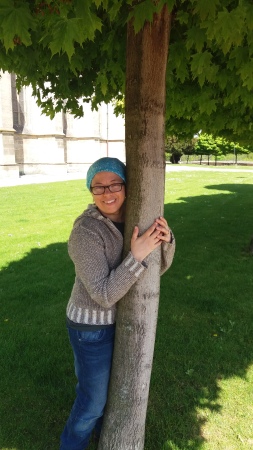
me hugging treeOn August 4th, I visited Auschwitz.  In the beginning, the reality of the experience did not match my surrealist expectations of it.  I expected to walk onto the grounds and get hit over the head with the heaviness of what happened there, to feel a sense of deep connection to the land covered in the ashes of my people, to have the opportunity to mourn the loss of the members of my family I never met and to be utterly speechless as to the twisted systematization and industrialization of murder that took place there.  That blow never came.  Why?

The day of my visit was out-of-this-world hot.  My guided tour, in Czech, started at 2pm.  I was early so I wandered among the crowd outside of the site.  There were families lounging on the lawns eating ice creams and drinking cokes.  There were tourists taking selfies.  There were lots of conversations and lots of laughter.  I was pretty convinced that I was the only Jew around.

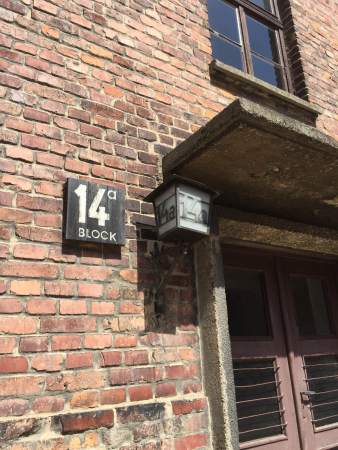
Upon entering the grounds, I was stunned by how green and lush it was.  There were many old brick buildings, seemingly orderly, with lanterns and building signs hanging outside the entrances.  Among it all, upwards of 500 people clustered in groups walked from place to place.auschwitz large stone memorial

The tour began with a basic history of the events of the Holocaust with “exhibits” contained within 3 or 4 different buildings. The guide seemed to me to have memorized a script in which we went from one building to another looking at the “exhibits,” most of which consisted of nothing more than one or two oversized pictures and maps.  Outwardly, I sensed no sentiment in the guide and no spirit in the exhibitions either.  Her voice was monotone, pronouncing the Czech in such a syllable-by-syllable fashion that it was nearly incomprehensible.  Most exhibition rooms were sparse, if they had any objects at all other than the black and white pictures and maps.  The tour and exhibitions portrayed such a distance from the events it was almost as if they didn’t happen there, in that place.

zyclon b
Zyklon B

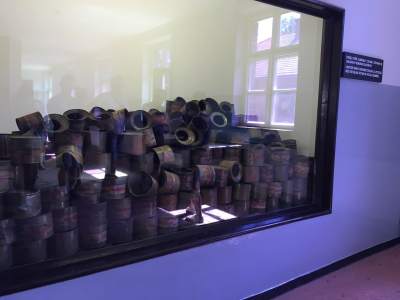
There were a few buildings with objects all hermetically sealed behind glass once again keeping us at a distance.  One room housed a display of used Zyklon B canisters and had an artist’s small scale all-white model of the “process of extermination,” meaning the “changing rooms,” “showers” and crematoriums – with tiny people crammed into the areas and bodies piled on the floors next to the ovens.  Two other buildings contained large displays, again behind glass and removed from their context, of what the exhibition called “evidence of the destruction:” piles of hair loosened from the burlaps sacks they had been founded in when the camp was liberated; shoes of the victims and a large (two-story) container filled with the pots and pans the victims had packed and brought with them but never used.

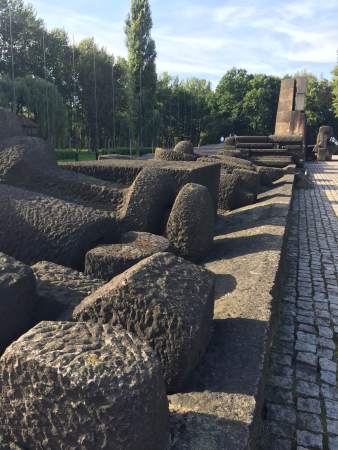
After we finished our tour of Auschwitz 1, we were given a 15 minute break and were instructed tolarge stone memorial reassemble by the bus that would take us to Auschwitz-Birkenau.  Once there, we rushed through the camp at such a pace that we were done in about 45 minutes.  In spite of the rush, I did manage to leave two stones on the pillars, which marked where the ashes of the victims were scattered (buried?).  We glanced at the memorial at the back of the camp as well as what was left of the bombed-out crematoriums.  Returning to the front of the camp, we ducked into a reconstructed dormitory and a reconstructed bathroom building.  The guide asked if we had any questions.  Silence.  The tour was done.

I stood there debating what to do.  Do I leave?  Do I stay?  I was pretty confident that it didn’t feel right to just go.  So, I headed back to the memorial.  The tour guide had said that each of the smaller stones creating the steps and floor commemorated one of the 1.1 million Jews killed in Auschwitz.  Yet, it was unclear as to the meaning of the large stones.  After circling the large stones and a futile attempt to make some meaning out of them, I went and sat on the stairs of the memorial and just looked out over the place and the people there.

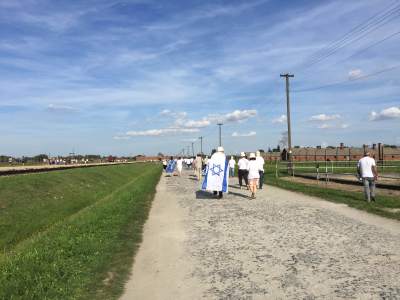
Jewish superherosStill puzzled but needing to catch the train, I made my way to the entrance.  In front of me was a group of Israeli Jews wrapped in Israeli flags, looking the Superhero part.  Something changed.  Maybe I didn’t need the sad, mournful, pit-of-the-stomach experience.  Maybe I’ve had it enough, learned about it enough, taught it enough and lived with it enough.  Maybe my pilgrimage there as a witness to the horrors was enough.

It was those Israeli Jews that I needed.  Walking into Auschwitz was one thing, but they were proud Jews walking out.  I followed them.  We, Jews, were the lucky ones who got to leave.  Isn’t that something!

Ivy Helman, Ph.D. is feminist scholar and faculty member at Charles University and Anglo-American University in Prague, Czech Republic where she teaches a variety of Jewish Studies and Ecofeminist courses.  She is an Associate of Merrimack College‘s Center for the Study of Jewish-Christian-Muslim Relations and spent many years there as an Adjunct Lecturer in the Religious and Theological Studies Department. 

Dance of Persephone: The Trata of Megara by Laura Shannon 

Laura Shannon square cropIn a previous post on FAR I explored Greek Easter customs which interweave Christian and pre-Christian beliefs.  Today I would like to take a closer look at one of these customs, the women’s ritual dance known as Tráta, ceremonially performed on ‘Bright Tuesday,’ the Tuesday after Easter. Versions of Tráta survive in the towns of Mégara and Elefsina just west of Athens, on the island of Salamína directly across from them, and in the surrounding area as far as Thebes.

Elefsina, of course, is Eleusis, where for over 2,000 years the Eleusinian Mysteries enacted the story of Demeter and her daughter Persephone’s descent to the Underworld. Choral dance was a central part of the ceremonies at Eleusis – as at other sacred sites including Delphi, Knossos, Athens, and Vravrona – and the ‘Well of the Beautiful Dances’ can still be seen at the archaeological site. It is a a visible reminder of the circle dancing which was a part of the initiatory experience, bringing cosmic order – symbolised by the circle – into the human world. This is still one of the functions of the Tráta as performed today.

Eleusis
Eleusis
Eleusis – ‘Well of the Beautiful Dances’

Continue reading “Dance of Persephone: The Trata of Megara by Laura Shannon “

A Complicated History by Elise M. Edwards

Elise EdwardsIn my previous post, I wrote about my participation in planning a memorial event for the lynching of a man named Jesse Washington in Waco, Texas one hundred years ago. It prompted me to reflect on the challenge of faithfully remembering a conflicted past.  It’s important that we don’t just remember past events, but that we remember them appropriately.

I’m convinced that when we remember the past, we must avoid oversimplifying the stories of what occurred to suit our present day agendas and sensibilities.  We have to acknowledge the complexity, tension and conflict in what occurred, and perhaps even our own guilt and complicity in what is still occurring.  As a black feminist Christian ethicist, I face this challenge when one aspect of my identity seeks to address a particular issue through a narrative that implicates or denigrates another aspect of my identity. Uncomfortable as it is, I recognize Christianity’s complicity in its defenses of chattel slavery.  I recognize women’s support of patriarchy.

I went to a lecture a few weeks ago by Walter Brueggemann, a well-respected Old Testament theologian, titled “The Risks of Nostalgia.” Brueggemann warned us of the dangers of mis-remembering the past.  Pointing to texts from the prophets and Psalms, he demonstrated how the people of Israel remembered a past before exile without remembering the difficulties, the exploitative conditions, and the tensions of that time.  Excluding these harsher realities allowed them to gloss over the differences among them to unite in hatred and distrust in a common enemy—the one responsible of their present situation.  By misremembering, they lamented a version of past that didn’t belong to all of them because it didn’t include their diverse histories.  But the singular narrative served a purpose—it furthered their cause, their yearning and motivation to return to the way things were before.  Did this cause really serve all those who were yearning for it? It’s a question that comes to mind when I hear women yearn for a pre-feminist era or Christians yearn for an era of Christendom.

Like the Old Testament people of exile, we are in moral danger when we remember the past with a nostalgia that sweeps over the real stories of what happened in the past.  We risk buying into a narrative that harms us in its oversimplifcation.  A simple solution will suffice if we believe we have a simple problem.

Lynching was not a simplistic problem and the Waco Horror is not a simplistic story.  A black man was lynched for raping and murdering a white woman named Lucy Fryer.  I’ll admit it. The realities of the story make me uneasy. Jesse Washington confessed to a crime and was found guilty in the court proceedings that preceded his murder.  It makes sense to question whether the criminal proceedings were biased and whether his confession was coerced or illegitimate in some other manner.  But even if we question his confession or conviction, we shouldn’t gloss over them as if they never occurred. To present him as a purely innocent victim would be to distort the past to serve a cause – and even a cause as noble as community unity or racial justice should not be attained through lies.  People of integrity must guard against distorting the past for “the good” because the distortions themselves cause pain and harm.

Fryer’s family is still experiencing pain over her murder which precipitated the lynching.  Sadly, their pain is made worse by the remembrances of Jesse Washington.  Their pain does not mean we should not remember, but it does mean we cannot, as people of good conscience, romanticize violence or idealize its victims.  Some people might make Washington out to be a hero or a martyr, but the organizers of the memorial service didn’t remember him that way.  We didn’t cast him as a blameless victim.  But we remembered him as a victim, nonetheless.

We didn’t romanticize the lynching crowds and their pursuit of justice, either. Washington was brutally tortured and killed before a crowd of thousands.  If Christians are a people who embrace the love and mercy of a God who forgives the worst of sinners, they have to condemn even those crimes committed in the name of justice; crimes committed against criminals.

Noble causes, if they are just, must stand in the truth – the messy, complicated truth that resists casting all our heroes as saints, all our villains as irredeemable sinners.  Real humans aren’t characters who wear the white hats and black hats of the old Westerns (or even the white hats of Olivia Pope & Associates on ABC’s Scandal).

When we resist remembering simplistic, nostalgic stories, we can begin to grapple with the reality of how difficult it really is to achieve justice.  We can see humankind for who we really are. And maybe then we can ask for help.

We can ask victims to help us heal the wounds that persist.  We need their help to understand their pain and the underlying causes we seek to solve.

We can ask for the help of those who study the various aspects of our world and culture—the economists, the sociologists, the historians, the artists, the theologians and ethicists, the criminologists, and the scientists. We can be humble enough to learn what we don’t know about what’s really going on.

And I hope we also ask for divine assistance.  Despite their own complicated histories, wrongs, and imperfections, our faith traditions can enable us to do more than merely rightly remember, consider, and observe the problems in the world. They can embolden us with the courage of Harriet Tubman, Sojourner Truth, and Ida B. Wells-Barnett to speak a complicated truth and yet still dare to fight to make this a better world.

Elise M. Edwards, PhD is a Lecturer in Christian Ethics at Baylor University and a graduate of Claremont Graduate University. She is also a registered architect in the State of Florida. Her interdisciplinary work examines issues of civic engagement and how beliefs and commitments are expressed publicly. As a black feminist, she primarily focuses on cultural expressions by, for, and about women and marginalized communities. Follow her on twitter, google+ or academia.edu.